
THC Topicals and Drug Tests: What the Research Shows
A THC cream, balm or lotion applied to your skin is very unlikely to cause a positive urine drug test. Studies keep finding that topical cannabinoids barely reach the bloodstream. The real risks are different. One is a mislabeled hemp product that contains more THC than advertised. Another is an oral fluid (saliva) test, where residue from topical use has shown up in some cases. The third is a safety-sensitive job where a lab-confirmed positive ends the discussion, whatever the cause.
This guide explains what the evidence says, how each test type behaves, and how to decide what to do before a screening.
TL;DR
- In a 2026 crossover study, 0 of 18 participants tested positive for THC metabolites in urine after topical hemp extract, compared with about 38% after oral use.
- Saliva is the exception. A clinical study of commercial topical products found some cases where topicals caused positive oral fluid tests, even though urine stayed negative.
- Mislabeling is the bigger danger. In one analysis, 52 of 80 unregulated CBD products contained measurable Δ9-THC.
- If you work under DOT rules, a confirmed positive stands. Medical Review Officers do not accept “topical use” as an explanation.
Table of Contents
- Why topicals behave differently from edibles and smoke
- What the studies found, test by test
- The quick comparison
- The real culprit: products that are not what the label says
- Permeation enhancers and heavy use
- When the science does not protect you: DOT and safety-sensitive jobs
- Your situation: a practical way to decide
- Perspective: how we read this evidence
- Test yourself before the real test
- Related questions worth a look
- FAQ
- Sources
Why topicals behave differently from edibles and smoke
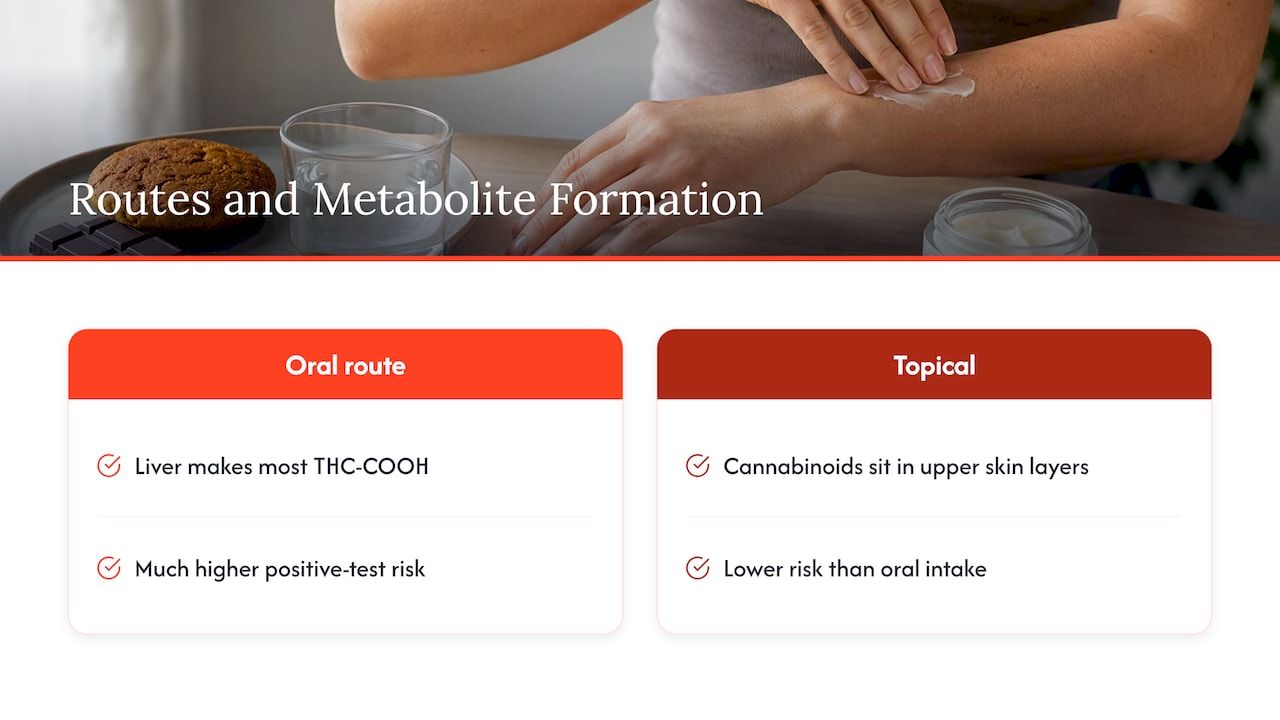
Urine drug tests do not look for THC itself. They look for a metabolite, 11-nor-9-carboxy-THC, usually shortened to THC-COOH. Your liver makes most of it after THC has been swallowed or inhaled and carried through the body. We explain the chemistry in our piece on why urine tests target an inactive metabolite.
Skin is a poor route for that process. It is a barrier built to keep things out. Cannabinoids are fat-loving molecules that tend to sit in the upper layers of skin rather than move into the blood. Researchers reviewing oral and topical exposure note that oral intake of even low-THC hemp oil carries a much higher risk of testing positive than topical application, because swallowed THC passes through the liver and becomes the exact metabolite the test is built to detect.
A case report published in a forensic journal makes the same point from the other side. A driver stopped by police had a blood sample drawn 35 minutes later. The authors concluded that topical application of THC-containing products cannot cause a positive cannabinoid finding in blood or urine.
What the studies found, test by test
Urine tests
Urine is the most common specimen in pre-employment screening. The 2026 crossover study compared topical and oral routes of a hemp extract cosmetic. Zero of 18 participants had positive urine results after topical use, and roughly 38% did after swallowing the same kind of extract. You can read the full paper in the PubMed Central record.
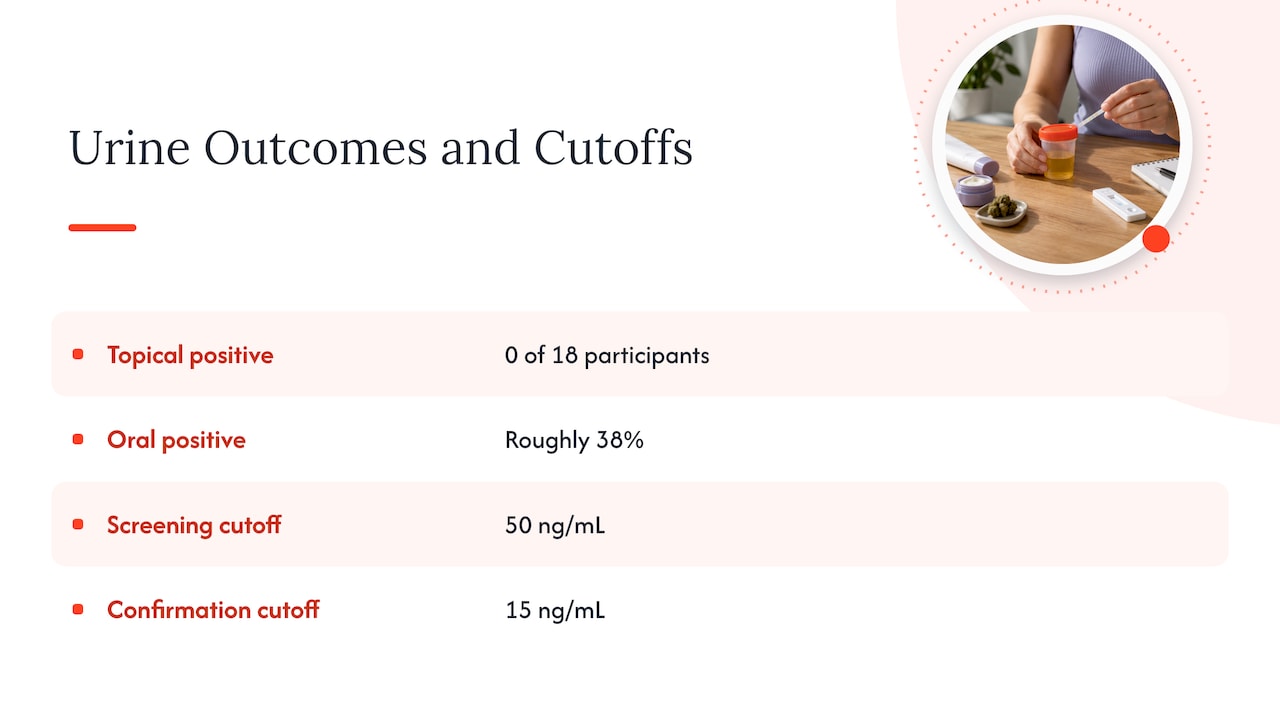
The federal numbers show how far apart those outcomes are. Under the guidelines effective July 7, 2025, the urine screening cutoff for marijuana metabolite is 50 ng/mL, with a 15 ng/mL confirmation cutoff. Topical use in the studies above did not produce metabolite levels in urine that cleared those lines. For a plain-English walk through the numbers, see what the federal drug test cutoff levels are.
Oral fluid (saliva) tests
Saliva tests are different. They look for parent THC, not the metabolite, and parent THC can sit on the skin, the lips and the hands. The same federal rule sets an oral fluid screening cutoff of 4 ng/mL and a confirmation cutoff of 2 ng/mL for THC. Those are low numbers.
In the clinical study of five commercial hemp-derived topical CBD products, urine results stayed consistent with the other work, but oral fluid tests turned positive in some cases. Most people never hear this, because most articles on topicals only discuss urine.
If an oral fluid test is coming, treat any cannabis product that touches your face, lips or hands near the time of the test as a risk. Our guide to passing a saliva drug test covers how that specimen works and what changes the result.
Hair and blood tests
Hair tests look back over a longer window and can pick up environmental exposure in some circumstances, but we have no good topical-specific research to cite, so we will not guess. Blood tests are short-window tests for recent use. The forensic case report above is the main evidence that skin application does not produce a blood finding. If hair is your test type, our page on the hair follicle drug test explains the basics.
The quick comparison
| Test type | What it detects | Topical risk based on studies cited here |
|---|---|---|
| Urine | THC-COOH metabolite (50 ng/mL screen, 15 ng/mL confirm) | Very low; 0 of 18 positive after topical hemp extract |
| Oral fluid | Parent THC (4 ng/mL screen, 2 ng/mL confirm) | Real, positives reported in some cases |
| Blood | THC and metabolites, short window | Very low per forensic case report |
| Hair | Longer-window exposure | Not established in the sources we reviewed |
The real culprit: products that are not what the label says
The studies on clean, properly formulated topicals are reassuring. The market is not always clean. CBD and hemp products are not overseen by the FDA the way medicines are, and independent testing keeps turning up surprises.
In the 2022 analysis of 80 unregulated products, Δ9-THC was found in 52 samples, at concentrations from 0.008 to 2.071 mg/mL. Among products marked “THC-free,” a meaningful share still tested positive for THC contamination, with levels reaching 0.656 mg/mL.
This matters for topicals in two ways:
- A cream sold as pure CBD may contain real THC, so “topical” does not guarantee a low dose.
- If you also take a tincture or gummy from the same brand, the oral product is the one most likely to produce a positive urine result.
The lesson is not that every product is risky. It is that the label alone is weak evidence, and the form (oral or skin) changes the risk far more than the brand name does.
Permeation enhancers and heavy use
Some topicals include ingredients meant to help active compounds get through the skin. The reviewed research suggests these may raise the chance of systemic absorption, although the clinical evidence still mostly says levels stay below what a federal urine test needs to confirm a positive.
Transdermal patches, which are built to deliver a compound into the blood over hours, are a separate category from creams and balms. We did not find clinical data on them in the sources for this article, so treat a THC patch as a higher-uncertainty product and not as a topical in the studies above.
When the science does not protect you: DOT and safety-sensitive jobs
A study is not a legal defense. If you hold a commercial driver’s license or perform other safety-sensitive work under federal transportation rules, the standard is strict. The Department of Transportation states that marijuana remains unacceptable for any safety-sensitive employee, and that MROs are not to accept CBD or hemp product use as a legitimate medical explanation for a positive result.
The FMCSA Clearinghouse repeats the point: the USDOT tests for marijuana, not CBD, and many CBD labels can mislead because the products may contain THC. For safety-sensitive workers, we cover the same ground in CBD and drug tests: what safety-sensitive workers must know.
If you are subject to DOT testing, the safest choice is not to use any cannabis or hemp-derived product, topical included. If you already did and a test is coming, speak with your employer’s designated employer representative or a Substance Abuse Professional, and ask a lawyer about your rights in your state. Do not rely on a blog post, ours included, to decide a career-level risk.
Your situation: a practical way to decide
Step 1: Identify the test type
Ask the employer or program which specimen is collected. Urine and oral fluid carry very different topical risk.
Step 2: Check who sets the rules
DOT-regulated and federal programs follow the cutoffs above and give you no medical defense. A private employer may use different cutoffs or a different panel. Our page on federal cutoff levels is a good starting point for comparing.
Step 3: Audit what you actually used
Write down every product, its form (cream, balm, tincture, gummy, vape) and how often you used it. If anything was swallowed or inhaled, topical studies no longer describe your exposure. Our THC detox timeline helps estimate risk when oral or inhaled use is involved.
Step 4: Stop adding unknowns
If a test is close, stop using products whose THC content you cannot verify. Skip anything that touches the mouth or lips if the test is oral fluid.
Step 5: Keep records
Keep the product label, the purchase receipt and any lab certificate of analysis. They will not change a federal result, but they matter in a private-employer conversation.
Perspective: how we read this evidence
We sell test kits and preparation products, and we hear from people who are scared of a cream. Most of those worries are bigger than the evidence supports for urine. Our honest read is this: a topical used as directed is rarely the reason someone fails a urine test, and we would rather tell you that than sell you something you do not need.
What we do see people overlook is the specimen. They study urine cutoffs and then get a saliva test. They also trust a label, when independent analysis shows labels can be wrong. And they forget that edibles and tinctures are a different exposure from anything applied to skin.
Our approach is to help you match the product or the information to the exact test you face: urine, saliva or hair, workplace, legal or personal. If you cannot tell which applies, call our support line during published business hours and we will help you work it out before you buy anything.
— MIchael
Test yourself before the real test
If you want certainty about where you stand, an at-home kit is a reasonable first step. We carry urine drug testing and saliva drug testing options, so you can screen on the same type of specimen your employer will use. We ship fast within the United States, and our team can help you pick the right product for your situation. Keep in mind that a home screen is not a lab confirmation, and it cannot replace the advice of your employer’s program or an MRO.
Related questions worth a look
If your concern is broader than topicals, these pages cover neighbouring risks: whether a weekend’s use can trigger a 50 ng/mL urine test, how secondhand smoke relates to the cutoff, and why THC stored in fat rarely causes a positive workplace test.
FAQ
How long does THC cream stay in your system?
For most people using a topical as directed, the studies cited here found no detectable metabolite in urine, so there is no meaningful clearance window to track. If a product contains more THC than labeled or you also used something oral, the timeline follows oral or inhaled use instead. That is where a tool like our THC detox timeline is more useful.
Will 1 mg of THC show on a drug test?
There is no single answer, because it depends on the route, your body and the test. Swallowed THC is processed through the liver into the metabolite urine tests target, while skin application largely is not. A small oral dose is a different matter from a topical dose of the same size. Oral fluid tests have a 2 ng/mL confirmation cutoff for THC, so anything touching the mouth deserves caution.
Can a THC or CBD topical cause a positive saliva test?
It can in some cases. A clinical study of commercial topical CBD products reported positive oral fluid results even when urine stayed negative. Keep cannabis products away from your face and lips, wash hands carefully, and avoid use close to a saliva test.
Does CBD cream show up on a DOT drug test?
It should not if the product is pure, but you cannot assume that. Labels can be wrong, and DOT does not accept a CBD or topical explanation for a confirmed positive. If you are a CDL driver or hold another safety-sensitive role, avoiding these products is the cautious path.
Sources
- Results of an Exploratory Crossover Pharmacokinetic Study Evaluating a Natural Hemp Extract-Based Cosmetic Product
- Pharmacokinetics and pharmacodynamics of five distinct commercially available hemp-derived topical cannabidiol products
- Cannabidiol (CBD) product contamination: Quantitative analysis of Δ9-THC concentrations
- Topical application of THC containing products is not able to cause positive cannabinoid finding in blood or urine
- Mandatory Guidelines for Federal Workplace Drug Testing Programs: Authorized Testing Panels (Federal Register)
- DOT’s Notice on Testing for Marijuana
- Clearinghouse Update: CBD use reminder (FMCSA)