
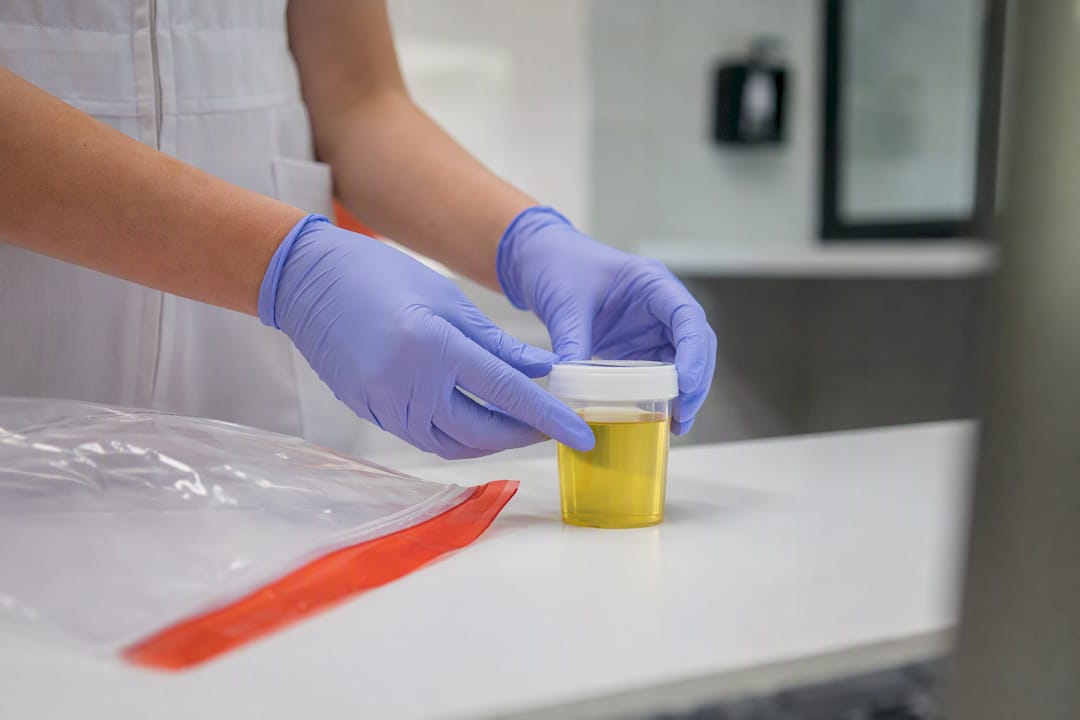
What Are the Federal Drug Test Cutoff Levels?
The federal cutoff for THC metabolite (THCA) in urine is 50 ng/mL for the initial screen and 15 ng/mL for confirmation. That single number drives most workplace drug policy in the United States, but it’s just one line in a much longer table. Cutoffs are the specific concentration a specimen must reach before a lab reports a positive, and every regulated drug panel has two thresholds: one for the initial screen, one for the confirmatory test.
Here’s the short list people search for most:
- THCA (marijuana metabolite): initial and confirmatory cutoff concentrations set at federally regulated levels
- Benzoylecgonine (cocaine metabolite): initial and confirmatory cutoff concentrations set at federally regulated levels
- Amphetamine/Methamphetamine: 500 ng/mL initial, 250 ng/mL confirmatory
- Opiates (codeine/morphine): initial cutoff concentrations established under federal rules with confirmatory values for morphine varying
- Fentanyl: 1 ng/mL under the newly expanded HHS panel
These figures come from two places: the DOT’s 49 CFR Part 40 §40.85 table, which governs safety-sensitive transportation employees, and the HHS/SAMHSA Mandatory Guidelines, most recently reaffirmed in a March 2026 Federal Register notice. DOT and HHS don’t always match exactly, and that gap matters if you’re trying to figure out which number applies to your situation.
Key Takeaways
Federal drug test cutoff levels set the exact concentration a specimen must reach for a lab to report a positive, and confirmatory testing determines the final legal result.
| Point | Details |
|---|---|
| THC cutoff numbers | THCA sits at 50 ng/mL initial and 15 ng/mL confirmatory under both HHS and DOT tables. |
| Two-step testing exists for accuracy | Immunoassay screening flags candidates fast; GC-MS or LC-MS/MS confirmation removes cross-reactivity errors. |
| Specimen type changes the math | Urine uses ng/mL, hair uses pg/mg, and oral fluid runs lower numeric thresholds tied to shorter detection windows. |
| Near-cutoff results have real explanations | Metabolism, diet, prescriptions, and dilution can all push a result close to a threshold without deception. |
| Passmydrugtest supports informed decisions | Passmydrugtest offers home test kits and detailed guides so you can check your status before a scheduled screening. |
This article is general information, not a substitute for advice from a qualified doctor. Consult a qualified healthcare professional about your own circumstances before acting on anything here.
Table of Contents
- Drug Test Cutoff Levels for Common Urine Analytes
- Screening vs. Confirmation: Why Two Tests Exist
- How Cutoffs Change by Specimen Type
- What Causes Results to Land Near a Cutoff
- If Your Result Hits or Exceeds a Cutoff
- How Cutoff Levels Compare Across Countries
- Why These Specific Numbers Were Chosen
- How Federal Drug Testing Standards Have Changed Over Time
- Cutoffs, False Positives, and False Negatives
- How Context Changes What a Cutoff Means
- What the Cutoff Numbers Actually Mean for You
- Resources to Prepare Before Your Test
- Sources
Drug Test Cutoff Levels for Common Urine Analytes
Every certified lab in the country works off some version of the same reference table. Knowing the initial and confirmatory number for your specific substance tells you exactly how close a result sits to a reportable positive.
- THCA: initial and confirmatory cutoff concentrations follow federally established standards
- Benzoylecgonine (cocaine): initial and confirmatory cutoff concentrations follow federally established standards
- Amphetamine and Methamphetamine: 500 ng/mL initial / 250 ng/mL confirmatory
- MDMA: typically tested according to federal amphetamine-class cutoff levels
- PCP: initial and confirmatory cutoffs reflect recognized federal thresholds
- Opioids (codeine, morphine, 6-AM): initial cutoff concentrations defined federally, with confirmatory thresholds varying by analyte
- Fentanyl: 1 ng/mL, added to the HHS panel as part of the 2025 to 2026 expansion
The “ng/mL” unit means nanograms of the drug or its metabolite per milliliter of urine. One nanogram is one billionth of a gram, so these are trace-level measurements, not visible amounts. Reading the two numbers side by side matters: the first is the immunoassay screening cutoff, and anything at or above it gets flagged for confirmation. The second, always lower, is the threshold a mass spectrometry test must clear before a lab reports a confirmed positive.
Fentanyl’s addition is the biggest recent shift in SAMHSA’s workplace guidelines. DOT had signaled plans to harmonize its own opioid panel with the HHS update, but regulatory alignment across agencies tends to lag by months or years, so always check which specific table applies to your test, DOT-regulated or general federal workplace.
Screening vs. Confirmation: Why Two Tests Exist
Immunoassay screening is the fast, cheap first pass. It works by using antibodies designed to bind to a target drug or its metabolite, and a lab can run hundreds of samples through this method in a single shift. The tradeoff is specificity. Antibodies sometimes bind to structurally similar compounds, which is how certain cold medications or poppy seed consumption can trigger a screen without any illicit drug use involved.
That’s why every positive screen has to go to confirmation. GC-MS or LC-MS/MS testing identifies compounds by their exact mass-to-charge ratio, which eliminates the cross-reactivity problem almost entirely. This is what forensic and legal proceedings rely on, because it can distinguish one molecule from another with a precision immunoassays simply can’t match.
The reporting logic is strict and mechanical: a screen below the initial cutoff is negative, full stop. A screen at or above the initial cutoff goes to confirmatory testing. If that confirmatory result comes back below its own (lower) confirmatory cutoff, the specimen is still reported negative. Only a confirmatory result at or above the confirmatory cutoff becomes a verified positive.
Pro Tip: If you ever get a result explained to you, ask specifically whether it was confirmed by GC-MS or LC-MS/MS. An immunoassay screen alone is not a legally defensible positive; a confirmed one is.
How Cutoffs Change by Specimen Type
Urine remains the default for most employment and DOT-regulated testing because it offers a reasonable detection window and a well-established federal cutoff table. It’s the reference point most policies are built around.
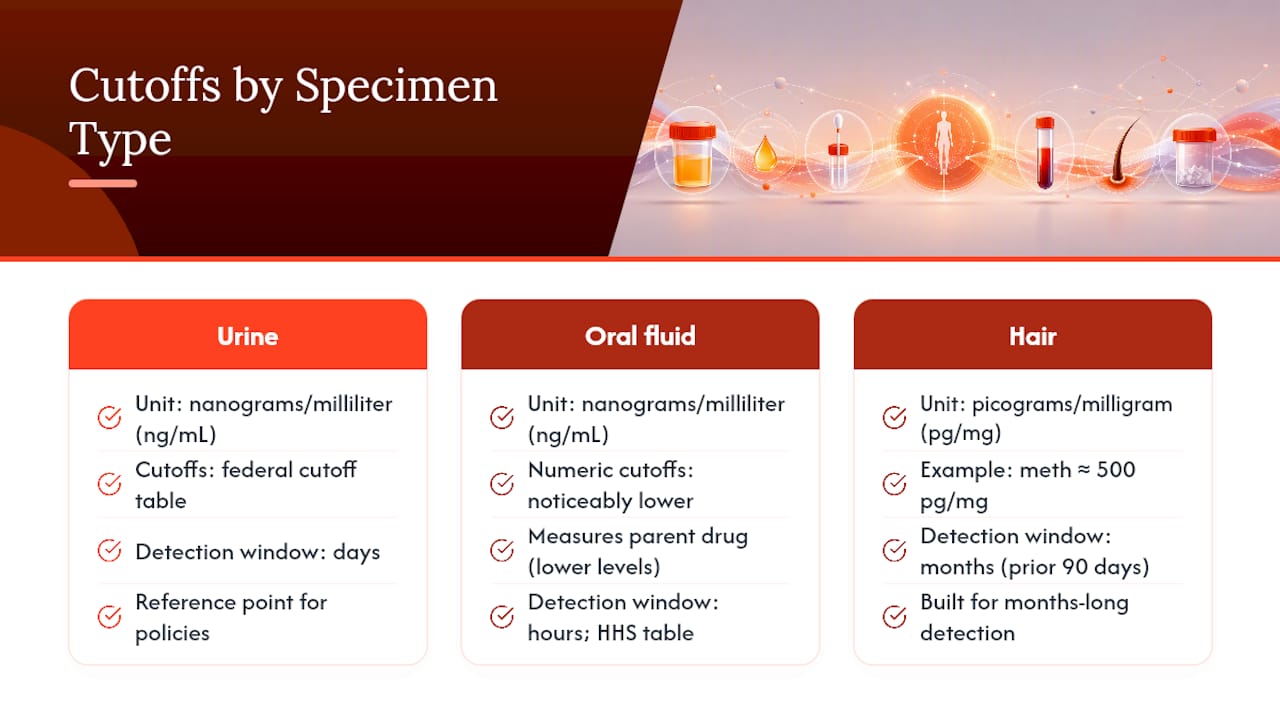
Oral fluid testing uses noticeably lower numeric cutoffs because saliva measures the parent drug rather than its metabolite, and parent drug concentrations run lower than metabolite concentrations in urine. HHS maintains a separate oral fluid cutoff table for this reason, and the detection window is shorter, typically hours rather than days.
Hair testing operates on an entirely different unit: picograms per milligram (pg/mg) instead of nanograms per milliliter. Representative cutoffs, like methamphetamine’s roughly 500 pg/mg threshold, reflect a test built for months-long detection rather than recent use. Hair testing tells an employer about patterns over the prior 90 days; it won’t catch someone who used a substance yesterday.
Instant and rapid point-of-collection tests are generally calibrated to match screening-level cutoffs, not confirmatory ones. A positive on a rapid cup test is preliminary. The confirmatory lab result is always the legal and procedural final word.
What Causes Results to Land Near a Cutoff
A handful of legitimate factors push a concentration up or down without any deception involved. Recent, heavy use produces higher concentrations than occasional use metabolized over several days, and how fast someone’s body clears a substance depends on individual metabolism, hydration, and body composition.
- Poppy seed consumption can push codeine or morphine levels up, which is part of why regulators raised certain confirmatory opiate cutoffs over the years
- Legitimate prescription opioids can trigger a positive that needs medical explanation, not dismissal
- Labs run dilution and adulteration checks (creatinine, specific gravity, pH) to catch tampered or overly diluted specimens
- Immunoassay cross-reactivity from over-the-counter medications explains some initial positives that confirmatory testing later clears
None of these factors change the cutoff number itself. They change where an individual’s true concentration lands relative to it, which is exactly why the confirmatory step exists.
If Your Result Hits or Exceeds a Cutoff
- Wait for confirmation. A single screening result isn’t final. Federal protocol requires GC-MS or LC-MS/MS confirmation before anyone reports a positive.
- Talk to the Medical Review Officer. The MRO reviews confirmed positives and gives you a chance to explain a legitimate prescription before the result gets reported to an employer.
- Request a split-sample retest if you dispute the outcome. Most collections split the specimen into two vials specifically for this purpose, and a certified second lab can retest the reserve sample.
- Keep your paperwork. Save the chain-of-custody form, collection notice, and any lab correspondence. If you need to challenge a result later, that documentation is what makes the case.
Pro Tip: Request the split-sample retest in writing and note the date. Most programs have a limited window to request it, often just a matter of days after notification.
How Cutoff Levels Compare Across Countries
The United States isn’t the only country with a formal cutoff system, but its structure, two federal tables run by DOT and HHS, is more standardized than what many other countries use. The European Union largely defers to individual member states, and cutoff values for workplace testing vary country by country rather than following one continental standard. Germany and the UK, for instance, both run robust occupational testing programs, but neither operates under a single harmonized cutoff table the way U.S. federal testing does.
Australia sets its cutoffs through Australian Standard AS/NZS 4308 for urine and AS 4760 for oral fluid, and the numeric thresholds differ from the U.S. HHS panel in several categories, sometimes stricter, sometimes looser, depending on the substance. Canada doesn’t have a single federal mandatory testing program comparable to DOT, so cutoff levels there largely follow employer policy or industry-specific frameworks, often referencing U.S. or Canadian laboratory accreditation standards rather than a unified national table.
This matters practically for one reason: a number that circulates online as “the” cutoff for THC or cocaine may actually be a value from a different country’s standard, not the U.S. federal panel. If you’re being tested under a DOT-regulated program or a U.S. federal workplace policy, the only cutoffs that apply are the ones published in §40.85 or the HHS Mandatory Guidelines, not a European or Australian equivalent, even if the numbers look similar on paper.
Why These Specific Numbers Were Chosen
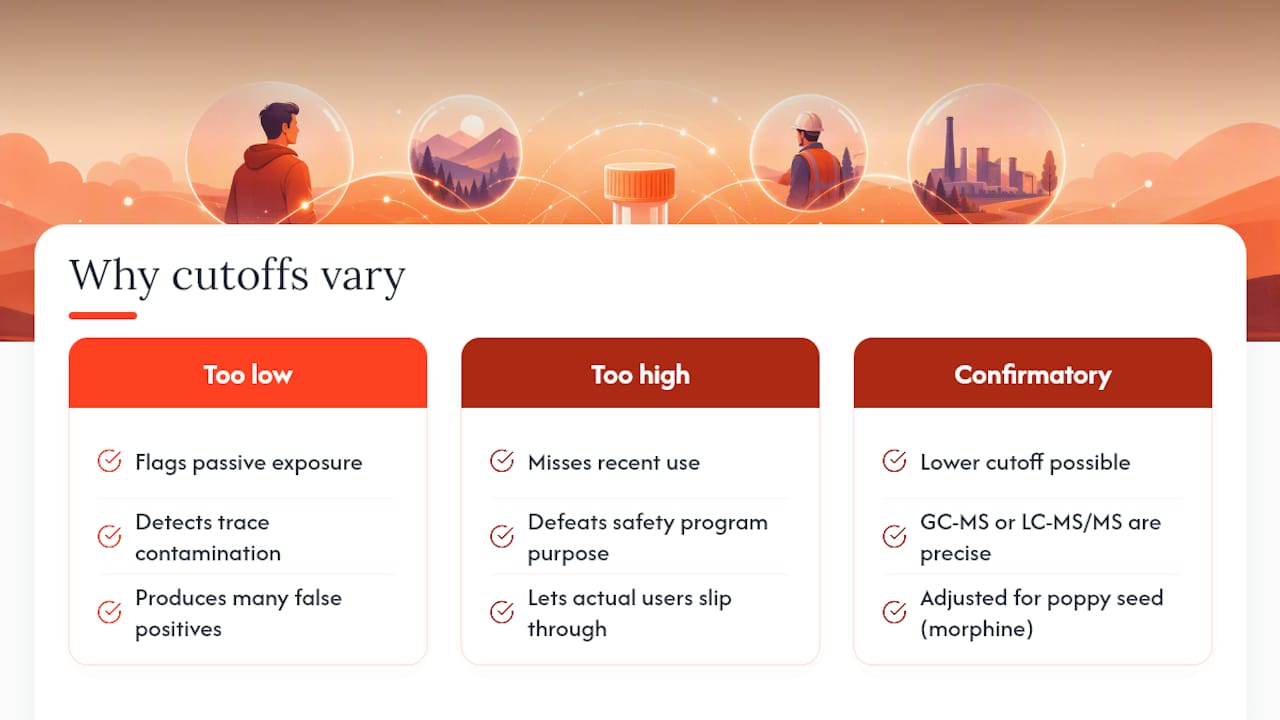
Cutoff levels aren’t arbitrary round numbers picked for convenience. Each one represents a calculated balance between detecting meaningful drug use and avoiding false positives from incidental exposure, trace contamination, or normal metabolic variation.
Setting a cutoff too low creates a test that flags nearly everyone, including people with passive exposure or unrelated compounds that share partial molecular similarity with the target drug. Setting it too high lets actual recent use slip through undetected, which defeats the purpose of a safety-sensitive workplace program. Regulators land somewhere in between based on pharmacokinetic data: how a drug metabolizes, how long its byproducts persist, and what concentration reliably distinguishes someone who used the substance from someone who didn’t.
The gap between initial and confirmatory cutoffs exists for a related but distinct reason. Immunoassay screening has a wider margin of error, so the initial cutoff is set with room for that imprecision. The confirmatory cutoff, tested by GC-MS or LC-MS/MS, can sit lower because the method itself is far more precise, measuring exact molecular identity rather than antibody binding likelihood. That’s also why some confirmatory thresholds moved historically. Morphine’s confirmatory cutoff, for example, was adjusted over time partly to account for legitimate dietary poppy seed consumption skewing results at the margins.
The scientific rationale ultimately serves a legal one: a cutoff has to be defensible in front of an arbitrator, a judge, or a licensing board. Every threshold in the federal tables reflects decades of accumulated toxicology data and is not a guess.
How Federal Drug Testing Standards Have Changed Over Time
The federal cutoff system has shifted more than most people realize. SAMHSA’s original workplace guidelines, dating back decades, covered a narrower drug panel than what’s tested today. Amphetamines, opiates, cocaine metabolite, PCP, and THC formed the traditional “five-panel” core for years before expanded panels became standard in many industries.
The most significant recent change is fentanyl’s addition to the HHS urine panel, set at 1 ng/mL and reaffirmed in the 2026 Federal Register notice. That single addition reflects how the fentanyl crisis reshaped what regulators consider essential to test for in a federal workplace panel that hadn’t meaningfully expanded its opioid coverage in years.
DOT and HHS don’t move in lockstep. DOT has historically taken longer to adopt panel expansions that HHS finalizes first, which is why a DOT-regulated commercial driver and a federal employee tested under general HHS guidelines can, for a period, be subject to slightly different opioid detection rules even though both trace back to federal authority.
The broader trend across two decades has been toward more precision, not more leniency. Confirmatory technology improved from older GC-MS-only protocols to LC-MS/MS methods capable of detecting a wider range of analytes at lower concentrations, and cutoff tables have adjusted accordingly, occasionally tightening a threshold as detection technology caught up with what was actually measurable and defensible in court.
Cutoffs, False Positives, and False Negatives
Every cutoff level is a tradeoff between two error types, and no single number eliminates both. A lower cutoff catches more actual drug use but raises the odds of flagging someone whose result stems from incidental exposure or a compound that partially cross-reacts with the immunoassay antibody. A higher cutoff reduces that risk but lets some recent, lighter use pass through as negative.
Confirmatory testing is the mechanism that resolves most of this tension. An immunoassay screen produces the occasional false positive because antibodies aren’t perfectly selective, but GC-MS or LC-MS/MS confirmation identifies the exact molecule present, which is why a properly confirmed positive is considered forensically reliable even though the initial screen alone would not be.
False negatives are trickier to eliminate entirely. Someone who used a substance days before testing, metabolized it faster than average, or diluted their specimen (intentionally or not) can produce a result below cutoff despite actual use. This is precisely why labs run specimen validity checks, creatinine and specific gravity screens designed to catch dilution that would otherwise mask a true positive as a false negative.
The practical takeaway: a negative result means the concentration fell below the established cutoff, not that zero drug was present in the body. And a positive, once confirmed, means the concentration exceeded a threshold specifically chosen to filter out incidental exposure. Neither result is a perfect binary; both are calibrated probabilities built into a legally workable system.
How Context Changes What a Cutoff Means
The same cutoff number carries different weight depending on where it’s applied. In a workplace drug testing program, a confirmed positive typically triggers an HR process, an MRO review, and potential termination or a return-to-duty agreement, especially in DOT-regulated safety-sensitive roles where the consequences extend to federal reporting requirements.
In a forensic or legal context, cutoffs matter even more strictly because the result may end up in front of a judge or arbitrator. Forensic toxicology demands full chain-of-custody documentation and confirmatory testing as a non-negotiable step, since a defense attorney will challenge any result that skipped it. The evidentiary bar is simply higher than in a routine employment screen.
Clinical settings operate differently again. A physician monitoring a pain management patient isn’t necessarily looking for a strict positive/negative call. They’re often tracking whether prescribed medication levels are consistent with the prescribed dose, which means the same cutoff table gets read through a completely different lens: compliance monitoring rather than zero-tolerance enforcement.
Private employers running non-DOT programs also have latitude that federal panels don’t. Private companies can legally set stricter cutoffs than the federal HHS panel for their own non-regulated testing, meaning two employees at different companies, tested for the same substance, could face different thresholds even though both tests reference the same underlying NCBI cutoff table as a baseline.
What the Cutoff Numbers Actually Mean for You
People assume a drug test cutoff is a fixed, universal line, and it just isn’t. The number that applies to you depends on whether you’re in a DOT-regulated role, a private employer’s program, a legal proceeding, or a clinical monitoring situation, and those four contexts can use meaningfully different thresholds for the same substance.
What gets lost in most discussions is how much the confirmatory step actually protects people from bad outcomes. An immunoassay screen flags a lot of things that aren’t drug use, but very few confirmed positives are wrong. If there’s one thing worth understanding cold before any test, it’s that a screening result is provisional, not a verdict. Passmydrugtest exists because that gap between screening and confirmation, and the anxiety it creates, is real, and people deserve straight answers about where the numbers actually come from before they make decisions based on fear rather than fact.
— MIchael
Resources to Prepare Before Your Test
Knowing the cutoff numbers is one thing. Knowing where you actually stand before a scheduled test is another, and that’s the gap Passmydrugtest exists to close. Unlike guessing based on forum posts or outdated blog cutoffs, Passmydrugtest gives you real product options and plain-language guidance built around the same federal tables covered above.
If you want to check your own status before a workplace or legal screening, a home marijuana test kit gives you a private, immunoassay-based readout using the same cutoff logic labs use. If your upcoming test is hair-based rather than urine, the hair testing information page breaks down detection windows specific to that specimen type. And if a past result came back positive and you suspect cross-reactivity rather than actual use, the false positive drug testing guide walks through common causes and next steps.
Start by identifying which specimen type and program applies to you, then pick the resource that matches your actual situation rather than a generic search result.
Sources
- § 40.85 What are the cutoff concentrations for urine drug tests? | U.S. Department of Transportation
- Federal Register: Notification of HHS urine and oral fluid panels (March 13, 2026)
- Recommended Cutoff Levels for Initial Tests – NCBI Bookshelf
- Hair testing certifications & cutoff levels | Quest Diagnostics