
CBD and Drug Tests: What Safety-Sensitive Workers Must Know
CBD itself won’t trigger a positive on a standard workplace drug test. What will is THC — and a significant share of over-the-counter CBD products contain enough of it to push you over the cutoff. For safety-sensitive workers subject to DOT or employer drug screening, that distinction matters in a very practical way.
Here’s what to do right now if you use CBD and have a test coming:
- Stop all non-pharmaceutical CBD products immediately. Don’t wait until the day before.
- Pull the Certificate of Analysis (COA) for any product you’ve used. No COA from an accredited third-party lab? Treat the product as suspect.
- Avoid full-spectrum CBD oils, gummies, and tinctures until after your screen is cleared.
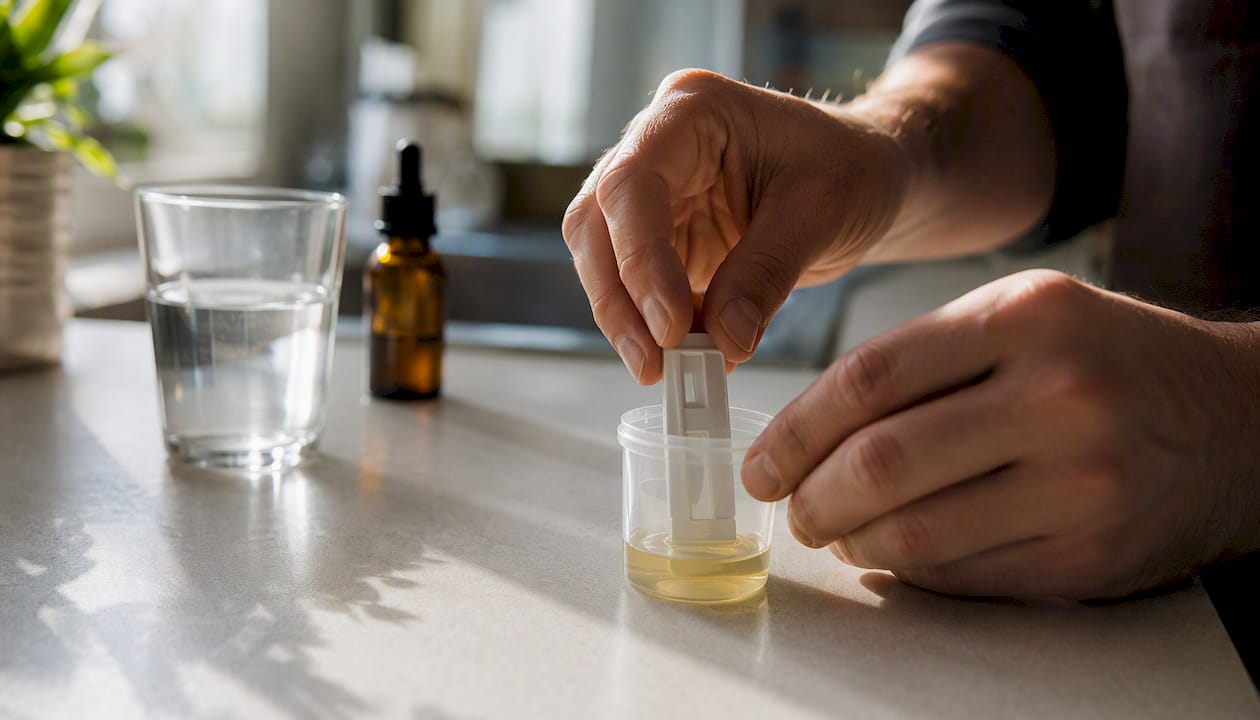
- Run a home THC urine test a few days before your scheduled screen to check your current status.
The DOT has stated clearly that a laboratory-confirmed marijuana positive cannot be medically excused by claiming CBD use. That’s the policy, full stop.
Pro Tip: Pick up an at-home marijuana drug test kit at least 72 hours before your workplace screen. A negative home result doesn’t guarantee a negative lab result, but a positive one tells you exactly where you stand.
Key Takeaways
CBD itself does not metabolize to THC-COOH, but THC present in mislabeled or full-spectrum CBD products can and does cause confirmed positive drug test results for safety-sensitive workers.
| Point | Details |
|---|---|
| CBD isn’t the target, THC is | Standard tests detect THC-COOH; CBD alone won’t trigger a positive, but product THC will. |
| Mislabeling is widespread | A study of 84 OTC CBD products found fewer than one-third within 10% of label claims. |
| DOT accepts no CBD excuse | A lab-confirmed marijuana positive stands regardless of claimed CBD use under 49 CFR Part 40. |
| Self-test before your screen | Run a home urine THC test 5–7 days out; a positive tells you exactly how much time you need. |
| Passmydrugtest | At-home THC test kits and detox products help you verify your status before a formal workplace screen. |
Table of Contents
- How does CBD differ from THC, and why does it matter for testing?
- How do workplace drug tests actually detect cannabis?
- What does the evidence say about CBD products and positive tests?
- What do DOT and employers actually do when you test positive?
- How to reduce your risk before a required drug screen
- What to do if you test positive
- What the science agrees on — and where it doesn’t
- An editorial perspective on CBD use for tested workers
- Verify your status before the test, not after
- Sources
How does CBD differ from THC, and why does it matter for testing?
CBD (cannabidiol) and THC (delta-9-tetrahydrocannabinol) are both cannabinoids from the cannabis plant, but they behave very differently in your body and in a drug test. Standard workplace screens don’t look for CBD at all. They target THC-COOH, the primary metabolite your body produces after processing THC.
That legal threshold sounds reassuring, but it doesn’t mean the product is safe for drug testing. A daily user consuming a high-dose full-spectrum oil could accumulate enough THC to exceed urine cutoffs. The FDA has acknowledged that it does not certify THC levels in consumer CBD products, and has issued warning letters for misbranded items. Legality and test safety are two separate questions.
Product types ranked by THC risk (highest to lowest):
- Full-spectrum CBD — contains all hemp cannabinoids including delta-9-THC up to 0.3%; highest risk for accumulation with regular use
- Broad-spectrum CBD — THC removed in processing, but trace amounts can remain; moderate risk
- CBD isolate — theoretically pure CBD; lowest risk, but cross-contamination during manufacturing is possible
Pro Tip: Even CBD isolate products can carry trace THC from shared production equipment. Manufacturers with certified GMP (Good Manufacturing Practices) facilities and dedicated processing lines reduce that risk, but don’t eliminate it entirely.
How do workplace drug tests actually detect cannabis?
Most workplace screens use a two-step process. The first step is an immunoassay, a rapid antibody-based screen that flags samples above a set cutoff. A presumptive positive then goes to a laboratory for confirmation using gas chromatography-mass spectrometry (GC-MS) or liquid chromatography-tandem mass spectrometry (LC-MS/MS). These confirmation methods are highly specific — they identify the exact compound, not just a class of molecules.
The ACMT position statement makes an important point: a urine THC metabolite result confirms THC exposure but cannot determine when exposure occurred, what the source was, or whether the person was impaired. That limitation cuts both ways. It means a test can’t prove you smoked marijuana — but it also means it can’t prove you only used CBD.
Common specimen types and approximate detection windows:
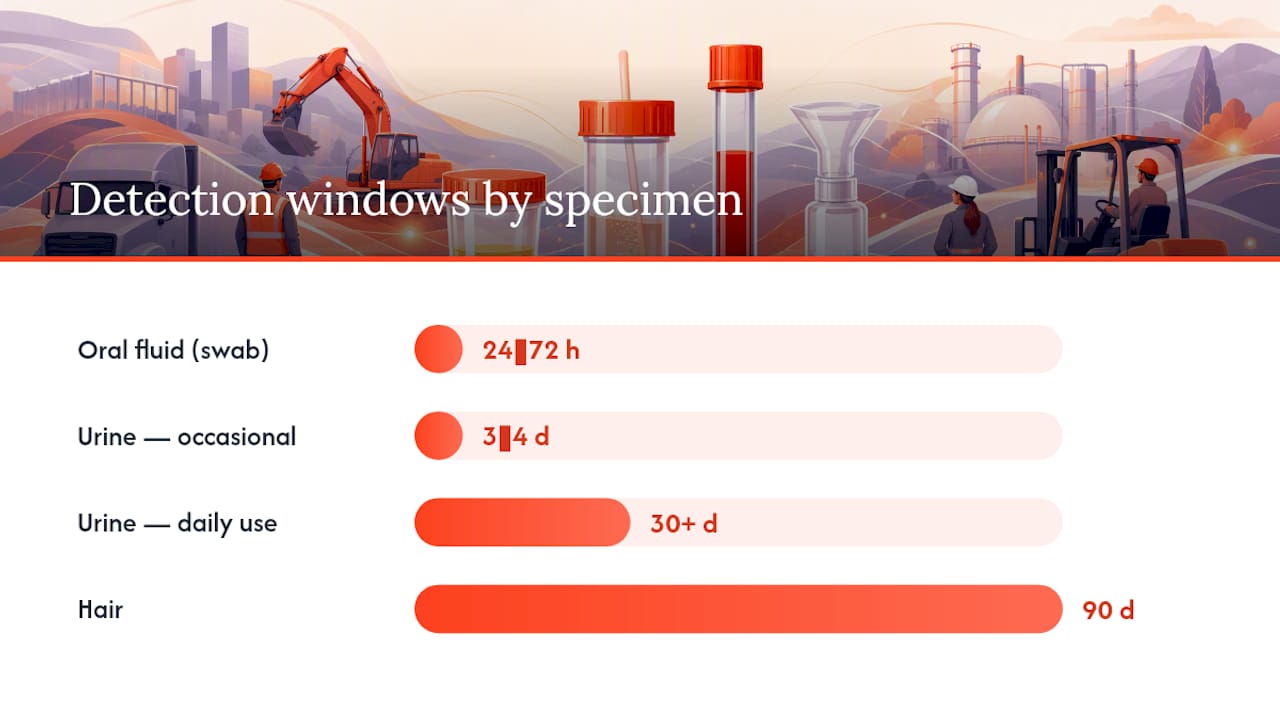
- Urine — most common; screen cutoff 50 ng/mL, confirmation cutoff 15 ng/mL; occasional use detectable 3–4 days, daily use up to 30 days or longer
- Oral fluid (mouth swab) — detects recent use; window roughly 24–72 hours for most users; see mouth swab test guidance for timing specifics
- Hair — 90-day window standard; not affected by short-term abstinence; hair testing details here
A Medical Review Officer (MRO) reviews every lab-confirmed positive before it reaches your employer. The MRO may contact you to ask about legitimate medical explanations; CBD use is not one of them under DOT rules.
Pro Tip: If you’re subject to random testing, urine is your highest-frequency risk. Hair tests are less common but punishing for anyone with months of regular use — short-term abstinence won’t clear a 90-day hair window.
What does the evidence say about CBD products and positive tests?
The research paints a consistent picture: pure CBD is unlikely to cause a positive, but most people aren’t using pure CBD.
A product survey cited by the Tennessee Poison Center at VUMC found that in a study of 84 OTC CBD products, fewer than one-third fell within 10% of their label claims, and many products contained detectable delta-9-THC. That’s not a fringe finding — it reflects a market with minimal federal enforcement.
On the clinical side, a small randomized crossover study (n=17) found that orally administered pure CBD at doses of 15–1500 mg did not produce THC-positive results on two point-of-collection oral fluid devices (the Securetec DrugWipe 5S and Dräger DrugTest 5000). That’s a useful data point — but the sample was tiny, the route was oral, and the CBD was pharmaceutical-grade. It tells you nothing about what happens with a contaminated gummy or an inhaled product.
Delta-8-THC and delta-10-THC add another layer of risk. Both are sold legally in many states, often marketed alongside CBD products, and both metabolize to compounds that can trigger a positive on standard THC immunoassays.
Red flags on a COA that should stop you from using a product before a test:
- No batch or lot number matching the product label
- Lab not ISO/IEC 17025 accredited
- No delta-9-THC result listed, or result listed as “ND” without a detection limit
- COA older than 12 months
Pro Tip: Search the lab name on the COA against the DEA-registered lab list or your state’s accredited lab database. A COA from an unaccredited lab is marketing material, not analytical data.
What do DOT and employers actually do when you test positive?
The DOT’s position leaves no room for interpretation. Per DOT guidance, safety-sensitive employees — commercial drivers, pilots, train operators, transit workers, pipeline personnel — should avoid CBD products entirely. A laboratory-confirmed marijuana positive under 49 CFR Part 40 is a positive, regardless of what you claim caused it.
The MRO will verify the confirmed result. If you tell the MRO you only used CBD, that explanation will not change the outcome under DOT rules. Your employer then receives a verified positive, and for safety-sensitive positions, the consequences are immediate: removal from safety duties, referral to a Substance Abuse Professional (SAP), and in many cases termination.
Private employers without DOT obligations vary more, but zero-tolerance policies are common in safety-critical industries. The SAMHSA employer toolkit gives employers a framework for drug-free workplace programs, and most large employers in transportation, construction, and healthcare follow similar structures.
The real-world stakes are documented. A commercial driver’s case reached the U.S. Supreme Court in 2024 after he was fired following a positive test he attributed to a CBD product. That case illustrates both the employment consequences and the difficulty of legal recourse once a confirmed positive is on record.
Before using any CBD product, check your employer’s policy on:
- Whether CBD use is explicitly addressed or prohibited
- Whether a positive for THC metabolites is automatically disqualifying
- Whether the company follows DOT Part 40 or a separate internal standard
- What the retest or appeal process looks like
Pro Tip: Ask HR for a written copy of the drug testing policy before you start any CBD regimen. Verbal assurances mean nothing if a positive result triggers automatic termination under a written zero-tolerance clause.
How to reduce your risk before a required drug screen
The most reliable risk-reduction strategy is complete avoidance of OTC CBD products. For workers who must use CBD for a medical reason, pharmaceutical-grade options (like FDA-approved Epidiolex) present a different risk profile than retail wellness products — but even then, inform your MRO in advance.
Practical steps in order of priority:
- Stop all non-pharmaceutical CBD products as soon as you know a test is coming, or immediately if you’re subject to random screening.
- Collect every COA, receipt, and product label from anything you’ve used recently.
- Run a home urine THC test 5–7 days before your scheduled screen. If it’s positive, you need more time.
- Run a second home test 48 hours before the screen. A negative here is a better signal, though lab confirmation cutoffs differ.
- Avoid environments with heavy cannabis smoke in the days before testing — secondhand inhalation can deposit detectable THC in oral fluid.
- If you’ve used full-spectrum products regularly, assume a longer clearance window and plan accordingly.
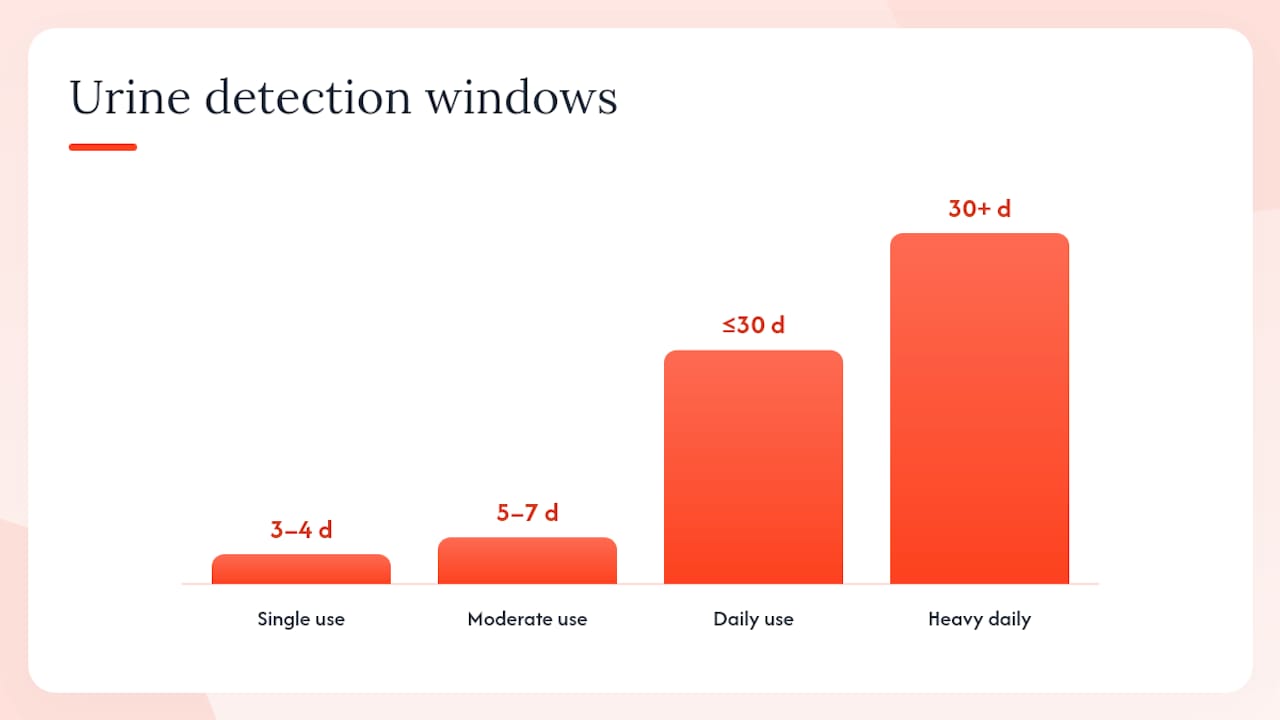
Approximate urine detection windows by use pattern:
| Use Pattern | Estimated Urine Detection Window | Notes |
|---|---|---|
| Single/occasional use | 3–4 days | Assumes standard 50 ng/mL screen cutoff |
| Moderate use (a few times/week) | 5–7 days | Individual metabolism varies |
| Daily use | Up to 30 days | Heavy users may exceed 30 days |
| Heavy daily use | 30+ days | Body fat stores THC-COOH; weight and hydration matter |
These windows apply to urine. Hair testing covers approximately 90 days regardless of use frequency, and hair strand test preparation requires a different approach entirely.
Pro Tip: Body fat percentage affects how long THC metabolites stay detectable. Higher body fat means longer storage and slower release. If you’re a heavier daily user, add at least a week to the estimates above as a buffer.
What to do if you test positive
A positive screen result is not the same as a confirmed positive. The process has steps, and each one matters.
- Ask for the specific result. Was it a preliminary screen positive or a laboratory-confirmed positive? Confirmed positives have gone through GC-MS or LC-MS/MS. Preliminary positives have not.
- Request the chain-of-custody documentation. Every confirmed positive must have a documented chain of custody from collection to lab. Errors in that chain can invalidate a result.
- Gather your product evidence immediately. Sealed product containers, COAs, purchase receipts, and any lab results you have on the product. Don’t discard anything.
- Respond to the MRO’s call. The MRO will contact you before reporting to your employer. This is your one opportunity to present any legitimate medical explanation. For DOT-regulated workers, CBD use is not an accepted explanation, but prescription medications that could cause a cross-reactive result are.
- Ask about split-specimen testing. Federal workplace testing requires a split specimen. You have the right to request that the B specimen be tested at a different certified lab at your expense.
- Consult an employment attorney if the positive will result in termination or disqualification from a licensed position. The Reuters-reported trucker case shows that litigation is possible, though outcomes are uncertain.
Pro Tip: Preserve the sealed product you were using. If you pursue legal action against a manufacturer for mislabeling, having the original lot with a matching COA is the foundation of any product liability claim. Once you discard it, that evidence is gone.
What the science agrees on — and where it doesn’t
The consensus is solid on a few points. CBD does not metabolize to THC-COOH, the compound urine tests detect. A person consuming pure CBD with no THC present will not produce a positive urine immunoassay result. The ACMT position statement confirms this, and the PMC clinical trial supports it for oral fluid devices specifically.
Where the science gets thin: most clinical studies use pharmaceutical-grade CBD in controlled doses, which doesn’t reflect what people actually buy at a gas station or wellness shop. Product surveys show widespread mislabeling, but they vary in methodology and sample size. POC device sensitivity varies by manufacturer and lot. And individual metabolism — body weight, liver enzyme activity, hydration — creates real variability in detection windows that no table can fully capture.
Delta-8 and delta-10 THC research is particularly thin. Both are metabolized similarly to delta-9 by standard immunoassays, but controlled dosing studies are scarce. Workers in states where these products are sold openly should treat them as equivalent to delta-9 THC for testing purposes.
What would change the advice: larger clinical trials using commercially available CBD products at real-world doses, standardized COA protocols with federal enforcement, and device-specific sensitivity data published by manufacturers. Until those exist, the conservative position holds.
Pro Tip: When reading a study on CBD and drug tests, check three things: Was the CBD pharmaceutical-grade or commercial? What was the route of administration? What device or lab method was used? A study that answers all three is worth citing. Most don’t.
An editorial perspective on CBD use for tested workers
The conventional wisdom in wellness circles is that CBD is safe, legal, and harmless for drug testing as long as you buy “good quality” products. That framing is dangerous for anyone subject to a workplace screen.
The regulatory reality is that no federal agency certifies the THC content of retail CBD products. And the DOT’s position is unambiguous: a confirmed positive is a confirmed positive. The source doesn’t change the outcome.
For safety-sensitive workers, the only defensible position is avoidance of OTC CBD until the regulatory and testing landscape catches up. If you’re managing a condition that CBD genuinely helps, that’s a conversation to have with your physician about pharmaceutical options — not a reason to gamble your CDL or your pilot’s certificate on a wellness product with no federal quality oversight. Passmydrugtest’s resources exist precisely for workers who want to understand where they stand before a screen, not after.
Verify your status before the test, not after
Knowing the risk is step one. Knowing where you actually stand before a formal screen is step two — and that’s where Passmydrugtest delivers real value.
Passmydrugtest gives safety-sensitive workers and pre-employment candidates a practical edge: at-home THC urine test kits that let you check your metabolite levels days before a formal screen, plus a full range of detox products for workers who need to support their body’s natural clearance process. The site also covers employee drug screening in plain language so you understand exactly what your employer’s test is looking for. Fast shipping on U.S. orders means you’re not waiting a week to get started. Check your status now at Passmydrugtest — before your employer does it for you.
Sources
The following sources support the claims in this article. Workers subject to DOT or employer testing should also review their specific employer policy and the applicable federal regulations directly.
- DOT “CBD” Notice | US Department of Transportation
- June 24, 2022: Could over-the-counter CBD or Delta-8 supplements cause positive urine drug screens? | Tennessee Poison Center
- Orally administered cannabidiol does not produce false‐positive tests for Δ9‐tetrahydrocannabinol on the Securetec DrugWipe® 5S or Dräger DrugTest® 5000 – PMC
- ACMT Position Statement: Interpretation of Urine for Tetrahydrocannabinol Metabolites
- FDA regulation of cannabis and cannabis-derived products, including cannabidiol (CBD)
- SAMHSA employer resources toolkit
This article is general information, not a substitute for advice from a qualified doctor. Consult a qualified healthcare professional about your own circumstances before acting on anything here.