
Hair Drug Test Accuracy: What the Science Shows
A hair drug test is accurate at what it was built to do: show whether a drug was taken over the past several months. It is not perfectly accurate, and no one can give you a single percentage. Peer-reviewed work describes hair testing as useful for long-term exposure, but it cannot reliably tell you how much, how often or on what date someone used. Whether a result holds up depends on the lab process as much as on the hair.
This guide covers what the research says about false positives and false negatives, how THC behaves in hair, which employers actually use hair tests, and what to do if a result looks wrong.
TL;DR
- Lab hair tests are very good at avoiding false positives in controlled studies. They are weaker at catching light or occasional THC use.
- A positive screen should be confirmed by mass spectrometry. If it was not, ask for the confirmation.
- Environmental contamination and cosmetic treatment can distort results in both directions.
- No shampoo, cleanse or trick has been shown to guarantee a negative hair result.
- Federal DOT testing uses urine, not hair, so check which specimen your employer’s policy requires.
Table of Contents
- Why there is no single accuracy number
- What studies show about false positives and misses
- Can a hair drug test be wrong?
- How a credible lab protects accuracy
- How long does hair keep a record?
- Does your employer even use hair testing?
- Can you beat a hair test?
- Our perspective
- Checking your situation with us
- What to do if you think a result is wrong
- FAQ
- Sources
Why there is no single accuracy number
People search for one figure, such as “99% accurate.” Researchers avoid it. A 2025 review by Jacqueline Hubbard in the Journal of Applied Laboratory Medicine points to two reasons: there is no strong link between how much of a drug someone took and how much ends up in the hair, and biology and sample handling vary a great deal from person to person.
Accuracy has two sides:
- Specificity is how often a test correctly returns negative for someone who did not use. High specificity means few false positives.
- Sensitivity is how often it correctly returns positive for someone who did use. Low sensitivity means false negatives.
A test can score well on one and poorly on the other, and hair testing does exactly that for cannabis.
What studies show about false positives and misses
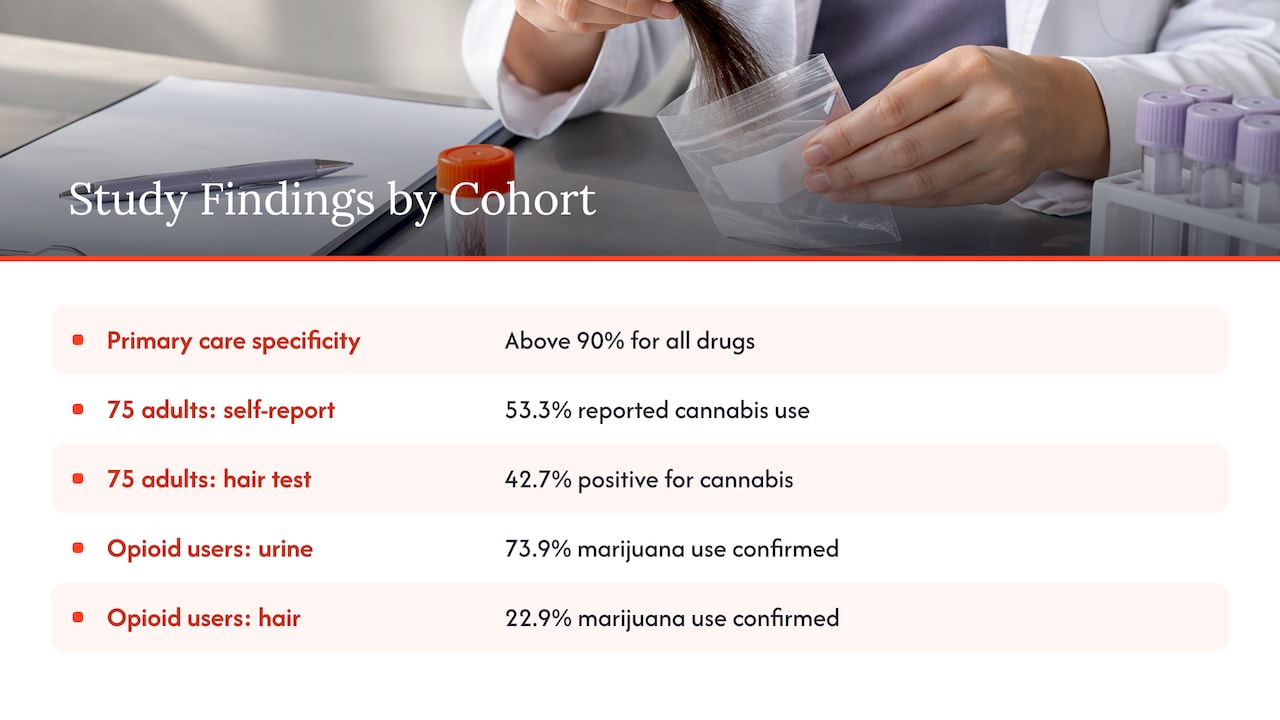
In a study of primary care patients, specificity of hair testing at standard laboratory cut-offs exceeded 90% for all drugs, while sensitivity compared with self-report was low. In plain terms, when the test said someone used, it was usually right. It also missed a fair amount of reported use.
THC is the clearest example. A 2026 study of 75 adults found 53.3% reported cannabis use, while 42.7% had a positive hair test. The authors note that hair THC sensitivity is limited, especially for occasional users. They also describe it as a small convenience sample, so it is not a national accuracy rate.
Another comparison in young adult opioid users found that urine confirmed far more self-reported marijuana use than hair did, 73.9% versus 22.9%. Hair is not the more sensitive method for every drug.
What this means if you use cannabis
THC does not incorporate into hair as readily as many other drugs. Heavy, regular use is more likely to show up than a few uses spread over months. But a negative result does not prove abstinence, and a positive one does not prove frequency. Neither outcome tells the full story.
Can a hair drug test be wrong?
Yes, in both directions. A toxicology review and National Institute of Justice research identify contamination, hair color and melanin, cosmetic treatment and unresolved routes of deposition as real limitations.
Ways a result can be falsely positive
- External contamination. Drug residue on hands, surfaces or in smoke can settle on hair. Labs wash samples to remove it, but the SoHT notes that interpretation must account for washing validation and external contamination.
- A screening result treated as final. Initial immunoassay screens can flag a sample that confirmation then clears.
- Related compounds. Hemp and cannabinoid products are widespread. A 2025 U.S. study of 1,787 hair specimens from forensic submissions found 30.5% positive for at least one cannabinoid, including Δ9-THC in 26.8%, Δ8-THC in 9.0%, CBD in 6.1% and Δ10-THC in 0.4%. The assay could not tell whether the compounds entered hair through use or environmental exposure. This is a convenience sample, not a false-positive rate.
Ways a result can be falsely negative
- Recent use. Hair typically does not capture use from roughly the first 7 to 10 days after exposure.
- Low exposure. Occasional use may fall below the cutoff.
- Too little hair or poor collection. An insufficient or unrepresentative sample lowers the odds of detection.
- Cosmetic damage. Bleaching, dyeing and perming can change how much drug is recovered. Our guide to what bleaching does to hair test results covers this in detail, including why labs may flag treated samples.
How a credible lab protects accuracy
The Society of Hair Testing (SoHT) treats accuracy as a property of the whole workflow. Its consensus on drugs of abuse testing in hair requires samples to be homogenized and decontaminated before extraction, and the group’s general recommendations say presumptive positives should be confirmed by mass spectrometry, considering the parent drug and relevant metabolites.
Here is what to look for in any result:
| Step | What good practice looks like | What to ask |
|---|---|---|
| Collection | Representative sample, correct orientation, documented chain of custody | Was the sample cut close to the scalp and sealed in front of you? |
| Decontamination | Validated wash step | Does the lab describe its wash procedure? |
| Screening | Immunoassay or similar at a stated cutoff | What cutoff was used? |
| Confirmation | Mass spectrometry on presumptive positives | Was a positive confirmed by LC-MS/MS or GC-MS? |
| Review | Qualified person interprets results, including medications | Can I submit prescriptions and exposure information? |
An at-home hair kit usually collects the sample for a lab to analyze, so the same standards apply to the lab it uses.
How long does hair keep a record?
A commonly analyzed 3 to 4 cm head-hair segment represents roughly 3 months. Growth rates vary, and hair does not become reliably “clean” on a fixed schedule: older incorporated material stays in the shaft until it is cut or grows beyond the tested segment. Stopping today cannot guarantee a negative for a test collected soon. A negative also does not prove lifelong abstinence.
For a closer look at timing, see our hair drug test window guide and detection times by substance.
Does your employer even use hair testing?
Many people prepare for the wrong specimen. Federal rules are specific. The DOT and FMCSA testing guide identifies urine as the specimen in the commercial-driver program, and in 2022 FMCSA denied a trucking group’s request for an exemption tied to this testing framework. SAMHSA’s 2023 advisory board minutes show federal hair guidelines were still under review at that time.
Private employers and some state or local programs can choose differently. Before you prepare for anything, confirm in writing:
- The specimen type (hair, urine, oral fluid).
- The panel, meaning which drugs are tested.
- The cutoff policy.
- The collection date.
- Whether a medical review officer or confirmation process applies.
HR or the testing facility can usually answer these.
Can you beat a hair test?
Honest answer: there is no evidence-based way to pass a hair test with 100% certainty using a shampoo, cleanse, supplement, shaving or a color change. The review literature notes that cosmetic or chemical treatment can change how much of an analyte the lab recovers, without reliably removing what is already inside the shaft. Shaving can lead to body hair being collected or to another testing decision.
Some treatments do change measured levels. Our write-ups on bleach and drug levels and on why detox shampoos fall short against lab methods lay out what we know and where the limits are. We would rather you hear that from us than from a promise on a label.
The defensible steps are:
- Stop use as early as you can, knowing it will not clear hair on a schedule.
- Disclose prescribed medications and relevant exposures.
- Ask for the lab’s confirmation and review process.
- Keep copies of collection paperwork.
Our perspective
We sell products for people facing drug tests, and we still tell customers the same thing: hair is the hardest specimen to plan around, because it keeps a long record and the result depends on a lab process you do not control. Most of the questions we hear are not about chemistry. They are “which test is my employer actually running?” and “how far back will it look?”
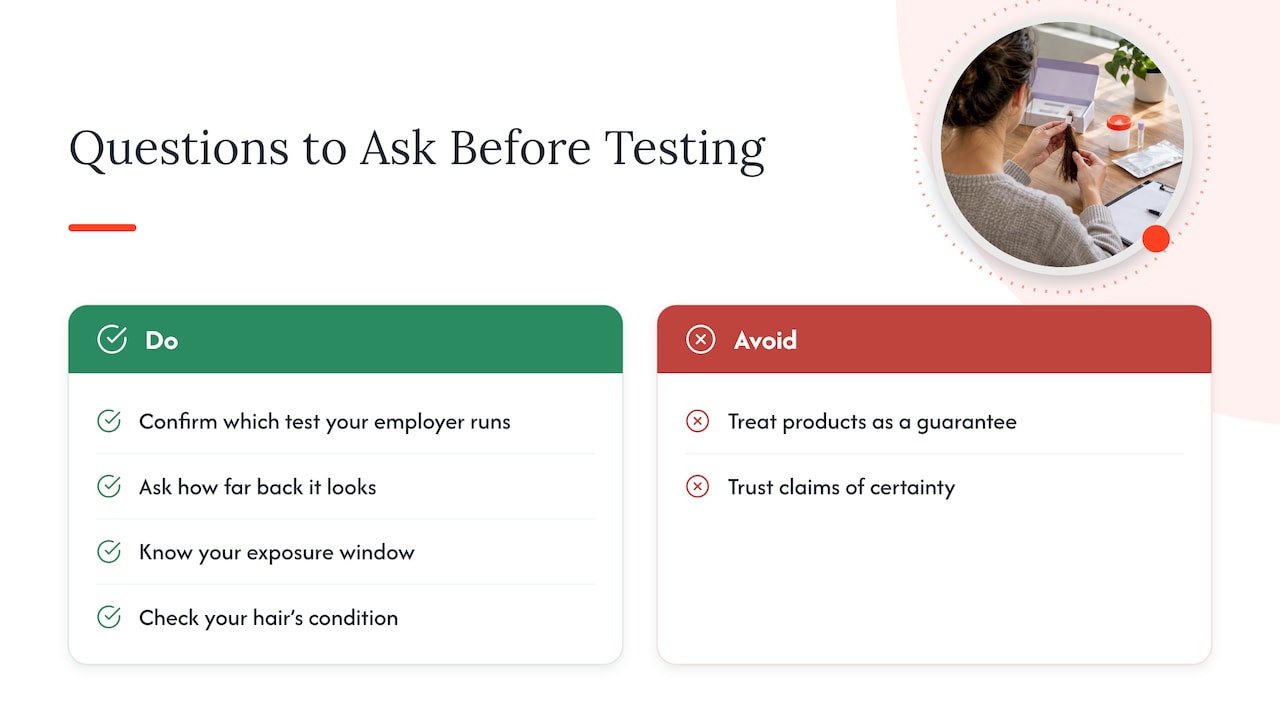
So we start with the specimen. If it is urine or saliva, the timelines and options are very different from hair, and our guides treat them separately. If it is hair, we suggest you know your own exposure window, check your hair’s condition, and treat any product as a possible aid rather than a guarantee. A product that claims certainty is selling you something the science does not support.
We also think people deserve to see a result for themselves before one is used against them. That is the reason we carry test kits alongside preparation products, and why we answer the phone during published business hours when someone is unsure which one fits.
— MIchael
Checking your situation with us
If you want to know what a lab might see, our hair drug testing kits let you check ahead of a screening. If you want to see how hair care products are positioned, browse our hair detox shampoo range with the limits above in mind. We ship fast within the United States, and our team can talk you through which test type applies to your case. For more on the hair kit itself, read our hair follicle drug test page.
What to do if you think a result is wrong
- Ask what was done. Request the lab report: cutoff, screening method and whether confirmation by mass spectrometry occurred.
- Disclose medications and exposures to the reviewing professional, in writing.
- Request retesting. Because a lab can often retest the same collected sample, a second analysis is a reasonable request. Hair may also be re-collected from another site.
- Consider the cannabinoid involved. If you used hemp-derived or CBD products, tell the reviewer. The 2025 study above shows why compound identity matters.
- Know your rights. For employment disputes, check your employer’s written policy and your state’s rules, and speak to an employment attorney if the stakes are high.
FAQ
How accurate is a hair follicle drug test?
In controlled studies, specificity at standard cutoffs exceeded 90%, so false positives are uncommon when the lab process is sound. Sensitivity is lower, especially for THC and occasional use. No credible source gives one overall accuracy figure.
What throws off a hair follicle test?
External contamination, cosmetic treatments like bleaching or dyeing, hair color, a sample that is too small and recent use that has not yet grown into the tested segment can all affect a result. Poor lab technique, such as skipping confirmation, can too.
Can hemp or CBD products cause a positive hair test?
They can complicate interpretation. A 2025 laboratory study found that Δ8-THC, Δ9-THC, Δ10-THC and CBD all appear in hair and that the assay could not tell ingestion from environmental exposure. Tell the reviewing professional about any such products you use.
How long does it take for hair to be clean for a drug test?
There is no fixed date. A 3 to 4 cm segment reflects about 3 months, but growth varies and drug stays in the hair until it is cut or grows out of the tested section. Stopping use today does not guarantee a negative result soon.
Do all employers use hair tests?
No. Federally regulated DOT drivers are tested by urine, and private employers set their own policies. Ask for the specimen type and panel in writing before you prepare.
Sources
- Review on Toxicology Testing in Hair, Journal of Applied Laboratory Medicine
- Society of Hair Testing general recommendations, Drug Testing and Analysis
- SoHT consensus on drugs of abuse testing in hair, 2021
- Hair drug testing results and self-reported drug use among primary care patients
- Comparison of urine and hair testing among young adult opioid users
- Detection of Δ9-, Δ8-, Δ10-THC and CBD in hair specimens
- Frontiers in Public Health, cannabis self-report and hair testing study
- Toxicology review on hair testing limitations, Clinical Toxicology
- Hair detection window study, American Journal of Drug and Alcohol Abuse
- FMCSA Drug-Testing Guide, U.S. Department of Transportation
- FMCSA decision on Trucking Alliance exemption application
- SAMHSA Drug Testing Advisory Board minutes, June 13, 2023