
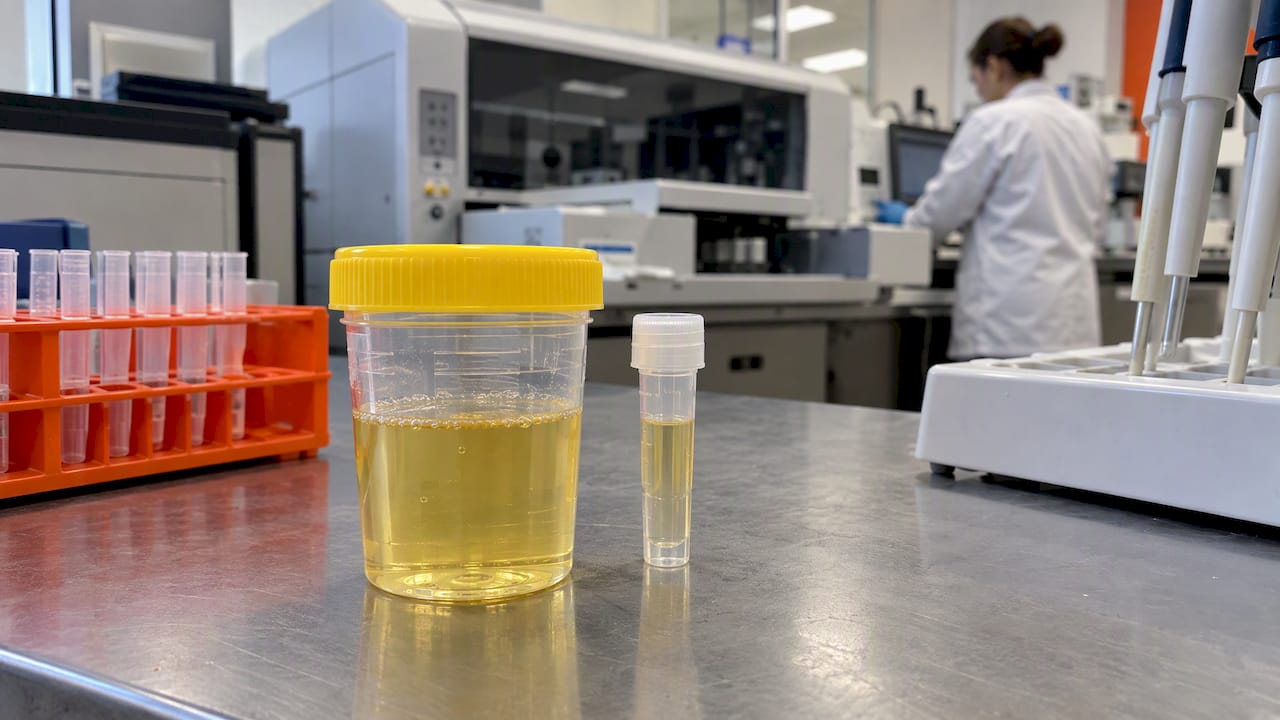
Uric Acid in Synthetic Urine: What Labs Check in 2026
Uric acid in synthetic urine helps a product look more like the real thing, but it does not make a sample pass. Human urine naturally contains uric acid, and some labs now look for it. Yet validity testing judges the whole profile of a specimen: temperature, creatinine, pH, specific gravity, oxidant checks and, increasingly, biomarkers. A formula with one good ingredient and a bad temperature still fails.
This guide explains what uric acid is, why it shows up on synthetic urine labels, what US labs actually test, and how to judge a product honestly before you spend money.
TL;DR
- Real urine contains uric acid, so a synthetic product that includes it is closer to a realistic profile than one that omits it.
- Uric acid is one marker among many. Labs read creatinine, pH, specific gravity, oxidants and temperature together, and the most advanced labs add enzymes and other biomarkers.
- Temperature is the first checkpoint at collection. A perfect formula that is outside the accepted range is a failed specimen.
- A substituted or invalid result is not the same as a negative. It can be treated as a refusal to test, with real consequences for DOT and many employer tests.
- Check your state’s law and your test type before buying anything. Rules differ, and a fair question is whether you need a substitute at all.
Table of Contents
- What uric acid is and why urine has it
- Why synthetic urine makers add uric acid
- What a US lab checks on a urine specimen
- Temperature comes before chemistry
- Why one ingredient is never enough
- Four checks a product can meet and still be exposed
- The risk side: what a failed validity result means
- Our perspective
- Where to start if you do need a urine option
- How to read a synthetic urine label
- FAQ
- Sources
What uric acid is and why urine has it
Uric acid is the end product of purine metabolism, the process your body uses to break down compounds found in cells and in many foods. Your kidneys filter it out, so it appears in normal urine. MedlinePlus reports that adults typically excrete roughly 250 to 750 mg of uric acid per 24 hours, and that the figure shifts with diet, metabolism and health.
That range matters for one reason: it shows uric acid is a variable, not a fixed number. A lab comparing a sample to “normal” is comparing it to a wide, living range, which is also why a single analyte is a weak basis for judging a sample.
If your search brought you here from a health angle, such as gout or kidney stones, note the difference. Clinical uric acid tests are blood or 24-hour urine tests ordered by a doctor to monitor kidney stone risk or metabolic conditions. Home uric acid meters measure blood, not urine specimens for drug screens. This article is about the drug-testing context only.
Why synthetic urine makers add uric acid
Early synthetic urine was mostly water, urea, salts and a yellow dye. Over time, labs began checking for more. A 2023 evaluation of assays and LC-MS-MS methods notes that advanced validity testing now routinely looks for endogenous markers such as urea, uric acid and enzymes like GGT and amylase, because older products lacked them.
Manufacturers respond. A 2022 update on urine adulterants and synthetic urine describes a continuing contest in which labs adopt new markers and the synthetic market then adds those components. Uric acid on a label is part of that response.
So a uric acid claim is meaningful in one narrow way: it suggests the maker is aware of what labs measure. It says nothing about whether the concentration is right, whether the batch is stable, or whether the rest of the profile holds up.
What a US lab checks on a urine specimen
Validity testing is layered. Here is how the pieces fit, based on federal rules and clinical guidance.
| Check | What it looks at | Why it matters for synthetic urine |
|---|---|---|
| Temperature | Measured at collection, within minutes of voiding | First-pass screen; an out-of-range reading draws immediate attention |
| Creatinine | A waste product from muscle metabolism | Very low values suggest dilution or substitution |
| Specific gravity | Concentration of dissolved particles | Extreme values, together with low creatinine, flag substitution |
| pH | Acidity of the sample | Out-of-range values point to adulteration or a non-human sample |
| Oxidant tests | Presence of adulterants such as bleach-type agents | Required on all federal specimens |
| Biomarkers | Urea, uric acid, enzymes, other endogenous molecules | Used by advanced labs to separate real from artificial urine |
Two regulatory details are worth knowing, and both are sourced.
Under DOT rules, a specimen is classed as substituted when creatinine is below 2 mg/dL and specific gravity is at or below 1.0010 or at or above 1.0200, on both the initial and confirmatory tests.
For federal workplace programs, the 2024 MRO guidance manual says labs determine creatinine and pH on every urine specimen, measure specific gravity when creatinine is under 20 mg/dL, and run tests for oxidizing adulterants on all specimens. Notice that uric acid is not on that required list. The federal minimum is creatinine, pH, specific gravity and oxidants. Many non-federal labs, however, go further.
If you want a deeper look at where the 20 mg/dL line sits and what it can miss, see our piece on urine validity checks and the 20 mg/dL cutoff.
Temperature comes before chemistry
Before any lab instrument sees a sample, the collector checks heat. Clinical guidance on urine drug monitoring describes an accepted window of 90°F to 100°F (32.5°C to 37.7°C) for a specimen checked within about four minutes of voiding.
That is why temperature handling matters more than any ingredient list. A formula with uric acid, urea and correct creatinine that reads 80°F is a specimen the collector questions on the spot. Conversely, a correct temperature does not protect a sample whose chemistry is wrong.
Why one ingredient is never enough
The forensic literature is consistent on this point. Specimen validity is judged by reading several parameters together. The practical guide to urine drug monitoring lists temperature, specific gravity, pH, creatinine and adulterant checks as parts of one assessment.
It goes further at the research end. A review of advances in sample manipulation testing describes labs moving toward multi-method approaches, including LC-MS-MS analysis of several endogenous biomolecules. Such methods can flag a substitute even when creatinine and specific gravity look physiological.
And the work keeps moving. A 2026 paper on sample validity lessons from challenging cases proposes additional biomarkers for synthetic urine detection, based on casework at a pathology lab. Whether any given lab uses such markers depends on that lab, which you will not know in advance.
Practical takeaway: treat uric acid as a minimum expectation, not a guarantee. If a product’s pitch rests on that one ingredient, be skeptical.
Four checks a product can meet and still be exposed
A synthetic product can match creatinine, specific gravity, pH and temperature and still be flagged for something else. We cover this in more detail in why synthetic urine can pass four checks yet biomarkers can expose it, and in our note on why routine checks can miss biocides in synthetic urine. The common thread is that a basic panel and an advanced panel answer different questions.
When you compare labels, ask:
- Does the product state its uric acid, urea and creatinine contents, or only say “balanced”?
- Is it intended to be used within a stated shelf life and prep window?
- How does the kit help you hold the correct temperature, and for how long?
- Does the seller explain what the product cannot do?
A seller that answers the fourth question plainly is usually the more trustworthy one.
The risk side: what a failed validity result means
Here we want to be direct. A substituted result is not a mild outcome. Under DOT rules, a substituted specimen is a refusal to test, which is treated as seriously as a positive in safety-sensitive jobs. For employers outside DOT, policy varies, but a flagged specimen can end a job offer or trigger discipline.
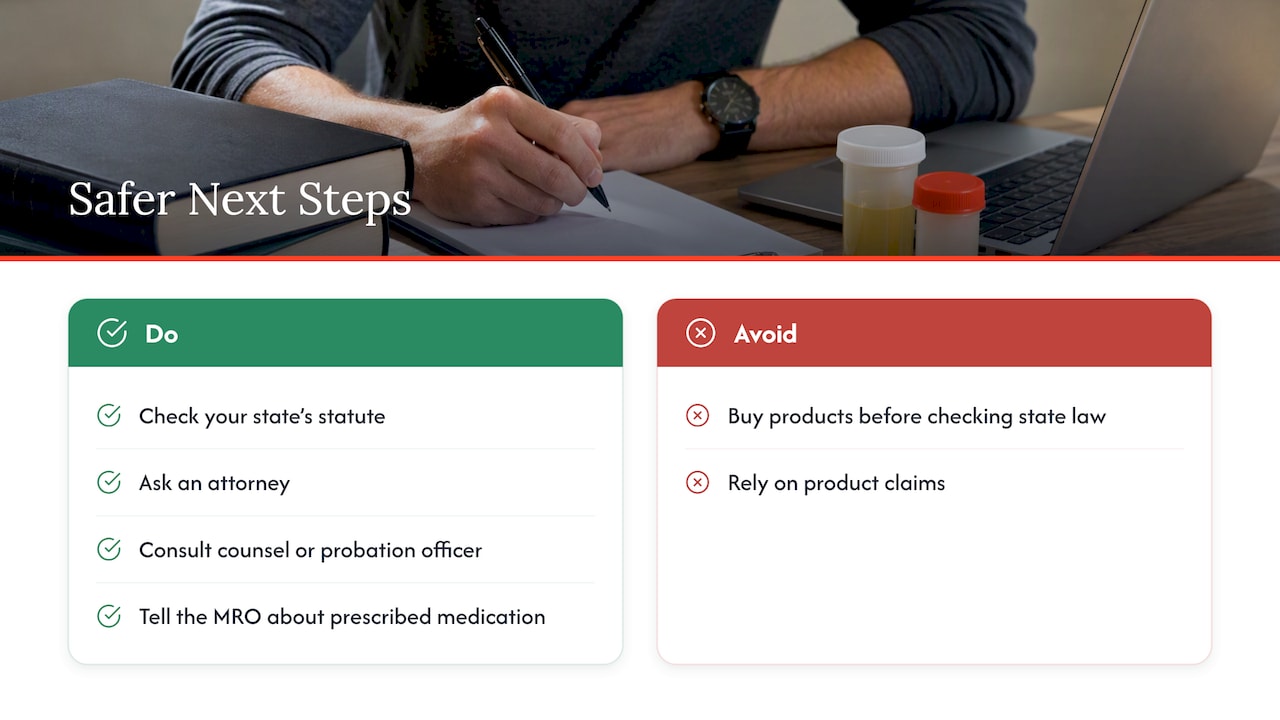
There is a legal side too. Some states have laws on selling or using substitution products to defeat a drug test, and the details differ by state. We have not linked a state-by-state source here, so before you buy anything, check your own state’s statute or ask an attorney. If your test is court-ordered or tied to probation, speak with your attorney or your probation officer first. The stakes there are higher than a lost job offer, and observed collection is more likely.
Also consider the quieter options. If your test is a few weeks out and you are a light or occasional user, abstaining is the only route that does not depend on a product claim. If you take a prescribed medication that may trigger a positive, tell the Medical Review Officer at the verification step. That is what the MRO role exists for.
Our perspective
We talk with people every day who are trying to make sense of a drug test scenario, and the same pattern repeats. Buyers fixate on a single feature, such as uric acid, because it is easy to compare. The labs do not think that way, and neither should you.
Our view is plain. Start by identifying the test: urine, hair or saliva, workplace or legal, observed or not. The right product, or the right decision to wait, follows from that. Urine and hair tests work on completely different principles, and a product for one does nothing for the other.
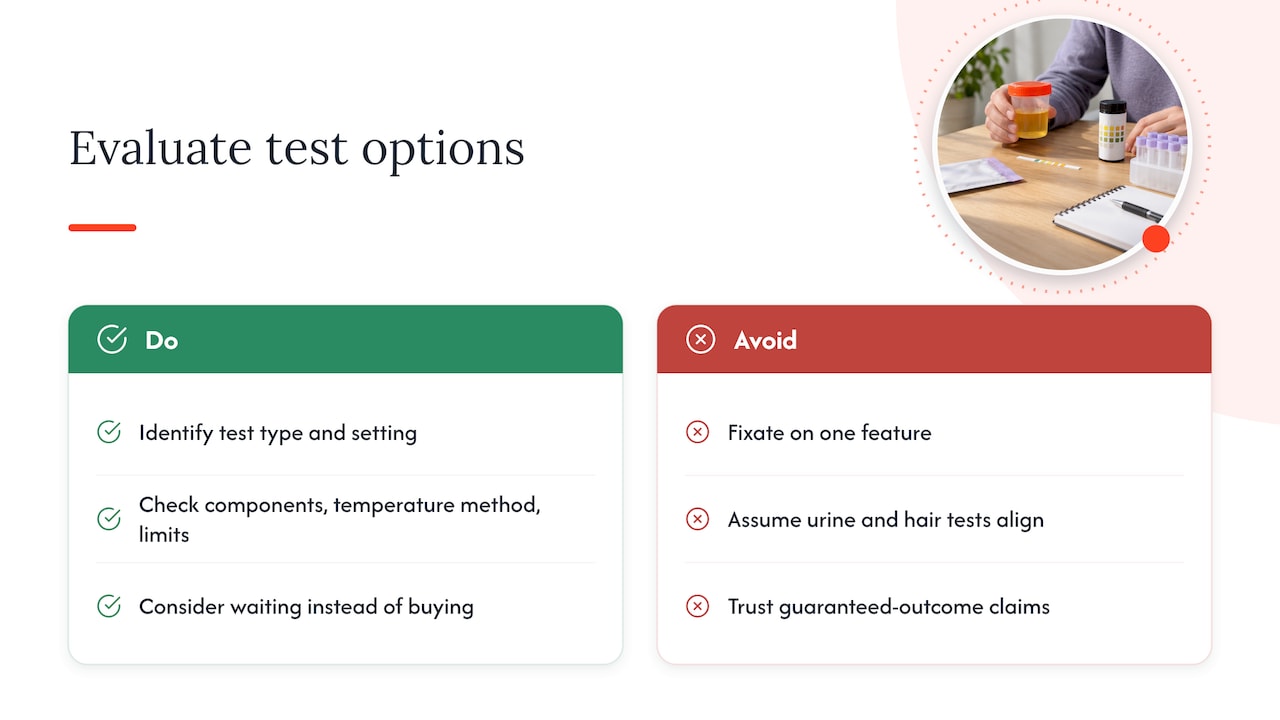
If a urine substitute is something you have decided to consider, read the label like a lab would. Look for stated components, a clear temperature method and honest limits. Be wary of any claim that promises a guaranteed outcome, because no seller controls the lab on the other end.
That is why we pair our shop with education: our guides on choosing a synthetic urine kit and the checks above exist so you can decide with eyes open, including deciding not to buy.
— MIchael
Where to start if you do need a urine option
If you want to browse after reading, our urine drug testing section collects the relevant products in one place. You can compare a synthetic urine kit with other approaches covered in our clean urine drug test guide. We ship across the United States, and our team answers questions by phone during published business hours, which is useful if you are unsure which scenario you fall into.
How to read a synthetic urine label
A short checklist you can apply to any product, ours or anyone else’s:
- Named components. Urea, creatinine and uric acid should be listed, not hidden behind “proprietary blend.”
- Concentrations. Real urine varies widely, so a product aiming at the middle of the physiological range is more defensible than one with extreme values.
- Temperature plan. The instructions should say how to reach and keep the accepted range, and acknowledge the short window at collection.
- Freshness. Check dates and storage directions. A degraded formula changes chemistry.
- Honest limits. Look for language that explains what labs can detect and that results are not guaranteed.
None of these items proves a product will pass. They simply separate careful makers from marketing copy.
FAQ
Does human urine have uric acid?
Yes. Uric acid is an end product of purine metabolism and is excreted in urine. MedlinePlus gives a typical adult range of about 250 to 750 mg per 24 hours, depending on diet and health.
Does synthetic urine need uric acid to pass a drug test?
Not for the federal minimum, which centers on creatinine, pH, specific gravity and oxidants. But some labs test additional biomarkers, and products have added uric acid for that reason. It improves realism without guaranteeing anything, since temperature and the rest of the profile still count.
Is uric acid the same as creatinine?
No. Both are waste products your kidneys clear, but they come from different processes. Uric acid comes from purine breakdown, while creatinine comes from muscle metabolism. Labs use creatinine as a core dilution and substitution marker, as in the DOT substitution criteria.
Can a lab tell synthetic urine from real urine?
Sometimes. Basic checks can miss it when the physical values look normal, but multi-method LC-MS-MS approaches can flag substitutes even then. Whether a given lab uses them varies, so no product can promise a pass.
Sources
- MedlinePlus: Uric acid, urine
- DOT 49 CFR 40.88: dilute and substituted criteria
- SAMHSA MRO Guidance Manual, 2024
- Evaluation of biochemical assays and LC-MS-MS for synthetic urine detection (PubMed)
- Update on Urine Adulterants and Synthetic Urine Samples (PubMed)
- Sample validity lessons from challenging cases (PubMed)
- Advances in testing for sample manipulation, Part A: urine (PMC)
- A Practical Guide to Urine Drug Monitoring (PMC)