
THC COOH: Why Urine Tests Target an Inactive Metabolite
THC COOH, or 11 nor 9 carboxy THC, is the inactive metabolite laboratories search for when they analyze urine for cannabis use, not the active Delta 9 THC itself. Standard urine screens target this compound because the body clears it slowly and in measurable amounts, which is why federal workplace testing monitors it as the primary marker. How long it stays detectable depends heavily on use pattern, and labs lean on normalization and confirmatory testing to interpret the result correctly.
TL;DR:
- Occasional use often clears within about a week; regular use may remain detectable into week three, while heavy use can last several weeks.
- Regulated programs require laboratories to confirm a positive immunoassay with gas or liquid chromatography mass spectrometry before reporting a final positive.
- Hydrolysis measures free and glucuronidated THC COOH together, while direct glucuronide measurement captures a narrower fraction, so near cutoff results may differ by method.
- For disputed or serial results, request confirmatory findings and creatinine normalized concentrations; new use assessments depend on the interval and ratio threshold applied.
Table of Contents
- How the Body Converts THC Into THC COOH
- How Urine Drug Tests Detect THC COOH
- Detection Windows for Occasional, Regular, and Heavy Users
- How Labs Interpret Results: Cutoffs, Normalization, and New Use Detection
- Common Questions About THC COOH and Testing Accuracy
- Reading a THC COOH Result Without Overreaching
- Where PassMyDrugTest Fits Into This Picture
- FAQ
- Sources
How the Body Converts THC Into THC COOH
When you inhale or ingest cannabis, Delta 9 THC enters the bloodstream and heads to the liver, where enzymes begin breaking it down. The first stop is 11 hydroxy THC, a metabolite that is still psychoactive and in some cases more potent than the parent compound. From there, liver enzymes oxidize it further into 11 nor 9 carboxy THC, the stable, non-psychoactive metabolite that urine tests are built around.
This carboxylated form does not travel through the body on its own for long. The liver attaches a glucuronide molecule to it, a process called glucuronidation, which makes the metabolite far more water soluble so the kidneys can filter it into urine. According to research on free and glucuronidated urinary cannabinoids, THCCOOH glucuronide is the dominant form found in urine, while free (unconjugated) THC COOH typically makes up a small fraction of the total.
That distinction matters for how labs actually run their analysis:
- Some laboratories hydrolyze the urine sample first, breaking the glucuronide bond chemically so the total THC COOH can be measured as one combined figure.
- Other labs measure the glucuronide conjugate directly using liquid chromatography tandem mass spectrometry, which avoids the hydrolysis step and can give a clearer picture of recent excretion patterns.
- The choice between these two approaches can change how a borderline result is reported, especially near a cutoff.
Because fat tissue acts as a reservoir for THC and its metabolites, the conversion to THC COOH does not happen in one burst. It continues gradually as THC stored in adipose tissue gets released back into circulation, which is part of why detection windows can stretch out for heavier or more frequent users.
How Urine Drug Tests Detect THC COOH
Most urine drug tests happen in two stages: an initial screen and, if that screen comes back positive, a confirmatory test. Each stage uses different technology, and understanding the gap between them explains why a preliminary result is never the final word.
Screening immunoassays are the first line. These tests use antibodies designed to bind to THC COOH, and they are fast, cheap, and automatable, which is why they are the default for high volume testing programs. Their tradeoff is specificity: antibodies can sometimes cross react with structurally similar compounds, producing a presumptive positive that needs to be verified. Screening cutoffs are typically set higher than what the most sensitive lab equipment could detect, which filters out trace level results before they ever reach a human reviewer.
Confirmatory testing is where gas chromatography mass spectrometry (GC MS) or liquid chromatography tandem mass spectrometry (LC MS/MS) comes in. These methods separate and identify molecules with far greater precision than an immunoassay, which is why regulated programs require a confirmatory result before anyone officially reports a positive. Peer reviewed method validation work shows that LC MS/MS can quantify both free and glucuronidated THC COOH separately, giving toxicologists more detail than older hydrolysis based methods that only report a combined total.
Hydrolysis versus direct measurement is more than a technical footnote. A lab that hydrolyzes the sample first measures total THC COOH (free plus glucuronide), while a lab running direct LC MS/MS on the glucuronide form is looking at a narrower slice of the same picture. Neither approach is wrong, but they are not interchangeable, and comparing results across different lab methods without accounting for this can create confusion.
One figure that illustrates why analytical choice matters: validated ultra high performance liquid chromatography tandem mass spectrometry assays report limits of detection that are orders of magnitude lower than older testing methods, which means the same urine sample can test negative on a routine immunoassay and still show trace level THC COOH under research grade analysis. That gap is exactly why cutoff selection, not just the presence or absence of the metabolite, determines whether a test is reported positive.
A few practical takeaways from how this workflow actually functions:
- Immunoassay screens exist to quickly rule out the majority of negative samples, not to serve as final proof of use.
- Confirmatory GC MS or LC MS/MS testing is required before a laboratory or Medical Review Officer finalizes a positive result.
- The specific analytical method a lab uses, hydrolysis based or direct glucuronide measurement, can affect how sensitive the test is near the cutoff.
Detection Windows for Occasional, Regular, and Heavy Users
Detection windows for THC COOH vary more than almost any other commonly tested substance, largely because of how long fat tissue holds onto THC and slowly releases it back into the bloodstream for metabolism. There is no single number that applies to everyone, but controlled studies give a useful range.
Controlled dosing research comparing smoked, vaporized, and oral THC found that THCCOOH glucuronide reaches its peak urinary concentration (Tmax) around 5.1 to 7.9 hours after use, regardless of route. That same research found that frequent users show substantially higher peak concentrations (Cmax) than occasional users, which is one of the main reasons their detection windows stretch out so much longer.
Separate controlled studies looking specifically at time to first negative result found a wide spread: some participants cleared the metabolite in less than a day, while others remained positive for more than 15 days, depending on their baseline concentration going into abstinence and their prior use pattern. Broadly, the pattern looks like this:
- Single or occasional use tends to clear from urine within days, often within about a week, assuming no further use during that window.
- Moderate, regular use can extend detectability into the second or third week, due to greater stored THC metabolite release.
- Heavy, chronic use can result in positive detection for several weeks, occasionally longer in high, sustained use cases.
Several factors push these windows longer or shorter for any given person. Body fat percentage matters because THC is lipophilic and accumulates in adipose tissue, meaning people with higher body fat tend to store and later release more of it. Hydration status matters too, since a dilute urine sample lowers the measured concentration of THC COOH without actually reflecting faster clearance, which is part of why labs correct for dilution rather than taking a raw concentration at face value. Route of administration and dose also play a role: higher doses and more frequent dosing intervals raise peak concentrations and slow the overall decline. Readers who want a closer breakdown of how these variables interact can look at our guide to THC detection times and the explanation of THC half life and elimination, both of which walk through the pharmacokinetics in more depth.
Cutoff concentration also shapes what counts as a positive. A sample that would read positive at a research lab’s trace level cutoff might read negative at the higher cutoff used in a routine workplace screen, even though the same amount of THC COOH is physically present in both samples.
How Labs Interpret Results: Cutoffs, Normalization, and New Use Detection
A raw THC COOH concentration by itself tells you very little. Interpretation depends on the cutoff used, how the sample is normalized, and in serial testing programs, how that result compares to the person’s own prior specimen.
Federal and most employer sponsored programs rely on SAMHSA and HHS mandatory guidelines, which set both the screening cutoff and the lower confirmatory cutoff. A sample has to clear the screening cutoff first, then get confirmed at the lower, more precise cutoff before a laboratory or Medical Review Officer calls it positive. This two tier structure exists specifically to prevent a borderline or cross reactive screening result from becoming a final decision on its own.
Because urine concentration swings with hydration, labs normalize results against creatinine or specific gravity. Someone who drinks a large volume of water before a test produces more dilute urine, which can lower a THC COOH reading without reflecting any real change in how much metabolite their body is clearing. Creatinine normalization adjusts for that by expressing the result relative to a marker of urine concentration rather than as a raw number, making comparisons between specimens far more reliable.
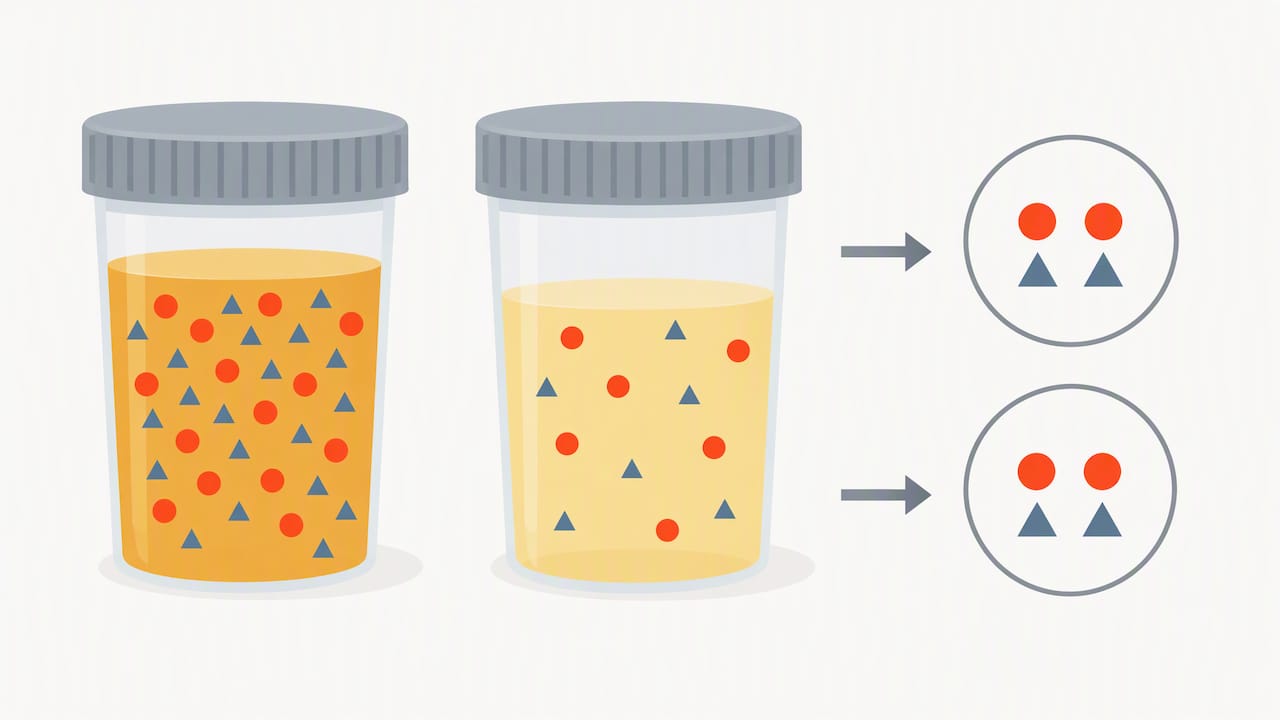
That reliability becomes essential in serial testing programs, like treatment monitoring or probation drug courts, where the real question is often not “is this person positive” but “did this person use again since their last test.” The creatinine normalized U2/U1 ratio method addresses exactly that. It compares a later specimen’s creatinine normalized concentration (U2) against an earlier one (U1) to flag a likely new use event rather than simple ongoing elimination of an old dose.
Here is how that decision process generally works:
- The program collects a baseline specimen and records its creatinine normalized THC COOH concentration.
- A follow up specimen is collected at a defined interval, and its normalized concentration is divided by the baseline to produce the U2/U1 ratio.
- For less than daily users, a ratio at or above a commonly recommended threshold is used to suggest new use, though the exact maxima and 95% limits vary depending on the time interval between specimens.
- High consequence settings, such as certain legal or safety sensitive programs, often apply a more conservative ratio, which reduces false positives at the cost of missing some genuine new use events.
Pro Tip: If you are reviewing a disputed result, always ask whether the lab normalized for creatinine or specific gravity and which ratio threshold the program applied, since that single detail can change the entire interpretation.
Common Questions About THC COOH and Testing Accuracy
A few misconceptions come up constantly around THC COOH testing, and most of them collapse once you understand what the assay is actually measuring.
- Passive inhalation almost never produces a positive at standard cutoffs. Forensic toxicology and Medical Review Officer guidance generally treats secondhand smoke exposure claims as insufficient to explain a federal cutoff level positive, barring extreme, sustained exposure in an unventilated space.
- THCA is not what gets measured in urine. Tests target THC COOH, the downstream metabolite, not the raw plant acid THCA found in unheated cannabis, so confusion between the two usually comes from conflating how a substance is tested in blood, hair, or plant material versus urine.
- Standard immunoassays target THC COOH specifically and are not generally cross reactive with CBD or other common phytocannabinoids at routine cutoffs, though unusually impure products can occasionally complicate a result.
- Edibles shift the timing, not the target. Oral THC is absorbed more slowly than smoked or vaporized THC, which can delay peak THC COOH concentration, but the metabolite being tested for stays the same across routes of use.
Reading a THC COOH Result Without Overreaching
A single THC COOH concentration indicates prior cannabis use but cannot specify the timing or impairment status at collection. Accurate interpretation requires serial sampling and normalization techniques. Serial specimens, creatinine normalization, and a documented ratio method get you much closer to a defensible answer than any single raw concentration ever will.
If a result is contested, the practical path is straightforward: confirm which cutoff applied, request the confirmatory GC MS or LC MS/MS report rather than relying on the screening result alone, and ask whether normalized concentrations were used in the comparison. A Medical Review Officer review exists specifically to catch cases where the raw data does not support the conclusion being drawn from it. For readers who want to go deeper on the pharmacokinetics behind these numbers, our breakdown of marijuana urinalysis detection times covers the testing side in more detail.
— MIchael
Where PassMyDrugTest Fits Into This Picture
Understanding the chemistry behind a THC COOH result is one thing. Having the right product on hand before a scheduled test is another, and that is where our catalog comes in. We carry at-home urine drug test kits alongside detox products and educational guides built around the same detection science covered above, so you are never choosing blind.
- We offer urine test kits to help you check your own status before a scheduled screening.
- Detox products and preparation resources are organized by category so you can match a product to your specific timeline.
- Orders ship across the United States, and phone support is available to help you pick the right option for your situation.
Browse our urine drug testing resources or reach out to our support line if you want help narrowing down the right product before your test date.
FAQ
How Long Should I Stop Smoking Before a Urine Drug Test?
There is no single safe number of days because clearance depends heavily on how often and how much you have used, since THC stored in body fat continues releasing metabolite over time. Occasional users often clear THC COOH within about a week, while regular or heavy users can take two to three weeks or longer based on controlled abstinence studies.
Is THC Metabolized in the Liver or Kidneys?
THC is metabolized primarily in the liver, where enzymes convert it first to 11 hydroxy THC and then to THC COOH. The kidneys do not perform the metabolic conversion; they filter the water soluble glucuronide form of THC COOH out of the blood and into urine, which is why glucuronidation in the liver matters so much for detection.
Can a Drug Test Tell the Difference Between THC and THCA?
Standard urine drug tests are built to detect THC COOH, the metabolite your body produces after using THC, not THCA, which is the non psychoactive acid found in raw, unheated cannabis plant material. Because urine testing targets a downstream human metabolite rather than a plant compound, the THC versus THCA distinction mostly applies to product labeling and blood or hair testing contexts rather than standard urine screens.
Why Did I Test Positive for THC if I Don’t Smoke?
A positive result without smoking usually points to edible consumption, concentrated products, or in rare cases, extremely heavy and prolonged secondhand exposure, though passive inhalation alone is generally insufficient to trigger a positive at standard federal cutoffs. Oral THC from edibles still converts to THC COOH through the same liver pathway, so it shows up on the same test even though no smoke was ever inhaled.