
Estimate Detection Risk: THC Detox Timeline, Urine 50/15 ng/mL
Urine tests can flag THC use for days to over a month, oral fluid usually clears in 24 to 72 hours, blood rarely holds a signal past a week, and hair can show use for months. Ranges vary this widely because dose, frequency, body fat, and metabolism all move the numbers. If a test is coming, stop using now, and if you have a few days, run an at-home check before the real one.
TL;DR:
- Urine tests detect THC metabolites for weeks to over a month, especially in heavy users, while oral fluid typically clears within 24 to 72 hours.
- Blood tests lose detectability within hours due to rapid redistribution, and hair tests reveal use over the past three months regardless of recent consumption.
- Heavy or daily users may remain above workplace test thresholds for weeks, making detox efforts less effective without extended abstinence.
- Drinking water does not speed up THC elimination; labs check urine dilution markers, which can cause retests or invalid results.
- Immediate cessation and self-testing before the exam are the most reliable steps to reduce detection risks, as detox products provide no guaranteed results.
Table of Contents
- THC Detox Timeline by Test Type: Cutoffs and Windows
- How Your Use History Changes the Timeline
- What Actually Speeds Up or Slows Down Clearance
- What Helps, What Doesn’t, and What’s Risky
- Why Your Sample Might Get Flagged Even If You’re Clean
- Checking Your Own Status Before Test Day
- Why Straight Answers Beat Vague Promises
- Matching the Right Product to Your Test and Timeline
- Sources
- FAQ
THC Detox Timeline by Test Type: Cutoffs and Windows
Every drug test targets a different marker, and that single fact explains most of the confusion around detection windows. Urine screens look for Δ9THCC (THCCOOH), the inactive metabolite your liver produces after THC breaks down. Federal workplace testing sets the initial immunoassay screening cutoff at 50 ng/mL, with a GC/MS confirmatory cutoff of 15 ng/mL, under 49 CFR § 40.85. Those two numbers matter because a sample can screen positive above 50 ng/mL but still fail to confirm if the lab’s follow-up test comes back under 15 ng/mL.
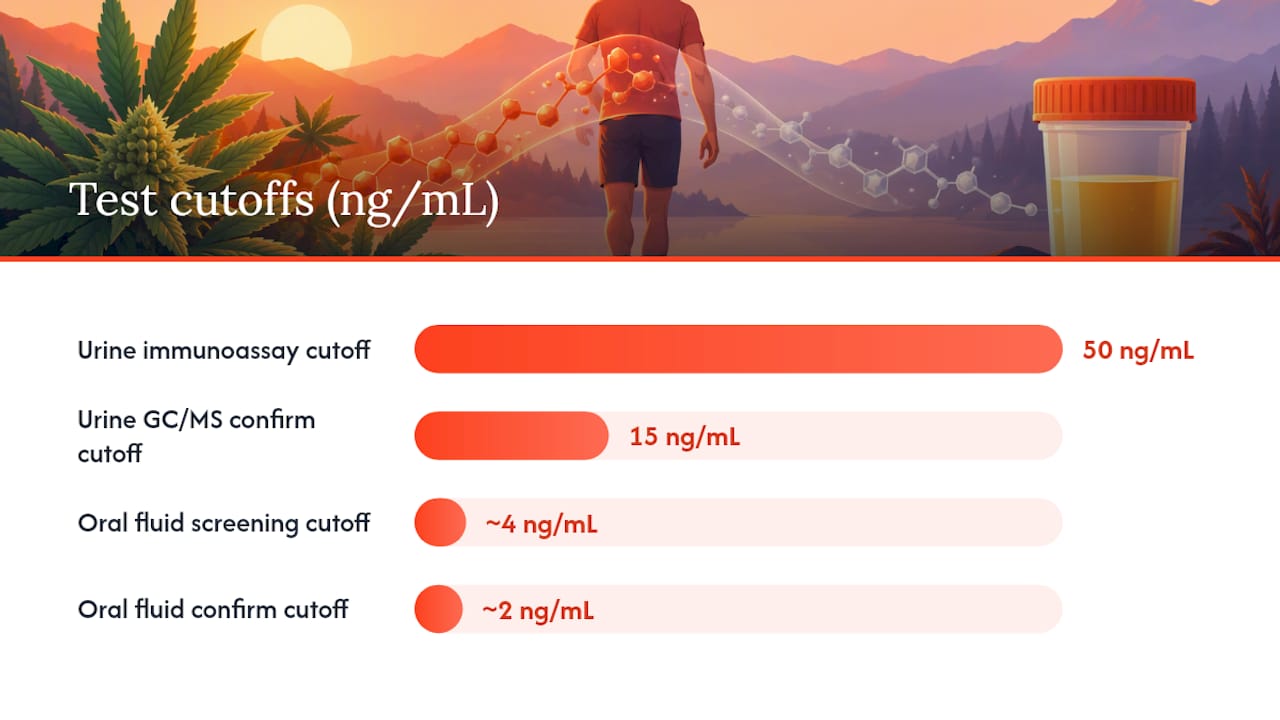
Oral fluid testing works differently. It targets parent Δ9THC rather than the metabolite, with an initial cutoff around 4 ng/mL and a confirmatory cutoff near 2 ng/mL, per the same federal cutoff standards. Saliva windows are typically shorter than urine, but not as short as people assume. Some research has found positive oral fluid results beyond 24 hours in heavier or more frequent users, which undercuts the popular idea of a universal one-day saliva window.
Blood and sweat testing round out the picture:
- Blood/plasma: Parent THC drops fast, often within hours, since it redistributes into fat tissue quickly. Models exist to estimate time since last use, but they lose accuracy for frequent users whose THC has already accumulated in fat stores.
- Hair: Detects patterns of use over roughly the past 90 days, not recent use.
- Sweat patches: Detect use across the days the patch is worn, rare outside specific probation or monitoring programs.
THC metabolite levels typically peak within several hours after use, with higher doses or oral routes tending to increase both peak concentration and detection window, according to urinary excretion research.
How Your Use History Changes the Timeline
There’s no single weed detox timeline that applies to everyone, and that’s the part most generic guides get wrong. Your usage pattern drives the range far more than any product you might try.
- Infrequent users (a handful of uses per month or less): Many clear a standard urine screen within a few days, and oral fluid often turns negative within 24 to 48 hours.
- Moderate or weekly users: Urine positives commonly persist for 1 to 2 weeks, depending on dose and how the THC was consumed.
- Heavy or daily users: Positive urine results can stretch several weeks, and in some cases beyond a month, because accumulated THC stored in fat tissue keeps releasing metabolites back into circulation. Hair tests for this group will almost certainly show positive results for months regardless of recent abstinence.
Peer-reviewed research on urinary detection windows confirms that frequent users can remain above workplace thresholds for weeks after their last use, driven by residual excretion rather than new intake. A more recent systematic synthesis of urinary THCCOOH elimination backs this up, showing that occasional users often drop below the 15 ng/mL confirmatory threshold within days, while daily users can stay above it for weeks. If you fall into the heavy-use category, treat any timeline estimate as a wide range, not a countdown.
What Actually Speeds Up or Slows Down Clearance
THC detox time frame estimates shift based on a handful of measurable factors, some you control and some you don’t.
- Dose and route: Higher doses raise peak metabolite concentration, and oral ingestion tends to produce higher THCCOOH levels than smoking or vaping, extending the detection window.
- Body fat and metabolism: THC is lipophilic, meaning it stores in fat tissue and releases slowly over time. Higher body fat generally means a longer tail on detection, especially for regular users.
- Hydration: Drinking extra water dilutes urine, but it doesn’t speed up actual clearance. Labs specifically check creatinine and specific gravity to catch dilution attempts.
- Individual metabolism: Two people with identical use patterns can clear THC at noticeably different rates.
Pro Tip: Don’t confuse a diluted sample with a clean one. A urine sample that comes back too watery often triggers a retest requirement rather than a pass, which wastes the time you were trying to save.
Understanding how THC half-life works helps explain why heavy users can’t just “flush it out” in a weekend the way infrequent users sometimes can.
What Helps, What Doesn’t, and What’s Risky
There’s no shortcut that replaces time, but some choices reduce risk more than others. Here’s the honest ranking:
- Stop use immediately. This is the only step that guarantees improvement over time. Every day of abstinence moves you closer to clearance, and there’s no substitute for it.
- Test yourself before the real one. An at-home immunoassay kit gives you a reasonable estimate of where you stand relative to the same cutoffs a lab uses.
- Consider matrix-specific products with realistic expectations. Detox drinks may offer a short window of reduced detectability for occasional users on urine tests, but the evidence is limited and results vary by body chemistry. Detox shampoos are formulated specifically to strip external residue from hair before a follicle test, which is a different mechanism than urine dilution.
- Avoid synthetic urine and adulterants for lab-monitored collections. Labs actively test for exogenous markers, and getting caught typically means an automatic refusal or disciplinary action, which is worse than a positive result in most workplace policies.
Pro Tip: Never chug excessive water right before a test hoping to dilute your way to a pass. Labs flag abnormally low creatinine, and an invalid result often triggers direct-observed retesting, which is the outcome you were trying to avoid in the first place.
Why Your Sample Might Get Flagged Even If You’re Clean
Collection procedures matter as much as the biology. Under SAMHSA’s urine collection standards, collectors must check specimen temperature within four minutes of collection, and it needs to fall between 90 and 100°F. Samples outside that range raise immediate suspicion of substitution.
- Minimum volume requirements typically require more than 45 mL; falling short means a partial collection and possible retest.
- Creatinine and specific gravity checks catch dilution, whether accidental (excessive water intake) or deliberate.
- Validity testing research shows labs increasingly screen for exogenous biomarkers tied to synthetic or adulterated samples.
If a specimen fails any of these checks, the collector doesn’t just discard it. Protocol moves to direct-observation collection or documents the event as a refusal, both of which carry consequences beyond a simple positive result.
Checking Your Own Status Before Test Day
An at-home urine immunoassay kit is the closest thing to a dry run you can get. These kits approximate the same screening sensitivity labs use, though results near the cutoff line can go either way.
- A positive home test result indicates a high likelihood the lab confirmatory test will also be positive.
- A negative result near test day is encouraging, but due to variability in home kit sensitivity, retesting within a couple of days can provide greater confidence.
- If your test is a hair follicle screen rather than urine, match your prep to that matrix. A detox shampoo built for follicle tests addresses a completely different detection mechanism than anything aimed at urine.
Plan honestly for the outcome you’re most likely to get, not the one you’re hoping for.
Why Straight Answers Beat Vague Promises
This guide leans on federal cutoffs and peer-reviewed elimination studies instead of guesswork, because a THC detox timeline built on real numbers is the only kind worth trusting. This guide pairs research with products and phone support for people who need answers now, not eventually.
— MIchael
Matching the Right Product to Your Test and Timeline
Guessing which product fits your situation wastes time you probably don’t have. The catalog is organized around common test types used by employers and courts, helping you select a product suited to your specific matrix instead of choosing something generic.
If you’re facing a urine screen, urine test kits let you check your status before the real one. Oral fluid tests call for a different approach entirely, and saliva testing resources cover what that process actually looks like. Facing a follicle test changes the math again: hair holds a much longer record of use, and hair detox shampoo is formulated specifically for that scenario, not as a general-purpose fix.
Not sure which category fits your situation? Phone support is available during published business hours, and orders within the US generally ship quickly. Visit Passmydrugtest to browse products by test type and get a straight answer before test day arrives.
Sources
- 49 CFR § 40.85 — Urine and oral fluid initial and confirmatory cutoff concentrations
- Studies on urinary detection windows and residual excretion (Huestis and colleagues)
- Collection Site Manual 2024 — Urine collection procedures (SAMHSA)
- Urinary 11-nor-9-carboxy-tetrahydrocannabinol elimination systematic synthesis (2026)
- Estimating time of last oral ingestion of cannabis from plasma THC and THCCOOH concentrations (Huestis et al.)
FAQ
How Long Does It Take to Detox From THC?
It depends entirely on use history: infrequent users often clear urine screens within days, while daily users can test positive for several weeks. Hair tests show use for months regardless of frequency, based on urinary detection window research.
What Is the THC Detox Process for a Urine Test Specifically?
Urine tests measure Δ9THCC, with a federal screening cutoff of 50 ng/mL and a confirmatory cutoff of 15 ng/mL. Abstaining is the only guaranteed way to lower your levels below those thresholds over time.
When Will THC Be Out of My System for a Saliva Test?
Oral fluid THC often clears within 24 to 72 hours for most users, though heavier or more frequent use can extend that window. The federal confirmatory cutoff for oral fluid sits at 2 ng/mL.
Can Detox Drinks or Shampoos Guarantee a Passing Result?
No product guarantees a pass, and claims that suggest otherwise should raise a red flag. Detox shampoos are designed specifically for hair follicle prep, while detox drinks offer limited, situational support mainly for occasional users facing urine screens.
Does Passmydrugtest Sell At-Home Test Kits to Check My Status First?
Yes, Passmydrugtest carries urine and saliva test kits so you can estimate your standing before a formal screening. Current product pricing is available directly on Passmydrugtest.