
THC Cutoff Levels: What 50 and 15 ng/mL Mean on a Drug Test
For a standard federal urine test, the THC cutoff is 50 ng/mL on the first screen and 15 ng/mL on the confirmation test. Both numbers measure a metabolite called THCA (THC-COOH), not THC itself. A result at or above the cutoff is positive. A result below it is reported negative, even if a trace of metabolite is in your system. Employers, probation offices and other programs can set their own limits, so the number that applies to you depends on who orders the test.
Below we cover where the numbers come from, how the two-step process works, what changes for saliva, and what the cutoff does and does not tell you.
TL;DR
- The federal urine cutoff for marijuana metabolites is 50 ng/mL for the initial screen and 15 ng/mL for confirmation.
- A cutoff is a reporting line, not a zero line. Below it, the lab reports the result as negative.
- Oral fluid limits are far lower, 4 ng/mL to screen and 2 ng/mL to confirm in the federal rule we cite below, because saliva tests look for THC itself.
- Private employers, courts and probation can use stricter or different limits, so ask which cutoff your test uses.
- Thirty days without use is not a guarantee. Heavy, frequent use can stay detectable for a month or longer.
Table of Contents
- What a cutoff level actually means
- The standard urine cutoffs: 50 ng/mL, then 15 ng/mL
- Quick reference: THC cutoffs by test type
- Saliva cutoffs are much lower
- Why urine tests look for THC-COOH
- Below the cutoff does not mean zero
- Who can use a stricter cutoff
- Is 30 days enough to test below the cutoff?
- What a cutoff cannot tell you
- Our perspective: plan around the number, not the rumor
- Preparing for a test: where we can help
- FAQ
- Sources
What a cutoff level actually means
A cutoff is the concentration boundary a lab uses to sort results. At or above it, the sample is positive. Below it, the sample is negative. NIDA explains that a urine result can be negative even when some THC metabolite is present, as long as the amount falls under the applicable cutoff.
NIDA also notes that cutoffs are chosen to limit false positives. That makes a cutoff an analytical line, not a measure of how impaired anyone is. A lab picks a number high enough to be confident the result is real, and low enough to be useful.
The unit is nanograms per milliliter (ng/mL). One nanogram is a billionth of a gram, so 50 ng/mL is a very small concentration. Labs can measure far lower than that. The cutoff is set higher on purpose.
The standard urine cutoffs: 50 ng/mL, then 15 ng/mL
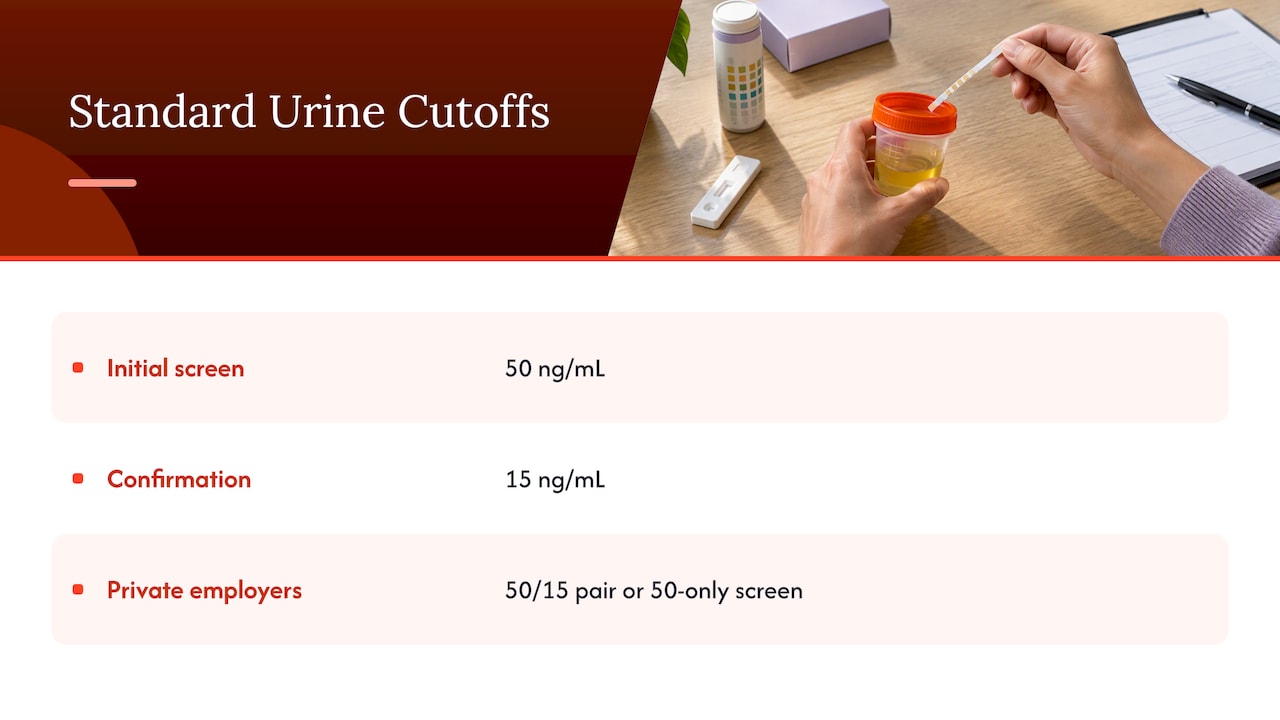
The benchmark most people mean by “THC cutoff levels” comes from the Department of Transportation. Under 49 CFR 40.85, the marijuana metabolite (THCA) cutoff is 50 ng/mL for the initial test and 15 ng/mL for the confirmation test.
The Nuclear Regulatory Commission uses the same pair. 10 CFR 26.163 sets a 50 ng/mL initial cutoff and a 15 ng/mL confirmation cutoff for marijuana metabolites in urine, unless an exception or a stricter cutoff applies.
Most private employers copy the federal 50/15 pair, or a 50 ng/mL screen alone. That is why those numbers show up on nearly every test panel. Our guide to federal drug test cutoff levels shows how THC sits next to the other drug classes, and our DOT drug test rules page covers what is tested and the consequences of a positive.
Why two numbers instead of one
The two tests do different jobs.
- Initial screen (50 ng/mL). A fast, inexpensive immunoassay. It reacts to a group of related compounds, so it can occasionally flag something that is not THC metabolite.
- Confirmation (15 ng/mL). A more specific lab method that identifies THCA itself. It uses a lower line because it is far more precise.
Under the DOT rule, a below-cutoff screen is negative and the process stops there. A screen at or above 50 ng/mL goes on for confirmation. The confirmation is negative below 15 ng/mL and a confirmed positive at or above it. The NRC rule likewise requires a positive initial specimen to receive confirmatory testing for that drug class.
So a sample that screens at 80 ng/mL but confirms at 12 ng/mL is negative under the federal rule. A sample that screens at 40 ng/mL never goes to confirmation at all.
The alternate-technology exception
There is one wrinkle. The DOT rule allows alternate-technology initial tests that are specific for THCA, and those use 15 ng/mL as the initial cutoff. Most routine screens are still the 50 ng/mL type, but if your lab uses a more specific method, the first line can be lower.
Quick reference: THC cutoffs by test type
| Test | Initial cutoff | Confirmation cutoff | What it measures |
|---|---|---|---|
| Federal urine (DOT) | 50 ng/mL | 15 ng/mL | THCA (THC-COOH) |
| Federal urine, specific alternate technology | 15 ng/mL | 15 ng/mL | THCA |
| Federal oral fluid (NRC rule) | 4 ng/mL | 2 ng/mL | THC |
| Nuclear industry urine (NRC) | 50 ng/mL | 15 ng/mL | Marijuana metabolites |
Sources: 49 CFR 40.85 and 10 CFR 26.163.
Hair tests use different units and different rules, and they are not covered by the numbers above. If your employer orders a hair test, see our hair follicle drug test page.
Saliva cutoffs are much lower
Oral fluid tests look for THC itself, not the inactive metabolite found in urine. The NRC rule lists federal oral-fluid cutoffs of 4 ng/mL for the initial marijuana (THC) test and 2 ng/mL for confirmation. An oral-fluid alternate-technology initial test that is specific for THC uses the 2 ng/mL confirmation cutoff as its initial cutoff.
The numbers look tiny next to 50 ng/mL, but the two scales cannot be compared directly. They measure different compounds in different fluids. What matters is the window: saliva tests are generally used to catch recent use, while urine reflects a longer history. Our guide on how a saliva drug test works explains the mechanics, and our THC detection times article lays out the windows test by test.
Why urine tests look for THC-COOH
The American College of Medical Toxicology (ACMT) identifies THC-COOH (11-nor-9-carboxy-delta-9-THC) as the main urinary metabolite used to interpret these tests. It is an inactive breakdown product. Your body makes it after THC is processed, and it lingers in urine far longer than the psychoactive compound does.
That is why a urine test can come back positive days or weeks after any effect has worn off. It is also why the result says nothing about whether you were impaired. For more on this, read why urine tests target an inactive metabolite.
Below the cutoff does not mean zero
Northwestern Medicine describes urine cannabinoid screening as a screen followed by confirmation, and notes that someone who used marijuana can still test negative when the THC level is under the lab’s reporting threshold. The DOT rule works the same way: the result is read against the threshold for that stage, not against zero.
Two practical consequences follow:
- A negative report does not prove abstinence. It only says the concentration was under the line.
- A result just over the line is still a positive. A screen of 51 ng/mL and one of 500 ng/mL both go to confirmation.
Who can use a stricter cutoff
The federal numbers are a floor for regulated programs, not a ceiling for everyone. The NRC rule explicitly lets a licensee or other entity set more stringent cutoffs than the listed levels, so even inside a covered program the working threshold can be tighter than 50/15 ng/mL.
Outside federal programs, the cutoff is whatever the employer, court or program contracts with its lab to use. That includes:
- Pre-employment screening. Many employers use a 50 ng/mL panel, but this is the employer’s choice. Our preemployment drug testing page covers what to expect.
- Probation and court-ordered testing. Programs vary by jurisdiction and testing authority, and some use lower screens or more frequent testing. Ask your officer or the program’s written policy for the exact cutoff and test type.
- Employer policies in DOT-covered jobs. Safety-sensitive transportation workers follow the DOT rule above.
If you cannot find the cutoff in writing, ask the collection site or the HR contact which panel is being used. It is a normal question, and the answer shapes how much time and caution you need.
Is 30 days enough to test below the cutoff?
Not always. ACMT reports that chronic heavy users may remain detectable for a month or longer. Concentration in urine depends on:
- how much and how long you used
- time since last use
- hydration
- body characteristics and other individual factors
A person who used once at a party and a person who used daily for years can differ by weeks on the same 50 ng/mL test. ACMT also explains that heavy water intake can dilute urine and push a measured value below a screening threshold. Labs know this, and they check creatinine and specimen validity, so a very dilute sample can be reported as dilute and may be recollected. Do not treat a water-loading plan as a safe shortcut.
For a realistic window by use pattern, see our THC detox timeline and marijuana urinalysis detection times.
A simple way to size up your own risk
- Confirm the test type. Urine, saliva and hair have different windows and different cutoffs.
- Find the cutoff. Is it the federal 50/15 pair, or something else?
- Be honest about your use pattern. Occasional use and daily use are not the same planning problem.
- Count the days from last use, and give yourself a margin rather than a best-case estimate.
- Test yourself first. An at-home screen gives you a rough read before the real one.
What a cutoff cannot tell you
A cutoff does not measure impairment. NIDA frames it as a boundary meant to limit false positives, not a gauge of intoxication. ACMT adds that a positive urine THC-metabolite result shows THC was present in the body, but does not establish the route or source of exposure, the dose, the timing, or whether exposure was intentional. It also says urine THC-metabolite testing is not designed to identify synthetic cannabinoids or CBD, and cannot by itself determine clinical impairment.
That matters for a few common worries. Passive exposure is one. At a 50 ng/mL screen, incidental contact is rarely enough to cross the line, as we explain in why secondhand smoke rarely triggers a positive. If you believe a positive result is wrong, ask for a review by the medical review officer or the program’s equivalent, and bring any prescriptions or documentation.
Our perspective: plan around the number, not the rumor
We talk with people every day who are staring at a test date and a cutoff they only half understand. Here is what we tell them.
First, learn the exact test. People often spend money and worry preparing for a urine test when the order is for saliva, or the reverse. Our whole catalog is organized by test type for that reason: urine, saliva and hair. Each behaves differently.
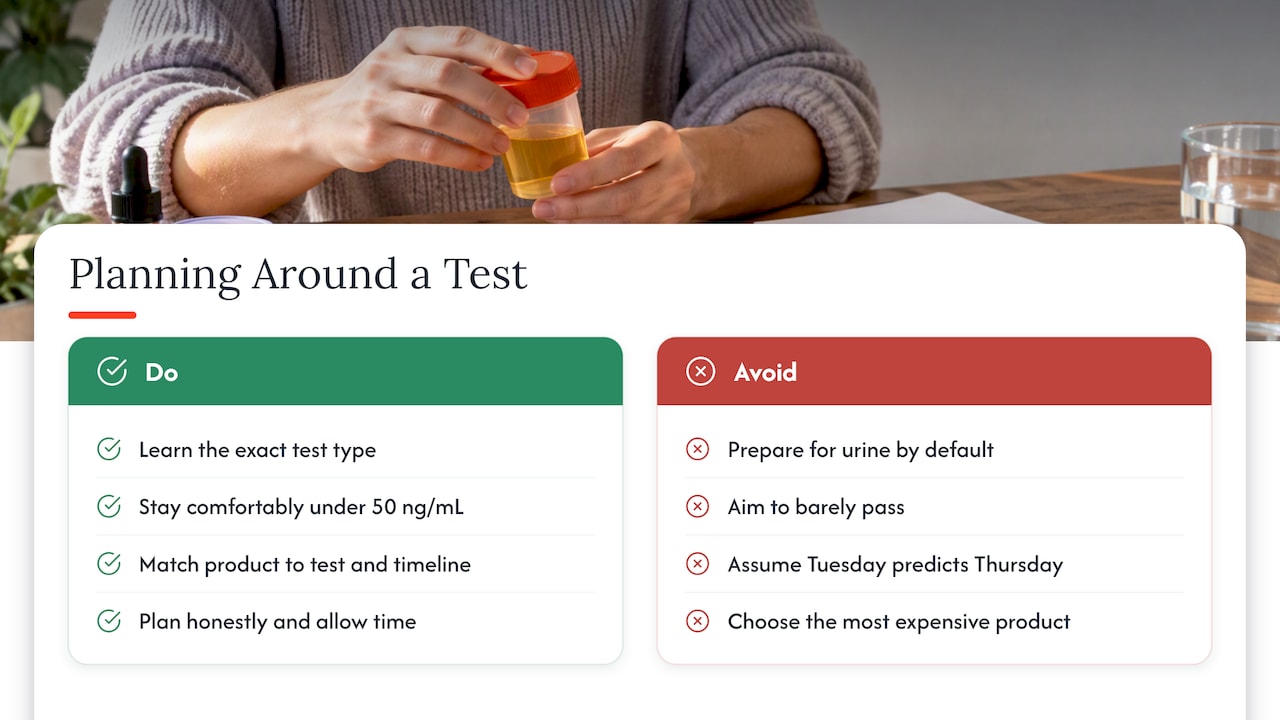
Second, treat 50 ng/mL as a line you want to be comfortably under, not barely under. Results move with hydration, time of day and your own metabolism. A sample that looks fine on Tuesday can land differently on Thursday.
Third, no product replaces time and honest planning. Anything you use should match your test type and your timeline, and we would rather help you pick the right product than the most expensive one. Our phone support exists for that conversation, during published business hours.
— MIchael
Preparing for a test: where we can help
If you have a test coming and want to prepare with the right tools, start with the test type on your paperwork. We carry at-home drug test kits so you can check yourself before the real thing, along with products for urine and hair situations, shipped fast within the United States. Browse the urine drug testing category, or head to the Pass My Drug Test home page to see everything we offer.
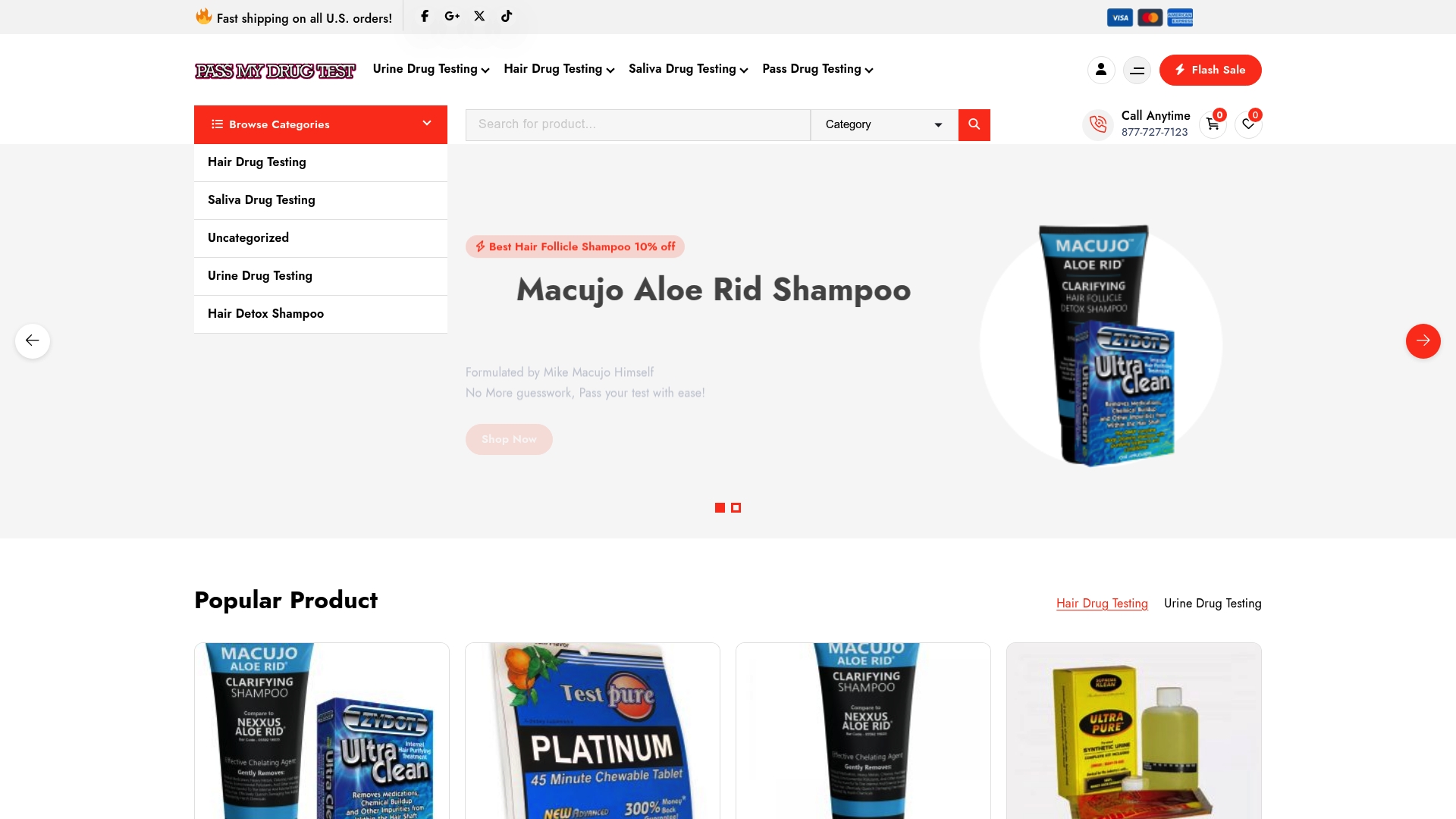
Not sure which fits your situation? Call us during business hours and we will help you match a product to your test. For more reading on marijuana specifically, see our marijuana drug test guides.
FAQ
What is the THC cutoff level for a urine drug test?
For federal DOT testing, the initial screen is 50 ng/mL and the confirmation test is 15 ng/mL for THCA. Many private employers use the same numbers. Some programs set stricter levels, so check which panel applies to you.
Does a result under 50 ng/mL mean I have no THC in my system?
No. It means the concentration was below the cutoff, so the test is reported negative. Some metabolite can still be present. The result is read against the threshold, not against zero.
Is the THC cutoff different for saliva tests?
Yes. Saliva tests look for THC itself rather than the urine metabolite, and the federal oral-fluid levels in the NRC rule are 4 ng/mL for the initial test and 2 ng/mL for confirmation. The detection window is also generally shorter than urine.
Is 30 days enough to pass a THC urine test?
It depends on how often and how heavily you used. Occasional users often clear sooner, but chronic heavy users can stay detectable for a month or longer. Hydration, body characteristics and time since last use all change the result, so 30 days is not a guarantee.
Can a probation program use a different THC cutoff?
Yes. Programs and testing authorities vary, and some use lower or different thresholds, as federal rules themselves allow stricter limits in covered programs. Ask your officer or the program for the written cutoff and test type.
Sources
- Drug Testing, National Institute on Drug Abuse (NIDA)
- 49 CFR 40.85, cutoff concentrations for urine drug tests (eCFR)
- 10 CFR 26.163, cutoff levels for drugs and drug metabolites (eCFR)
- ACMT Position Statement: Interpretation of Urine Drug Testing for Marijuana
- Cannabinoid Screen and Confirmation (Urine), Northwestern Medicine