
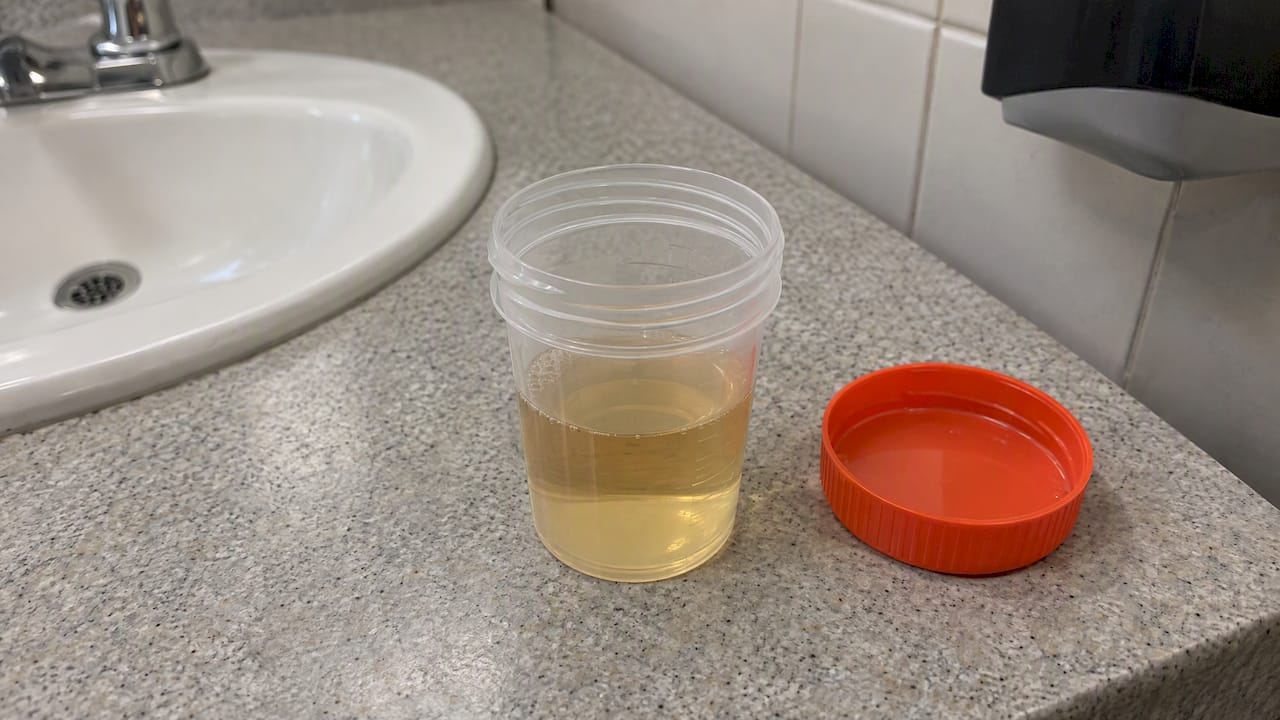
Synthetic Urine Smell: What It Is and What It Tells a Lab
Synthetic urine usually smells faint, slightly chemical or almost nothing at all, and there is no single standard scent across brands. That is the short answer. The longer one matters more if you are thinking about a test: odor is only one of several things a collection site and a lab look at, and it is rarely the one that decides the outcome.
This guide covers what the smell is, why it varies, how it compares with real urine, what collectors and labs check besides odor, and when a change in the smell of your own urine is a reason to call a doctor.
TL;DR
- Synthetic urine has no one characteristic smell. A 2025 study of 10 commercial products found no standardized odor profile, so brands differ.
- Fresh, healthy human urine is usually only faintly scented, so a strong chemical, ammonia or sweet note stands out in either direction.
- Smell is a weak test. U.S. federal validity criteria rest on temperature, pH, creatinine and specific gravity, and labs add other checks on top.
- If your own urine suddenly smells strong along with fever, burning or back pain, that is a medical question, not a test question.
- Check your state and employer rules before you buy anything. We sell kits and explain them, but the legal and job consequences are yours.
Table of Contents
- What synthetic urine actually smells like
- How it compares with real urine
- Can a collector really smell the difference?
- What labs check besides smell
- Our perspective
- Why a sample can smell wrong
- Choosing a kit when odor is a concern
- Shop for your test
- When the smell is your own urine
- Quick checklist before test day
- FAQ
- Sources
What synthetic urine actually smells like
Synthetic urine is a lab-made liquid that copies the look and chemistry of human urine: water, urea, creatinine, salts and a pH buffer, with a yellow color added. Most of the compounds that give real urine its scent come from metabolism, food and bacteria. A formula built from clean chemicals does not have those sources.
In practice people describe three things:
- Almost no odor. Many powder-based and premixed products smell like slightly salty water when fresh.
- A faint chemical or soapy note. This often comes from preservatives, surfactants or the dye.
- A stale or sharp smell after storage. A product that has sat warm, been opened for a while or been mixed too early can pick up an off smell.
The research backs the idea that there is no single answer. A 2025 paper in Drug Testing and Analysis characterized 10 commercial products with physical evaluations, clinical urinalysis, mass spectrometry and microscopy. Its abstract reports no standardized odor panel or single characteristic smell across them. If someone tells you that all synthetic urine smells like one specific thing, they are generalizing from one or two brands.
Why odor varies from product to product
Formulas are not regulated like pharmaceuticals. Each maker picks its own ingredients, its own preservatives and its own fragrance or lack of one. Some add a scent on purpose so the sample reads as more natural. Some sell an optional scent separately. Others try to stay neutral. The same brand can also smell different when it is fresh, when it has been heated, and when it has been stored for months.
Two practical points follow:
- Do not assume the smell of one kit tells you anything about another.
- Read the label for storage instructions and shelf life. Heat and time change how a liquid smells.
How it compares with real urine
People assume real urine smells strongly of ammonia. Usually it does not. According to MedlinePlus, fresh urine from a healthy person who drinks enough fluid normally has no strong smell. Concentrated urine can smell like ammonia, and foods, medicines and vitamins can change the scent.
Poison Control describes the same picture: urine odor is likely tied to volatile organic compounds, and food, drink, metabolism, hydration and health conditions can all shift it. Urine that has aged is a different story. One lab reference notes that aged urine can smell especially strong because of ammonia, putrefaction compounds and hydrogen sulfide.
That creates a real contrast:
| Sample | Typical smell when fresh | What changes it |
|---|---|---|
| Healthy human urine | Faint or nearly none | Hydration, diet, medication, vitamins, infection |
| Concentrated human urine | Ammonia-like | Low fluid intake, first-morning samples |
| Aged human urine | Strong, sulfurous | Time, bacteria, warmth |
| Synthetic urine | Faint, neutral or slightly chemical, varies by brand | Preservatives, scent additives, storage, heat |
The takeaway: a sample that smells oddly chemical, oddly sweet or unusually flat can raise a question. But a sample that smells like nothing is also what a hydrated person produces, so odor alone proves little in either direction.
Can a collector really smell the difference?
Sometimes a collector says they can. In a 2023 Ohio Court of Appeals case, a certified urine drug collector testified that he could smell the difference between synthetic and natural urine, describing a chemical odor as his baseline. That is one person’s account in one dispute, not a scientific standard. It does show that collectors are trained to notice things and that an unusual smell can lead to a closer look.
What a collection site is supposed to check is more structured. One clinical reference lists substitution flags such as a temperature outside 90 to 100°F, precipitate or cloudiness, and an unusual odor. Notice that odor is the third item on a list, next to things that can be measured with a thermometer and the naked eye.
So a faint odor will not by itself sink a sample, and a clean odor will not save one that fails on temperature or chemistry. If you want to understand the whole picture, our breakdown of four checks synthetic urine can pass and the biomarkers that can expose it goes through them in order.
What labs check besides smell
Odor is subjective. Labs prefer numbers. For U.S. federally regulated testing, a SAMHSA presentation to its Drug Testing Advisory Board lists pH, creatinine, specific gravity and temperature as the NLCP urine criteria. The same document notes that the compounds behind urine’s characteristic scent, including urea, ammonia, heptanones, pentanones, lactones and diamines, were considered and rejected as validity targets. In plain words: the scent chemistry was not a reliable enough basis for a validity rule.
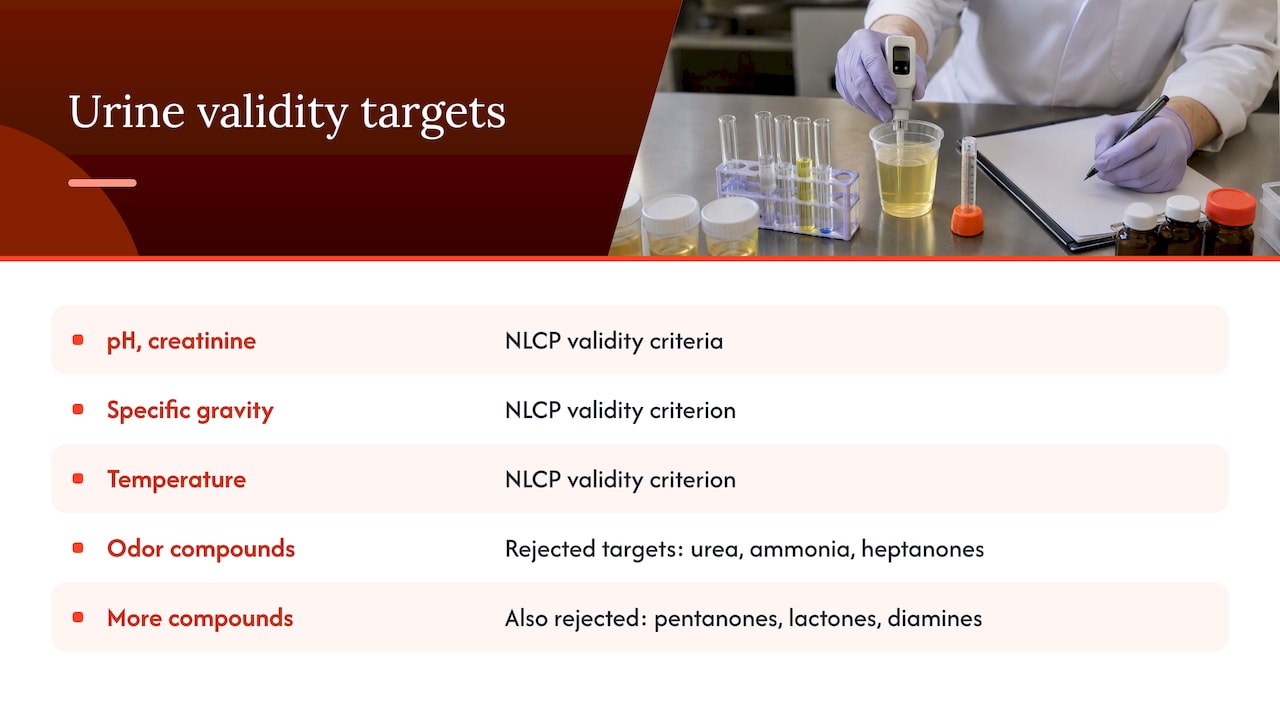
That is the key point for anyone worried about smell. The official framework does not run on what a sample smells like.
The checks that matter more
- Temperature. Taken within minutes of collection. A sample that is too cool or too hot is the easiest flag to raise.
- Creatinine and specific gravity. They show whether a sample looks like concentrated or diluted human urine.
- pH. It should fall in a human range.
- Appearance. Cloudiness, particles or unusual foam get noticed. Some adulterants can produce rainbow-like foam.
- Non-routine tests. Research notes that synthetic formulations evolve, so labs may benefit from extra, non-routine validity tests.
Newer lab methods
Two lines of research show where testing is going. In the 2025 microscopy study, automated microscopy showed 100% sensitivity and 98% specificity for identifying synthetic products in that sample set, and the authors say microscopic analysis may help tell synthetic products from real urine. Separately, a 2026 case-based paper reports that routine creatinine, pH and oxidant tests failed to identify the synthetic samples it examined, and that phenylacetylglutamine has been reported as a human-specific validity biomarker.
An earlier assay study reached a measured conclusion too: the test was analytically valid but clinically limited, and the authors recommend using it with other indicators of synthetic urine. No single check is final. Labs combine them, and not every lab runs the advanced ones.
If you want the chemistry side in more depth, we have written about what labs check for uric acid in synthetic urine and why routine checks can miss biocides.
Our perspective
We get this question from customers more often than the search numbers suggest, and the worry behind it is usually the same: “Will somebody smell it?” Here is how we see it.
First, smell is the part of the process people can feel, so they fixate on it. But the sample is judged on temperature, appearance and chemistry long before anyone’s nose matters. A kit that is the wrong temperature fails regardless of how neutral it smells.
Second, we would rather you buy once, read the instructions and store the product correctly than chase a perfect odor. Heat, age and a rushed mix cause more off smells than the brand does. Pick a kit with clear storage and shelf-life guidance, and do not use anything that smells sour, sulfurous or noticeably different from the instructions.
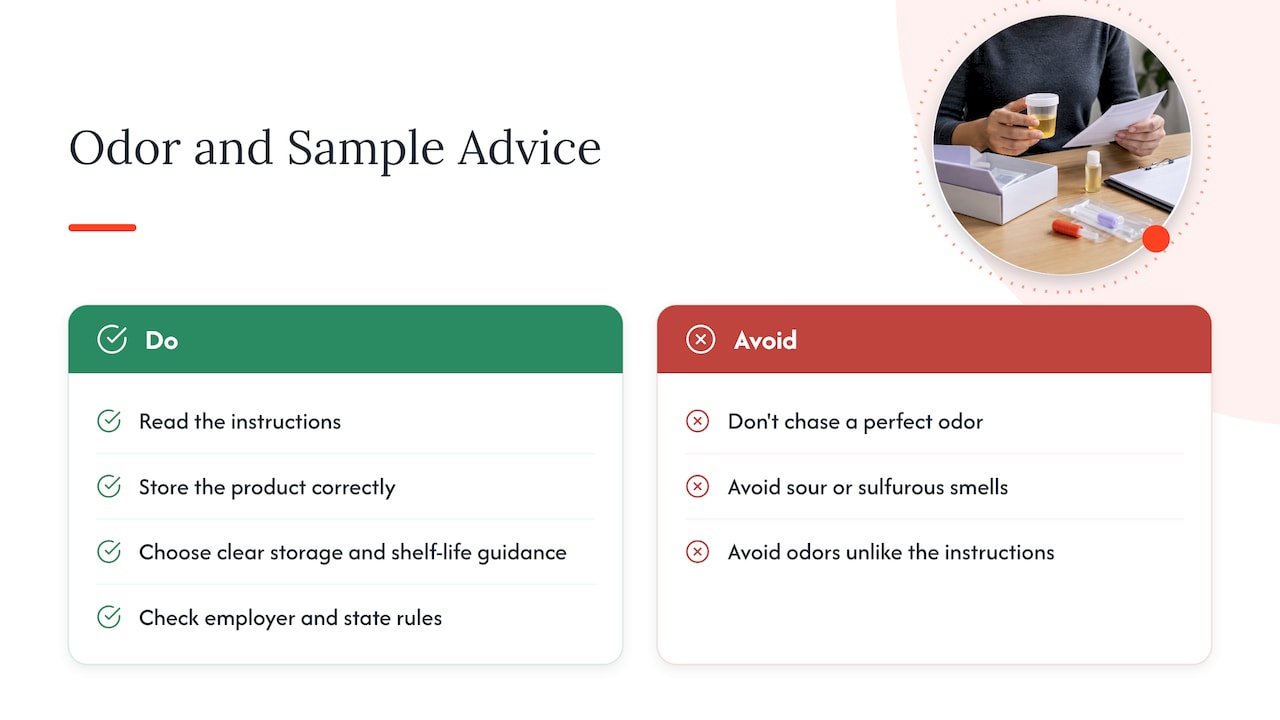
Third, be honest with yourself about the stakes. Rules on using these products differ by state and by employer, and a failed or flagged sample can cost more than a positive result would have. If you are unsure of your situation, read your employer’s policy and your state’s rules, and consider whether another route, like waiting or retesting, fits better. Our guide to false positives in drug testing covers cases where a result is wrong for reasons that have nothing to do with what you took.
Our role is to lay out how tests work and to supply products that are clearly described, with live phone support during published business hours when you need to talk a scenario through.
— MIchael
Why a sample can smell wrong
The usual causes are boring:
- Heat exposure. Leaving a kit in a hot car or a warm bag changes the liquid. Follow the storage directions on the package.
- Age. Products have shelf lives. A sour or sulfurous note is a reason to stop.
- Reconstitution mistakes. With powder formulas, using the wrong amount of water or the wrong water temperature can affect both smell and clarity.
- Added scent. Some products include a fragrance. That is a design choice, and it may smell more noticeable than the base liquid.
- Contamination. An opened container, a dirty bottle or a reused container can introduce bacteria and a foul smell.
If any of these apply, the fix is not to cover the smell. It is to not use that product.
Choosing a kit when odor is a concern
If you decide to use a synthetic product where it is allowed, compare on what actually decides outcomes:
- Clear instructions on temperature. A kit should tell you how to reach and hold a realistic body temperature, since this is a flag a collector can read quickly.
- Shelf life and storage. Look for a printed date and storage guidance.
- Premixed or powder. Premixed is simpler but may smell different if stored badly. Powder lets you mix fresh but adds a step to get right.
- Complete kit contents. A heating method and a way to check temperature matter more than fragrance.
- Support. Being able to ask a person a question before test day beats guessing.
Our comparison of the best synthetic urine kits for a drug test walks through those criteria, and you can browse the synthetic urine kit page directly.
Shop for your test
If you have a urine screen coming up, our urine drug testing category gathers the products and guidance for it in one place, with fast shipping on United States orders and phone help during published hours. If your test is a different type, the main site also covers hair and saliva testing, plus hair detox shampoo.
When the smell is your own urine
Maybe you landed here because your own urine smells different. That is a separate question from synthetic urine, and it usually has simple causes.
According to MedlinePlus, foods, medicines and vitamins can change urine odor, and concentrated urine can smell like ammonia, which often means you need more fluid. Asparagus, coffee, B vitamins and some antibiotics are common culprits that people mention.
See a health care provider if a strange smell comes with fever, chills, burning when you urinate or back pain. A foul odor can be caused by bacteria, as in a urinary tract infection, and that needs treatment rather than waiting. A sweet smell that persists, especially with heavy thirst or frequent urination, is worth raising with a clinician too, since it can be linked to blood sugar problems.
One more point for test-takers: changes in your own urine from hydration are normal, and heavy water loading can dilute a sample in ways labs flag through creatinine and specific gravity. Dilution is its own issue and a separate topic from smell.
Quick checklist before test day
- Read your employer’s drug policy and your state’s rules on altering or substituting a sample.
- Know which test you are facing: urine, hair or saliva. Hair and saliva tests do not involve urine at all, so a urine product is irrelevant to them.
- Store any product exactly as directed and check the date.
- Do not use a liquid that smells sour, sulfurous or markedly different from what the instructions describe.
- If you are taking medication, bring it up with the testing site’s medical review process, since some medicines and foods affect results or odor.
- Call us if you want to talk through your situation before ordering.
FAQ
Does synthetic urine smell like real urine?
Not reliably. Fresh real urine from a hydrated person is usually faint, and synthetic products range from nearly odorless to slightly chemical depending on the brand. A 2025 study of 10 products found no single characteristic smell, so there is no universal comparison.
Can a drug test detect synthetic urine by smell?
A collector may notice an unusual odor, and it is one item on a list of substitution flags. But the formal U.S. validity criteria rest on pH, creatinine, specific gravity and temperature, and labs can run additional tests beyond those. Smell is the least objective of the checks.
Why does my urine smell like chemicals or ammonia?
Often it is concentrated urine from not drinking enough, or something you ate or took, such as vitamins or medicine. MedlinePlus says to contact a provider if the odor comes with fever, chills, burning urination or back pain. If it keeps happening without those signs, mention it at your next checkup.
Can old synthetic urine go bad and smell?
Yes, liquids can degrade with heat, age or contamination. Aged real urine is known to become strong from ammonia and sulfur compounds, and a stored synthetic liquid can also turn off. Check the date and storage directions, and discard anything that smells sour or foul.
Sources
- Characterization and Identification of Commercial Synthetic Urine Products (Drug Testing and Analysis, 2025)
- Meros v. Sunbelt Rentals, Inc., Ohio Court of Appeals, 2023
- Update on Urine Adulterants and Synthetic Urine Samples (Journal of Analytical Toxicology, 2022)
- Is smelly urine anything to worry about? (Poison Control)
- Use of Urine Biomarkers in Validity Testing (SAMHSA, 2024)
- A new automated assay for the detection of synthetic urine (Drug Testing and Analysis, 2019)
- Sample validity lessons learned from challenging cases (Journal of Analytical Toxicology, 2026)
- Specimen Validity Testing and Specimen Tampering (clinical reference guide, 2019)
- Urine odor (MedlinePlus Medical Encyclopedia)