

DOT Drug Test Rules: What’s Tested, Cutoffs and Consequences
A DOT drug test follows one federal rulebook, 49 CFR Part 40, no matter which transportation mode you work in. It screens for five drug classes, including marijuana, and a safety-sensitive employee can be tested in six situations. Skipping the test, tampering with it or refusing it counts the same as a positive result. State marijuana laws and medical cards do not change any of that.
This guide covers who the rules apply to, what the lab looks for, the cutoff numbers, and what happens if a result comes back non-negative. It also covers a point that trips up many THC users: DOT testing is a different animal from the ordinary employer screen.
TL;DR
- DOT tests cover five drug classes: marijuana metabolites, cocaine, opioids, amphetamines and PCP. Labs may not test DOT specimens for anything else.
- The urine cutoff for marijuana (THCA) is 50 ng/mL on the initial test and 15 ng/mL on confirmation. Oral fluid cutoffs are 4 ng/mL and 2 ng/mL.
- Testing happens at pre-employment, random, reasonable suspicion, post-accident, return-to-duty and follow-up stages.
- Marijuana is still Schedule I federally, so a state card or a doctor’s recommendation is no defense. CBD products are no defense either.
- Refusing a test, or trying to cheat it, is treated like a positive result. Do not rely on any product to get past a DOT collection.
Table of Contents
- Who falls under the DOT rules
- The six situations when you can be tested
- What a DOT drug test screens for
- DOT cutoff levels for THC
- What happens at the collection site
- Refusals count as positives
- State laws, medical cards and CBD do not help
- The MRO interview, and why a home test will not rescue you
- After a positive or a refusal
- Our perspective: DOT testing is not the test we help with
- If your test is not a DOT test
- FAQ
- Sources
Who falls under the DOT rules
49 CFR Part 40 tells every party that conducts DOT-required drug and alcohol tests how to do it and which procedures to use. The individual DOT agencies then decide which workers must be tested. In practice that means safety-sensitive employees in:
- trucking and bus driving (FMCSA, for commercial driver’s license holders)
- aviation
- rail
- transit
- pipelines
- maritime work under the Coast Guard
The common thread is that one standard applies across all of them. As FMCSA’s overview of the rules puts it, Part 40 is a DOT-wide regulation. A driver cannot shop around for a gentler lab or a different threshold.
If you are not in a safety-sensitive DOT job, your employer’s test is probably a private one. Those follow company policy and state law instead. We cover that difference near the end.
The six situations when you can be tested
The FMCSA test schedule and the FTA’s employee handbook describe the same six triggers:
| Test type | When it happens |
|---|---|
| Pre-employment | Before you perform a safety-sensitive duty for a new employer. For CDL drivers, the employer must receive a negative result before you operate a commercial vehicle. |
| Random | Unannounced, drawn from a pool of covered employees. |
| Reasonable suspicion | A trained supervisor observes signs of drug use. |
| Post-accident | After certain accidents defined by your DOT agency’s rules. |
| Return-to-duty | After a violation, before you go back to safety-sensitive work. |
| Follow-up | Unannounced tests after you return to duty. |
Random testing has a minimum rate set by regulation. One compliance guide that ranks for this topic reports the minimum annual random drug testing rate as 50 percent for the covered pool, but rates vary by DOT agency and can change year to year. Your employer’s program administrator can tell you the rate that applies to you.
What a DOT drug test screens for
Under § 40.82, a lab must test for five drugs or classes of drugs in a DOT specimen and must not test for any others:
- Marijuana metabolites
- Cocaine metabolites
- Amphetamines and methamphetamines
- Opioids, including codeine, morphine, heroin, and semi-synthetics such as oxycodone, hydrocodone, oxymorphone and hydromorphone
- Phencyclidine (PCP)
FMCSA’s substances page lists the same five classes. This is the so-called 5-panel, although the DOT version is defined by federal rule, not by whichever panel a store sells. If you want to see how a standard 5-panel compares with other formats, our 5-panel drug test guide walks through it.
Two things people often assume are wrong. A DOT test does not look for alcohol in the drug panel; alcohol is tested separately, by breath. And it does not screen for CBD. The DOT looks for marijuana metabolites, not CBD, which brings us to a common trap.
DOT cutoff levels for THC
A cutoff is the concentration a specimen must reach before the lab reports it as positive. Cutoffs are set in the regulation, and the lab uses a two-step process: an initial screen, then a more precise confirmation test on any specimen that screens positive.
| Specimen | Initial test (marijuana) | Confirmation test (marijuana) | Rule |
|---|---|---|---|
| Urine | 50 ng/mL (THCA) | 15 ng/mL (THCA) | § 40.85 |
| Oral fluid | 4 ng/mL (THC) | 2 ng/mL (THC) | § 40.91 |
The cutoffs for cocaine, opioids, amphetamines and PCP are in the same two sections, which are the authoritative place to check current numbers. Our explainer on federal drug test cutoff levels puts them in plain language.
Three practical points about these numbers:
- A lower cutoff is not a loophole. Your result is either at or above the confirmation threshold, or it is not. Nobody can tell you in advance where your own number will land.
- Detection time varies a lot. It depends on how often you use, your body composition, and how potent the product was. Occasional users and daily users can differ by weeks. Our page on marijuana urinalysis detection times covers the typical ranges and why they are only ranges.
- Oral fluid is a newer option. Part 40 allows it as an alternative specimen, but which specimen you provide is your employer’s choice of program, not yours.
What happens at the collection site
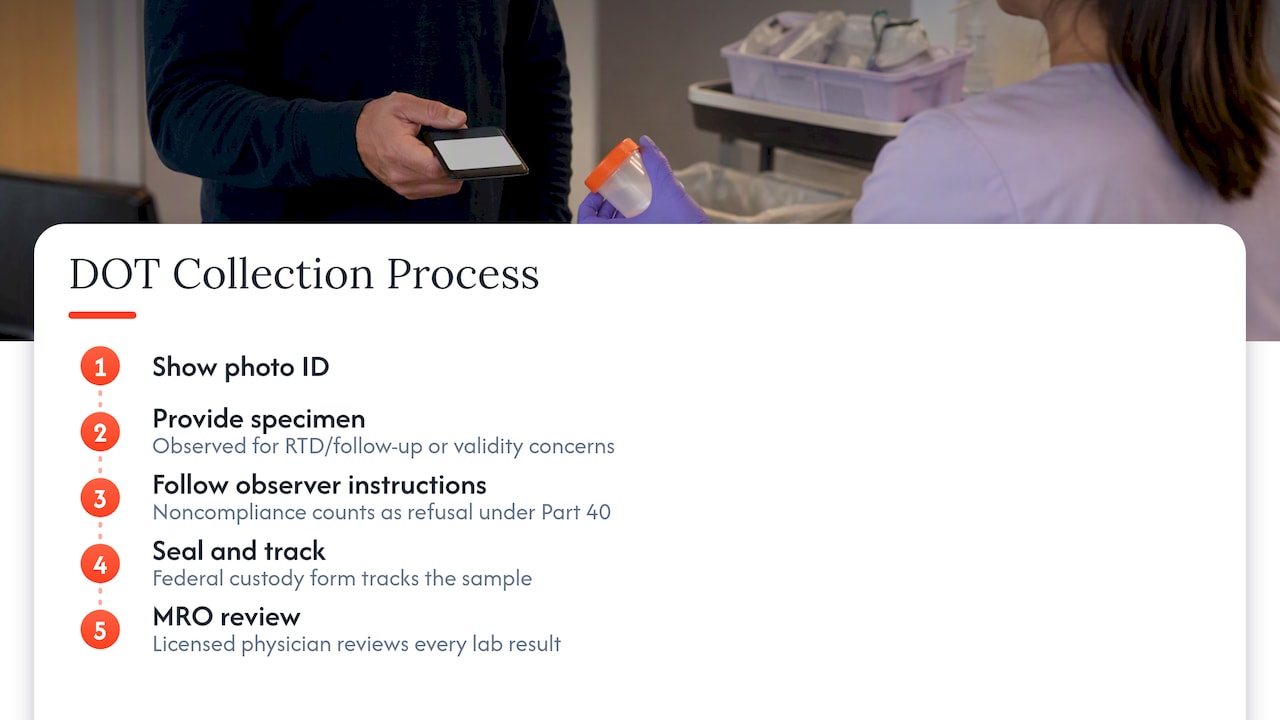
DOT collections are tightly scripted. You show photo ID, you provide a specimen under a defined procedure, and the sample is sealed and tracked on a federal custody and control form from the moment it leaves your hands. A Medical Review Officer (MRO), a licensed physician, reviews every lab result before the employer hears about it.
Some collections are directly observed, meaning a same-gender collector watches the specimen leave your body. That happens in specific circumstances such as return-to-duty and follow-up tests, or when there is a reason to doubt the specimen’s validity. Part 40 says that failing to permit observation is a refusal, and the same goes for failing to follow the observer’s instructions to raise and lower your clothing, under § 40.191.
This matters for anyone tempted by shortcuts. A collection in which someone is watching, with a temperature check on the specimen and a sealed chain of custody, is built to stop substitution. If you want a deeper look at how ordinary employer screens differ, see our guide to pre-employment drug testing.
Refusals count as positives
The FTA handbook is blunt: a failure to show up, interfering with the process, or refusing to test is treated as seriously as a positive result. The refusal list in § 40.191 includes:
- failing to appear for a test within a reasonable time after being directed to
- leaving the site before the process is complete
- failing to permit observation or monitoring when required
- not following the observer’s instructions
The pre-employment case has a narrow exception: an applicant who leaves before the testing process begins is not deemed to have refused. Do not treat that as an invitation to walk out once things have started.
Submitting an adulterated or substituted specimen is also a refusal under Part 40. We do not sell, and would not recommend, anything for use at a DOT collection.
State laws, medical cards and CBD do not help
This is where the most expensive mistakes happen.
State legalization. Marijuana remains a Schedule I controlled substance under federal law, per FMCSA’s Clearinghouse update from ODAPC. DOT rules continue to prohibit its use by safety-sensitive employees regardless of what your state allows.
Medical marijuana. FMCSA has reminded employers and drivers that Part 40 does not authorize Schedule I drugs for any reason, and a physician’s recommendation is not a legitimate medical explanation. An MRO cannot accept it.
CBD. The DOT requires testing for marijuana, not CBD, and warns that CBD labels can be misleading because products may contain THC. Using CBD is not a valid medical explanation for a positive result.
If you drive for a living and use CBD, the safest reading of that guidance is that you carry the risk of what is in the bottle.
The MRO interview, and why a home test will not rescue you
When the lab reports a non-negative result, the MRO contacts you before anything goes to your employer. According to the FTA handbook, this interview is where you can offer a legitimate medical explanation, such as a valid prescription for an opioid. It is not a place to argue that marijuana should be legal or that the procedure was unfair.
A negative result from a drugstore kit or private lab does not overturn a DOT-verified positive either. Part 40 keeps the DOT process separate from any other testing. Home kits are useful for personal awareness, but they are not part of the DOT chain.
After a positive or a refusal
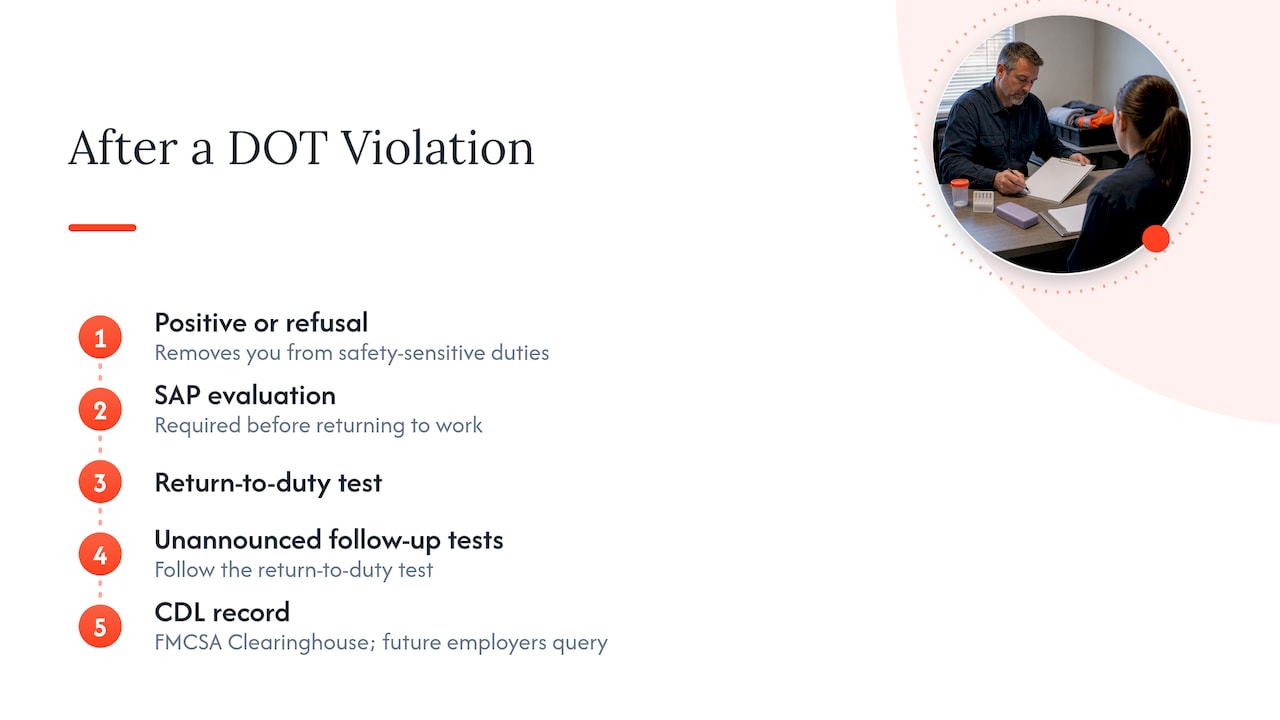
A verified positive or a refusal removes you from safety-sensitive duties immediately. Before you can go back, DOT rules require an evaluation by a substance abuse professional, a return-to-duty test and then a program of unannounced follow-up tests. Your employer should hand you a list of SAP resources. For CDL holders, violations are also recorded in the FMCSA Clearinghouse, which future employers query.
If you are in this position, talk to a substance abuse professional first. They guide the next steps; a retailer or a forum does not.
Our perspective: DOT testing is not the test we help with
We run an online store and guide for people who face drug screens, so we see a lot of questions that start with a DOT test and end up somewhere else. Our honest view is this.
A DOT test is the most controlled screen in the country. Observed collections, federal custody forms, an MRO and a certified lab leave very little room, and the penalty for a refusal is severe. That is why we do not pitch any product as a way past one, and why we would tell a CDL holder that the only dependable approach is time without marijuana.
Where we can help is the much larger set of screens that are not DOT tests: private employer urine tests, saliva tests, hair tests, and testing for legal or personal reasons. Knowing the rules above also helps there, because the same five-panel logic, the same THC metabolites and the same cutoff thinking shape how those tests read. Learn which specimen you will give, how long your own use window might be, and read the employer’s written policy before you decide anything.
— MIchael
If your test is not a DOT test
Many employers that are not DOT-regulated still screen with panels similar to the DOT’s five. If that is you, start by finding out the specimen type: urine, saliva or hair. Each has its own detection window and its own preparation questions. Our employee drug testing overview explains how employer programs usually work.
We stock urine, saliva and hair drug testing products for non-DOT situations, with US shipping and phone support during published business hours. Browse the urine drug testing category or the saliva drug testing category to compare what is available. Our products are for personal and non-DOT screening only, not for use at a DOT collection.
FAQ
What does a DOT drug test test for?
It tests for five drug classes: marijuana metabolites, cocaine metabolites, amphetamines and methamphetamines, opioids, and PCP. Under § 40.82, a lab may not test DOT specimens for anything else. Alcohol is tested separately.
What is the DOT cutoff level for marijuana?
For urine, the initial test cutoff is 50 ng/mL and the confirmation cutoff is 15 ng/mL for THCA, per § 40.85. For oral fluid, the cutoffs are 4 ng/mL initial and 2 ng/mL confirmation for THC, per § 40.91.
Can a medical marijuana card or CBD use excuse a positive DOT test?
No. FMCSA states that a physician recommendation for medical marijuana or CBD use is not a legitimate medical explanation. An MRO cannot verify a marijuana positive as negative on that basis.
How long do you have to be clean to pass a DOT drug test?
There is no single number, because detection depends on how often and how heavily you used, among other things. The regulation sets cutoff concentrations, not waiting periods. Our page on marijuana urinalysis detection times shows typical ranges, but only a test can show where you stand.
Is refusing a DOT drug test better than failing it?
No. The FTA handbook says a refusal is treated as seriously as a positive result, and the same return-to-duty process applies.
Sources
- 49 CFR Part 40, eCFR
- 49 CFR Part 40 Subpart I, Problems in Drug Tests (§ 40.191)
- § 40.82, What drugs do laboratories test for?
- § 40.85, Cutoff concentrations for urine drug tests
- § 40.91, Cutoff concentrations for oral fluid drug tests
- FMCSA: Overview of Drug and Alcohol Rules
- FMCSA: What Substances Are Tested?
- FMCSA: When does testing occur and what tests are required?
- FMCSA Clearinghouse: CBD use reminder
- FMCSA Clearinghouse: ODAPC update
- FMCSA CSA: What’s New
- FTA: What Employees Need to Know About DOT Drug & Alcohol Testing