
THC Detection Times: Test-by-Test Windows and What Affects Them
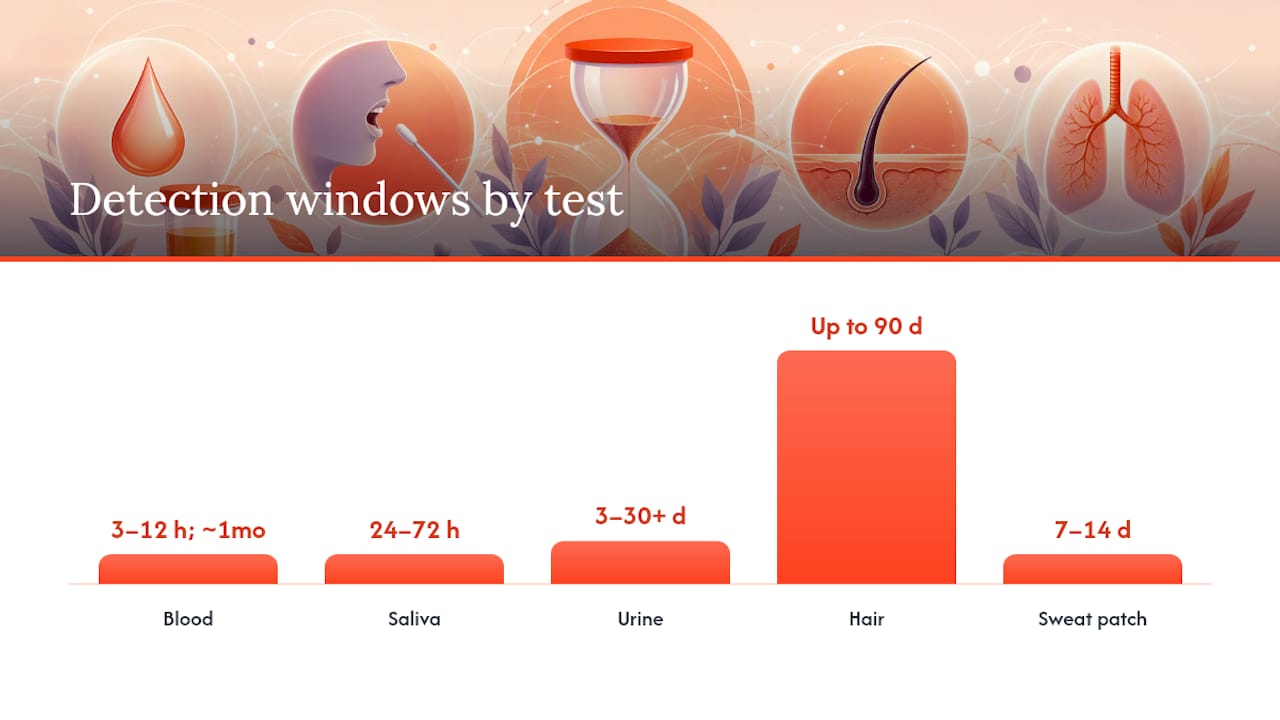
THC detection times vary widely depending on which test is used: blood and saliva clear within hours to a few days, urine can stay positive for days to several weeks, and hair holds evidence for up to 90 days. Those ranges are not fixed. Lab cutoffs, how often you use, and your body composition all shift the window in ways that matter.
Common U.S. lab cutoffs you’ll encounter:
- Urine screen (immunoassay): 50 ng/mL (SAMHSA standard)
- Urine confirmation (GC–MS / LC–MS/MS): 15 ng/mL total THC-COOH
- Blood: no single federal standard; typically reported at 1–2 ng/mL in forensic contexts
- Oral fluid (SAMHSA proposed): 4 ng/mL screen, 2 ng/mL confirmation
- Hair: 1 pg/mg (SAMHSA proposed)
- WADA decision limit: higher than most workplace urine thresholds
The single most important thing to understand: a positive urine result tells you metabolites were present above a cutoff. It does not tell you when someone last used, or whether they were impaired. The ACMT position statement makes this explicit, and it changes how every number in this article should be read.
Key Takeaways
THC-COOH detection in urine can persist for 30 days or more in chronic users, and the 50 ng/mL screen cutoff and 15 ng/mL confirmation cutoff are not the same threshold.
| Point | Details |
|---|---|
| Detection windows vary by test | Blood clears in hours to days; urine lasts days to 30+ days; hair covers up to 90 days. |
| Chronic users face longer windows | Blood THC was detectable up to ~1 month in some chronic users in controlled abstinence research. |
| Cutoffs determine the result | A 50 ng/mL screen and a 15 ng/mL confirmation cutoff produce different outcomes from the same sample. |
| Positive ≠ recent use or impairment | ACMT states a positive urine result does not prove recent use; fat storage prolongs excretion. |
| Passmydrugtest | Offers at-home test kits and detox products to help you prepare; test yourself before the official screen. |
Table of Contents
- How long does THC stay in your system by test type?
- How your body processes and stores THC
- What factors actually change your THC detection window?
- How screening and confirmation tests differ, and why cutoffs matter
- What to expect based on your usage pattern
- What actually works for detox, and what doesn’t
- Why a positive test doesn’t prove recent use or impairment
- Sources
How long does THC stay in your system by test type?
Each test measures something different, which is why the detection windows vary so dramatically. Here is what each one actually looks for, the typical windows U.S. labs use, and the cutoffs that determine a “positive.”
What each test measures
Blood detects parent THC and its active metabolite 11-OH-THC. Both are short-lived in circulation. THC peaks in blood within minutes of smoking, then drops sharply as it redistributes into fat tissue. For occasional users, blood THC typically clears within 3–12 hours. The catch: a controlled abstinence study found THC and THC-COOH still detectable in blood up to approximately one month in some chronic users, with a median last-detection time for THC around 22 days. Blood testing is most common in roadside DUI investigations and post-accident workplace testing, where recency of use is the question.
Saliva (oral fluid) captures parent THC deposited in the mouth during smoking or vaping. It reflects very recent use, typically within 24–72 hours for most users, though WebMD’s summary notes the window can extend slightly in heavy users. Roadside oral fluid testing is growing in several U.S. states precisely because it correlates better with recent consumption than urine.
Urine is the dominant workplace test in the U.S. It does not detect parent THC. It detects THC-COOH (11-nor-9-carboxy-THC), the inactive metabolite produced after the liver processes THC. THC-COOH is lipophilic and accumulates in fat, then slowly releases back into urine over days or weeks. That slow release is why urine detection windows stretch so far beyond the period of actual intoxication.
Hair incorporates metabolites into the hair shaft as it grows. A standard 1.5-inch sample covers roughly 90 days of history. Detection does not appear immediately after use; metabolites take about 7–10 days to show up in the growing portion of the hair. Hair testing is common in pre-employment and court-ordered contexts where long-term use history matters more than recent exposure.
Sweat patches are used in probation and drug court monitoring. They accumulate THC and metabolites over the wear period (typically 7–14 days), making them a cumulative measure rather than a point-in-time snapshot.
Detection windows and U.S. cutoffs at a glance
| Test | Typical detection window | Common U.S. screen cutoff | Confirmation cutoff |
|---|---|---|---|
| Blood | 3–12 hours (occasional); up to ~1 month (chronic) | 1–2 ng/mL (forensic) | 1 ng/mL |
| Saliva | 24–72 hours | 4 ng/mL (SAMHSA proposed) | 2 ng/mL |
| Urine | 3–30+ days | 50 ng/mL (immunoassay) | 15 ng/mL (THC-COOH) |
| Hair | Up to 90 days | 1 pg/mg (SAMHSA proposed) | 1 pg/mg |
| Sweat patch | Duration of wear (7–14 days) | 4 ng/mL | 2 ng/mL |
The gap between the 50 ng/mL screen and the 15 ng/mL confirmation cutoff is operationally significant. A sample that screens negative at 50 ng/mL could still contain THC-COOH above 15 ng/mL, which is why confirmation testing exists and why WADA’s decision limits differ from standard workplace thresholds. Low oral doses of 1–5 mg can sometimes push urine THC-COOH above the 15 ng/mL workplace confirmation cutoff, a fact that surprises many people who assume edibles are “safer” for testing purposes.
Pro Tip: Employers and courts typically default to urine because it’s cheap, non-invasive, and has decades of established cutoffs. Blood is reserved for situations where recency matters legally (DUI, post-accident). Hair is used when the question is long-term use history, not yesterday’s session. Knowing which test you’re facing changes everything about how you interpret your timeline.
How your body processes and stores THC
THC is lipophilic. That single fact explains most of what makes cannabis detection so different from alcohol or most other drugs.
When you smoke or vape, THC enters the bloodstream within seconds, peaks quickly, and then redistributes out of blood into fat tissue and organs. The liver converts THC into two key metabolites: 11-OH-THC (active, psychoactive) and THC-COOH (inactive, the primary urinary metabolite). For edibles, the route is different. THC passes through the gut and liver before reaching systemic circulation, a process called first-pass metabolism. This produces higher ratios of 11-OH-THC relative to parent THC and delays the onset, but it also means metabolite production is prolonged compared to inhalation.
Key metabolic steps:
- Inhalation: THC reaches blood in seconds; 11-OH-THC and THC-COOH form rapidly in the liver
- Oral ingestion: slower absorption, higher first-pass conversion to 11-OH-THC, delayed but extended metabolite production
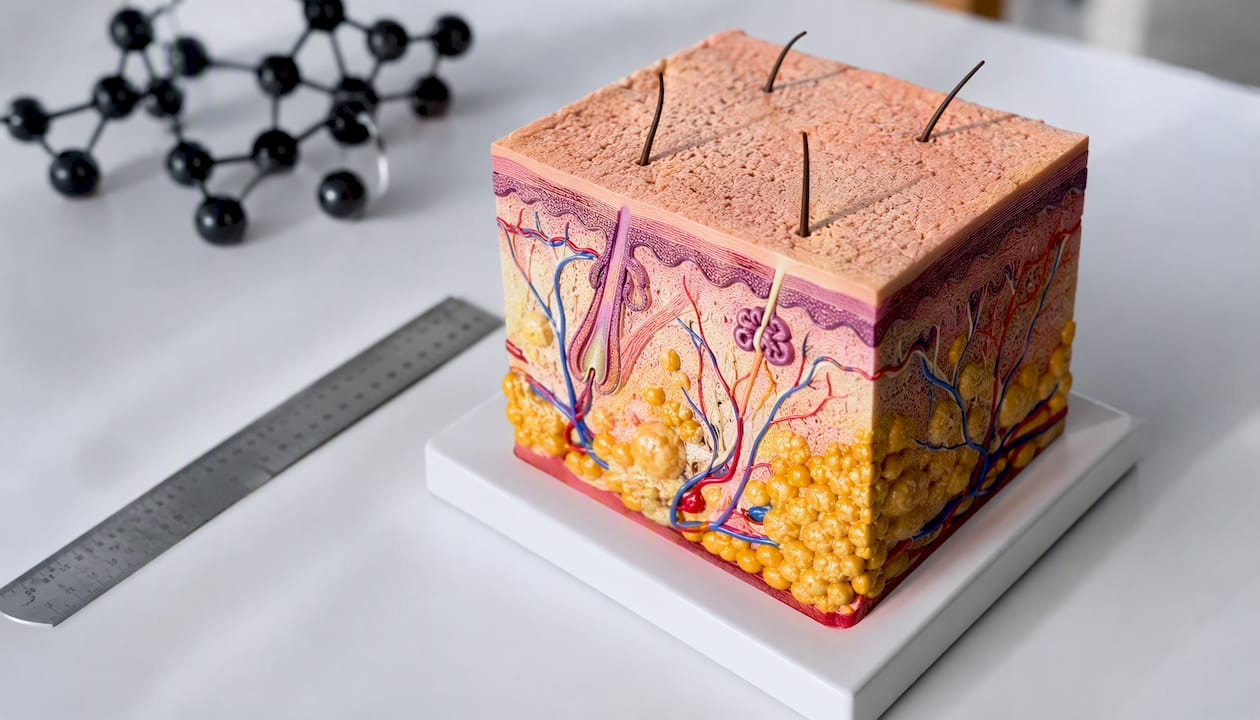
- Fat storage: THC-COOH accumulates in adipose tissue and releases slowly back into blood, then filters into urine
- Excretion: roughly 65% of THC metabolites leave the body in feces; about 20% exit via urine as THC-COOH conjugates
The fat-storage mechanism is why urine detection windows for heavy users are so much longer than for occasional users. Someone with higher body fat percentage carries a larger metabolite reservoir, and that reservoir drains slowly. Metabolism speed, influenced by age, genetics, and liver enzyme activity (primarily CYP2C9 and CYP3A4), also affects how quickly THC-COOH is produced and cleared.
The practical implication: THC-COOH in urine is not a clock. It’s a reservoir reading. The same concentration on day 10 after last use could mean very different things for a 150-pound occasional user versus a 250-pound daily user. This is why the ACMT cautions against treating a positive urine result as evidence of recent use without additional context.
For a deeper look at how marijuana detection in drug testing works across different methods, Passmydrugtest has a dedicated resource that covers the mechanics in more detail.
What factors actually change your THC detection window?
Frequency and recency of use drive the detection window more than any other single variable. Everything else modifies the baseline those two factors set.
Ranked by influence on urine detection time:
- Frequency of use — the dominant factor. Daily users build up a fat-stored metabolite load that takes weeks to clear. A single use clears in days.
- Dose and potency — higher THC content per session means more metabolite production and a longer excretion tail
- Body fat percentage / BMI — more adipose tissue means a larger metabolite reservoir and slower clearance
- Metabolism rate — age, genetics, and liver health all affect how fast THC-COOH is produced and excreted
- Route of administration — edibles produce more prolonged metabolite excretion than inhalation for equivalent doses
- Hydration and urine concentration — affects the measured concentration in a given sample, not the total metabolite load
To put the frequency factor in concrete terms: a single smoking session typically produces detectable urine THC-COOH for 3–4 days in most people. Weekly use extends that to roughly 5–7 days after the last session. Daily use for several months can leave detectable metabolites for 30 days or more after the last use, and in some chronic heavy users, even longer.
Pro Tip: Labs don’t just measure concentration. They also check creatinine levels to assess urine dilution. Drinking large amounts of water before a test lowers the THC-COOH reading, but it also lowers creatinine, which flags the sample as dilute. A dilute result often triggers a retest or is treated as a non-negative result in some workplace programs. Dilution is not a reliable strategy.
How screening and confirmation tests differ, and why cutoffs matter
Screening tests and confirmation tests are not the same thing, and the difference between them directly affects whether a result is reported as positive.
Immunoassay screening is the first step. It’s fast, inexpensive, and designed to catch positives at a set threshold (50 ng/mL for urine in most U.S. workplace programs). Immunoassays are not specific to THC-COOH alone; they can cross-react with related compounds, which is why a positive screen is not a confirmed positive.
Confirmation testing uses gas chromatography–mass spectrometry (GC–MS) or liquid chromatography–tandem mass spectrometry (LC–MS/MS). These methods identify and quantify specific metabolites. The confirmation cutoff for urine is typically 15 ng/mL total THC-COOH. A sample that screens positive at 50 ng/mL but confirms below 15 ng/mL is reported as negative.
Common U.S. cutoffs by context:
- SAMHSA federal workplace urine screen: 50 ng/mL
- SAMHSA federal workplace urine confirmation: 15 ng/mL THC-COOH
- WADA anti-doping urine decision limit: higher than the 15 ng/mL workplace threshold
- Oral fluid screen (SAMHSA proposed): 4 ng/mL
- Hair (SAMHSA proposed): 1 pg/mg
The URMC cannabinoid testing guide is direct on one point that often gets overlooked: urine tests cannot specify the exact day or hour of last use. A concentration above the cutoff tells you metabolites were present. It tells you nothing about when the person last consumed cannabis.
A 2026 systematic review of urinary THC and metabolite concentrations found that the 15 ng/mL workplace cutoff can be exceeded by low oral doses and that weekly to daily users may remain above that threshold for weeks after stopping. That finding matters because it means even people who stopped using days before a test may still confirm positive if they were regular users.
Mayo Clinic Laboratories notes that traditional lab testing often fails to distinguish new from residual cannabis use. Serial creatinine-normalized urine ratios from two specimens collected days apart can help identify whether a new use event occurred between them. This approach is used in drug court and probation monitoring, not in standard pre-employment screening.
What to expect based on your usage pattern
These are ranges, not guarantees. Individual variation is real, and the factors covered above all shift these windows.
A few practical notes on these ranges:
- The single-use urine window assumes a standard 50 ng/mL screen. At the 15 ng/mL confirmation cutoff, that same session could remain detectable for 5–6 days.
- Hair detection for a single use is genuinely uncertain. One session may or may not deposit enough metabolite in the hair shaft to exceed the 1 pg/mg cutoff, and the segment containing that use won’t even be testable for 7–10 days after exposure.
- Blood detection in chronic users is longer than most people expect. The controlled abstinence study found a median last-detection time of around 22 days for THC in blood among chronic users, with some individuals testing positive at nearly one month.
For detailed information on hair drug test detection times, Passmydrugtest covers the specific mechanics of how metabolites incorporate into hair and what that means for your timeline.
What actually works for detox, and what doesn’t
Most popular detox tactics do not change how fast your body excretes THC-COOH. They may change the concentration in a single sample. That’s a meaningful difference.
Common claims and the evidence:
- Extreme hydration / water loading: Lowers urine concentration temporarily. Labs check creatinine; a creatinine below 2 mg/dL flags the sample as substituted, and below 20 mg/dL flags it as dilute. Neither outcome is a clean negative.
- Cranberry juice: No published evidence it accelerates THC-COOH excretion. Functions as a diluent at best.
- Niacin (high-dose): Circulates as a detox myth. High doses carry real toxicity risk (flushing, liver stress). No controlled evidence it clears THC-COOH faster.
- Vinegar / acidic drinks: No mechanism for altering renal THC-COOH excretion. Not supported by evidence.
- Saunas / exercise: Theoretically, burning fat could temporarily mobilize stored THC-COOH back into circulation and increase urine concentrations in the short term before they clear. Not a reliable strategy before a test.
- Commercial detox drinks: Some products work by dilution and creatinine masking. Effectiveness varies. Labs increasingly flag samples with abnormal specific gravity or creatinine.
- Synthetic urine: Substituting a sample is a different category entirely. It carries legal risk in many U.S. states and federal testing programs. Laboratories test for temperature, pH, creatinine, and specific gravity; modern labs also screen for common adulterants.
The only reliable strategy is time and abstinence. The ACMT is clear that dilution rarely converts a chronically positive THC-COOH excretion pattern into a reliably negative result. Labs flag dilute and substituted samples routinely.
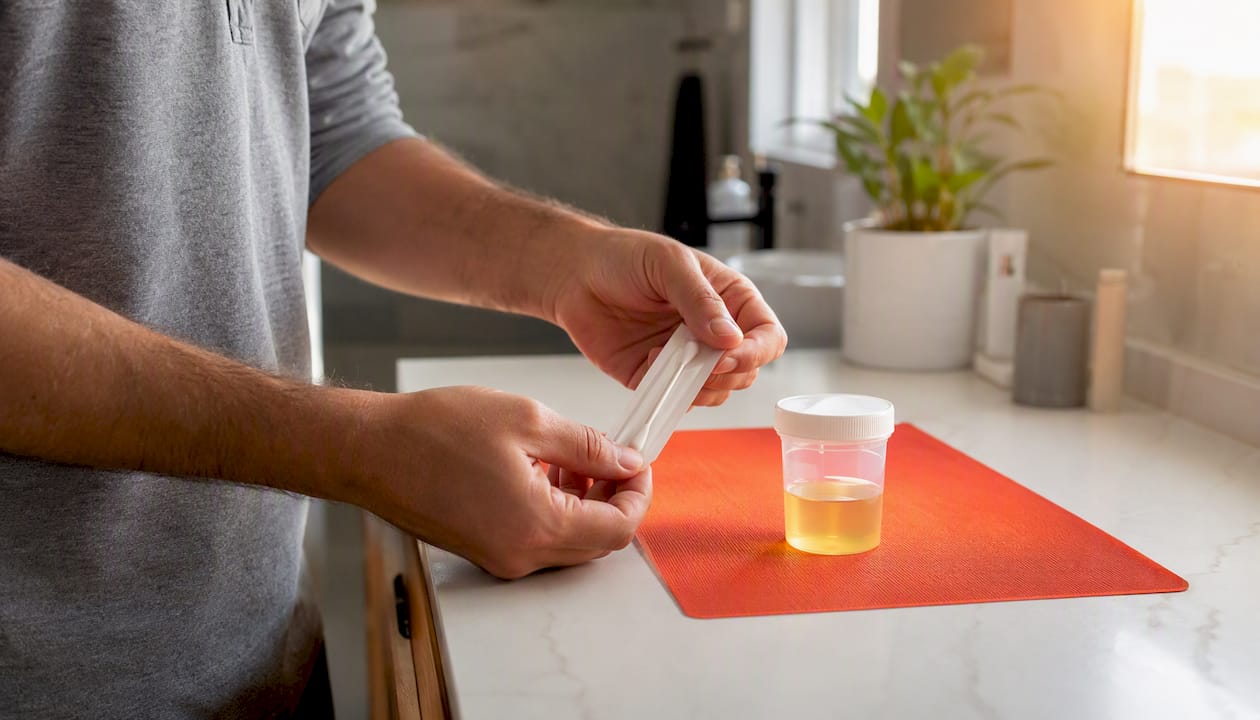
Pro Tip: The smartest move before a high-stakes test is to test yourself first. An at-home marijuana test kit uses the same 50 ng/mL immunoassay cutoff as most workplace screens. If you’re still positive at home, you’ll be positive at the lab. That information is worth having before the official test, not after.
For a frank look at home remedies and what they actually do, Passmydrugtest covers the evidence on common approaches alongside product options.
Why a positive test doesn’t prove recent use or impairment
This is the most legally consequential point in the entire article, and it’s the one most often misunderstood by employers, courts, and the people being tested.
THC-COOH has a long half-life in fat tissue. It is not psychoactive. Its presence in urine tells you that THC was consumed at some point before the sample was collected. It does not tell you whether the person was impaired at the time of the test, at the time of the incident in question, or even within the last 24 hours.
The controlled abstinence study found THC detectable in blood up to approximately one month in some chronic users after their last use. That means a blood test positive for THC in a chronic user does not necessarily mean they used that day.
Multiple positive urine results over days or weeks in a chronic user do not automatically indicate new use. Mayo Clinic Laboratories specifically addresses this: without creatinine-normalized serial ratios, a lab cannot reliably distinguish ongoing excretion of old metabolites from a new use event. Courts and drug monitoring programs that treat every positive as a new violation without this analysis are working with incomplete information.
The ACMT position statement states directly that a positive urine assay result does not necessarily indicate recent use. Chronic heavy users may have detectable THC-COOH for a month or longer due to fat storage. ACMT recommends cautious interpretation in high-stakes settings.
If you’re facing employment consequences, a custody dispute, or a probation violation based on a positive cannabis test, the practical steps are: document your abstinence timeline, request confirmation testing if only a screen was run, ask whether creatinine-normalized serial testing was used, and consult a lawyer before responding to any formal action. These are not just defensive moves. They reflect what the science actually supports.
For context on random drug test scenarios and how employers typically handle them, Passmydrugtest has a dedicated resource on workplace testing protocols.
What this article gets right that most guides miss
Most articles on THC detection times give you a table of ranges and call it done. The ranges are real, but presenting them without the cutoff context is how people get blindsided.
The 50 ng/mL screen cutoff and the 15 ng/mL confirmation cutoff are not interchangeable. A person who tests negative on a home screen at 50 ng/mL could still confirm positive at a lab running 15 ng/mL confirmation. That gap is not a technicality. It’s the difference between passing and failing a pre-employment test.
The other thing most guides underplay: the detection window for chronic users is genuinely long, and the science backs that up. The controlled abstinence data showing blood THC detectable at nearly one month is not an outlier finding. It reflects the pharmacology of a lipophilic compound stored in fat. Treating a 30-day urine window as a worst-case edge case, rather than a realistic expectation for daily users, sets people up for failed tests they didn’t see coming.
The framing here relies on ACMT guidance, peer-reviewed detection-window studies, and published lab cutoffs because those are the sources that hold up in court and in clinical practice. Consumer-facing articles that cite ranges without cutoffs, or that imply detox products reliably clear metabolites, are not giving you the full picture.
Passmydrugtest has product options worth knowing about
If you’ve read this far, you know that time and abstinence are the only reliable long-term strategies. But there are practical tools that can help you prepare more intelligently.
Passmydrugtest carries detox products for passing a drug test including detox drinks, cleanse kits, and preparation supplements, alongside at-home marijuana test kits that use the same 50 ng/mL cutoff as most U.S. workplace screens. Testing yourself before the official test is the most practical thing you can do with the information in this article. Fast shipping is available on U.S. orders, and phone support is available during published business hours. No product eliminates metabolites that your body hasn’t cleared yet. These tools work best as part of a preparation strategy, not a substitute for one. This is general information, not medical or legal advice. For high-stakes situations, confirm results with a certified lab and follow your employer’s or court’s instructions.
Sources
- ACMT position statement: Interpretation of urine for tetrahydrocannabinol metabolites
- Cannabinoid screen and confirmation (urine) — URMC
- How long does weed stay in your system? — WebMD
- Marijuana — Mayo Clinic Laboratories