
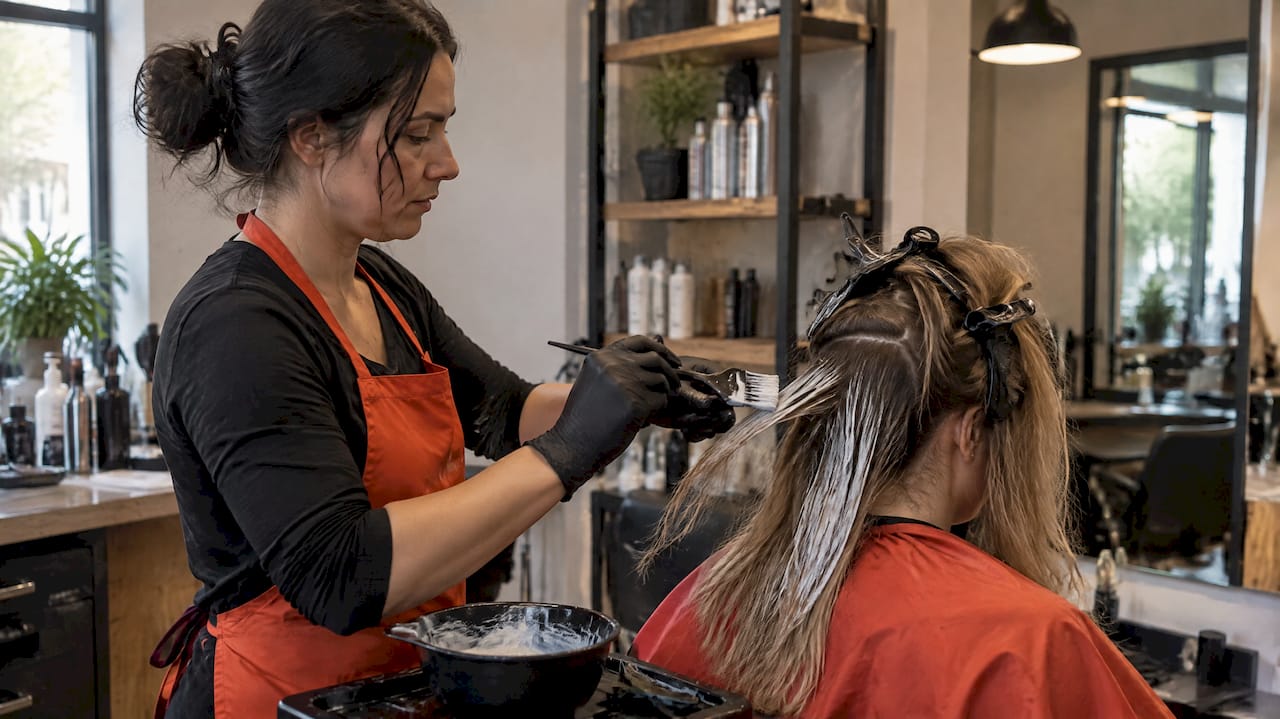
Hair Bleaching and Drug Tests: What Actually Happens
Bleaching can lower the amount of THC a lab finds in a hair sample, but it does not reliably produce a negative result, and it can create new problems of its own. Forensic studies show reductions that vary widely from person to person. Some bleached samples still test positive, some metabolites can behave in unexpected ways, and a sample damaged enough may be rejected or flagged for review. If you are weighing bleach against a hair follicle test, this guide walks through the evidence so you can decide with your eyes open.
TL;DR
- Bleach can reduce THC in hair, with forensic research reporting reductions often in the range of 30 to 60 percent. It is not a clearance method, and drug levels frequently stay detectable.
- Results are unpredictable. Studies on bleaching hair in a lab overstate what happens on a real head.
- Labs wash samples before testing, and newer biomarkers can flag oxidative hair treatments for closer review.
- Badly damaged hair can be reported as untestable, which an employer or court may treat as a failed or invalid test.
- Hair covers roughly 90 days, so the best plan starts with knowing your timeline and which test you are actually facing.
Table of Contents
- How a hair test finds THC in the first place
- What bleaching does to THC in hair
- What the lab does with your hair
- Bleach, dye and other treatments compared
- Does a bleached head change the odds for your situation?
- Perspective: what we see at Pass My Drug Test
- Questions to settle before you touch the bleach
- Shampoos, kits and what we offer for hair tests
- A realistic plan if you have a hair test coming
- FAQ
- Sources
How a hair test finds THC in the first place
A hair test does not look at what is on the surface of your hair. It looks for drug compounds that entered the hair as it grew. According to a 2025 review in the Journal of Applied Laboratory Medicine, drugs can enter hair by diffusion from the bloodstream, through sweat or sebum bathing the hair, or through external contamination. Because they become part of the strand, they stay there as the hair grows out.
That is why the test reaches so far back. Standard hair tests cover about 90 days of use, according to the Brassets Group FAQ and the research summarized for this article. Compare that with urine, where drugs are generally detectable for days. If you want the full timeline, our guide to hair drug test detection times breaks it down by substance, and the hair drug test window article explains how the 90 days are counted.
A typical collection takes around 100 to 120 strands cut close to the scalp, according to USA Mobile Drug Testing. The lab then analyzes the segment nearest the scalp, which represents the most recent months.
Two details matter for the bleaching question:
- The drug is inside the hair shaft, not just coating it.
- Labs wash the sample before analysis to remove outside contamination.
Bleach works on the first point by chemically attacking the hair structure. The lab’s wash protocol works on the second. Neither side of that story is simple.
What bleaching does to THC in hair
Bleach is an oxidizer. It breaks down pigment, and it also damages the cuticle and the inner structure that holds drug molecules. Research on this is consistent about the direction of the effect.
A study that tested bleaching, perming and permanent coloring on cannabinoids in hair found that bleaching and perming reduced cannabinoid concentrations, with THC affected more than THC-COOH, CBN and CBD. It described bleaching as causing strong chemical degradation of cannabinoids, while perming mostly leached them out. Single applications of permanent color had only a small effect.
Forensic work summarized in the research for this article puts typical reductions from bleaching at about 30 to 60 percent, depending on how harsh the treatment is and on the person’s hair. The Drug Testing and Analysis paper on coloured hair makes the practical point: a reduction is not the same as a clean result, and significant concentrations often remain detectable, particularly in frequent users.
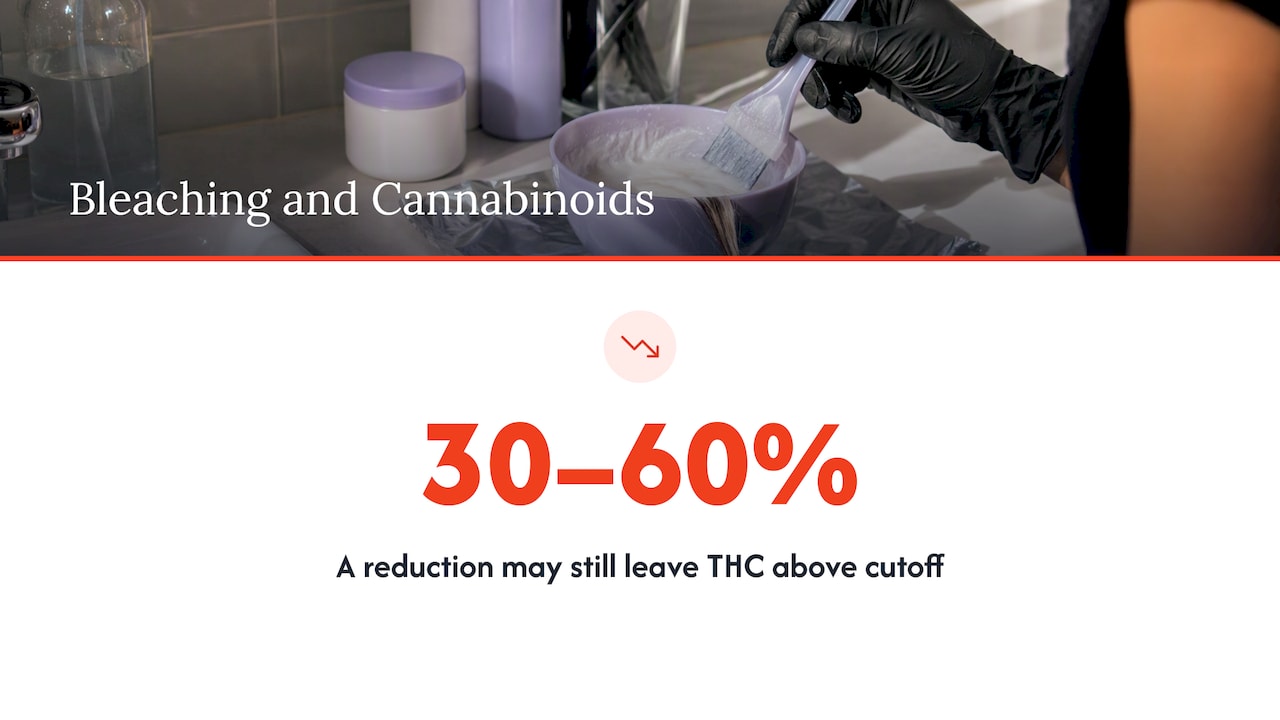
Think about what that means in numbers. If your hair carries a level well above the cutoff, a 40 percent drop may leave it above the cutoff. If you were borderline, the same drop could matter. You cannot know which situation you are in before the test, and the lab does not tell you where you fall.
Why lab results do not match what you read online
Many online claims about bleaching come from experiments where hair was soaked in bleach in a dish. That is called an in vitro setup. Hair on a living head is different. It grows continuously, receives drugs through blood, sweat and sebum, and is exposed to products for a shorter and less controlled time than a lab soak.
The result is that real-world outcomes are far less predictable than the most dramatic published numbers. A guide promising near-total removal is leaning on the best case. The study on manipulating THC hair concentrations with commercial products set out to clarify whether and how far results can be changed with products. The wider body of work shows that outcomes are highly variable, and some samples stay positive even after intense treatment.
The metabolite surprise
Here is the part most guides skip. Labs confirming cannabis use in hair commonly look at THC and at THC-COOH, a metabolite. The 2025 Journal of Applied Laboratory Medicine review describes how metabolite levels such as THC-COOH can behave differently from parent THC in treated hair. In some cases they have been observed to rise, possibly through formation during oxidation or through release from damaged keratin.
The practical takeaway is not that bleach always makes things worse. It is that bleach does not behave like an eraser. It changes the chemistry, and the change is not guaranteed to move every marker in the direction you want.
What the lab does with your hair
Before analysis, laboratories wash the sample. One lab’s published FAQ describes a wash of about 3 hours and 45 minutes, and says cosmetic bleaching and dyeing do not affect the integrity of results, per the Brassets Group FAQ. That is one provider’s position, but it reflects a wider industry view: cosmetics are a known variable that labs plan for.
The wash is designed to remove external contamination. It does not strip out what is inside the shaft. That is also why the washing step cuts both ways for people hoping to change a result with surface treatments. Anything sitting on the outside gets removed, and anything inside stays.
Flags, biomarkers and damaged samples
Labs have a growing toolkit. A 2023 review on testing for sample manipulation in hair discusses how toxicologists are developing better markers, such as PTCA, to identify hair that has been chemically treated with oxidizers. Their reasoning is simple: it is analytically very hard to tell a deliberate attempt to beat a test from ordinary cosmetic treatment, so the goal is to flag affected samples for further review instead of ignoring the treatment.
The same review and the research behind this article point to a second risk. If the hair is so damaged that it cannot be tested reliably, the lab may report it as untestable. Depending on the program, that can count as a failed or invalid test, or trigger a re-collection under closer supervision. In a pre-employment setting you may not get a friendly explanation. In a family court or probation setting, a flagged or rejected sample can look worse than a plain positive.
Experts also recommend that abstinence programs combine hair testing with urine analysis, particularly for THC, because cosmetic treatments can lower hair results, per the Drug Testing and Analysis paper. So if your situation involves a monitoring program, a second sample type may be on the table.
Bleach, dye and other treatments compared
Not all hair treatments are equal. This table summarizes what the cited research found for THC in hair. Findings describe study samples, not guarantees for you.
| Treatment | What the research found | Main risk for you |
|---|---|---|
| Bleaching | Reduces THC, often more than THC-COOH; strong chemical degradation | Unpredictable result; hair damage; possible flag for oxidative treatment |
| Perming | Reduces cannabinoids, mostly by leaching out | Damage and a still-positive result |
| Single permanent dye | Only a little effect on cannabinoids | Little benefit |
| Lab-style washing only | Removes surface contamination, not drug inside the shaft | Does not address internal drug |
The 2026 study on permanent dye color and drug levels in chemically treated hair was published in the context of family law cases and underlines why laboratories care about this. It recognizes that chemical treatments can alter results in forensic testing.
Does a bleached head change the odds for your situation?
It depends on who is testing you and why.
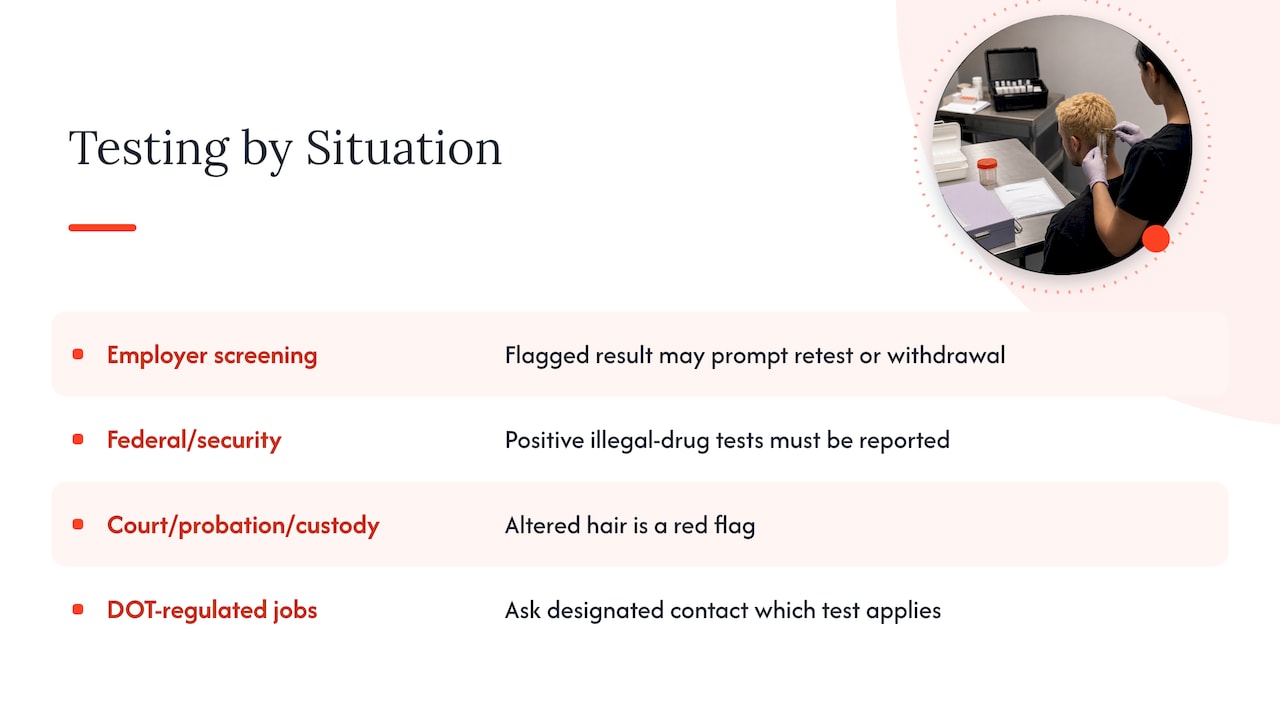
Employer pre-employment screening. Many employers use urine, and some use hair. If your employer uses hair, you will usually be told when and where to give the sample. A flagged or untestable result may lead to a retest or a withdrawn offer. Policies vary by company and by industry.
Federal and security-related employers. Marijuana remains illegal under federal law, whatever your state allows. Lockheed Martin, for example, states on its employee reporting page that testing positive for an illegal drug must be reported, and marijuana is included. A security-clearance form from the company also says unlawful marijuana use can be a basis for ineligibility for special access, per its additional documents and instructions. Employee comments on Indeed mention urinalysis at hire, but those are anecdotal and dated 2016, so ask the recruiter which test applies to you.
Court, probation or child custody. These programs often value hair for its long window, and they sometimes pair it with other tests. Altered hair is a red flag in this setting. If you are in a legal matter, talk to your attorney before changing your hair or buying anything.
DOT-regulated jobs. If your job falls under federal transportation rules, check the rules for your role and ask your employer’s designated program contact which test applies. Do not guess.
Perspective: what we see at Pass My Drug Test
We sell test preparation products, and we still tell people the same thing: do not treat bleach as a plan. The science says it moves numbers around, not to zero. A person who bleaches expecting a guaranteed clean result is betting on the middle of a wide range of outcomes, with the added risk of a damaged, flagged sample.
What we try to do on the site is help people match the product to the test. Many people who contact us are not even sure which test they will face. That is the first question to answer, because a hair test, a urine test and a saliva test call for very different preparation. Our phone support during published business hours exists for that conversation, and our education pages exist so you can read before you buy.
Our honest view is that the lowest-risk approach is knowing your window. Hair reflects about three months. If you have used recently, no cosmetic shortcut changes that history cleanly. If your test is urine or saliva, hair bleaching does nothing at all, and you would be damaging your hair for no reason. Read our own take on the topic in Bleaching Hair Cuts Drug Levels but Labs May Flag Tests.
— MIchael
Questions to settle before you touch the bleach
Work through these in order.
- What test is it? Ask the employer or program in writing if you can. Hair, urine and saliva are different problems.
- What is your actual timeline? If your test is a hair test, the window is about 90 days. See the hair follicle drug test overview for how samples are collected.
- How much hair is there? The sample comes from near the scalp, so the newest growth is what counts.
- What happens if the sample is rejected? Ask whether a retest is allowed and what a flagged sample means for your job or case.
- What would a bad hair result cost you? If the stakes are high, the uncertainty of bleach is a real cost.
For anything legal, speak to an attorney. For a workplace issue, the company’s HR or medical review officer can tell you what happens after a non-negative result. This article is not legal advice.
Shampoos, kits and what we offer for hair tests
If you face a hair test and want to prepare, our hair category covers both at-home testing and hair-focused products. You can check your own situation with an at-home kit from our hair drug testing collection, and browse the hair detox shampoo range, including Zydot Ultra Clean Shampoo. Our guide to hair follicle drug test shampoo explains what shampoos can and cannot do, and the same honesty applies: a wash targets the outside of the hair, not what is inside it.
We ship quickly within the United States, and you can call us during business hours to talk through your scenario. If your test is urine or saliva rather than hair, start at the homepage and pick the category that matches your test.
A realistic plan if you have a hair test coming
Here is the sequence we would follow in your position.
- Confirm the test type and date. Everything depends on it.
- Count your window. If the test is hair, think in months, not days.
- Avoid harsh damage. Heavy bleaching can leave hair brittle, and a rejected sample is not a pass.
- Do not assume cosmetics are invisible. Labs plan for them and are developing better ways to flag them.
- Read before you buy. Compare what a product claims with what independent studies show.
- Ask about alternatives. If the program allows another sample type, it may change your preparation entirely.
FAQ
Does bleaching hair work for a drug test?
Sometimes it lowers the amount of THC found, but it does not reliably produce a negative. Forensic research reports reductions often around 30 to 60 percent, and some samples stay positive after intense treatment. Results vary by person, hair type and how harsh the treatment is.
Can a lab tell if I bleached my hair?
Often it can raise a flag. Researchers are developing biomarkers such as PTCA to identify hair treated with oxidizers, though it is hard to tell deliberate manipulation from routine cosmetic use. A flagged sample may be reviewed further or retested.
Will hair dye affect a drug test?
A single application of permanent color had only a small effect on cannabinoids in the cited cosmetic treatment study. Bleaching and perming had larger effects. Dye is not a dependable way to change a result.
What if my hair is too damaged to test?
The lab may report the sample as untestable. Depending on the employer or program, that can count as a failed or invalid test, or lead to a supervised re-collection. Ask the testing program how it handles that situation before you treat your hair.
Does Lockheed Martin hair test?
We could not confirm that. The company states that a positive test for any illegal drug, marijuana included, must be reported, and employee comments mention urinalysis at hire. Ask your recruiter which test applies to your role.
Sources
- Utility of coloured hair for the detection of drugs and alcohol, Drug Testing and Analysis
- Review on Toxicology Testing in Hair, Journal of Applied Laboratory Medicine
- Manipulation of THC Hair Concentrations by Commercially Available Products, PMC
- Advances in testing for sample manipulation, part B: hair samples, PMC
- Influence of cosmetic hair treatments on cannabinoids in hair, ScienceDirect
- The Effect of Permanent Dye Colour on Illicit Drug and Metabolite Levels in Chemically Treated Hair
- Brassets Group FAQ
- USA Mobile Drug Testing: Hair Follicle Drug Test
- Lockheed Martin: reportable drug test policy
- Lockheed Martin: Additional Documents and Instructions
- Indeed: Lockheed Martin pre-employment drug test question