
Hair Drug Test Window: What to Expect and How Long It Lasts
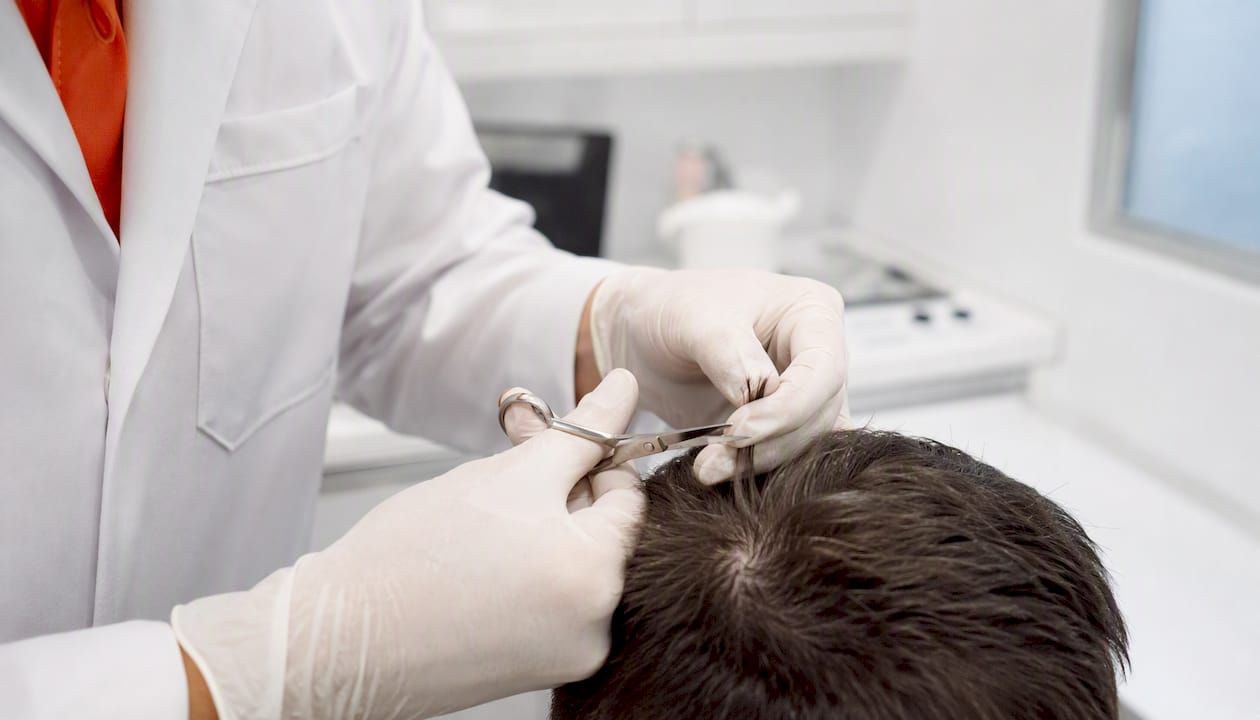
A standard hair follicle drug test covers roughly three months of use history. That’s the number that matters most. The lab takes a 1.5-inch (3.9 cm) segment cut from the root end of your scalp hair. Because head hair grows about 0.5 inches (1.3 cm) per month, that segment maps to approximately three months of exposure.
A few quick facts before you read further:
- Standard window: about three months for a 1.5-inch scalp hair sample
- Body hair exception: Body hair grows in different cycles and can reflect use over a much longer period, potentially many months, though with less precise date mapping
- Earliest detection: Drugs typically become detectable in hair roughly 5–10 days after use, not immediately
- Longer scalp samples: If a lab tests a longer segment, the look-back period extends proportionally
The hair drug test detection period is longer than any other common matrix. Urine typically covers 1–7 days; oral fluid covers as little as 5–48 hours. Hair is the only method built to show patterns of use over months.
Key Takeaways
A standard 1.5-inch scalp hair sample covers approximately 90 days of use history, and that window is shaped by hair growth rate, lab cutoffs, and individual factors that no single number can fully capture.
| Point | Details |
|---|---|
| Standard detection window | A 1.5-inch (3.9 cm) scalp sample covers approximately 90 days of use history. |
| Body hair extends the window | Body hair can reflect use over many months, sometimes up to 12 months, but without precise date mapping. |
| Drugs appear after a delay | Drugs typically become detectable in hair roughly 5–10 days after use, not immediately. |
| Confirmation is required | Positive screens must be confirmed by GC-MS or LC-MS/MS and reviewed by an MRO before a result is final. |
| Passmydrugtest | Offers educational guides and preparation products with honest disclaimers; visit the hair testing information page to research your options. |
Table of Contents
- How the hair drug test window actually forms
- Detection windows by drug class
- How samples are collected and processed in the lab
- What actually changes your detection window
- Common myths about hair testing, and what the evidence actually says
- What to do after you get your hair test result
- Costs and where to get hair testing in the U.S.
- What lab standards and authoritative bodies actually say
- A note on what this site is and what it can tell you
- What Passmydrugtest offers for hair test preparation
- Sources
How the hair drug test window actually forms
Hair follicle testing works by detecting drug metabolites that become permanently embedded in the hair shaft as it grows. When you use a drug, it enters your bloodstream. As the hair follicle produces new hair cells, those cells incorporate drug compounds and metabolites from the surrounding blood supply. Once locked into the shaft, those compounds don’t wash out with ordinary shampooing.
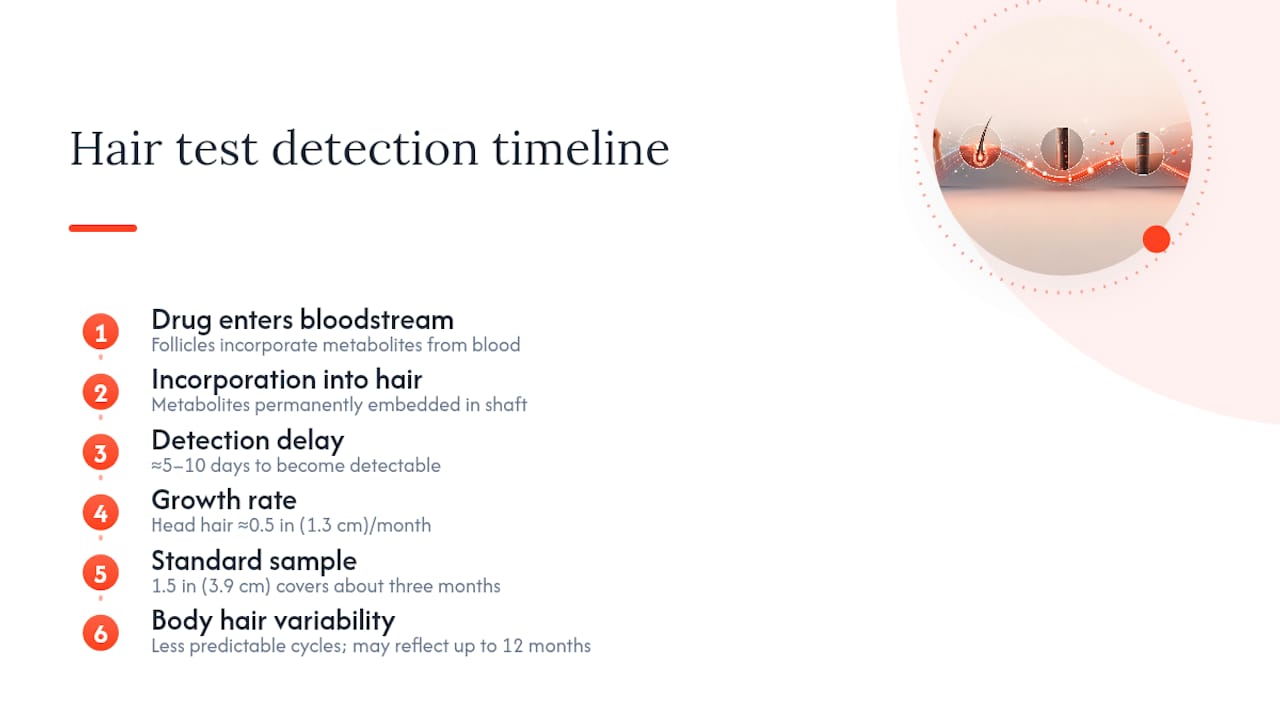
Head hair grows at roughly 0.5 inches (1.3 cm) per month. A standard 1.5-inch (3.9 cm) sample therefore covers about three months. The math is simple: approximately one month of history per half-inch of hair. Quest Diagnostics describes this as the basis for the standard collection protocol, with the sample cut from the vertex crown of the scalp.
Why doesn’t a drug show up in hair the same day you use it? Because the drug-containing hair cells need time to travel from the follicle up through the scalp and become part of the collectible shaft. NIDA research puts that delay at roughly 5–10 days. So if you used a substance nine days ago, it may have just crossed into the detectable zone. If you used it yesterday, it likely hasn’t.
Body hair is a different story. Unlike scalp hair, body hair (chest, arm, leg, pubic) grows in longer dormancy phases called telogen. The growth cycle is less predictable, which means a body hair sample can’t be mapped to specific calendar dates the way scalp hair can. Labs sometimes use body hair when scalp hair is unavailable or too short, and that sample may reflect use over many months, potentially up to 12 months, but with considerably more uncertainty about timing.
Hair testing is primarily used for lifestyle and pattern detection: pre-employment screening, random workplace testing, child custody cases, and legal proceedings. It’s not the right tool for detecting whether someone used a drug last night. StatPearls on NCBI notes that urine and oral fluid remain superior for detecting recent use, while hair is the preferred matrix for longer-term exposure history.
Detection windows by drug class
The 90-day baseline applies across most drug classes, but the actual window for any individual depends on lab cutoffs, use frequency, and the drug’s own metabolite profile. The table below shows typical detection ranges for a standard 1.5-inch scalp sample.
A few important caveats:
- Single use vs. chronic use: A single-use event may produce concentrations too low to exceed the lab’s cutoff threshold, especially for THC. Chronic or heavy use deposits more drug into the hair shaft and is more reliably detected. LabCorp’s FAQ confirms that detection times vary with dose and frequency of use.
- THC specifically: The metabolite tested is THC-COOH, not THC itself. Because THC is fat-soluble, it can accumulate in tissue and release slowly, which may affect how consistently it deposits in hair.
- Benzodiazepines: These incorporate into hair at lower rates than stimulants or opioids. Some labs use lower cutoffs to improve sensitivity, but detection is less reliable than for cocaine or amphetamines.
- All windows are approximate. Lab cutoff levels, hair characteristics, and individual metabolism all shift the real-world window. The 90-day figure is a standard, not a guarantee.
A published research review on PubMed confirms that hair testing has been validated across cocaine, amphetamines, opiates, cannabis, and other compounds, with decades of forensic and clinical use supporting its reliability for pattern detection.
How samples are collected and processed in the lab
The collection process is more controlled than most people expect. Here’s what happens from the moment a collector takes your sample to when a result is reported.
Collection:
- Hair is cut from the vertex crown (top-back of the scalp), where growth rate is most consistent
- The collector takes a small bundle, roughly the diameter of a pencil, and cuts it as close to the scalp as possible
- Only the root-end 1.5 inches (3.9 cm) are used for the standard 90-day panel; the rest is discarded or archived
- Collection is supervised to prevent substitution or tampering
- A chain of custody form documents every step from collection to lab receipt
Lab workflow:
- Prewash: The sample is washed to remove external contaminants (sweat, smoke residue, environmental exposure) before extraction
- Extraction: Drug compounds are extracted from the hair matrix using solvent or enzymatic digestion
- Screening: An immunoassay (similar to a rapid antibody test) flags presumptive positives
- Confirmation: Any presumptive positive goes to GC-MS (gas chromatography-mass spectrometry) or LC-MS/MS (liquid chromatography-tandem mass spectrometry) for definitive identification and quantification
- MRO review: A licensed Medical Review Officer reviews all confirmed positives before the result is reported to the employer or requesting party
The Society of Hair Testing (SOHT) is explicit: screening must always be followed by mass-spectrometry confirmation. A positive immunoassay alone is never a final result.
| Step | Method | Purpose | Next Step |
|---|---|---|---|
| Screening | Immunoassay | Flag presumptive positives quickly | Confirm or clear |
| Confirmation | GC-MS or LC-MS/MS | Definitively identify and quantify the drug | Report to MRO |
| MRO review | Medical review | Evaluate legitimate medical explanations | Final report issued |
For more detail on how the collection process works, Passmydrugtest’s hair strand test guide walks through each stage.
What actually changes your detection window
The 90-day figure is a useful baseline, but it’s not a fixed rule. Several variables can push results in either direction.
Use frequency and dose
This is the biggest factor. Chronic, heavy use deposits far more drug metabolite into the hair shaft than occasional use. A single exposure may produce concentrations below the lab’s cutoff threshold and return a negative result even within the 90-day window. The reverse is also true: very heavy use can produce concentrations that remain detectable even in hair that’s grown slightly beyond the standard sample length.
Hair color and melanin content
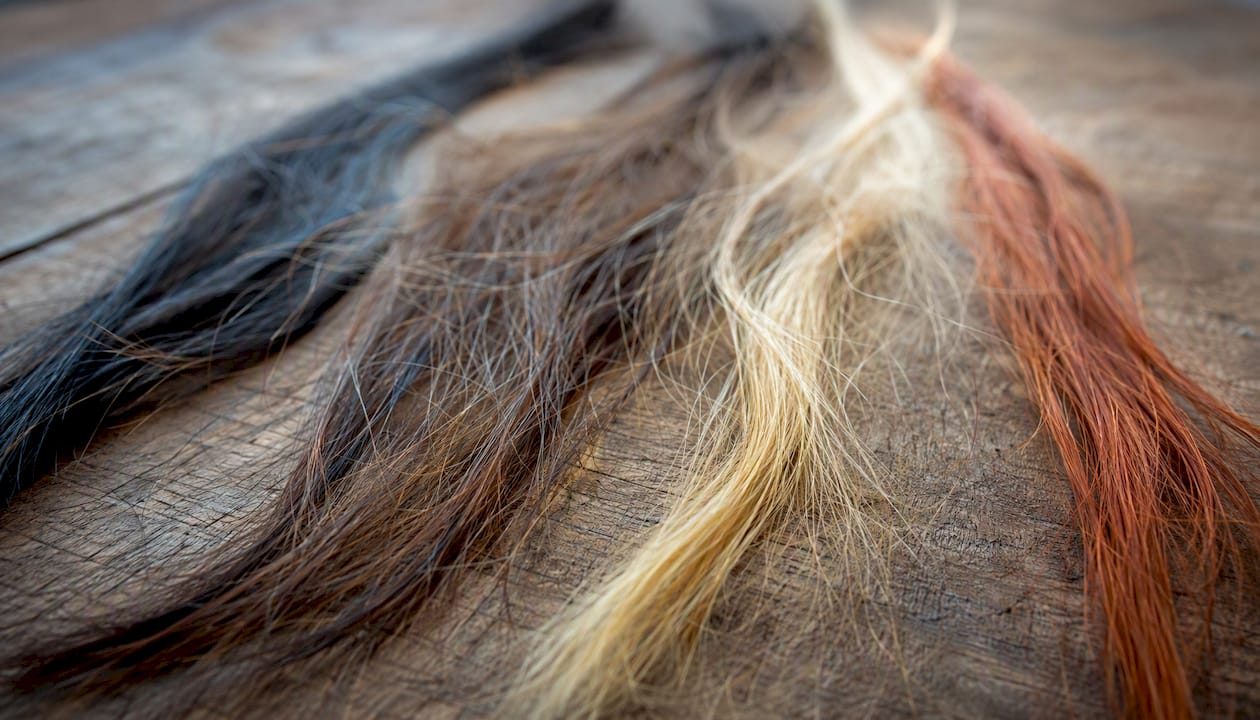
Melanin binds certain drug compounds, particularly cocaine and amphetamines, more readily than it binds others. Darker hair tends to incorporate higher concentrations of these drugs than lighter hair at the same level of use. This is a real analytical consideration, not a myth, and the SOHT consensus specifically calls for case-level interpretation that accounts for hair color and type.
Chemical treatments
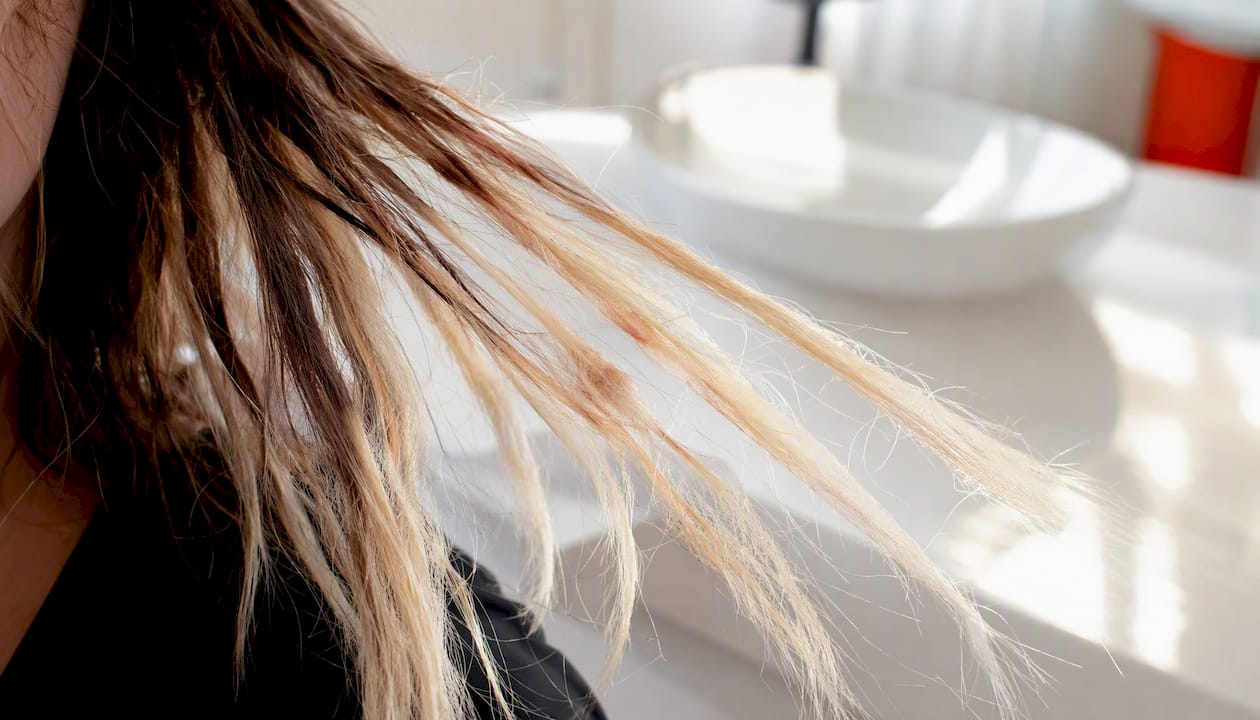
Bleaching, dyeing, perming, and chemical straightening can reduce measurable drug-metabolite concentrations in hair. The degree of reduction depends on the treatment’s harshness and how many times it’s been applied. SOHT guidance acknowledges that chemical treatments can alter concentrations and must be factored into interpretation. This doesn’t mean treatments reliably produce a negative result; it means labs and MROs are trained to recognize the pattern and weigh it accordingly.
External contamination
Passive exposure to drug smoke or residue can deposit trace amounts on the hair surface. The prewash step is designed to remove surface contamination before extraction, but it’s not perfect. Labs and the SOHT recommend that any borderline result near the cutoff be interpreted with contamination as a possible explanation.
Sample source and hair length
Scalp hair maps reliably to time. Body hair does not. If a collector uses body hair because your scalp hair is too short (less than 1.5 inches), the resulting window is longer and less precise. You can’t determine from a body hair result whether use occurred three months ago or eight months ago.
Pro Tip: If your hair has been chemically treated, bleached, or dyed in the past three months, document the treatment type and date before your test. Tell the collection site. This information goes into the chain of custody record and gives the MRO context if your result is borderline. It won’t automatically clear a positive, but it creates a documented record that supports a fair interpretation. You can find more detail on how treatments affect results at Passmydrugtest’s hair drug test information page.
Common myths about hair testing, and what the evidence actually says
A lot of misinformation circulates about how to defeat a hair drug test. Most of it is wrong, and some of it can make things worse.
Myth: Shaving your head will prevent a positive result.
Fact: Collectors are trained for this. If scalp hair is unavailable, they collect body hair from the chest, arms, legs, or underarms. Showing up with a shaved head doesn’t stop the test; it just changes the sample source and potentially extends the detection window.
Myth: Detox shampoos can clean drugs out of your hair.
Fact: Drug metabolites are embedded inside the hair shaft, not sitting on the surface. Ordinary shampoo, clarifying shampoo, and products marketed as “detox shampoos” clean the outside of the hair. The prewash step in the lab does the same thing more thoroughly. No shampoo penetrates the cortex of the hair shaft to remove metabolites that are chemically bonded to the keratin matrix. For a frank look at what shampoo products can and can’t do, see Passmydrugtest’s hair follicle drug test shampoo page.
Myth: Secondhand smoke can cause a positive hair test.
Fact: Environmental exposure to cannabis or cocaine smoke can deposit trace amounts on the hair surface, but the lab’s prewash step removes surface contamination before extraction. A confirmed positive via GC-MS or LC-MS/MS reflects internal incorporation from actual use, not surface residue. The SOHT consensus addresses this directly: confirmation testing and case-level interpretation exist precisely to distinguish passive exposure from active use.
Myth: Hair testing is infallible.
Fact: No test is. Hair testing has known limitations: it cannot pinpoint the exact date of use, it may miss a single low-dose exposure, and it can be affected by hair characteristics and treatments. That’s why the SOHT requires mass-spectrometry confirmation and case-level MRO review for every positive result. A false positive drug test screening is rare after GC-MS confirmation but not impossible, which is why the MRO review step exists.
Hair testing is strong for detecting patterns of use over months. It’s poor for answering “did this person use drugs in the last 48 hours?” That’s what urine and oral fluid are for.
What to do after you get your hair test result
Whether the result is positive or negative, there are clear steps to take.
If you receive a positive screen (before MRO review):
- Understand that a screen is not a final result. Ask whether confirmation testing (GC-MS or LC-MS/MS) has been completed.
- Request a copy of the confirmatory test report, including the specific drug, metabolite, and concentration detected.
- Ask whether an MRO has reviewed the result. If not, that review is required before any final report is issued to an employer.
- Review the chain of custody documentation. Any break in custody is grounds to challenge the result.
If you receive a confirmed positive:
- You have the right to request a split-sample re-test if a split sample was collected. Ask the MRO or the testing facility about the timeline and process for this.
- If you have a legitimate medical explanation (a prescription, a documented medical condition), provide that information to the MRO. The MRO’s job is to evaluate exactly these situations.
- If you believe the result is wrong, consult an attorney, particularly if the result affects employment or a legal proceeding.
If you receive a negative result but believe it may be inaccurate:
- Consider whether the timing was right. If use occurred within the past 5–10 days, it may not have been detectable yet.
- Ask the lab about the cutoff levels used. A result near the cutoff in either direction may warrant a retest.
- For additional testing options, MedlinePlus provides a clear overview of drug testing types and their respective detection windows.
If you need treatment resources:
- SAMHSA’s National Helpline (1-800-662-4357) provides free, confidential referrals to treatment programs 24 hours a day. MedlinePlus also links directly to SAMHSA’s treatment locator for anyone seeking help.
Costs and where to get hair testing in the U.S.
Hair testing costs more than urine testing, and the price varies depending on who orders it and why.
Typical cost ranges:
- Employer-ordered panels: Usually covered by the employer; the employee pays nothing directly
- Direct-pay consumer tests: Generally range from around $100 to $175 for a standard 5-panel hair test at a walk-in collection site, though extended panels (10-panel or more) cost more
- Forensic or legal panels: Costs vary significantly based on the number of substances tested and whether expert testimony is required
Where to get tested:
- LabCorp operates thousands of collection sites across the U.S. and handles both employer-ordered and direct-pay hair tests
- US Drug Test Centers and similar national networks provide walk-in collection at locations in most major cities
- Many occupational health clinics and urgent care centers also offer hair collection, though they send samples to a reference lab for analysis
Turnaround time:
- Screening results typically come back within 24–72 hours of the lab receiving the sample
- Confirmation testing (GC-MS/LC-MS/MS) adds time; a confirmed result usually takes 3–5 business days total
- Contested results or split-sample retests can take longer
Choosing an accredited lab:
Look for labs certified under CLIA (Clinical Laboratory Improvement Amendments) and accredited by CAP (College of American Pathologists). SAMHSA-certified labs meet federal workplace drug testing standards and are the required standard for federally mandated testing programs. Accreditation matters because it means the lab’s methods, equipment, and staff have been independently verified. A result from a non-accredited lab carries less legal and evidentiary weight.
What lab standards and authoritative bodies actually say
The standards that govern hair testing in the U.S. come from a small number of authoritative sources, and their guidance is consistent.
SOHT consensus (2022):
The Society of Hair Testing sets the international benchmark for hair testing methodology. Their consensus document requires:
- A prewash step to remove external contamination before extraction
- Immunoassay screening followed by mandatory mass-spectrometry confirmation (GC-MS or LC-MS/MS) for any presumptive positive
- Case-level interpretation: labs and MROs must consider hair color, chemical treatments, and potential external contamination rather than applying a single numeric cutoff in isolation
StatPearls/NCBI:
StatPearls reinforces that scalp hair typically reflects approximately a 3-month history, while urine and oral fluid detect more recent use. The source also notes that methodology and cutoff selection directly influence sensitivity and specificity, meaning two labs testing the same sample with different cutoffs can produce different results.
Quest Diagnostics:
Quest Diagnostics describes hair testing as the only method that provides up to a 90-day history of repetitive drug use, and explains the collection rationale: the vertex crown is preferred because growth rate there is most consistent, and the 3.9 cm (1.5 in) segment is the standard for the 90-day window.
Why accreditation and MRO review matter:
A confirmed positive from a CLIA/CAP-accredited lab, reviewed by a licensed MRO, is defensible in court, in employment proceedings, and in child custody cases. A positive from an unaccredited lab or one without MRO review is not. The chain of custody, the confirmation method, and the reviewer’s credentials are what give a hair test result its legal and evidentiary weight.
A note on what this site is and what it can tell you
Passmydrugtest combines educational content with a product marketplace for people navigating drug testing in the U.S. The information here is drawn from published lab standards, SOHT consensus guidance, and public health sources including SAMHSA and MedlinePlus.
Detection windows are approximate. Labs vary in their cutoff levels, and individual factors including hair characteristics, use patterns, and chemical treatments all affect real-world results. Nothing on this site constitutes medical, legal, or professional advice. For questions about a specific test result, consult the MRO who reviewed it or a qualified professional. For treatment resources, contact SAMHSA at 1-800-662-4357 or visit MedlinePlus.
What Passmydrugtest offers for hair test preparation
Facing a hair drug test is stressful, and the 90-day window means you can’t simply wait it out the way you might with a urine test. Passmydrugtest gives you one place to research your options, understand what the science actually supports, and find products that may help you prepare.
The site’s information on hair testing covers the full picture: how labs collect and analyze samples, what affects your result, and what the confirmation process looks like. For readers who want to go further, the detox products page lists shampoos and preparation products with honest descriptions of what each one does and doesn’t do.
No product can guarantee a negative result. Hair testing is rigorous, and any site that promises otherwise isn’t being straight with you. What Passmydrugtest offers is clear information, real products, and fast U.S. shipping so you can make an informed decision before your test date. Phone support is available during published business hours if you have questions about which product fits your situation.
Sources
The following sources were used throughout this article. Each is a primary or peer-reviewed authority on hair drug testing methodology, detection windows, and lab standards.
- Consensus_v7_FINAL Version 27NOV22 (SOHT)
- Drug Testing – StatPearls (NCBI Bookshelf)
- Hair testing – FAQ (Quest Diagnostics PDF)
- Workplace Drug Testing | Frequently Asked Questions (LabCorp)
- Drugs
- Diagnostic usefulness of hair testing (PubMed article)
- MedlinePlus: Drug testing (lab tests overview)
Labs that follow SOHT consensus methods, use GC-MS or LC-MS/MS confirmation, and hold CLIA/CAP accreditation produce the most defensible results. When evaluating any hair test result, those three criteria are the baseline for reliability.
This article is general information, not a substitute for advice from a qualified lawyer. Consult a qualified legal professional about your own circumstances before acting on anything here.