
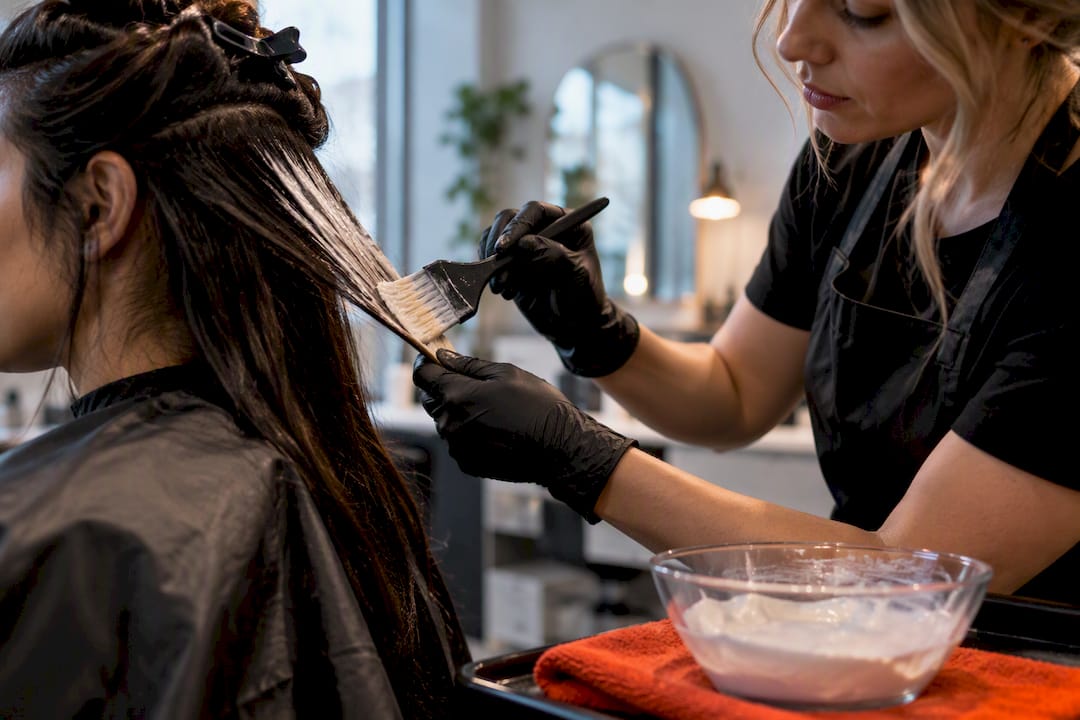
Bleaching Hair Cuts Drug Levels 40–90% But Labs May Flag Tests
Bleaching can cut detectable drug concentrations in hair by roughly 40 to 90 percent depending on the drug and how aggressively you bleach, but it does not reliably produce a clean result. Labs increasingly catch the chemical fingerprints of oxidative damage, and a heavily bleached sample is more likely to come back inconclusive, get flagged for re-testing, or trigger a request for a different sample type rather than sail through as negative.
TL;DR:
- Bleaching hair can reduce detectable drug concentrations by approximately 40 to 90 percent, but it does not guarantee a clean or negative test result.
- Heavily bleached samples are more likely to trigger lab flags or inconclusive results due to oxidative damage markers and altered metabolite ratios.
- The extent of drug loss varies widely depending on the drug chemistry, bleach strength, hair melanin content, and number of bleaching cycles.
- Detection methods can often identify signs of chemical treatment through biomarkers like PTCA and PTeCA, visual inspection, and structural analysis.
- Disclosing recent chemical treatments during collection reduces the risk of being flagged and ensures clarity about potential sample alterations.
Table of Contents
- Bleach and Hair Drug Tests: What Actually Happens Chemically
- Which Drugs Survive Bleaching Best?
- How Do Labs Catch Bleached or Altered Hair Samples?
- Do DIY Bleach and Detox Regimens Actually Work?
- What Happens at Collection and How Results Get Read
- What Do Authoritative Bodies Say About Handling Bleached Hair Samples?
- Is Bleaching Your Hair Before a Drug Test Legal?
- What If a Hair Sample Can’t Be Trusted?
- The Honest Take on Bleaching and Hair Testing
- How Passmydrugtest Can Help You Prepare
- Sources
- FAQ
Bleach and Hair Drug Tests: What Actually Happens Chemically
Hydrogen peroxide does not just lighten hair. It rips into the cortex, breaking down melanin and oxidizing many of the same drug molecules a lab is trying to measure. That’s the physical basis behind every claim about bleaching hair for a drug test working, and it’s also why the effect is so inconsistent from one person’s hair to the next.
The alkaline environment created during bleaching, often pushed further by persulfate boosters in high-lift formulas, increases the leaching of water-soluble metabolites out of the hair shaft. Higher peroxide concentrations and repeated bleaching sessions cause more damage, and more damage means more analyte loss during the wash and extraction steps a lab performs before testing. Porosity is the key variable here: the more bleach opens up the hair’s outer layer, the more of the drug residue washes out during processing, and the more washes away during the lab’s own decontamination step before analysis.
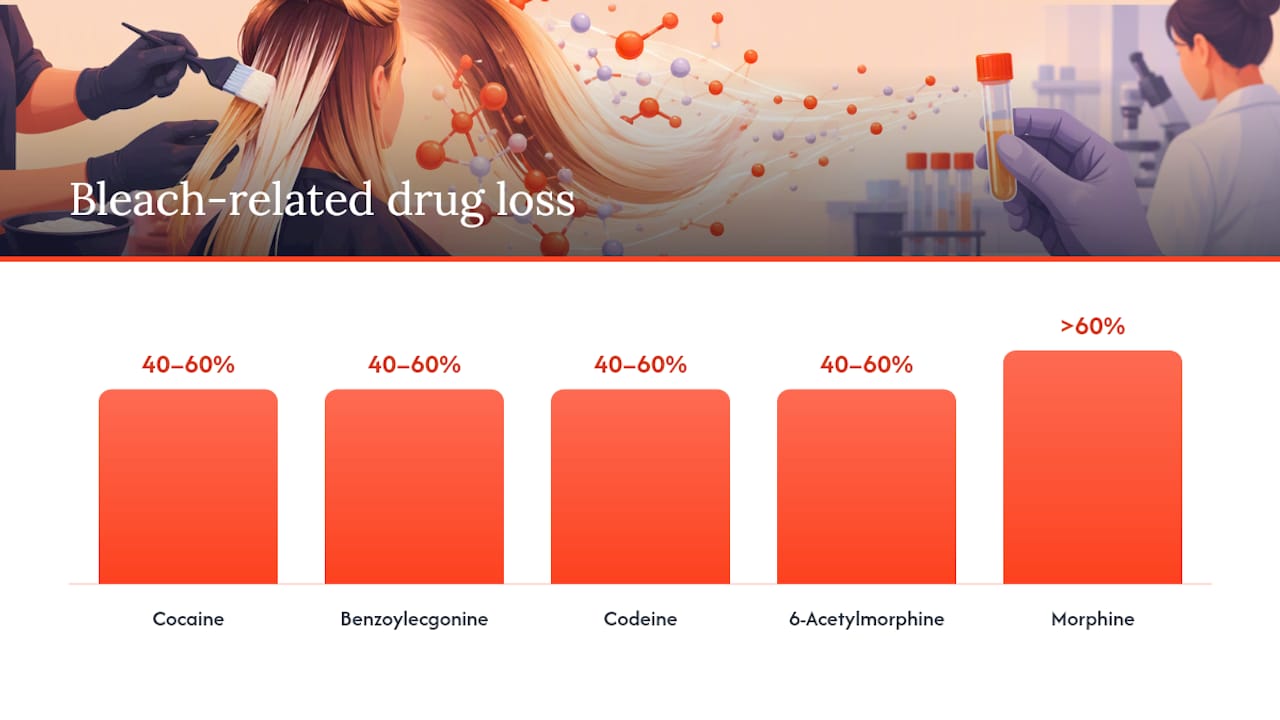
Reported reduction ranges vary widely across peer-reviewed research on cosmetic hair treatments, which found mean decreases commonly in the 40 to 60 percent range for cocaine, benzoylecgonine, codeine, and 6-acetylmorphine, with some morphine samples dropping more than 60 percent. Bleaching consistently produced bigger reductions than simple dyeing.
A few variables drive how much any individual sample loses:
- Melanin content. Darker, coarser hair binds more drug compound to begin with, so the percentage drop can look larger even when absolute residue left behind is still detectable.
- Bleach strength and cycle count. A single at-home box treatment behaves nothing like three professional lightening sessions in a week.
- Drug chemistry. Some molecules are simply more vulnerable to oxidation than others, which is why no single “bleach removes drugs from hair” number applies across the board.
Quick fact: One study on cosmetic treatments found bleaching produced measurably larger drug losses than dyeing across every analyte tested, with damage severity tracking directly with the size of the reduction, according to the same cosmetic-treatment research.
Which Drugs Survive Bleaching Best?
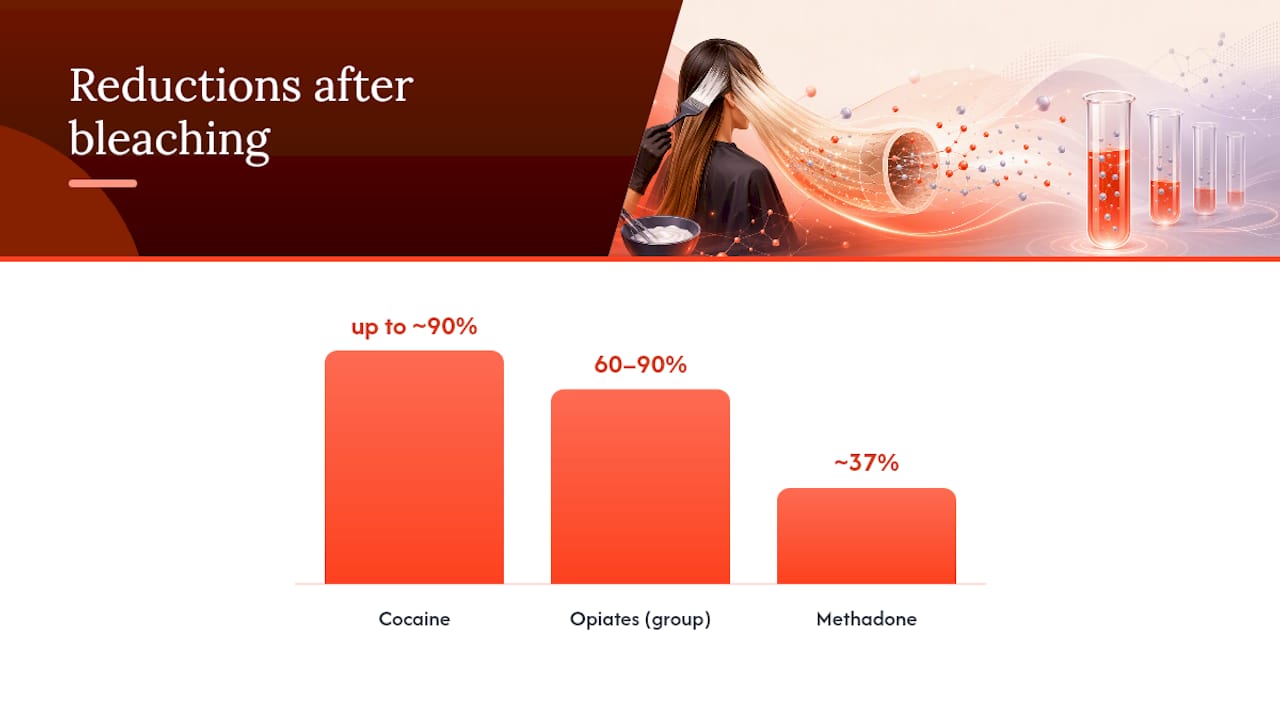
Not every substance reacts to bleach the same way, and that matters if you’re trying to gauge your own risk. Cocaine and several opiates tend to show the steepest declines. Research summarized in CUNY graduate work on cosmetic hair alteration reports reductions of up to roughly 90 percent for cocaine under some bleaching protocols, while methadone dropped by a much smaller margin, around 37 percent in the same body of research.
Amphetamines generally show sizable decreases too, though the numbers bounce around more between studies than they do for cocaine. THC and its metabolites are the trickiest category. Cannabinoids sit at a lower concentration in hair to begin with, and reductions after bleaching tend to be smaller and less predictable than what shows up for stimulants or opiates.
A few patterns worth remembering:
- Cocaine and opiates: often the largest documented drops, sometimes exceeding 60 to 90 percent.
- Amphetamines: significant but inconsistent reductions across different research protocols.
- Methadone and THC: comparatively modest and more variable reductions.
Part of the confusion comes down to metabolite behavior. Labs often measure a parent drug alongside its metabolites, and oxidation can degrade one faster than the other, according to SAMHSA’s technical review of metabolites in hair testing. That shift in ratio can make a sample look unusual even when it isn’t actually clean, which is exactly the kind of red flag that pushes a result toward “inconclusive” rather than “negative.”
How Do Labs Catch Bleached or Altered Hair Samples?
Detection starts before the sample ever reaches a lab. Collectors are trained to look for telltale signs: unusually brittle texture, uneven color, visible regrowth lines that don’t match the rest of the strand, or a donor history that includes recent chemical treatment. Most intake forms ask directly about hair coloring or bleaching, and an honest answer here changes how the sample gets handled downstream.
Once a sample reaches the lab, the real forensic work begins. Standard practice includes a decontamination wash to remove external contamination before extraction, followed by LC-MS/MS analysis to quantify parent drugs and metabolites at sensitive thresholds. More advanced labs go further. Research on untargeted hair metabolomics identified 69 metabolites significantly altered by oxidative bleaching, and flagged two candidate biomarkers, PTCA and PTeCA, that can indicate a sample has been chemically treated. Some forensic facilities also use ATR-FTIR spectroscopy or fluorescence microscopy to detect structural changes in the hair shaft consistent with bleach damage.
None of this is foolproof. Melanin content varies so much between individuals that marker levels aren’t directly comparable across donors, and there’s no single universal cutoff every lab applies. Detection also has to distinguish drug-related tampering from routine salon coloring, which most people undergo for reasons that have nothing to do with a drug test.
Pro Tip: If your hair has been bleached or colored in the last 90 days, disclose it at collection. An undisclosed treatment discovered later during lab analysis reads as an attempt to manipulate the sample, which is a worse outcome than an honest disclosure that simply gets noted on the chain-of-custody form.
Do DIY Bleach and Detox Regimens Actually Work?
Online forums are full of multi-step regimens promising to strip a hair sample clean, and the research on this is more nuanced than either side of the debate wants to admit. Controlled testing of homemade treatments, including baking soda and salicylic acid combined with bleach, along with repeated bleaching and dyeing cycles, found some protocols produced very large reductions for certain drugs.
By the numbers: One controlled study of homemade hair treatments found a baking soda, salicylic acid, and bleach combination produced mean decreases of up to roughly 90 percent for cocaine, while THC and methadone were consistently less affected by the same protocol.
Here’s the part that should worry anyone considering this route: some of these regimens didn’t leave obvious visible damage, even while significantly reducing analyte concentrations. That’s actually a bigger problem for the person attempting it, not a smaller one, because a lab can’t always eyeball a sample and know it’s been chemically stripped. Instead, labs lean on the biomarker and metabolite-ratio methods described earlier, and an unusual chemical signature without matching cosmetic evidence is exactly the kind of thing that gets a sample sent back for confirmation testing.
The real risks stack up fast:
- Severe, sometimes irreversible hair damage from repeated bleaching cycles in a short window.
- Insufficient remaining hair mass to meet the lab’s minimum sample requirement.
- Heightened suspicion and a higher chance of a flagged, inconclusive, or contested result.
- Employment or legal consequences if a program treats a compromised sample as an attempt to defeat the test.
What Happens at Collection and How Results Get Read
If a collector suspects treated hair, the process doesn’t stop. It shifts. Here’s the general sequence donors and employers should expect when hair shows signs of chemical treatment:
- Documentation. The collector notes the condition of the hair, asks about recent coloring or bleaching, and records it on the chain-of-custody form.
- Standard collection proceeds. A 1.5-inch scalp sample is still taken, covering the standard 90-day window, unless there genuinely isn’t enough hair to collect.
- Lab analysis and interpretation. Screening typically returns in 24 to 72 hours, though confirmation testing on borderline results takes longer, according to testing overview data.
- Outcome determination. The lab reports negative, positive, or inconclusive; an inconclusive result often triggers a request for a second sample, a segmental re-analysis, or an alternative testing matrix.
Lowered concentrations from bleaching can push a result below a lab’s cutoff even when drug use occurred, which is the mechanism behind most bleaching-related false negatives. But labs that catch mismatched metabolite ratios or oxidation markers won’t just call it negative and move on. They’re more likely to flag it. The most practical advice for anyone in this position is straightforward: disclose any recent treatment, expect the possibility of a re-test, and ask ahead of time whether an alternative matrix, like urine or saliva, is an approved fallback under your specific program’s rules.
What Do Authoritative Bodies Say About Handling Bleached Hair Samples?
There’s no single federal rulebook that spells out exactly how every lab must treat a bleached sample, but the guidance that does exist points in a consistent direction. SAMHSA’s technical materials on hair testing acknowledge that external contamination and chemical processes can alter both parent drugs and metabolites, which is precisely why federal workplace testing programs have historically leaned on urine as the primary certified matrix rather than hair.
Forensic toxicology practice, meanwhile, generally treats a cosmetically altered sample as a case for heightened scrutiny rather than automatic rejection or automatic acceptance. Practitioner literature on factors influencing hair drug test outcomes notes that collection sites still rely heavily on visual inspection and donor disclosure, since no single standardized lab workflow can objectively catch every form of cosmetic manipulation. That gap is exactly why segmental analysis, biomarker screening, and requests for alternate samples exist as fallback tools.
The practical guideline that emerges from this patchwork isn’t a bright-line rule. It’s a process: disclose treatment history, expect additional scrutiny if the hair shows chemical damage, and understand that a lab flagging your sample for further review is a normal part of the system working as designed, not evidence that something has gone wrong.
Is Bleaching Your Hair Before a Drug Test Legal?
Bleaching your own hair is not illegal in itself. Nobody can stop you from coloring your hair whenever you want, for any reason. The legal and ethical trouble starts with intent and context, not with the chemical process itself.
If you bleach your hair specifically to defeat a court-ordered test, a probation drug screen, or a workplace policy you’ve agreed to follow, that shifts from a personal grooming choice into an act that many programs classify as tampering or an attempt to circumvent testing. Consequences vary by context: a probation violation can carry real legal weight, while a workplace screening failure or refusal often triggers the same disciplinary outcome as a positive result under most employer drug policies.
Disclosure matters here more than people expect. Being upfront with a collector about recent chemical treatment isn’t an admission of wrongdoing. It’s a routine part of the intake process that protects you if the sample later shows unusual markers. Concealing it, on the other hand, can turn an honest cosmetic choice into something that looks a lot like consciousness of guilt if a lab later flags oxidative damage markers. The ethical line is simple even when the legal consequences vary by jurisdiction and employer: use hair treatments for the reasons people normally use them, and be straightforward about your hair’s recent history when a test is on the table.
What If a Hair Sample Can’t Be Trusted?
When a hair sample is too damaged, too short, or flagged for suspected tampering, testing programs don’t just give up. They pivot to a different matrix entirely.
Urine testing remains the most widely used and federally recognized alternative, with a detection window of roughly a few days for most substances, far shorter than hair’s 90-day range but far less vulnerable to cosmetic interference. Saliva testing offers another option, particularly useful for detecting very recent use within the past 24 to 48 hours, and it’s difficult to adulterate in the way hair can be chemically altered.
Some programs also turn to segmental hair analysis on a different body site, since body hair grows more slowly and isn’t typically exposed to the same bleaching and coloring routines as scalp hair. This won’t work for every donor, and it comes with its own interpretive complexities, but it’s a genuine fallback when scalp hair is compromised.
The larger point is that a compromised hair sample rarely ends the testing process. It usually just redirects it toward whichever matrix the specific program already recognizes as an approved backup, whether that’s a urine collection or a saliva-based screen. Anyone facing a hair test should ask upfront which alternatives their specific program allows, since policies differ significantly between employers, courts, and probation offices.
The Honest Take on Bleaching and Hair Testing
Bleaching is not a reliable strategy, and treating it like one misunderstands what the research actually shows. The evidence points to real, sometimes dramatic reductions in specific analytes, but reduction is not the same as elimination, and the lab science built to catch oxidative tampering keeps getting better. The responsible path is disclosure paired with informed decisions, not chemical roulette with your hair and your job. Passmydrugtest exists to help people understand how hair testing actually works and what legitimate options look like once you know the real odds.
— MIchael
How Passmydrugtest Can Help You Prepare
Guessing your way through a hair drug test with a bottle of bleach is a gamble with bad odds and permanent hair damage as a side effect. Some companies take a different approach: real product options paired with research to understand how they fit your specific situation, sometimes backed by fast shipping and customer support if you need to talk through your options before you buy.
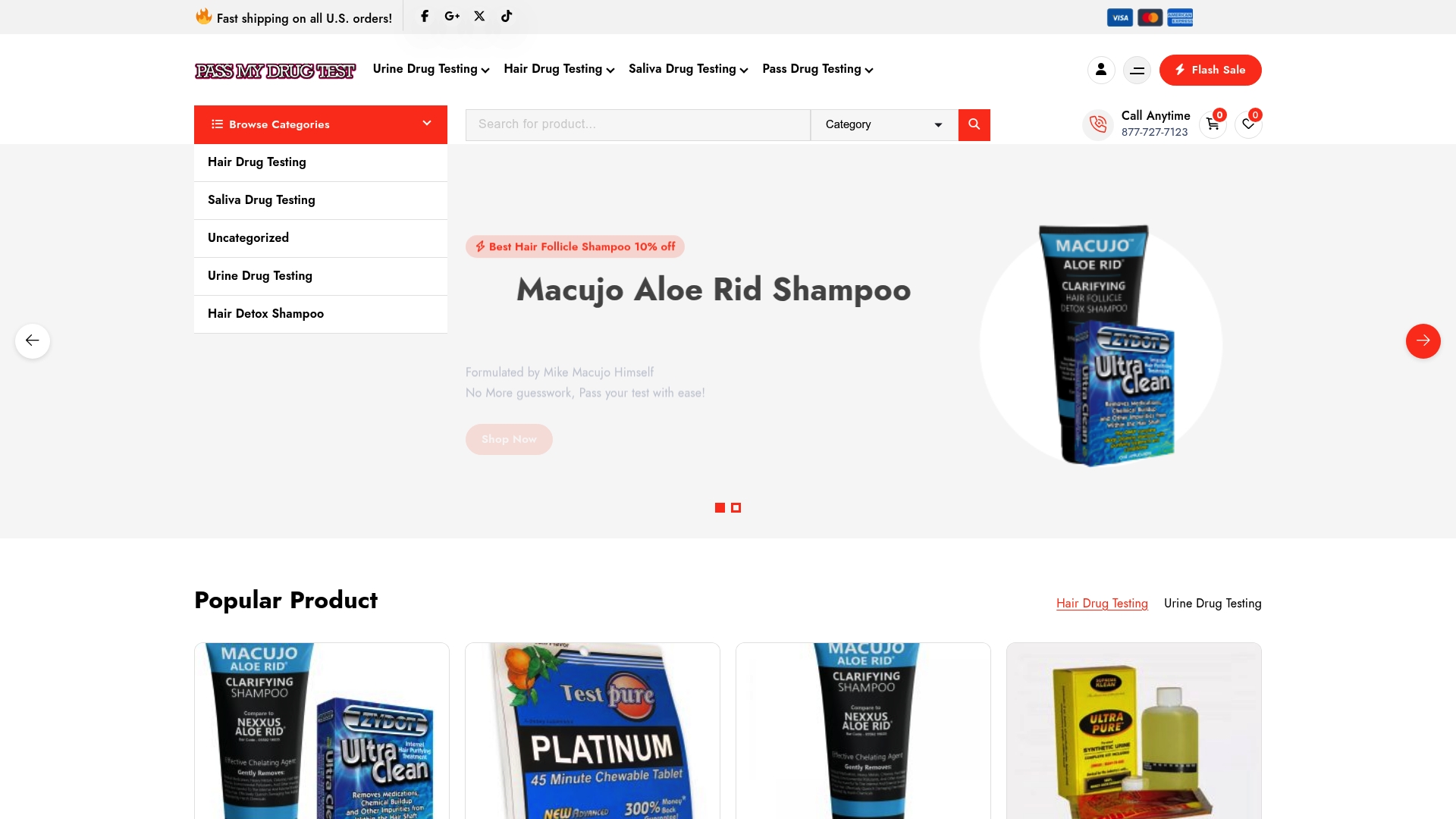
If you’re facing a scheduled hair screening, start by reading through the hair follicle testing overview to understand what collectors actually look for, then browse the hair detox shampoo category if you’re weighing a legitimate detox approach over a risky bleach regimen. No product on the market, including anything sold here, can guarantee a specific test outcome, and any site that promises otherwise isn’t being straight with you. What Passmydrugtest can offer is clear information and a curated product lineup so you’re making a decision based on evidence instead of forum rumors. Visit Passmydrugtest to explore the full range of hair, saliva, and urine testing solutions, or call during business hours if you want to talk through which option actually fits your timeline.
This article is general information, not a substitute for advice from a qualified lawyer. Consult a qualified legal professional about your own circumstances before acting on anything here.
Sources
- Influence of cosmetic treatments on hair drug concentrations — PubMed
- Hair analysis: Assessment of homemade hair treatment effects on drug concentrations in the keratin matrix — PubMed (2023)
- Cheating on forensic hair testing? Detection of potential biomarkers for cosmetically altered hair samples — RSC (2020)
- Testing
FAQ
How Can I Detox My Hair Follicles?
There’s no method proven to fully clear drug residue from hair follicles, but specialized detox shampoos are designed to strip surface buildup and reduce external contamination before a test. Passmydrugtest’s hair follicle shampoo kits are one option people research, though no product guarantees a specific lab result, and heavy bleaching regimens carry the added risk of visible hair damage without reliably clearing the test.
Does Bleach Affect the Hair Follicle?
Yes. Bleach oxidizes melanin and increases hair shaft porosity, which allows more drug residue to wash out during processing. Studies show this can reduce detectable concentrations by roughly 40 to 90 percent depending on the drug and bleaching intensity, but the resulting damage can also trigger biomarker-based detection of the treatment itself.
Can a Lab Tell if I Bleached My Hair Before a Drug Test?
Labs can often detect signs of oxidative treatment through biomarkers like PTCA and PTeCA, along with visual inspection and altered metabolite ratios, according to research on cosmetically altered hair samples. Detection isn’t guaranteed in every case, since melanin levels vary between individuals, but a heavily bleached sample carries a real chance of being flagged.
How Long After Bleaching Should I Wait Before a Hair Test?
There’s no established waiting period that reliably restores normal drug concentrations, since bleaching’s effect on hair is largely permanent for the treated portion of the strand. New hair growth reflects your most recent drug use regardless of how long ago you bleached, and a standard 1.5-inch sample still covers roughly a 90-day detection window.
What Happens if My Hair Test Comes Back Inconclusive?
An inconclusive result typically means the lab detected something unusual, like a mismatched metabolite ratio or a marker of chemical treatment, without a clear negative or positive reading. Most testing programs respond by requesting a re-test, a segmental analysis, or an alternative sample type such as urine or saliva.