
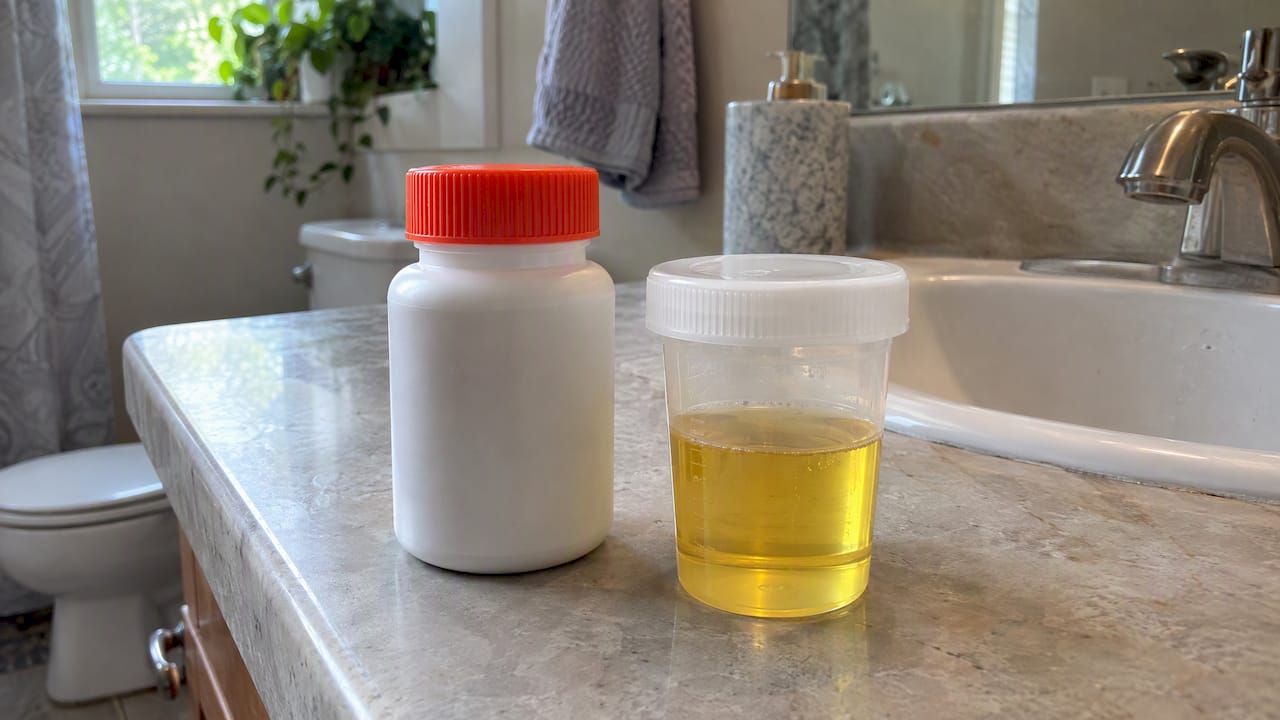
B Vitamins and Drug Tests: What Actually Happens
B vitamins do not clear THC from your body, and they will not make a urine drug test come back clean. B12 is not known to cause a false positive for THC. A few B vitamins can change urine color or interfere with certain lab assays, and high-dose niacin (B3) has sent people to the hospital. Here is what each one does, what the evidence says, and what to do if you have a test coming up.
TL;DR
- No B vitamin has been shown to remove THC metabolites or turn a positive urine test negative. The CDC found no scientific evidence that niacin alters a urine test result.
- Vitamin B2 (riboflavin) and B3 (niacin) mostly change urine color. Color is not the same as a clean sample, and a lab can flag it.
- Biotin (B7) interferes with many blood immunoassays, such as thyroid tests. It is a lab-test problem more than a drug-screen problem.
- If you get a positive result you think is wrong, ask for confirmatory testing (GC/MS or LC-MS) and a Medical Review Officer interview.
- The only reliable way to a negative THC result is time without use. Plan the timeline first, then choose your tools.
Table of Contents
- Why people connect B vitamins to drug tests
- Can B vitamins help you pass a THC urine test?
- What B vitamins do to urine color, and why that backfires
- Biotin (B7): a lab-test problem, not a drug-screen trick
- Can B vitamins cause a false positive?
- If your result is positive: what to do
- How long does THC stay in urine after one hit?
- Our perspective
- Choosing the right preparation for your test type
- Practical rules if you take B vitamins
- FAQ
- Sources
Why people connect B vitamins to drug tests
The idea comes from two directions. One is the myth that flooding your system with B12 or a B-complex “cleans” urine. The other is the worry that a daily multivitamin might make you test positive for something you never took.
Both are understandable. Urine screens are blunt tools, supplements are everywhere, and message boards are full of confident claims. The two worries have very different answers, so it helps to separate them.
The first question is whether B vitamins can help you pass. They cannot, and one version of the trick is dangerous. The second is whether B vitamins can make a clean person fail. In practice that is very unlikely, though some interference has been documented in older lab methods.
Can B vitamins help you pass a THC urine test?
No. A standard urine screen looks for THC metabolites above a set cutoff. The American College of Medical Toxicology notes that a urine drug test only shows the presence of metabolites above a threshold. It does not show the route, timing or dose of exposure. That is also why urine results alone cannot establish impairment.
Nothing in a vitamin pill changes how much metabolite is in your bladder. What changes it is how much you used, how often, your body composition and how much time has passed. Vitamins do not appear in that list.
Vitamin B12
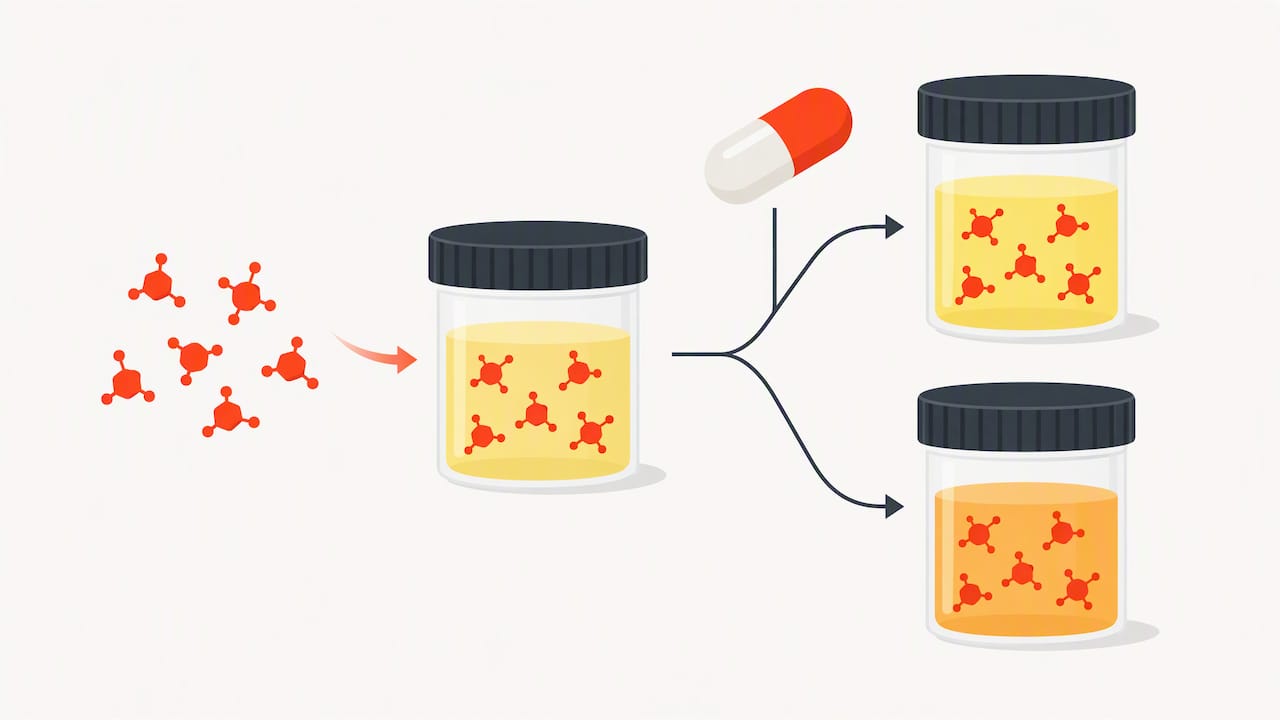
B12 is the vitamin most people ask about, and it is the one with the least to offer. It is water soluble, and the excess you take is excreted in urine. That can give your urine a brighter color, but it does not touch THC metabolites.
We did not find an official or academic source showing that B12 causes a false positive for THC or any other drug on a standard screen. Some supplement-retail blogs claim it does. Treat those with caution, since they cite no controlled testing. If you take B12 for a deficiency, your doctor’s guidance matters more than a rumor, and you can tell the Medical Review Officer about it if you are ever asked about medications and supplements.
We have a longer look at the color trick in our piece on why B12 urine color won’t beat a pre-employment test.
Vitamin B2 (riboflavin)
Riboflavin is what turns urine neon yellow after a multivitamin or B-complex. It is also the one B vitamin with a documented analytical effect. A 1998 study found that high riboflavin levels can interfere with Abbott TDx immunoassays, producing errors or results of questionable validity.
Note what that means. The interference produced unreliable readings, not a clean pass. And that study concerned one older instrument line. Modern workplace programs send non-negative or odd samples to confirmatory testing, so a vitamin-driven anomaly is more likely to draw attention than to hide anything.
Vitamin B3 (niacin): the risky one
Niacin is the B vitamin most tied to drug-test folklore, and it is where the real harm sits. The CDC reviewed cases of people who took large niacin doses to try to beat a urine test. It concluded there is no scientific evidence niacin can alter a urine drug-test result.
The same report described four cases of toxicity. They included liver injury, metabolic acidosis, changes in blood glucose, low neutrophil counts and heart rhythm effects. Two cases involved life-threatening reactions. If a friend suggests megadosing niacin before a test, this is the answer: it does not work, and it can put you in an emergency room.
If you have already taken a large dose and feel unwell, call poison control or seek emergency care instead of waiting for the test.
What B vitamins do to urine color, and why that backfires
It is true that large niacin doses can give urine an intense yellow color. Ohio’s Supreme Court drug-court education materials describe it as a tactic sometimes used to disguise diluted samples. That tells you something: the people running programs already know the trick.
Collection sites and labs do not judge a sample by color alone. They look at creatinine, specific gravity, pH and signs of adulteration. Diluting your urine and then coloring it can make the sample look dilute or odd, not clean.
What happens next depends on the program:
| Situation | What typically follows |
|---|---|
| Negative result reported as dilute, federal workplace program | The employer may be permitted or required to order a recollection, depending on the lab’s creatinine findings |
| Positive result also reported as dilute, federal workplace program | It is treated as a verified positive, and you are not directed to retest based on dilution alone |
| Invalid or substituted sample | Reviewed by a Medical Review Officer before any final report |
The first two rows come from the Department of Transportation’s rule on dilute specimens. Private employers set their own policies, so ask your employer’s testing policy rather than assuming the DOT process applies. For more on how validity checks work, see our guide to urine validity checks and what the 20 mg/dL cutoff can miss.
Biotin (B7): a lab-test problem, not a drug-screen trick
Biotin gets mentioned a lot in search results for this topic, and the confusion is worth clearing up. Biotin interferes with many immunoassays that use a biotin-streptavidin design. These are mostly blood tests for things like thyroid hormones, not workplace drug screens.
The FDA issued a safety communication that high biotin intake can make some lab results incorrect, and reported adverse events, including one death. A study of 59 Roche interference-suppressed assays found biotin interference was probable, with falsely high results more common than falsely low ones.
So if you take a hair, skin and nails supplement with biotin, tell your doctor before any blood work. For a urine THC screen, we have not found a checked source showing that biotin changes the outcome.
Can B vitamins cause a false positive?
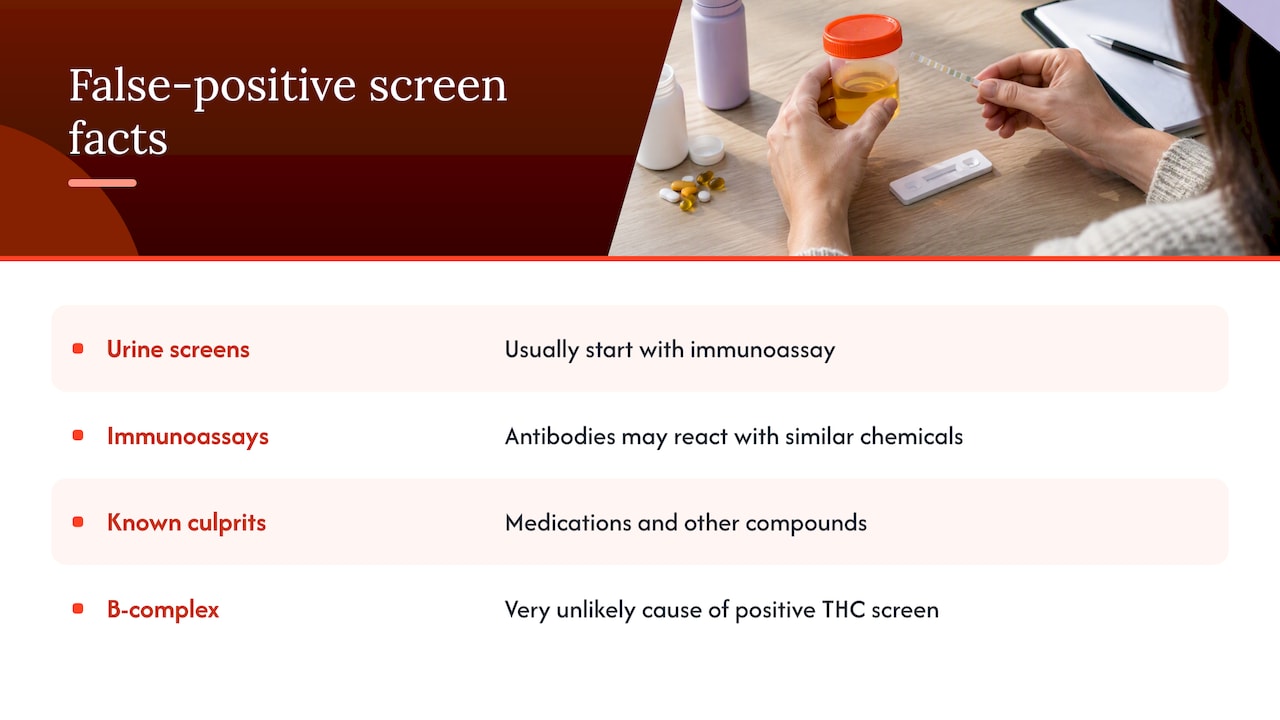
Urine drug screens usually start with an immunoassay. These use antibodies, which can react with chemicals that resemble the target drug. The ACMT notes that immunoassays are prone to cross-reactivity with structurally similar chemicals, which can produce false positives. Emergency physicians say the same about rapid screens: antibody-based tests lack the specificity needed for reliable decisions.
The known culprits are medications and other compounds, not B vitamins. For example, some cold medicines are linked to amphetamine screen problems, which we cover in our Sudafed drug test guide. On the cannabis side, screens cannot tell different tetra- and hexahydrocannabinols apart. Increasing use of unregulated cannabinoids is expected to raise the number of positive screens that need mass-spectrometric confirmation. If you use hemp products, our article on delta-8 positives and LC-MS/MS confirmation is the more relevant read.
The practical conclusion: a B-complex is a very unlikely reason for a positive THC screen. If you do test positive and take supplements, list them, but do not assume they are the explanation.
If your result is positive: what to do
A screen is not the final word. In federal workplace testing, the lab must use separate portions of the sample for the initial and confirmatory tests. The confirmatory test must use a different, more specific method, such as chromatography with mass spectrometry. NIDA describes the same pattern: a positive screen can be followed by GC/MS or LC-MS confirmation.
Here is a sensible order of steps:
- Ask whether the result was confirmed. A screen-only positive can be a cross-reaction.
- Talk to the Medical Review Officer. The MRO reviews positive, adulterated, substituted and invalid results, and gives you a chance to present a legitimate medical explanation.
- Write down everything you took. Prescriptions, over-the-counter drugs, supplements, CBD or hemp products and foods.
- Ask what method and cutoff were used. Our GC-MS drug test guide lists the questions worth asking.
- Read our page on a false positive urine test for how disputes usually go.
If the result is a true positive from your own THC use, vitamins will not argue it away. Be honest with the MRO about what you can, and check your employer’s policy on a second test or a treatment pathway.
How long does THC stay in urine after one hit?
There is no honest single number. A urine test reports metabolites above a cutoff, and the ACMT is explicit that it says nothing about timing or dose. A single use by someone who rarely uses is very different from daily use. Detection windows vary widely with frequency, body fat, hydration, the cutoff the lab uses and the sample itself.
What we can say is that B vitamins do not shorten any of it. If your test date is near, the most useful things are knowing which test you face (urine, saliva or hair), when it is, and what your employer’s policy says.
Our perspective
We sell products for people facing drug tests, so you might expect us to say a vitamin routine is part of the answer. It is not, and we would rather tell you that than take the order.
What we see in the questions customers ask is a pattern. Someone reads that B12 “turns urine yellow so it looks normal,” takes a handful of supplements, and then worries because the sample looks odd or the test is on a different matrix than they assumed. The color is a cosmetic effect. The decision that matters is which test you are facing and how much time you have.
Our approach is to match the product to the test scenario. Urine, saliva and hair are different problems with different tools. A person with a mouth swab in two days needs different information from someone whose employer collects hair. That is why our site pairs product pages with guides, and why our phone support exists: to help you choose, not to promise outcomes nobody can guarantee.
If you are unsure whether something you take could affect a test, ask your pharmacist or doctor. If you get an unexpected positive, ask for confirmation and an MRO review before you accept it.
— MIchael
Choosing the right preparation for your test type
Once vitamins are off the table, the question becomes which test you actually face. Our shop is organized by test type, with educational pages beside each category:
- Urine: browse urine drug testing products and read our guide to the clean urine drug test. If a sample might be checked for authenticity, read what synthetic urine can pass and what biomarkers expose first.
- Saliva: see how a saliva drug test works and the saliva testing category.
- Hair: start with the hair follicle drug test overview and the hair detox shampoo range.
- Job screening: our pre-employment drug testing page explains what to expect.
We ship fast within the United States, and you can call us during our published business hours if you want help matching a product to your situation. Start from the Pass My Drug Test home page.
Practical rules if you take B vitamins
- Do not megadose niacin. The CDC cases show the risk without any benefit.
- Keep taking prescribed supplements. Stopping medically needed B12 for a test is a decision for your doctor.
- Tell your doctor about biotin before blood work, especially thyroid or hormone panels.
- Expect brighter urine from B2 and B-complex. It is harmless, but it will not hide anything.
- Know your test. Hair and saliva tests are not influenced by urine color at all.
FAQ
Does B12 show up on a drug test?
B12 is not something standard workplace drug panels look for. We found no authoritative source showing it causes a false positive for THC. It can make urine look brighter, which does not help you pass.
Do B vitamins clean your system of THC?
No. The CDC found no scientific evidence that niacin changes a urine test result, and nothing supports B12 or a B-complex doing so either. THC metabolites leave your body over time, based on your use patterns and body, not on vitamin intake.
Can a vitamin B complex cause a false positive?
It is unlikely. Riboflavin has been shown to interfere with one older family of immunoassays, producing unreliable readings. Medications and cannabinoid products are far more common causes of false positives, and confirmatory testing is built to catch them.
Can you argue a false-positive drug test?
Yes. Ask whether the result was confirmed by GC/MS or LC-MS, and speak with the Medical Review Officer, who can consider legitimate medical explanations. Bring a list of everything you took, including supplements.
Sources
- CDC: Use of Niacin in Attempts to Defeat Urine Drug Testing
- Vitamin B2 interference with TDx drugs-of-abuse assays
- Ohio Supreme Court: MythBusters, Drug Testing Myths
- The biotin interference within interference suppressed immunoassays
- Safety Communication: Biotin May Interfere with Lab Test Results
- DOT 49 CFR Part 40, Section 40.197
- NIDA: Drug Testing
- SAMHSA Medical Review Officer Guidance Manual
- ACMT Position Statement: Interpretation of Urine Drug Testing
- Appearance of hexahydrocannabinols as recreational drugs
- Urine Drug Screens in the Emergency Department