
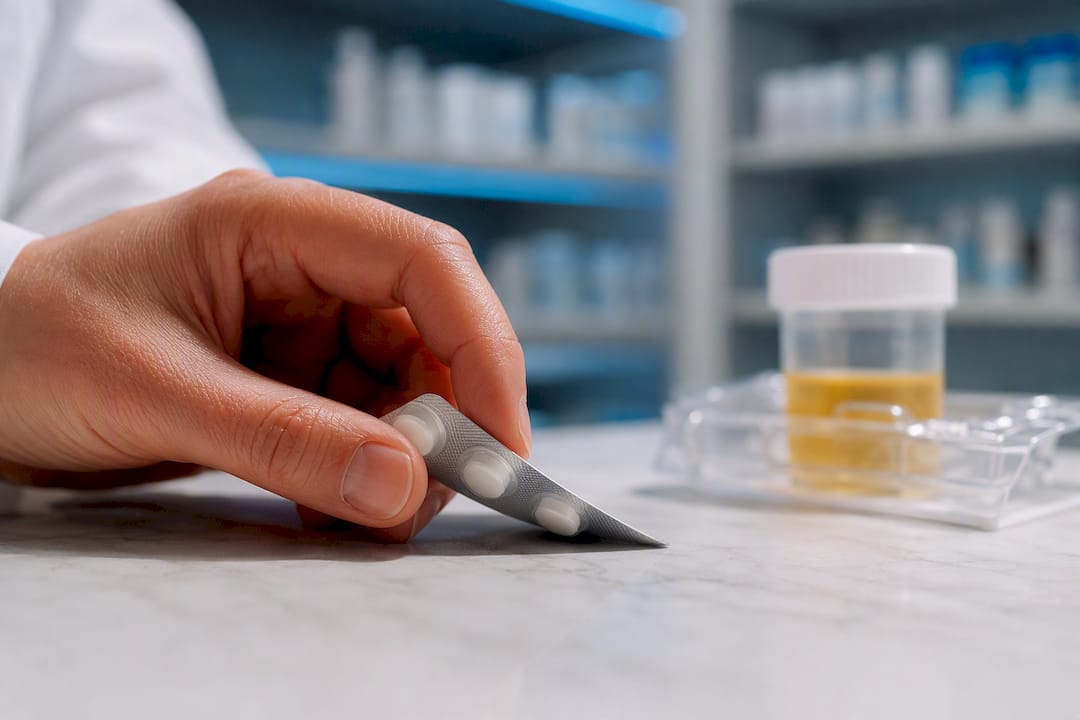
Up to 75% False Positive Risk: Sudafed Drug Tests and What to Do
Yes, Sudafed can trigger a presumptive positive for amphetamines on a urine immunoassay screen. That result is preliminary, not final. Federal testing standards require confirmatory testing with GC/MS or LC-MS/MS whenever a screen comes back nonnegative, and that method reliably tells pseudoephedrine apart from illicit amphetamine or methamphetamine. If you take Sudafed and get flagged, disclose the medication to the testing site or Medical Review Officer immediately and request confirmatory testing.
TL;DR:
- Sudafed’s pseudoephedrine can trigger false positives for amphetamines on immunoassay screens, but confirmatory testing using GC/MS or LC-MS/MS reliably distinguishes it.
- Up to 75% false-positive rates have been documented with certain reagent chemistries, depending on test sensitivity, manufacturer, and urine concentration factors.
- Confirmatory lab analysis includes molecular identification and chiral testing to differentiate legal pseudoephedrine from illicit methamphetamine, especially for isomer ratios.
- Disclosing recent Sudafed use promptly, presenting purchase evidence, and requesting confirmatory and chiral tests can protect against wrongful positive results.
- Non-regular testing settings vary widely, so understanding your specific process before testing helps ensure proper follow-up and reduces false positives.
Table of Contents
- How urine immunoassay screening works and why false positives happen
- Why Sudafed specifically can trigger amphetamine and methamphetamine screens
- How long does pseudoephedrine stay in urine?
- How labs tell Sudafed apart from illicit amphetamines
- If you get a positive result, here’s what to do next
- What this means for workplace and legal drug testing
- Do all drug testing settings treat a positive the same way?
- How to disclose Sudafed use before you get tested
- Alternatives to Sudafed that won’t interfere with drug tests
- Is pseudoephedrine legal, and does that affect testing outcomes?
- Preparing for a test when you’re worried about accuracy
- The gap between what testing guidance promises and what actually happens
- Sources
How urine immunoassay screening works and why false positives happen
Immunoassay screens are the fast, cheap first pass in drug testing. They use antibodies designed to latch onto a drug class, not a single molecule, which is exactly why they can be fooled. The antibodies don’t distinguish between a controlled substance and a chemical cousin that happens to share the same shape.
Pseudoephedrine shares a phenethylamine backbone with amphetamine and methamphetamine. To an antibody scanning for that structural pattern, Sudafed’s active ingredient can look enough like the target molecule to trigger a reaction. This is why immunoassay results are labeled “presumptive positive,” not “positive.”
Not every screen behaves the same way. Reagent chemistry varies by manufacturer, and that variation matters more than most people realize:
- Some immunoassay reagents cross-react with pseudoephedrine far more than others, even when testing the same urine sample.
- Assay sensitivity settings (cutoff levels) change how easily a legal decongestant trips the screen.
- Lab-based immunoassays and point-of-care cup tests don’t always use identical reagent formulations.
Studies have reported false-positive rates as high as 75% for certain immunoassay reagents when pseudoephedrine is present in the urine sample. That’s not a fringe number. It’s a documented reagent-dependent problem serious enough that laboratory guidance treats it as a known interference, not a rare fluke.
Why Sudafed specifically can trigger amphetamine and methamphetamine screens
Sudafed’s active ingredient is pseudoephedrine, and it shows up in more products than the classic red-and-white box. Combination cold and allergy medications, some sinus formulas, and generic store-brand decongestants behind the pharmacy counter all carry the same compound. If you’ve taken any product with “pseudoephedrine HCl” on the label, the same cross-reactivity risk applies.
The research on pseudoephedrine and immunoassay interference has been documented for years, yet it still surprises people who assume an over-the-counter drug is automatically drug-test-safe. Reviews of the case data note that manufacturers don’t always report cross-reactivity frequencies consistently, so clinicians are told to treat nonnegative results with caution rather than take a screen at face value.
Here’s what actually varies from one test to the next:
- The specific antibody reagent used by the lab or testing kit.
- The screening cutoff concentration set for amphetamines.
- Whether the dose was recent, high, or part of an extended-release formulation.
- The individual’s kidney function and urine concentration at the time of the sample.
Some labs won’t flag pseudoephedrine at all. Others will, almost every time, depending entirely on which reagent sits in their testing line. That inconsistency is precisely why one screening result should never be treated as the final word.
How long does pseudoephedrine stay in urine?
Pseudoephedrine typically clears the bloodstream with a half-life of roughly 5 to 8 hours in adults with normal kidney function, and traces can generally show up in urine for around 1 to 2 days after the last dose. That range shifts depending on the person, so treat it as a rough estimate, not a countdown clock.
Several variables push that window wider or narrower:
- Urine pH: acidic urine speeds up elimination, while alkaline urine slows clearance and extends detectability.
- Hydration level: more diluted urine can lower measured concentration without necessarily shortening true detection time.
- Kidney function: reduced renal clearance keeps pseudoephedrine circulating longer.
- Dose and formulation: a single 12-hour extended-release tablet behaves differently than three doses of the fast-acting version taken over a day.
Don’t try to time a dose around a testing date using an estimated window. Individual metabolism swings too much for that math to be reliable, and guessing wrong puts you in the exact situation this article is trying to help you avoid.
Pro Tip: Keep the original Sudafed box or a pharmacy receipt with the purchase date. If a screen flags you, that paperwork gives the Medical Review Officer something concrete to match against your test date.
How labs tell Sudafed apart from illicit amphetamines
Confirmatory testing is the step that actually resolves a presumptive positive, and it works on a completely different principle than the initial screen. Instead of an antibody reacting to a general shape, chromatography-based methods like GC/MS or LC-MS/MS separate and identify the exact molecule present in the sample. There’s no ambiguity left once this step runs. Either the molecule is d-methamphetamine, or it’s pseudoephedrine, or it’s something else entirely.
When a methamphetamine result specifically needs sorting out, labs can go one step further with chiral, or isomer, analysis. Methamphetamine exists in two mirror-image forms: d-methamphetamine, associated with illicit use, and l-methamphetamine, found in some legal decongestant and inhaler products. Chiral testing measures the ratio between those two isomers, and a sample dominated by the l-isomer supports a legitimate over-the-counter explanation rather than illicit stimulant use.
The typical sequence after a nonnegative screen runs in a predictable order:
- The initial immunoassay flags a presumptive positive.
- The lab automatically or on request runs GC/MS or LC-MS/MS confirmatory testing on the same sample.
- If methamphetamine specifically is implicated, the lab performs chiral analysis to check isomer ratios.
- The Medical Review Officer reviews the confirmed lab data alongside your reported medication history.
- The MRO issues a final determination, either verified negative or verified positive.
| Testing stage | Method | What it detects |
|---|---|---|
| Initial screen | Immunoassay | General drug class (presumptive only) |
| Confirmation | GC/MS or LC-MS/MS | Exact molecular identity |
| Isomer resolution | Chiral analysis | d- vs l-methamphetamine ratio |
This layered process exists precisely because immunoassays are fast but imprecise, and the HHS Mandatory Guidelines require confirmatory testing before any federally regulated workplace result gets reported as positive.
If you get a positive result, here’s what to do next
A flagged screen is not a verdict. It’s a prompt to move to the next stage of the process, and how quickly you act matters.
- Disclose the medication immediately. Tell the testing site or MRO exactly what you took, when, and how much. Bring the original packaging or a pharmacy receipt if you still have it.
- Ask for the quantitative immunoassay result, not just a pass/fail label. Numbers give the MRO more to work with than a simple flag.
- Request confirmatory testing using GC/MS or LC-MS/MS if it hasn’t already been run automatically. Under most federal and many workplace protocols, it will be.
- Ask specifically for chiral analysis if the confirmed result names methamphetamine. This is the step that separates Sudafed-related l-isomer findings from illicit d-isomer use.
- Follow up with the MRO directly. MROs are trained to weigh medication history against lab data before finalizing any determination, and a documented conversation moves your case along faster than silence.
Confirmatory and chiral testing add time to the process, usually a matter of days rather than hours, but that delay is the price of accuracy. A false positive urine test resolved through documentation rarely turns into a lasting problem on your record.
Pro Tip: Write down the date, time, and dose of your last Sudafed use as soon as you’re tested, before you forget the details. A same-day note carries more weight with an MRO than a reconstructed memory two weeks later.
What this means for workplace and legal drug testing
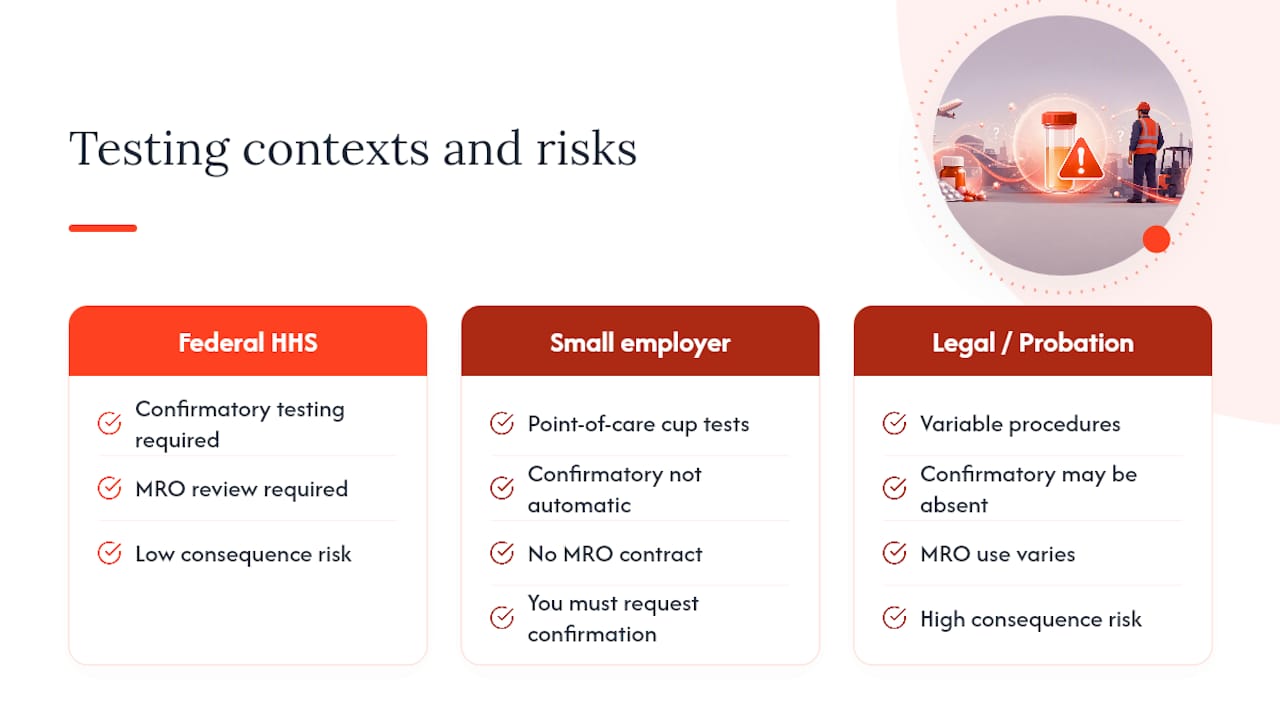
Workplace testing programs that follow HHS and SAMHSA guidelines are actually the safest place for a Sudafed-related flag to happen, because those programs are legally required to route any nonnegative screen through confirmatory testing and MRO review before it becomes a reportable result. An employer never sees a raw immunoassay flag as your final outcome under federal protocol.
The risk grows in settings with looser procedures. Some smaller employers, especially those running quick point-of-care cup tests without a contracted MRO, may not automatically escalate a positive screen to confirmatory testing. In that setup, the burden shifts to you to speak up and request it. Silence can let a presumptive result stand unchallenged.
Legal contexts, including probation and parole testing, carry higher stakes because consequences can include supervision violations. Courts and probation offices vary widely in whether they use MRO-style review at all, so asking directly about their confirmation policy before results are finalized protects you far more than assuming the same safeguards apply everywhere.
The practical lesson: know your testing program’s protocol before you’re tested, not after. If your workplace or legal supervisor hasn’t described a confirmation and MRO process, ask. It’s a reasonable question, and it establishes that you understand your rights before any dispute arises.
Do all drug testing settings treat a positive the same way?
No. Sensitivity thresholds, confirmation requirements, and appeal processes differ sharply depending on where the test happens.
Federally regulated workplace testing (transportation, government contractors) follows the strictest rules. SAMHSA-certified labs must run confirmatory testing on any nonnegative screen, and a certified MRO reviews every result before it reaches an employer. Cutoff levels are standardized and published.
Private employer testing varies enormously. Some companies use the same SAMHSA-style protocol voluntarily; others run cheaper point-of-care tests with no built-in confirmation step unless the employee requests one.
Probation and parole testing often prioritizes speed and cost over rigor. Rapid urine cups are common, and confirmatory lab testing may only happen if the individual specifically challenges a result, so knowing to ask matters more here than in a heavily regulated workplace.
Sports and athletic testing operates under its own separate rulebooks, often with therapeutic use exemption processes built in for legitimate medications, but cutoff sensitivity and banned-substance lists differ from workplace standards entirely.
The common thread: the more regulated the setting, the more automatic the safeguards. The less regulated the setting, the more the burden falls on you to request confirmation and documentation yourself.
How to disclose Sudafed use before you get tested
Disclosure works best when it happens before a screen, not after a flag. If you know a test is scheduled and you’ve recently taken Sudafed or any pseudoephedrine-containing product, mention it to the collector or testing coordinator at intake, not as an excuse but as a factual note for the record.
Be specific rather than vague. “I’ve been taking cold medicine” gives an MRO almost nothing to work with. “I took Sudafed 12-hour, two doses over the past 24 hours, last dose this morning” gives them something they can actually cross-reference against lab data.
If your testing program has a medical history form or medication disclosure sheet, fill it out completely, including over-the-counter products. People routinely skip OTC items because they don’t think of Sudafed as a real medication worth reporting. That gap is exactly what causes confusion later when a screen comes back nonnegative and there’s no paper trail explaining why.
Keep it simple and keep it factual. You’re not building a defense. You’re giving the people reviewing your test the information they need to interpret it correctly the first time.
Alternatives to Sudafed that won’t interfere with drug tests
If you’d rather avoid the cross-reactivity question altogether, several decongestant alternatives don’t share pseudoephedrine’s structural overlap with amphetamines.
Phenylephrine, found in many “PE” labeled cold products, works through a different mechanism and hasn’t been linked to the same amphetamine cross-reactivity pattern in the immunoassay literature. It’s generally considered a weaker decongestant than pseudoephedrine, but it carries less testing ambiguity.
Saline nasal sprays and rinses clear congestion mechanically rather than chemically, which means there’s no systemic drug to metabolize or flag at all.
Nasal corticosteroid sprays (available over the counter) reduce inflammation-driven congestion over a few days of use and don’t interact with urine drug screening.
Antihistamines like loratadine or cetirizine address allergy-driven congestion without the stimulant-adjacent structure that causes Sudafed’s testing problem.
If you’re facing a test soon and congestion is manageable, switching to one of these for a few days beforehand removes the guesswork entirely. It’s a simpler solution than tracking half-lives and urine pH, and it sidesteps the disclosure conversation altogether.
Is pseudoephedrine legal, and does that affect testing outcomes?
Pseudoephedrine is legal and widely available, but it’s regulated more tightly than a typical over-the-counter drug because it’s a precursor chemical used in illicit methamphetamine production. Under federal law, pharmacies must keep it behind the counter, log purchaser identification, and cap how much a person can buy within set time periods.
That regulatory status has nothing to do with drug testing eligibility. Pseudoephedrine is legal for personal medical use with no prescription required, and the purchase logs pharmacies keep can actually work in your favor. If you need to document a Sudafed purchase for an MRO, that pharmacy record with a date and time stamp is exactly the kind of evidence that speeds up a resolution.
Workplace and legal drug testing policies don’t treat pseudoephedrine as a banned substance. The concern is purely a testing accuracy issue, an immunoassay limitation, not a legal one. Understanding that distinction matters when you’re explaining a flagged result: you’re not disclosing something prohibited. You’re explaining a lab limitation that federal guidelines already account for through mandatory confirmatory testing.
Preparing for a test when you’re worried about accuracy
If you’re navigating an upcoming screening and want to understand your options beyond just documentation, Passmydrugtest’s drug testing products page walks through at-home test kits that let you check your own results before a formal screening, which can be useful if you’ve recently taken Sudafed and want to see how your body is processing it. For workplace-specific scenarios, the site’s guide on preemployment drug testing covers what to expect from employer screening protocols and how confirmatory testing typically factors into hiring decisions. Neither replaces talking to your MRO directly, but both give you a clearer picture of the testing landscape before you’re sitting across from a collector wondering what happens next.
The gap between what testing guidance promises and what actually happens
The peer-reviewed evidence on pseudoephedrine cross-reactivity is solid and has been available for years. What’s inconsistent is how well that evidence translates into practice at the point of collection.
Federal guidelines are clear: confirmatory testing is mandatory before a positive gets reported. But plenty of readers aren’t tested under federal protocol. They’re tested by a probation office running a $12 urine cup, or a small employer using a rapid test with no MRO contract at all. That’s where the conventional advice, “just tell them you took Sudafed and it’ll get sorted out,” falls short. It assumes a confirmation infrastructure that doesn’t exist everywhere.
My actual recommendation: ask about the confirmation process before you’re tested, not after you’re flagged. Find out if there’s an MRO involved. Find out if the reagent used at that facility has documented pseudoephedrine issues. That single question, asked early, does more to protect you than any amount of documentation gathered after the fact.
— MIchael
This article is general information, not a substitute for advice from a qualified doctor. Consult a qualified healthcare professional about your own circumstances before acting on anything here.
Sources
- Pseudoephedrine and false-positive immunoassay urine drug tests (PubMed)
- What drugs are likely to interfere with urine drug screens? (UIC Pharmacy FAQ)
- False positives in toxicology testing (Axis Forensic Toxicology)
- Chiral analysis and interpretation in methamphetamine testing (PubMed)