
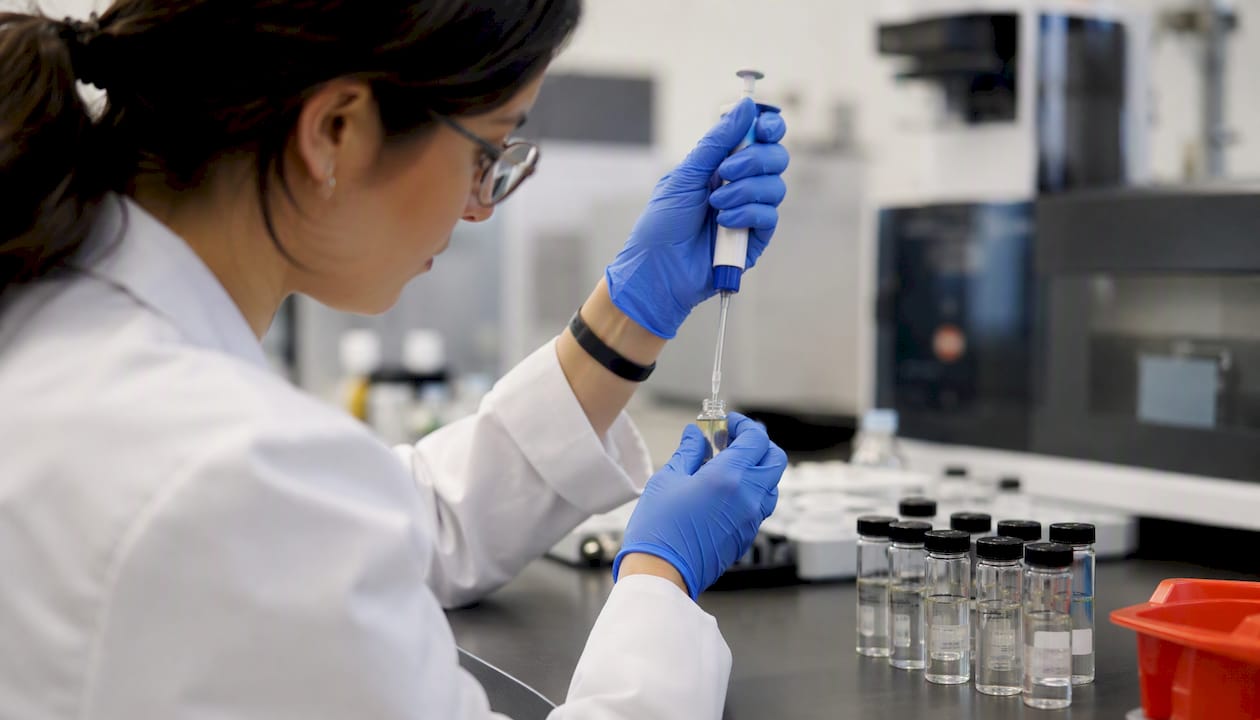
GC-MS Drug Test: How It Works and What to Ask
A GC-MS drug test combines gas chromatography and mass spectrometry into a single analytical method that can definitively identify drugs and their metabolites in a biological sample. It is the confirmatory gold standard in U.S. workplace, forensic, and clinical toxicology testing, called in specifically to verify a non-negative result from an initial immunoassay screen before any legal or employment consequence is applied.
Here is what that means in practice:
- What GC stands for: Gas chromatography separates the compounds in a sample by how quickly they travel through a heated column, sorted by volatility and chemical affinity.
- What MS stands for: Mass spectrometry ionizes those separated compounds and measures the mass-to-charge (m/z) ratios of their fragments, producing a unique spectral “fingerprint.”
- Why it is confirmatory: The combination of retention time (GC) plus spectral fingerprint (MS) makes misidentification extremely unlikely, which is why courts, employers, and federal agencies accept GC-MS results as legally defensible evidence.
- When it is triggered: In standard U.S. workplace testing, a positive immunoassay screen prompts the lab to run GC-MS confirmation before a result is reported as positive.
Key Takeaways
GC-MS is the forensic and workplace confirmatory gold standard because it identifies drugs by two independent criteria, retention time and mass spectral fingerprint, making results legally defensible in ways that immunoassay screens are not.
| Point | Details |
|---|---|
| GC-MS is confirmatory, not a first screen | It follows a non-negative immunoassay result; confirmation typically takes 1–2 days to process. |
| Two-stage identification reduces false positives | Retention time plus mass spectral library match makes misidentification extremely unlikely. |
| Panel gaps are real | Certain benzodiazepines, some cannabinoids, and buprenorphine may not be covered unless specifically requested. |
| Chain of custody and accreditation matter | Ask for CLIA, CAP, or SAMHSA/NLCP certification and documented chain of custody before accepting a result as final. |
| Passmydrugtest supports your research | At-home test kits, detox products, and educational guides help you understand your status and options before a scheduled test. |
Table of Contents
- How the GC-MS testing process works, step by step
- When and where GC-MS analysis for drugs is used
- Advantages and limitations you should know
- Which sample types GC-MS supports and how labs prepare them
- The U.S. testing workflow, turnaround time, and legal defensibility
- How GC-MS compares to immunoassays and LC-MS/MS
- How labs detect specimen tampering and what validity tests show
- What GC-MS results actually tell you
- What Passmydrugtest offers readers preparing for a drug test
- Sources
How the GC-MS testing process works, step by step
Gas chromatography and mass spectrometry work as a two-stage pipeline. Understanding each stage makes lab reports much easier to interpret.
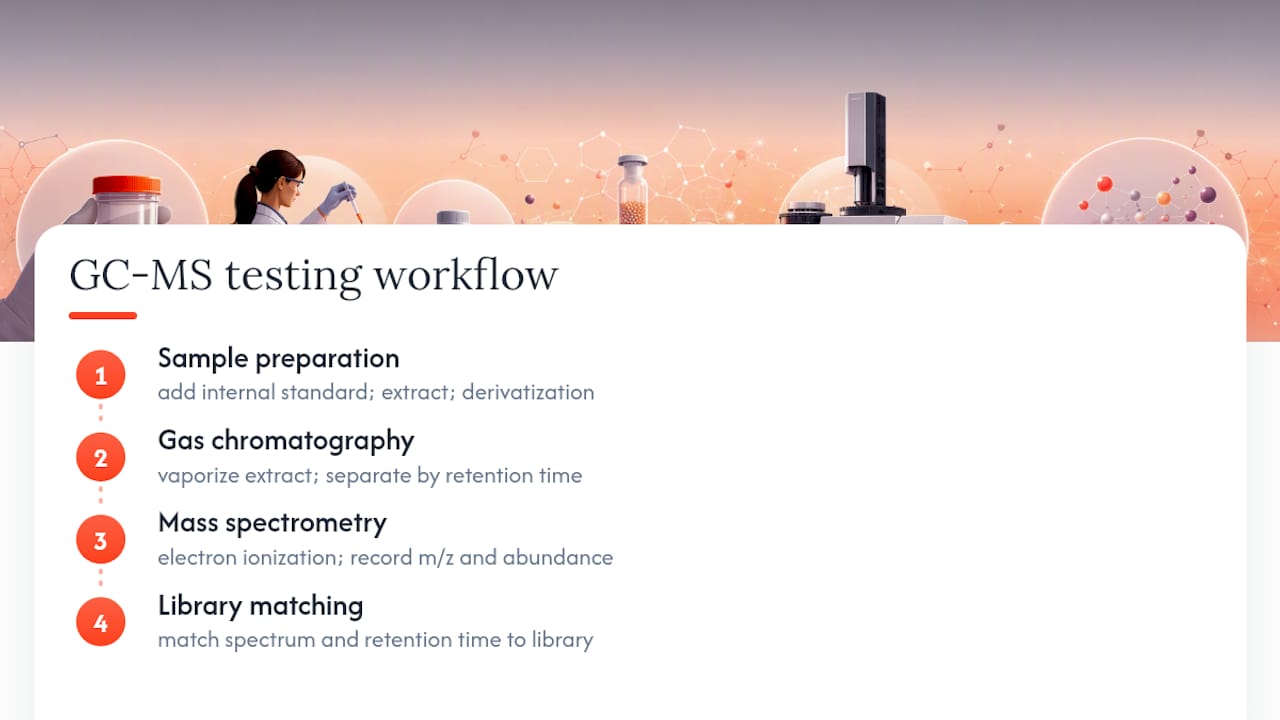
Stage 1: Sample preparation. Raw biological specimens (urine, blood, hair) cannot go directly into the instrument. The lab first adds an internal standard, a known compound at a known concentration, to track recovery and correct for instrument variability. Then it extracts the target analytes using liquid-liquid extraction or solid-phase extraction, concentrating them and removing matrix interferences. For compounds that are thermally unstable or poorly volatile, the lab performs derivatization, a chemical reaction that converts the analyte into a more stable, more volatile form so it survives the GC column without degrading.
Stage 2: GC separation. The prepared extract is injected into the GC inlet, where it is vaporized and carried through a long, narrow capillary column by an inert carrier gas (usually helium). The column is inside a temperature-programmed oven. Compounds with lower boiling points and weaker column interactions elute first; heavier, stickier compounds elute later. Each compound exits the column at a characteristic retention time, which is the first piece of identification evidence.
Stage 3: MS ionization and detection. Compounds leaving the GC column enter the mass spectrometer, where they are bombarded by electrons (electron ionization) and shatter into charged fragments. The detector records the m/z ratio and abundance of every fragment, producing a mass spectrum unique to that molecule. Think of it as a molecular bar code.
Stage 4: Library matching. The instrument’s software compares the sample’s mass spectrum against a reference spectral library containing tens of thousands of known compounds. A high-confidence match on both retention time and spectral pattern confirms the identity of the substance.
Labs choose between two detection modes: full-scan, which captures all m/z values and is useful for broad unknown screening, and selected ion monitoring (SIM), which watches only a few diagnostic ions for a target compound and delivers lower detection limits for targeted panels.
Pro Tip: Derivatization is not just a prep formality. A validated clinical GC-MS platform using programmable temperature vaporizer (PTV) injection and automated spectral deconvolution (AMDIS) demonstrated routine screening of over 200 drugs with improved sensitivity compared to a standard platform. If your lab result involves a low-volatility compound like a glucuronide metabolite, ask whether derivatization was performed.
When and where GC-MS analysis for drugs is used
GC-MS is almost never the first test run. It is the second, definitive step in a two-stage process.
- Workplace and pre-employment testing: Federal guidelines (DOT, SAMHSA) require GC-MS confirmation of any non-negative immunoassay before a result is reported as positive. Confirmatory GC-MS typically takes 1–2 days after the lab initiates the process.
- Forensic and legal investigations: Law enforcement and medical examiners use GC-MS to identify substances in evidence samples, post-mortem specimens, and DUI blood draws, where results must hold up in court.
- Clinical toxicology and overdose evaluation: Emergency and clinical labs use GC-MS (or LC-MS/MS) to identify unknown substances in overdose patients when an immunoassay panel gives ambiguous or negative results despite clinical symptoms.
- Sports anti-doping: WADA-accredited labs use GC-MS to confirm prohibited substances in athlete urine and blood samples, particularly for stimulants, anabolic steroids, and diuretics.
- Custody and compliance monitoring: Courts and treatment programs use GC-MS confirmation when a positive immunoassay result will affect custody, probation, or treatment status.
The common thread: any situation where a wrong result carries a serious consequence gets GC-MS confirmation. A presumptive positive from an immunoassay alone is not sufficient for adverse action in most regulated settings.
Advantages and limitations you should know
Why GC-MS earns its gold-standard reputation
The American Chemical Society describes GC-MS as a synergistic combination: GC handles separation, MS handles unambiguous structural identification. Together they produce results that are legally defensible in ways that immunoassays simply are not.
- High specificity: Two independent identification criteria (retention time + mass spectrum) make false positives extremely rare.
- Library matching: Spectral libraries with tens of thousands of entries let labs identify unknowns, not just confirm suspects.
- Broad analyte coverage: GC-MS handles most volatile and semivolatile drugs well, including amphetamines, opiates, cocaine metabolites, cannabinoids, barbiturates, and many others.
- Legal defensibility: Courts and federal agencies accept GC-MS results because the method is standardized, validated, and produces a documented spectral record.
Where GC-MS has real limits
- Thermally labile compounds: High GC inlet temperatures can degrade unstable molecules. Derivatization solves this for many analytes but adds prep time and complexity.
- Panel gaps: Not every drug class is automatically included. Certain benzodiazepines, some cannabinoids, and buprenorphine may not appear in a standard GC-MS panel unless specifically requested or the lab’s validated library covers them.
- Nonvolatile compounds: Large polar molecules (some peptide hormones, high-molecular-weight drugs) do not vaporize well and are better handled by LC-MS/MS.
- Throughput: GC-MS runs are slower than immunoassay strips, which is why immunoassays remain the first-line screen.
A quick comparison: immunoassays are fast and cheap but prone to cross-reactivity and false positives; GC-MS is slower and more expensive but definitively identifies the compound. LC-MS/MS, discussed in the comparison section below, can outperform GC-MS for certain analytes.
Which sample types GC-MS supports and how labs prepare them
GC-MS works across multiple biological matrices, but the prep steps differ significantly by specimen type.
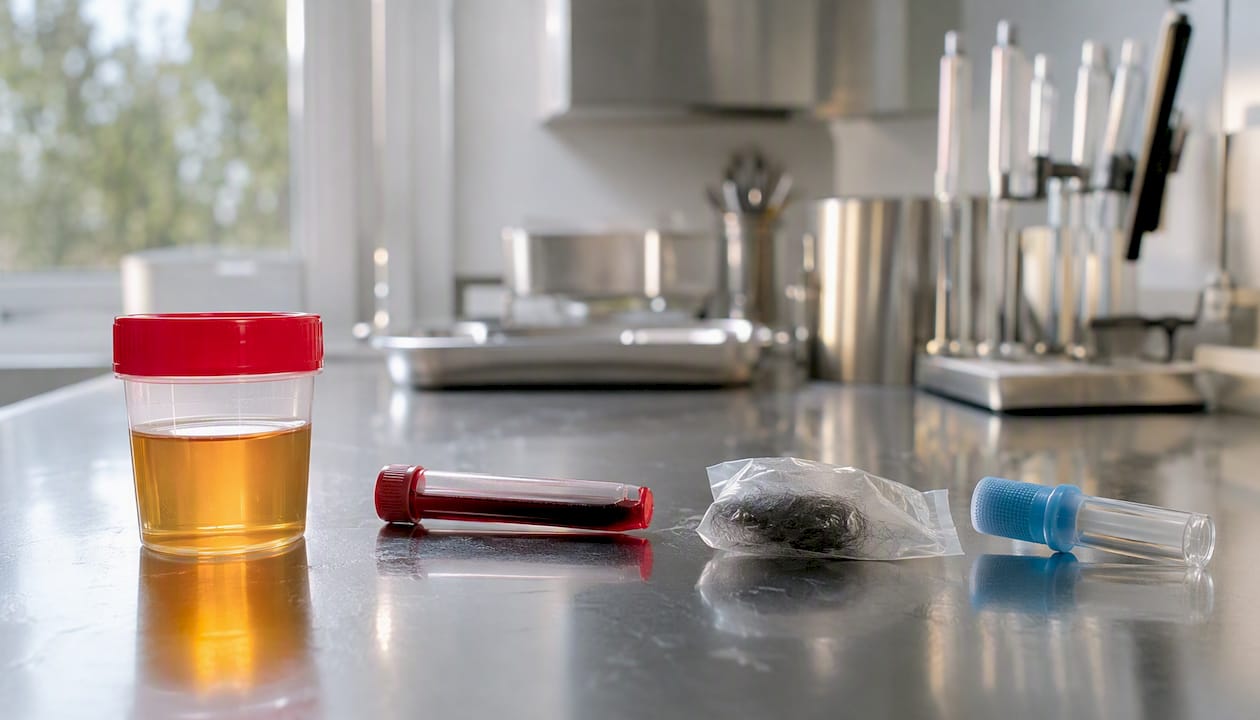
Urine is the most common matrix in U.S. workplace testing. Labs typically hydrolyze conjugated metabolites (glucuronides) first, then extract, concentrate, and derivatize before injection. Urine offers a relatively wide detection window for most drugs.
Blood and plasma are used in forensic and clinical settings where recent impairment matters more than past exposure. Blood prep usually involves protein precipitation followed by liquid-liquid or solid-phase extraction. Detection windows are shorter than urine.
Hair provides the longest detection window, up to 90 days for many substances, because drugs incorporate into the hair shaft as it grows. Hair testing requires digestion of the hair matrix (typically with methanol or alkaline hydrolysis), extraction, and often derivatization before GC-MS analysis.
Oral fluid is increasingly used for roadside and workplace testing. It requires different extraction protocols because of the lower drug concentrations and the presence of salivary proteins.
Across all matrices, labs add an internal standard before extraction begins. This is a deuterium-labeled analog of the target drug, chemically identical but distinguishable by mass. It corrects for extraction losses and instrument drift, which is why quantitative GC-MS results are reliable enough for legal reporting.
Some analytes require special protocols. Conjugated THC metabolites need enzymatic or acid hydrolysis before extraction. Certain benzodiazepines require specific derivatization reagents. If a result seems unexpected, the first question to ask the lab is whether the analyte in question was covered by the validated method used.
The U.S. testing workflow, turnaround time, and legal defensibility
Understanding the procedural chain matters as much as the chemistry, especially when a result has employment or legal consequences.
Typical workflow:
- Step 1: Initial immunoassay screen. The lab runs a rapid immunoassay (urine dipstick or automated analyzer). Results are reported as negative or non-negative, never “positive” at this stage.
- Step 2: Confirmation request. A non-negative screen triggers GC-MS confirmation. In regulated workplace testing, this is mandatory before any adverse action.
- Step 3: GC-MS processing. Confirmation typically takes 1–2 days after the lab begins the process, accounting for sample prep, instrument run time, and review by a qualified scientist.
- Step 4: Reporting. A confirmed positive report states the substance identified, its retention time match, the mass spectral match score, and the quantified concentration if requested. A Medical Review Officer (MRO) reviews the result before it reaches the employer in federally regulated testing.
What makes a GC-MS result legally defensible:
- Documented chain of custody: An unbroken paper trail from specimen collection through lab analysis. Any gap can be challenged in court or an administrative hearing.
- Lab accreditation: Look for CLIA certification, CAP accreditation, or ISO 17025 certification. SAMHSA/NLCP certification is required for federally mandated workplace testing.
- Method validation records: Labs must document limits of detection and quantitation, linearity, precision, accuracy, specificity, and carryover for each confirmatory method.
- Instrument calibration logs: Calibrators and quality controls run with every batch; records must be available for review.
A confirmed positive is categorically different from a presumptive positive. The confirmed result names the specific compound, its concentration relative to the cutoff, and the spectral evidence. A presumptive positive from an immunoassay only says a compound in a drug class may be present.
How GC-MS compares to immunoassays and LC-MS/MS
GC-MS/MS and LC-MS/MS have expanded the confirmatory toolkit. Here is how the main methods compare across the dimensions that matter most.
| Dimension | Immunoassay | GC-MS | LC-MS/MS |
|---|---|---|---|
| Purpose / best use | Rapid presumptive screen | Confirmatory; volatile/semivolatile analytes | Confirmatory; nonvolatile, thermally labile analytes |
| Sensitivity & specificity | High sensitivity, lower specificity; cross-reactivity risk | High specificity; sensitivity varies by mode (SIM better than full-scan) | Very high sensitivity and specificity for targeted analytes |
| Turnaround / throughput | Minutes; high throughput | 1–2 days for confirmation; moderate throughput | 1–2 days; moderate-to-high throughput |
| Sample types | Urine primarily; some oral fluid | Urine, blood, hair, oral fluid | Urine, blood, oral fluid, hair |
| Cost & complexity | Low cost; minimal training | Moderate cost; requires trained analysts | Higher instrument cost; requires skilled operators |
| Forensic defensibility | Presumptive only; not stand-alone | Gold standard; court-accepted | Accepted; increasingly used in forensic labs |
When LC-MS/MS is preferred: Analytes that do not vaporize well or degrade under GC heat, such as certain benzodiazepines, synthetic cannabinoids, fentanyl analogs, and large polar molecules, are better handled by liquid chromatography. LC-MS/MS also offers lower detection limits for some opioids and designer drugs.
When GC-MS remains the go-to: Volatile and semivolatile drugs with well-established spectral libraries (amphetamines, cocaine metabolites, opiates, THC-COOH) are reliably confirmed by GC-MS, and the method’s decades-long forensic track record gives it unmatched legal credibility.
Questions to ask your lab: What method was used for confirmation? Was derivatization performed? What spectral library and match-score threshold were applied? What were the cutoff concentrations? These questions are not unusual; any accredited lab should answer them without hesitation.
How labs detect specimen tampering and what validity tests show
GC-MS confirms what compounds are present in a sample. But before that analysis even runs, labs perform specimen validity testing (SVT) to verify the sample is what it is supposed to be.
Standard SVT checks on urine include:
- Creatinine concentration: Normal urine falls within a defined range. Values below 2 mg/dL suggest substitution; values above 300 mg/dL suggest an unusual specimen.
- Specific gravity: Measured by refractometry; normal range is 1.003–1.030. Values outside this range flag dilution or substitution.
- pH: Normal urine pH runs 4.5–8.5. Values outside this range suggest adulteration.
- Oxidant/adulterant screens: Reagent strips or colorimetric assays detect bleach, nitrites, chromates, and other common adulterants.
- Temperature at collection: Urine should be 90–100°F within four minutes of collection. Out-of-range temperature is the first indicator of substitution.
Synthetic urine products are designed to mimic these parameters, but labs have added more specific checks. Some labs test for uric acid (present in real urine, absent in many synthetic products), specific enzyme markers, or use mass spectrometry-based profiling to identify an atypical chemical signature. As labs update their SVT panels, the gap between what synthetic products replicate and what labs can detect continues to narrow.
A note on ethics and legality: attempting to substitute or adulterate a specimen in a federally regulated drug test is a federal offense under 49 CFR Part 40. Beyond the legal risk, tampering with a test ordered for clinical or safety-sensitive reasons creates genuine health and safety hazards. Understanding urine drug test validity is legitimate consumer knowledge; acting on it to deceive a regulated test is not.
What GC-MS results actually tell you
GC-MS is the most reliable confirmatory tool available for drug testing, but reliability is not the same as infallibility. The method’s strength is specificity: when a GC-MS result comes back confirmed positive, the compound has been identified by two independent criteria and the result is almost certainly accurate. The practical questions are about what the test was designed to find and whether the lab’s panel covered it.
A few things worth keeping in mind when you receive or review a GC-MS report:
Ask whether the lab is SAMHSA/NLCP-certified for federally mandated testing, or CLIA/CAP-accredited for clinical testing. Ask what cutoff concentrations were used, because a result near the cutoff carries different weight than one ten times above it. If a drug you did not expect appears on the report, ask specifically whether derivatization was performed and what the spectral match score was. And if the result carries employment, legal, or clinical consequences, consult an occupational health physician, a toxicologist, or legal counsel before acting on it. A confirmed positive is serious, but the procedural record around it matters just as much as the chemistry.
What Passmydrugtest offers readers preparing for a drug test
If you are researching GC-MS because a workplace, pre-employment, or legal test is coming up, knowing the method is only part of the picture. Passmydrugtest gives you the other part: at-home test kits that let you check your own status before the lab does, plus educational guides on drug testing methods and employment screening that explain detection windows, cutoff thresholds, and what different test types actually measure.
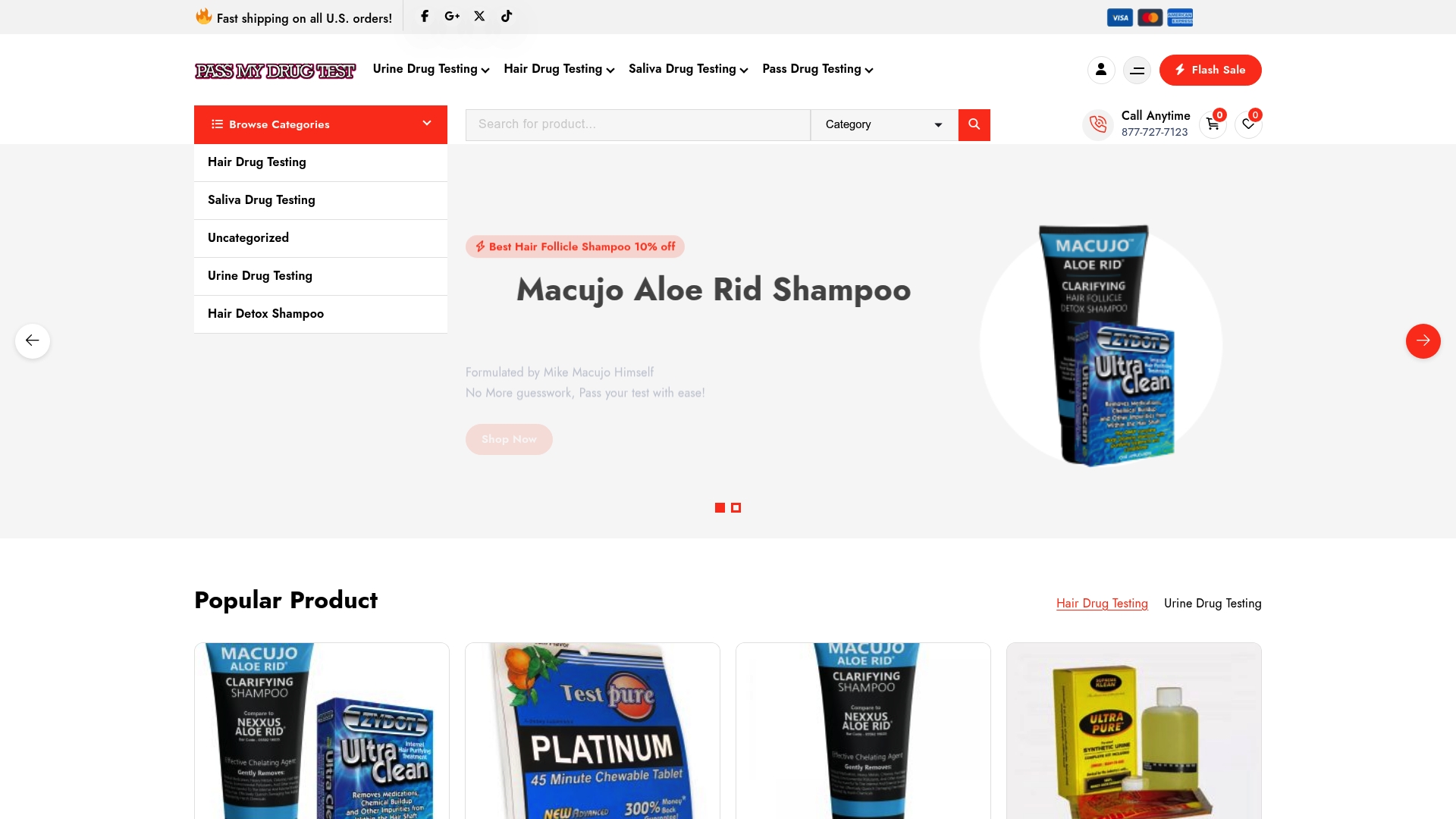
The site also carries detox products and preparation resources for readers who want to explore their options ahead of a scheduled test. Every purchase ships fast within the United States. Browse the full range of detox products and preparation guides at Passmydrugtest, and use the phone support line during business hours if you have questions about which product fits your situation. Always follow applicable laws and your employer’s policies.
This article is general information, not medical, legal, or professional advice. Confirm current testing requirements and cutoff standards with your lab, employer, or a qualified professional.
Sources
- Gas Chromatography Mass Spectrometry (GC-MS) Information | Thermo Fisher Scientific – US
- Drug Screen by GC/MS, Urine
- Clinical GC‑MS platform employing PTV injection and AMDIS for routine drug screening — NCBI PMC