
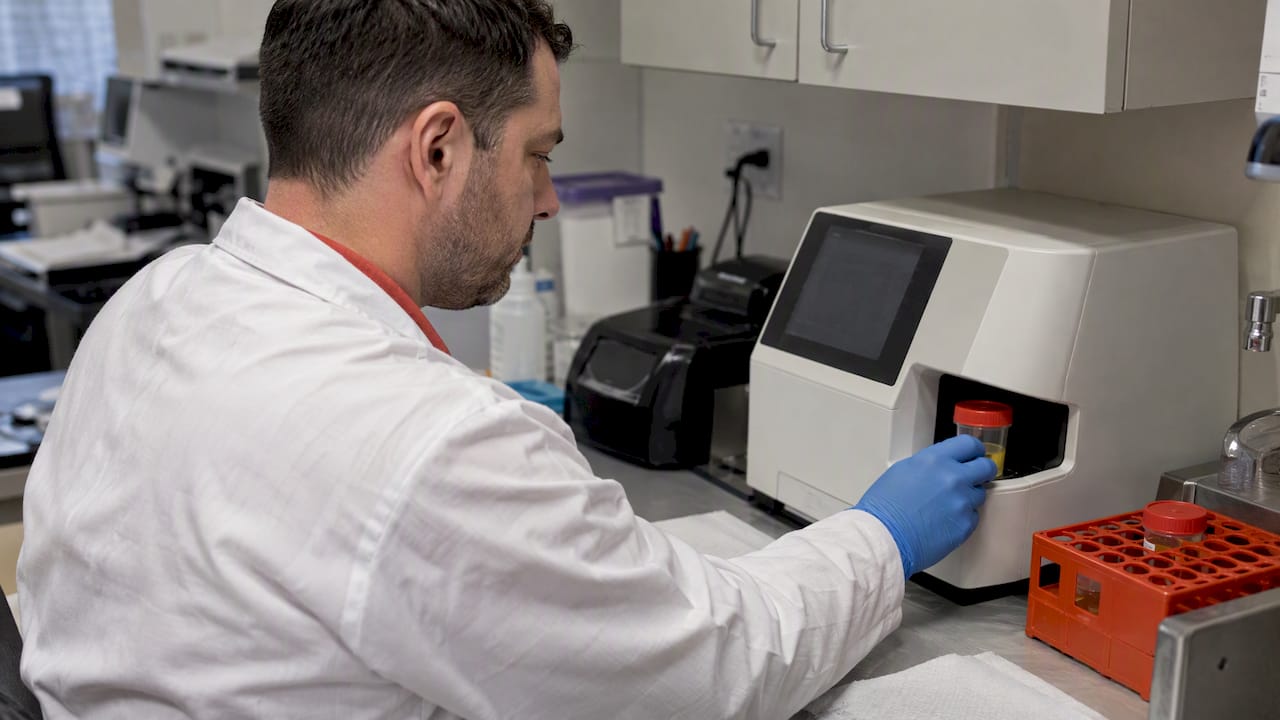
Urine Validity Checks: What the 20 mg/dL Cutoff Can Miss
Urine validity checks work by measuring creatinine and specific gravity to catch dilution or substitution, pH and oxidant or nitrite levels to catch chemical adulteration, and temperature or volume at collection to flag tampering on the spot. Under HHS/DOT Part 40, labs do not rely on any single number. They weigh these measures together before classifying a specimen as dilute, substituted, adulterated, or invalid.
TL;DR:
- A dilute classification requires creatinine of at least 2 mg/dL but below 20 mg/dL, plus specific gravity above 1.0010 and below 1.0030.
- A substituted or adulterated finding requires confirmation on a second aliquot before the laboratory reports it to the medical review officer.
- Collectors check temperature within four minutes; readings outside 90 to 100 degrees Fahrenheit, low volume, or unusual appearance can prompt a directly observed recollection.
- Rapid strips typically screen six to seven markers in one to two minutes, but positive or borderline readings require formal laboratory testing.
- Normal hydration helps prevent an innocent dilute result, while medical conditions, heavy exercise, or detox products can affect readings; disclose relevant factors.
Table of Contents
- What specimen validity testing actually measures
- How labs classify results: official cutoffs and reporting rules
- Collection-site checks that catch problems before the lab does
- Common adulterants and how rapid test strips screen for them
- Where standard checks fall short and what labs add
- How to provide a sample that won’t come back invalid
- How validity checks differ by testing context
- What actually happens after a result gets flagged
- Educational resources and product options from Passmydrugtest
- FAQ
- Sources
What specimen validity testing actually measures
Specimen validity testing (SVT) exists because a urine sample can look normal and still not be a true, unaltered reflection of what someone’s body produced. Labs run a handful of routine measurements on every specimen to catch dilution, substitution, or chemical tampering before the drug screen result even matters.
Creatinine is the anchor measurement. It is a waste product the kidneys excrete at a fairly steady rate, so a healthy adult’s urine almost always contains a measurable, predictable amount of it. When creatinine comes back unusually low, that is one of the first signs a specimen may have been diluted with water or swapped for something that is not urine at all.
Specific gravity measures how concentrated the urine is compared to pure water. It should rise and fall in step with creatinine. When specific gravity is too close to water’s value while creatinine is also low, the two measurements reinforce each other and point toward dilution or substitution rather than a one-off lab error.
pH extremes matter because human urine normally sits in a fairly narrow range. A reading that is unusually acidic or unusually alkaline can indicate someone added an acid or a base to the sample in an attempt to interfere with drug detection.
Oxidant and nitrite testing looks for chemical adulterants like bleach, hydrogen peroxide, or nitrite-based products sold specifically to destroy drug metabolites in the sample before testing.
Temperature and volume are the first checks, taken within minutes of collection:
- Temperature outside the expected range at collection suggests the specimen was not freshly produced by the donor.
- Volume below the minimum required amount can trigger a recollection under direct observation.
How labs classify results: official cutoffs and reporting rules
HHS/DOT Part 40 spells out exactly which validity tests a laboratory must run and what the numbers mean once they come back. Every primary specimen gets a creatinine measurement. When creatinine falls below 20 mg/dL, the lab also determines specific gravity. pH and initial oxidant testing happen on every specimen as well, with additional validity tests run whenever something looks off.
The classifications themselves are specific, not a matter of lab judgment:
- A specimen is dilute when creatinine is at least 2 mg/dL but less than 20 mg/dL, and specific gravity is above 1.0010 but below 1.0030.
- A specimen is substituted when creatinine is below 2 mg/dL and specific gravity is at or below 1.0010 or at or above 1.0200.
- A specimen is adulterated when it contains a detectable oxidant, nitrite, or halogen above the established cutoff, or shows pH or other characteristics inconsistent with normal human urine.
A substituted or adulterated finding cannot be reported off a single test. Part 40 requires confirmation on a second aliquot of the same specimen before that classification becomes official. This two-aliquot rule exists specifically to prevent a single measurement error or instrument glitch from ending someone’s test on a false substitution call.
When a lab suspects an adulterant it cannot identify with its own methods, the rules direct it to send the specimen to a second HHS-certified laboratory equipped to pin down the substance. Once results are finalized, the lab reports specific numeric values, creatinine, specific gravity, pH, and oxidant test results, to the medical review officer (MRO), who uses those figures, not just a pass or fail label, to decide how the result gets handled.
Collection-site checks that catch problems before the lab does
Many substitution attempts get caught before a sample ever reaches a laboratory, simply because collection staff are trained to watch for a short list of red flags in real time.
- Check the temperature strip within four minutes of collection. A specimen fresh from the body typically reads between 90 and 100 degrees Fahrenheit; anything outside that window raises suspicion immediately.
- Confirm the donor emptied pockets and bags before entering the collection area, removing the chance of hidden substitute samples or dilution aids.
- Secure or shut off water sources in the collection room so a donor cannot dilute the specimen on the spot.
- Escalate to a supervised or directly observed recollection when temperature, volume, or appearance looks wrong the first time.
These collection controls often catch substitution faster than any lab test can, because they happen in the same minute the sample is produced, before dilution, synthetic products, or temperature manipulation have any chance to pass undetected into a batch of samples waiting for analysis.
Common adulterants and how rapid test strips screen for them
People attempting to beat a urine screen generally try one of two approaches: diluting or replacing the sample, or adding a chemical to disrupt the lab’s detection chemistry. Water loading and synthetic urine products target the dilution and substitution side. On the chemical side, the usual suspects are household bleach, nitrite-based liquid additives, glutaraldehyde, pyridinium chlorochromate (PCC), and surfactants marketed as “cleansing” products.
Rapid adulteration test strips, the kind used for an immediate, on-site presumptive check, typically measure six to seven parameters on one strip: creatinine, specific gravity, and pH, plus color-change pads for oxidants, nitrite, glutaraldehyde, and PCC. Manufacturer testing documentation describes these as semi-quantitative screens, fast and useful for flagging a problem, but not a final determination.
- Strips read in roughly one to two minutes by comparing pad colors to a reference chart.
- A positive or borderline reading flags the specimen for formal laboratory validity testing.
- Strip results are never reported as the final outcome of a drug test on their own.
Pro Tip: Any dip-strip result, whether run at a collection site or bought for personal use, is a presumptive screen only; treat an abnormal reading as a signal to investigate further, not as a confirmed lab finding.
Where standard checks fall short and what labs add
Standard SVT (creatinine, specific gravity, pH, oxidants) catches most dilution and obvious chemical tampering, but it was not built to catch every version of synthetic urine on the market. SAMHSA/NLCP guidance lays out the normal ranges labs compare against: pH between 4.5 and 9.0, creatinine above 20 mg/dL for a normal reading, specific gravity between 1.001 and 1.030, and temperature between 90 and 100 degrees Fahrenheit at collection.
The same guidance notes that some synthetic urine formulations have gotten sophisticated enough to land inside those normal ranges on the routine panel alone. That is why labs increasingly reach for additional, non-routine biomarkers when a specimen looks borderline or when a program wants extra assurance:
- Uric acid and urea, both naturally present in human urine but absent or inconsistent in many synthetic formulations.
- Gamma-glutamyl transferase (GGT) and amylase, enzymes that occur in real urine but are difficult to replicate convincingly in a lab-made product.
- Osmolality, a concentration measure that can catch inconsistencies standard specific gravity testing misses.
Combining endogenous markers like these with the standard exogenous adulterant panel gives labs more confidence in a finding and reduces the odds of a false call either way. The tradeoff is complexity: cutoffs for these added markers have to be set carefully, since legitimate low-creatinine samples from first-morning urine or certain diets can otherwise get flagged as suspicious. As synthetic urine products add more of these markers to their own formulas, this remains an area where lab panels keep evolving rather than staying fixed.
How to provide a sample that won’t come back invalid
Most invalid results trace back to something avoidable rather than deliberate tampering. A few habits make a real difference.
Stay hydrated normally in the days before a test, but avoid loading up on large amounts of water right before collection. Overhydration is one of the most common, and most innocent, causes of a dilute result, since it genuinely lowers creatinine and specific gravity even without any intent to cheat.
Give a full void rather than a partial one when the collection site asks for a minimum volume. Low volume forces a recollection, often under direct observation, which adds time and stress that a complete first sample avoids entirely.
Avoid self-medicating with large doses of vitamins, baking soda, or other substances marketed online as detox aids right before a test; some of these can shift pH or other readings in ways that look suspicious even when nothing illicit is involved.
If a medical condition affects urine output, concentration, or pH (certain kidney conditions, diabetes, or recent heavy exercise can all play a role), mention it to the collector or be ready to discuss it with the medical review officer if asked. Documentation of a legitimate medical cause is often the fastest way to resolve a flagged result without further complication.
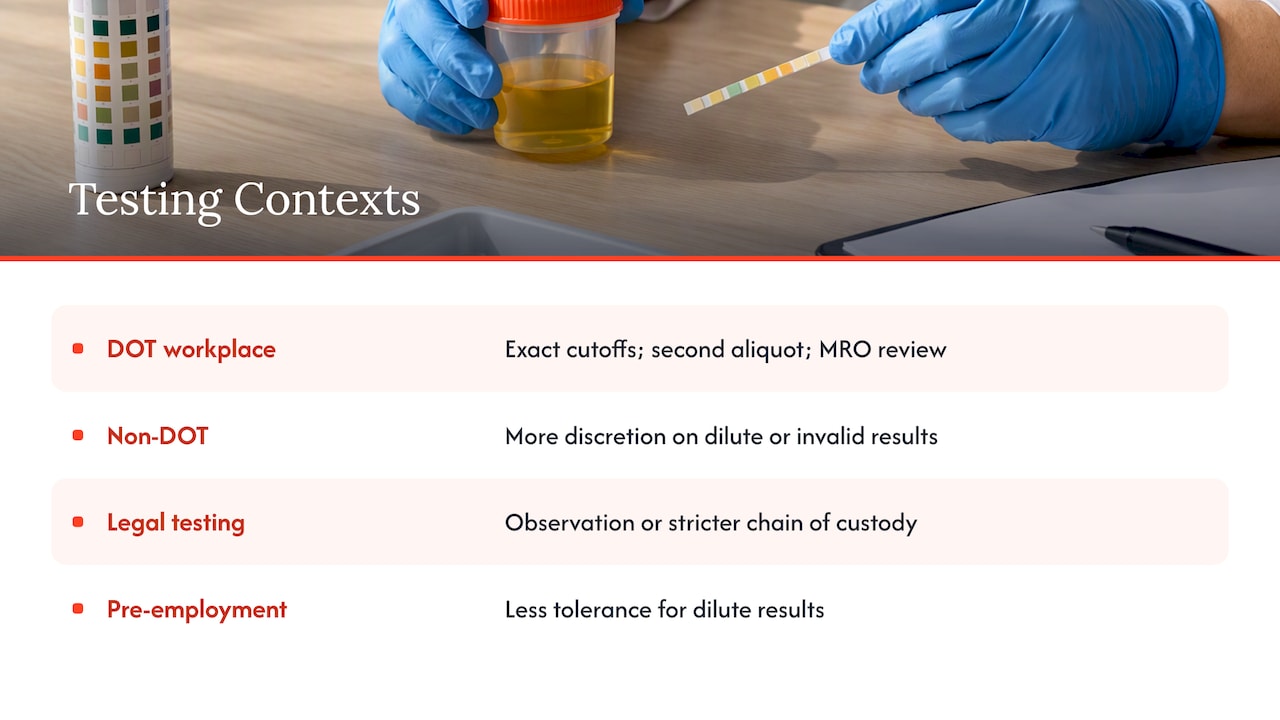
How validity checks differ by testing context
The chemistry behind SVT does not change based on why someone is being tested, but the stakes and the strictness of enforcement do.
Workplace testing under DOT-regulated programs follows Part 40 to the letter: exact cutoffs, mandatory confirmatory testing on a second aliquot, and a defined role for the MRO in every borderline case. Non-DOT employers often use similar lab panels but have more discretion in how they respond to a dilute or invalid result, since they are not bound by the same federal reporting rules.
Legal and court-ordered testing, such as for probation or custody cases, tends to add direct observation or stricter chain-of-custody requirements from the start, since the legal consequences of a substituted or adulterated finding are often more severe than in a typical workplace setting.
Pre-employment screening generally mirrors standard workplace SVT but may carry less tolerance for a dilute result, since a candidate who has not yet been hired often has less standing to contest a recollection request compared to a current employee contesting a result through a grievance process.
Across all three contexts, the underlying measurements, creatinine, specific gravity, pH, and oxidants, stay the same. What changes is who reviews a flagged result, how much room there is for explanation, and how fast a recollection gets ordered.
What actually happens after a result gets flagged
A flagged validity result is a data point, not a verdict. Standard practice is confirmatory testing on a second aliquot, possible send-out to a specialized lab, and MRO review before anything gets reported as final. Transport time, hydration, diet, infection, and certain medical conditions can all shift pH or creatinine without any intent to cheat, and sorting out which explanation applies is exactly what the MRO process is designed to do. My own view: donors who understand the steps ahead of time, and cooperate with collection procedure rather than resist it, tend to get through a flagged result with far less friction than those who treat it as an accusation.
— MIchael
Educational resources and product options from Passmydrugtest
Understanding what creatinine, specific gravity, and oxidant tests actually measure is the first step. Putting that knowledge to use, whether you are preparing for a specific testing scenario or just want to understand your options, is where we come in. We built Passmydrugtest around two things: clear educational content on how drug testing works, and a curated catalog of test-related products, with fast shipping across the United States and phone support if you need to talk through your situation before ordering.
If you want to go deeper on one specific measurement, our article on specific gravity readings between 1.003 and 1.035 breaks down what those numbers mean in practice. And if you are looking at collection tools or test-prep products while you plan ahead, our urine testing category is the place to start comparing what is available.
FAQ
How long does urine stay good for a pee test?
A urine sample is generally considered reliable only when tested fresh, ideally within an hour of collection, since it can change temperature, pH, and bacterial content the longer it sits. Collection sites account for this by requiring temperature checks within minutes of the void specifically because a sample loses its validity markers over time.
Can a lab tell if you use synthetic urine?
Labs run specific validity tests, creatinine, specific gravity, pH, and oxidant screening, specifically designed to catch substitution, and a product that fails even one of these measures gets flagged under HHS/DOT rules. Some labs also use additional biomarkers like uric acid, urea, or GGT when a specimen needs extra scrutiny, since these are harder for synthetic formulas to replicate convincingly.
What is urine validity testing?
Urine validity testing, often shortened to SVT, is the set of lab measurements, creatinine, specific gravity, pH, and oxidant or nitrite levels, used to confirm that a urine specimen is genuine, undiluted, and free of added chemicals before a drug screen result is reported. HHS/DOT Part 40 requires these checks on every specimen submitted for federally regulated testing.
How long is first morning urine good for in a cup?
First morning urine should be tested as soon as possible after collection, generally within an hour, because the same temperature and chemical shifts that affect any urine sample apply to it as well. Keeping the sample cool and sealed helps preserve its characteristics, but it is not a substitute for prompt testing, since validity markers like pH and oxidant levels can drift the longer the sample waits.
Sources
- 40.88 – Specimen validity test for urine (DOT / HHS)
- Use of urine biomarkers in validity testing; Strategies and complexities (SAMHSA / NLCP)
- iScreen™ Urine Test Adulteration Test Strip (Abbott Toxicology)