
Synthetic Urine Can Pass 4 Checks, but Biomarkers Can Expose It
Synthetic urine can be detected, but the odds depend entirely on which test tier a lab runs. Routine specimen validity testing catches obvious fakes through temperature, pH, and creatinine checks, while advanced biomarker panels and LC-MS/MS testing can catch formulas that pass those basic checks. A flagged sample often gets treated the same as a refusal to test, which can trigger the same consequences as a confirmed positive.
TL;DR:
- Collection staff check temperature within four minutes, then labs assess pH, creatinine, and specific gravity; suspicious color, cloudiness, or conduct can prompt scrutiny.
- Advanced review may compare GGT, amylase, uric acid, urea, and other human markers together; LC-MS/MS can identify synthetic compounds or missing metabolites.
- Because advanced panels cost more and take longer, labs generally reserve them for samples flagged by collectors, employers, or inconsistent result patterns.
- Under DOT rules, a substituted specimen counts as refusal to test, and donors should respond promptly to the MRO with records supporting any medical explanation.
Table of Contents
- How standard specimen validity testing works and its limits
- Advanced laboratory detection: biomarkers and LC-MS/MS
- Collection-site checks and immediate red flags
- Consequences and regulatory handling under DOT and MRO review
- If your sample is flagged: practical next steps
- Whether routine labs can detect synthetic urine
- Common brands and formulations of synthetic urine and their detectability
- Techniques laboratories use beyond standard validity panels
- Recent advancements in synthetic urine formulations designed to evade detection
- Guidance on timing and freshness of synthetic urine samples affecting detectability
- Legal implications and employer policies related to synthetic urine use
- What our team has learned covering drug testing science
- How we can help you prepare
- FAQ
- Sources
How standard specimen validity testing works and its limits
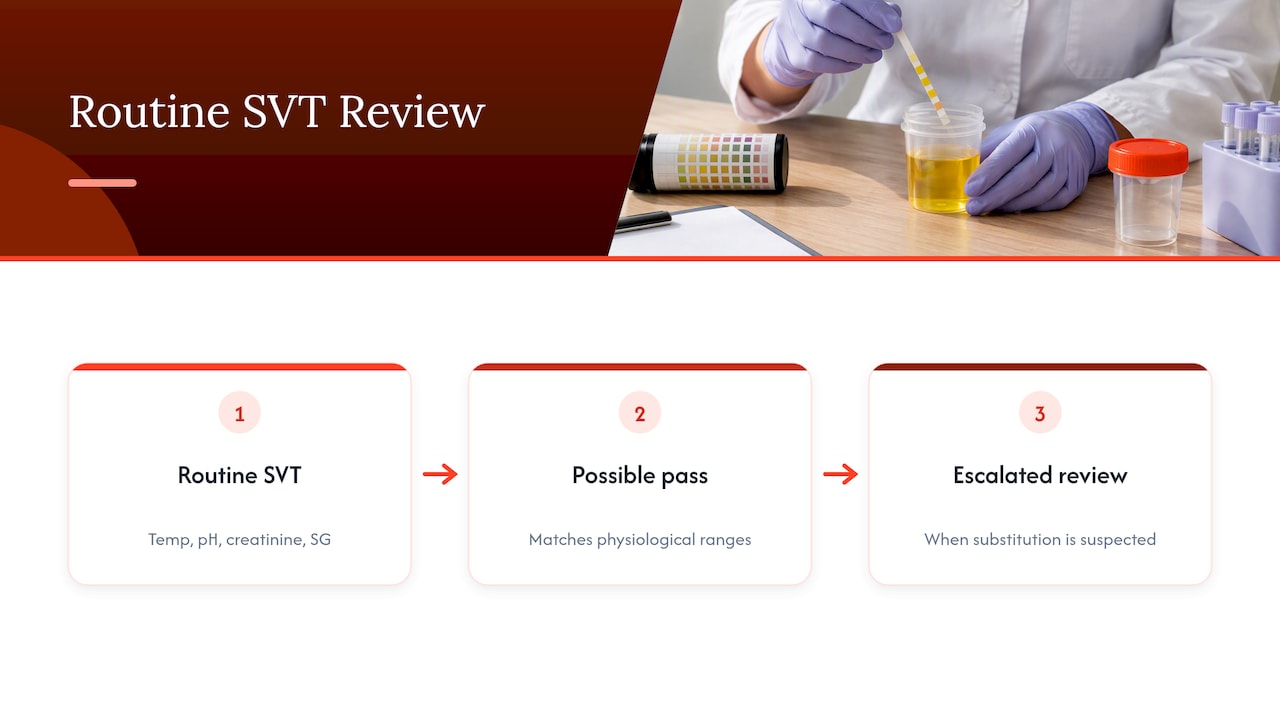
Every urine drug screen starts with specimen validity testing, a set of checks designed to confirm the sample is actual human urine within a normal physiological range. Collection staff run an on-site temperature check within four minutes of the donor handing over the specimen, inspect its color and clarity, and watch the collection process itself to prevent tampering.
Once the sample reaches the lab, technicians measure it against federal thresholds for pH, creatinine, and specific gravity. Federal specimen validity parameters define what counts as physiologically normal urine, and a result outside that range gets classified as substituted, dilute, or adulterated rather than simply negative or positive.
- Temperature must fall within the strip’s indicated range within four minutes of collection.
- Creatinine below the federal threshold suggests a sample that is not concentrated human urine.
- Specific gravity outside the normal range points to dilution or substitution.
- pH far outside normal physiological bounds indicates tampering or a non-urine substitute.
Many synthetic urine products are formulated specifically to clear these four checks. They include creatinine, urea, and buffering agents to land inside the federal ranges, and they ship with heating elements or hand warmers to hit the correct temperature window. SAMHSA collection guidance documents how collectors handle specimens that look suspicious, but a well-made synthetic formula that is fresh and properly warmed can pass routine SVT without raising a flag. That is exactly why labs escalate certain samples, particularly those flagged by collectors or requested by an employer, to a second tier of testing that routine SVT was never designed to catch.
Advanced laboratory detection: biomarkers and LC-MS/MS
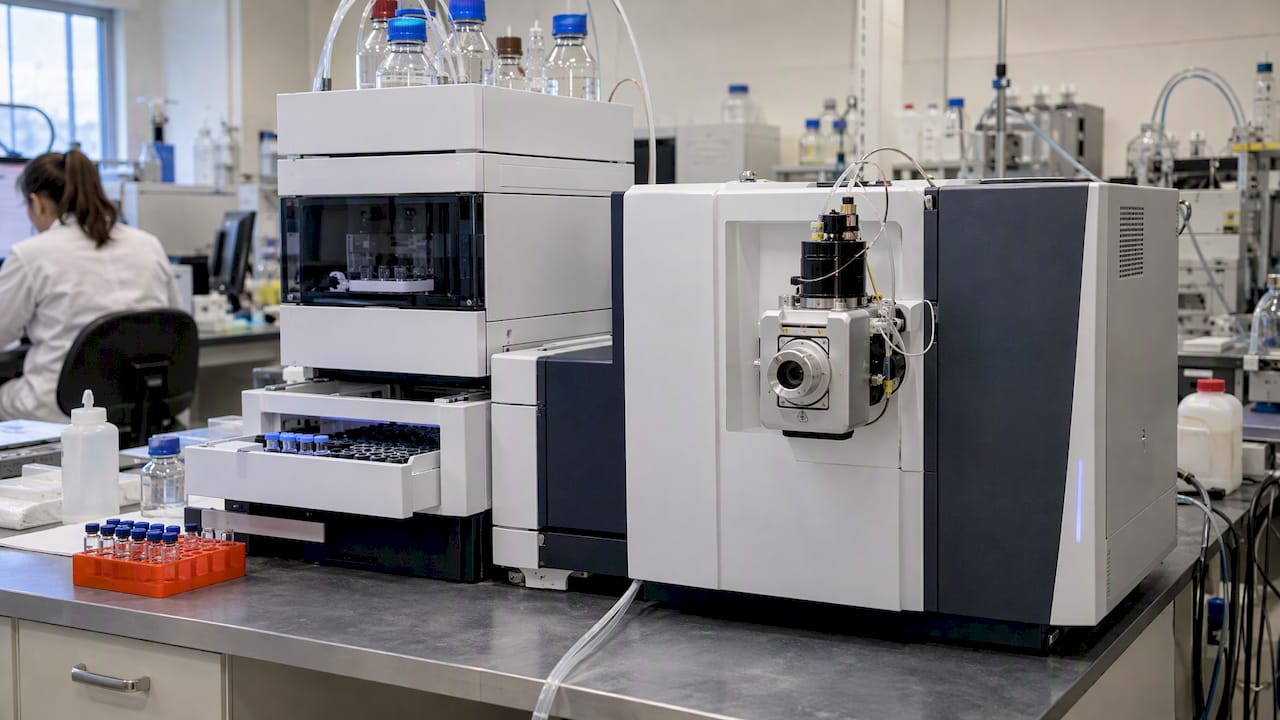
When a sample clears basic SVT but still looks questionable, labs can turn to biomarker analysis and liquid chromatography tandem mass spectrometry, commonly called LC-MS/MS. This tier works two ways: direct detection, which looks for compounds that only exist in synthetic formulas, and indirect detection, which looks for the absence of substances that real human urine should contain.
Several endogenous markers show up in this second category:
- Gamma-glutamyl transferase (GGT), an enzyme typically present in human urine.
- Amylase, another enzyme usually detectable in genuine samples.
- Uric acid, a waste product from normal metabolism.
- Urea, a byproduct of protein breakdown.
- Phenylacetylglutamine, a compound tied to gut microbial activity.
A toxicology laboratory study found that GGT and amylase were consistently absent from synthetic urine samples identified during routine casework, and the researchers recommended adding both enzymes to standard SVT panels. Peer-reviewed research on synthetic urine detection confirms that routine SVT alone often misses these products, while biomarker panels combined with LC-MS/MS confirmation can expose the absence of compounds a real donor’s body would produce.
No single validity marker reliably detects every synthetic urine formula on the market.
That line matters because labs do not rely on one enzyme or one metabolite. They interpret a panel of markers together, since a formula that successfully mimics creatinine and pH might still be missing uric acid or GGT, and a formula engineered to include those enzymes might still fail a different check. The practical result is a moving target: no synthetic formula stays undetectable indefinitely once labs adjust their panels.
Collection-site checks and immediate red flags
The first line of defense happens before a sample ever leaves the collection site, and it often decides whether a specimen gets extra scrutiny.
- Temperature window: collectors must record the strip reading within four minutes of collection, and a reading outside the acceptable band is an immediate red flag.
- Visual inspection: unusual color, cloudiness, foreign particles, or abnormal foaming all prompt a closer look.
- Volume check: a specimen below the minimum volume threshold is treated as insufficient and handled under separate procedures.
- Donor conduct: unusual behavior during collection, such as prolonged delays or attempts to shield the specimen, can trigger direct observation.
SAMHSA collection site guidance requires collectors to document any of these red flags and, when criteria are met, to require a directly observed collection for the next attempt. Refusing to cooperate with that process is treated as a refusal to test under DOT and SAMHSA protocols, carrying the same consequences as a confirmed positive.
Pro Tip: A specimen that fails the temperature check almost always gets flagged before it ever reaches a lab, regardless of what the formula inside it was designed to do.
Consequences and regulatory handling under DOT and MRO review
Federal transportation rules do not treat a substituted specimen as a gray area. DOT Rule 49 CFR Part 40 Section 40.191 classifies a substituted specimen as a refusal to test, and refusals carry the same consequences as a confirmed positive result under DOT regulations. For safety-sensitive employees, that typically means immediate removal from safety-sensitive duties pending review.
- A substituted or adulterated result is reported to the Medical Review Officer (MRO) before it reaches the employer.
- The MRO contacts the donor to determine whether a legitimate medical explanation exists.
- Absent a valid explanation, the result is reported as a refusal, triggering the employer’s established consequences.
- Return to safety-sensitive duty typically requires a return-to-duty evaluation and follow-up testing under a monitored program.
Employers outside DOT-regulated industries often adopt similar policies, treating a flagged specimen as equivalent to a positive result for disciplinary purposes.
If your sample is flagged: practical next steps
A flagged specimen is not automatically the end of the process, but how a donor responds in the following days matters.
- Cooperate fully with any request for a second or directly observed collection.
- Request contact information for the MRO assigned to the case.
- Gather medical records promptly if a physiological condition could explain the result.
- Notify HR or a union representative, if applicable, early in the process.
- Respond to MRO outreach within the timeframe given, since missed deadlines can convert a pending review into a final refusal finding.
MRO case studies on urine testing describe the kinds of documentation MROs evaluate, including physician statements and lab records tied to a specific medical condition. The burden of proof sits with the donor, and a vague claim without supporting records rarely changes the outcome.
Whether routine labs can detect synthetic urine
Routine labs are built to catch tampering, not to confirm biological origin with certainty. Standard SVT checks temperature, pH, creatinine, and specific gravity against federal thresholds, and a synthetic formula with incorrect ratios or a cold temperature will fail at this stage every time.
The limitation is that routine SVT was designed around the physiological ranges of real urine, not around detecting every compound a manufacturer might add or omit. A well-formulated synthetic product that matches those ranges and arrives at the right temperature can clear routine testing without triggering a second look. Research on synthetic urine detection methods confirms that routine SVT often fails to catch modern formulas for exactly this reason.
This is why routine testing functions as a filter rather than a final verdict. It catches careless attempts, poorly mixed formulas, and samples submitted at the wrong temperature, but it was never built to detect a product engineered specifically to mimic human urine’s basic chemistry. Labs that suspect substitution, whether from a collector’s note, an employer’s request, or an unusual pattern in prior results, escalate to biomarker and LC-MS/MS testing precisely because routine checks have a known ceiling.
Common brands and formulations of synthetic urine and their detectability
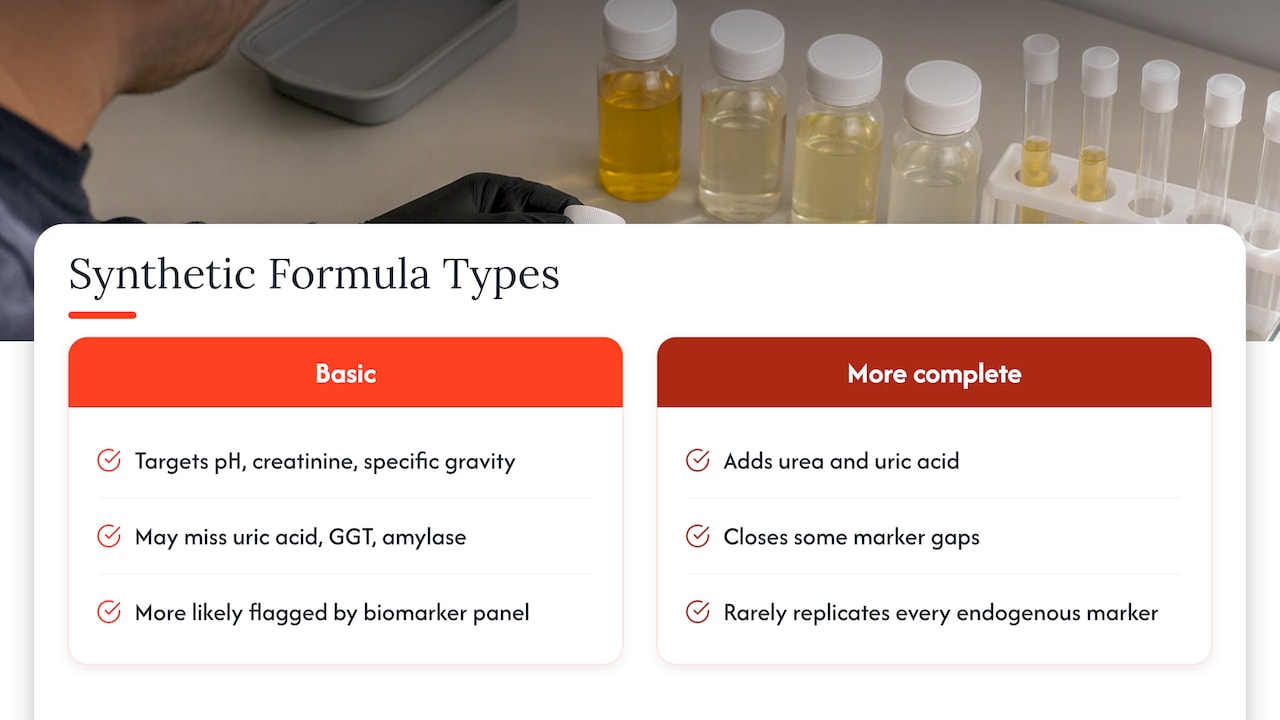
Synthetic urine products on the market generally fall into two categories: basic formulas that include only the compounds needed to pass pH, creatinine, and specific gravity checks, and more complete formulas that also add enzymes like urea and uric acid to mimic a fuller biological profile.
The gap between these categories is where detectability diverges. A basic formula missing uric acid, GGT, or amylase can pass routine SVT but is far more likely to get flagged if a lab runs a biomarker panel, since those compounds are exactly what enzyme-based detection research found absent in identified synthetic samples. A more complete formula closes some of those gaps but rarely replicates every endogenous marker a lab might check.
Freshness and storage also affect detectability regardless of formula quality. A product left unused past its labeled shelf life can separate, change pH, or lose the characteristics that let it pass temperature and appearance checks, and that kind of visible inconsistency is one of the simplest ways a sample gets flagged before any lab chemistry comes into play. No formulation on the market today is immune to every detection tier, which is why the gap between “passes routine SVT” and “passes comprehensive lab review” keeps narrowing as biomarker testing becomes more common in suspicious cases.
Techniques laboratories use beyond standard validity panels
Beyond the standard four-point SVT check, labs investigating a suspicious specimen can draw on a broader toolkit. LC-MS/MS stands out because it can identify specific compounds at very low concentrations, letting technicians confirm the presence of synthetic additives or the absence of expected human metabolites in the same run.
Labs also look at the relationship between markers rather than any single value in isolation. A sample with normal creatinine but no detectable uric acid, urea, or phenylacetylglutamine tells a different story than one missing just a single marker, since real human urine typically contains all of these compounds together. Peer-reviewed case reports from a clinical setting document how repeated real-world substitution attempts were identified through this kind of combined review rather than any one test.
Cost is a practical factor in how often this happens. Biomarker panels and mass spectrometry confirmation are more expensive and time-consuming than routine SVT, so labs tend to reserve them for samples already flagged by a collector, an employer, or an inconsistent result pattern rather than running them on every specimen by default.
Recent advancements in synthetic urine formulations designed to evade detection
Manufacturers have responded to biomarker testing by adding compounds like uric acid, urea, and in some cases synthetic versions of enzymes such as GGT or amylase to newer formulas, aiming to close the gap that indirect detection relies on. Some products also market improved temperature-retention packaging to reduce the risk of failing the four-minute check.
These changes have made detection harder in some cases, but they have not made it reliable. A formula that adds one or two missing markers may still lack others, and the exact enzyme ratios in human urine vary enough that a synthetic approximation can still look chemically off to a lab running a full panel. Research on biomarker-based detection notes that no single additive solves the underlying problem, since labs are checking for a consistent biological profile rather than any one compound in isolation.
This dynamic functions as an ongoing back-and-forth: manufacturers adjust formulas, labs adjust their panels, and the products that cleared yesterday’s testing standard are not guaranteed to clear tomorrow’s. Literature on detection methods describes this as requiring multi-target, evolving detection approaches rather than a fixed checklist, which is part of why advanced testing stays reserved for flagged samples instead of becoming the universal standard overnight.
Guidance on timing and freshness of synthetic urine samples affecting detectability
Freshness affects nearly every check a sample goes through. Temperature is the most time-sensitive factor, since a formula that was warmed before leaving home can cool below the acceptable range by the time it reaches a collection site, and the four-minute window leaves little room for delay.
Chemical stability also shifts over time. A formula’s pH and the balance of its additives can drift once mixed or exposed to air, and a sample stored too long or under poor conditions is more likely to show an abnormal reading on routine SVT before it ever reaches advanced testing. Appearance changes, including cloudiness or separation, are visible red flags that collectors are trained to note during the initial inspection.
None of this is a workaround for the detection tiers described above. Timing and freshness affect whether a sample clears the most basic checks, temperature and appearance, but they have no bearing on whether a biomarker panel or LC-MS/MS run would detect the absence of compounds like uric acid or GGT. A perfectly fresh, perfectly warmed sample can still fail advanced testing if its underlying chemistry does not match what a lab expects from real human urine.
Legal implications and employer policies related to synthetic urine use
Several states restrict the sale, possession, or use of synthetic urine specifically for the purpose of defeating a drug test, and the specifics vary by jurisdiction. Readers facing a drug screen should check their own state’s current statutes rather than assume a product’s availability means its use is unrestricted everywhere.
On the employer side, DOT regulations are explicit: a substituted specimen is treated as a refusal to test, which carries the same consequences as a confirmed positive for anyone in a DOT-regulated safety-sensitive role. Many non-DOT employers mirror this approach in their own drug-free workplace policies, treating a flagged or substituted sample as grounds for the same disciplinary action a positive result would trigger, including termination in at-will employment settings.
This overview is informational, not legal advice. Anyone weighing the legal exposure of using a substitute product, or responding to a flagged result, should review their specific state’s laws and their employer’s written policy rather than relying on general guidance, since consequences and legal restrictions differ meaningfully by location and by industry.
What our team has learned covering drug testing science
We built Passmydrugtest around the two things people facing a screening actually need: clear information about how testing works and a curated selection of products suited to specific situations. Educational guides track developments in specimen validity testing and lab detection methods, while product catalogs and phone support help visitors match a product to their circumstances.
None of this replaces legal or medical advice. Where a flagged result raises a legal question or a medical explanation, we point readers toward their employer’s MRO process or a qualified professional rather than offering guidance ourselves.
— MIchael
How we can help you prepare
Whatever your testing situation looks like, we carry urine drug testing products alongside hair, saliva, and detox categories, backed by fast United States shipping and phone support during business hours.
- Browse our urine drug testing category for current product options.
- Read our guide on THC detox timelines if you are weighing detection windows before deciding what to do.
- Call the support line during business hours if you need help picking a product for a specific scenario.
Visit Passmydrugtest to review our full catalog and start narrowing down the right option for your test.
FAQ
Will I fail my drug test if I smoked two weeks ago?
It depends on frequency of use, metabolism, and the test’s cutoff level, since THC metabolites can remain detectable for days to weeks after last use. Our guide on THC detox timelines breaks down how usage patterns affect detection windows in more detail.
Will I pass a lab test if I pass a home drug test?
A home test and a laboratory test are not guaranteed to produce the same result, since lab testing can use more sensitive methods and different cutoff levels than many at-home kits. A negative home result lowers risk but does not guarantee a lab will report the same outcome, particularly if the lab runs confirmatory testing.
What does a lab look for in a urine drug test?
A lab checks for both the presence of drug metabolites and specimen validity, meaning temperature, pH, creatinine, and specific gravity all get reviewed before results are finalized. When a specimen looks suspicious, labs may add biomarker checks for compounds like GGT and amylase to confirm whether the sample is genuine human urine.
Can synthetic urine pass a standard drug test?
Many synthetic formulas are designed to clear basic temperature, pH, creatinine, and specific gravity checks, and some succeed at that routine tier. Peer-reviewed detection research shows that advanced biomarker panels and LC-MS/MS testing can still catch many of these products when a lab escalates testing.
What happens if my sample is flagged as substituted?
Under DOT rules, a substituted specimen is treated as a refusal to test, carrying the same consequences as a confirmed positive. The Medical Review Officer reviews the case first and will consider documented medical explanations before the result is finalized.
Sources
- Urine collection site manual (SAMHSA) 2024
- Sample validity lessons learned from challenging cases and proposed biomarkers for synthetic urine detection | Journal of Analytical Toxicology
- Synthetic urine detection: how labs find fake urine
- Synthetic Urines in a Buprenorphine Clinic – PMC – NIH