
Delta-10 and Drug Tests: Will It Show Up on Yours?
Yes, delta-10 THC can make you fail a drug test. Standard urine screens look for a THC metabolite, not for a product label, and a National Institute of Justice study found that every delta-10 THC analog it tested cross-reacted with six commercial urine cannabinoid immunoassays. How strongly depends on the kit and the cutoff, but “it’s hemp, so it’s safe” is not a plan.
This guide explains why that happens, how a screen differs from a lab confirmation, how long delta-10 may stay detectable, and what is realistic to do if a test is coming.
TL;DR
- Delta-10 can trigger a positive cannabinoid screen. Every delta-10 analog in a 2023 NIJ study cross-reacted with the urine assays tested.
- Tests cannot tell you where the THC came from. Hemp-derived and legally sold products can still produce a positive result.
- Detection windows run from a few days after a single low dose to a month or more for daily users, depending on dose, frequency and metabolism.
- No method guarantees a negative result. Time without THC is the factor that matters most.
- If the test is federal or DOT-regulated, a hemp label or a doctor’s recommendation does not count as a medical explanation.
Table of Contents
- Why delta-10 is treated like any other THC
- What the research found
- Screen versus confirmation
- How long delta-10 can stay detectable
- “But it’s legal hemp”
- Our perspective
- What to do before a test
- Where we can help
- FAQ
- Sources
Why delta-10 is treated like any other THC
Delta-10 THC is a cannabinoid usually made by converting hemp-derived compounds in a lab. It is a close chemical cousin of delta-9 THC, the compound in marijuana, and of delta-8 THC. Close is the key word. Drug screens do not measure how high you feel or which cannabinoid you consumed. They detect molecules that look similar enough to the target.
The target in a standard urine test is THC-COOH, an inactive metabolite your body produces after processing THC. If you want the background on why labs chase that particular molecule, we explain it in our guide to THC-COOH.
The ACMT position statement on urine interpretation makes the same point in clinical terms: a urine THC metabolite result does not identify the source of exposure, and immunoassays can react to other chemicals with a similar shape. So a positive screen after delta-10 is not a malfunction. It is how the test works.
What the research found
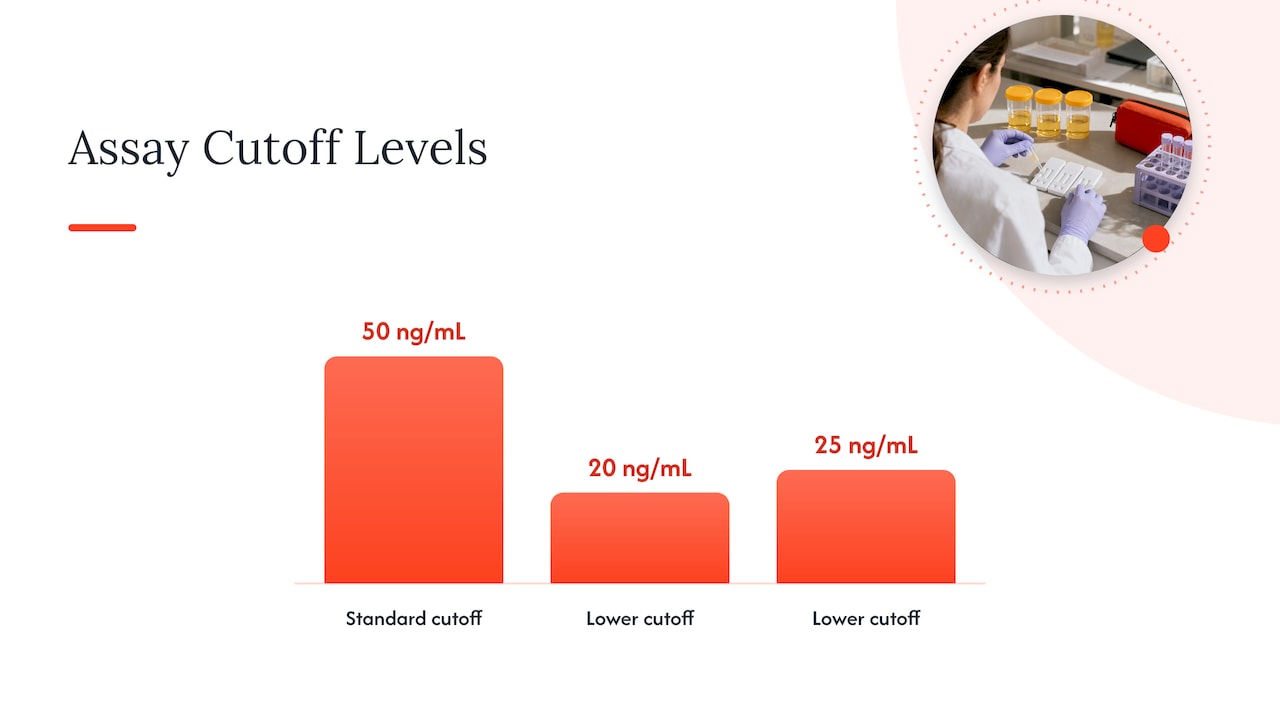
The most useful evidence is the NIJ study mentioned above. Researchers tested delta-8 THC, delta-10 THC and CBD analogs against six commercial urine cannabinoid immunoassays. The assays were run at a 50 ng/mL cutoff and, depending on the assay, at 20 or 25 ng/mL. The result for delta-10: all tested chiral analogs cross-reacted with the assays, though the degree varied by kit and by cutoff.
Three practical takeaways:
- A test does not need to be “made for” delta-10. Structural similarity is enough. A routine THC panel can react to an emerging analog even if nobody designed it to.
- The kit matters. Because selectivity varied, one employer’s screen might flag you while another’s might not. You usually will not know which one you face.
- The cutoff matters. A lower cutoff catches smaller amounts. Most workplace panels use 50 ng/mL for the initial screen, but not all.
The same logic applies to delta-8. A 2023 case series reported positive cannabinoid urine immunoassays after delta-8 exposure, and confirmatory testing found a delta-8 carboxy metabolite rather than delta-9 THC metabolites. That shows an analog alone can produce a positive screen.
Screen versus confirmation
Most people think of a drug test as one step. It is usually two.
Step 1: the immunoassay screen. This is the fast, inexpensive test, and it works by structural recognition. A cross-reacting compound can produce a presumptive positive.
Step 2: confirmation. A presumptive positive is typically sent for chromatographic and mass spectrometry testing. A laboratory explanation from Aegis Sciences describes screening as relying on cross-reactivity and definitive confirmation as using mass spectrometry, and it cautions that interpretation can differ among laboratories.
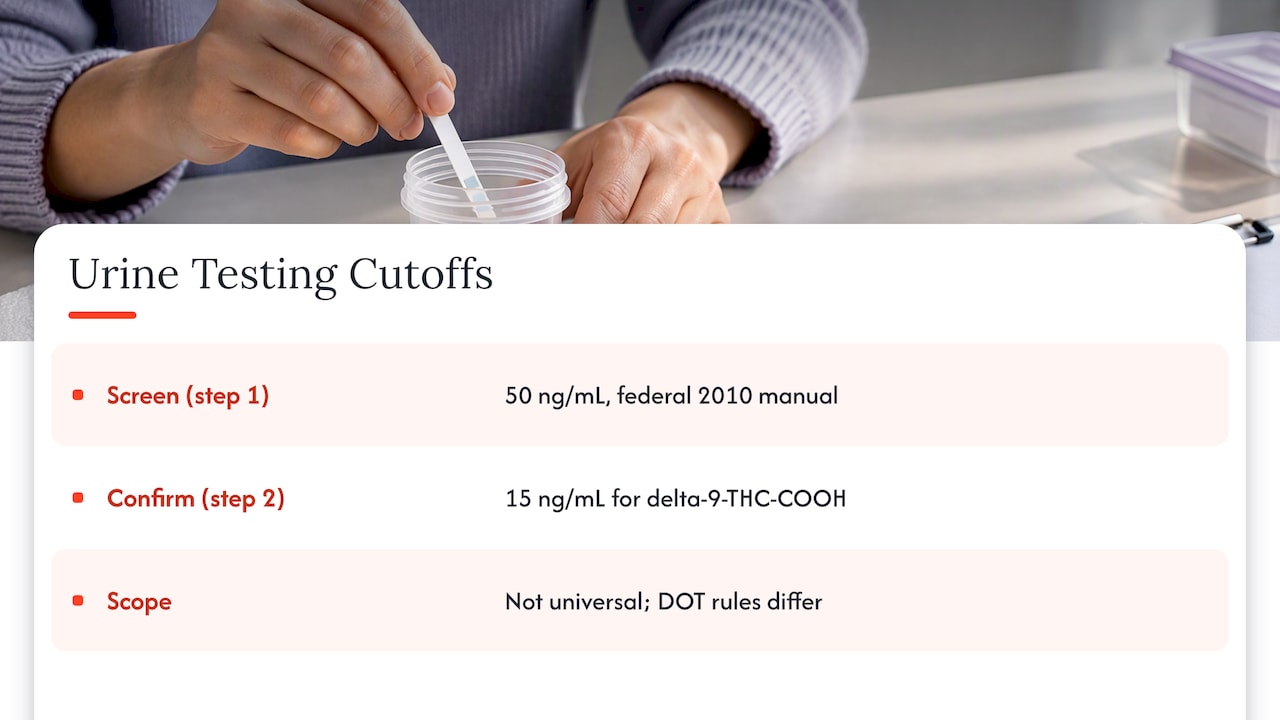
For federal agency testing under the 2010 manual, the initial cutoff is 50 ng/mL and the confirmatory cutoff is 15 ng/mL for delta-9-THC-COOH, per the SAMHSA Medical Review Officer Manual. That manual does not apply to DOT testing, where 49 CFR Part 40 requires labs to report results below the cutoff as negative and to confirm anything at or above the initial cutoff with a second methodology.
What does that mean for delta-10? We would not bank on confirmation clearing you. Whether a given confirmation method distinguishes a delta-10 metabolite from a delta-9 one depends on the lab’s method, and many standard THC confirmations are built around the delta-9 metabolite. Your result can also depend on what else you used. If you also use regular marijuana, confirmation will find it. For a closer look at the numbers behind these cutoffs, see our explainer on federal drug test cutoff levels.
How long delta-10 can stay detectable
There is no tidy, peer-reviewed delta-10 timeline, so be careful with any site that gives you an exact number. What we can say rests on how THC metabolites behave in general.
The SAMHSA manual notes that infrequent marijuana use may leave detectable metabolites for 1 to 5 days, while chronic use can last much longer because THC is stored in fatty tissue and gradually re-enters the bloodstream. A university health resource on delta-10 puts urine windows at roughly 3 days after a single low dose to 30 or more days for chronic daily users, depending on metabolism, dose and frequency.
A rough picture for urine:
| Pattern of use | What to expect |
|---|---|
| One low dose | A few days, sometimes less |
| Occasional use (a few times a month) | Several days to about a week |
| Regular use (several times a week) | One to two weeks or more |
| Daily use | Often a month or longer |
That table is our reading of the sources above, not a promise. Body fat, hydration, the potency of the product and how concentrated the sample is all move the needle. Many delta-10 products are also unregulated, so the dose you think you took may not be the dose you took.
For test-by-test windows (urine, saliva, hair, blood), our THC detection times guide lays them out. If you are trying to place yourself on a timeline, the THC detox timeline estimator uses the 50/15 ng/mL urine cutoffs. For occasional users, this look at weekend use against a 50 ng/mL test is the closest match.
Other test types
Urine is the most common, but not the only one. Saliva tests look for recent use, and hair tests reach back much further. A 2025 hair study set out to detect environmental exposure to delta-8, delta-9 and delta-10 THC in hair, which shows researchers treat delta-10 as something labs may see. If your test is hair or saliva, the windows and the method differ from urine, so check which one you have been told to take.
“But it’s legal hemp”
This is the argument we hear most, and it does not hold at the test site. Legality of a product and the result of a drug test are separate questions. Academic guidance from UBC says hemp-derived delta-10 can cause a positive test because standard tests cannot distinguish it from delta-9 THC.
Three more reasons it can go badly:
- Product quality. A 2025 UNC School of Government post notes that delta-10 is the least researched THC compound for therapeutic effects and that unregulated delta-10 products are not guaranteed to stay under 0.3% delta-9 THC. You may be getting more delta-9 than the label suggests.
- No medical excuse in federal programs. Under federal workplace programs, marijuana use is not an acceptable alternative medical explanation for a positive THCA result, and dronabinol (Marinol) is the sole pharmaceutical source of THC. A 2025 SAMHSA memo adds that a physician’s recommendation for a Schedule I substance is not a legitimate medical explanation.
- Rules differ by employer. If you work under a federal program and have questions about hemp or delta-8 products, SAMHSA directs employees to their agency’s Ethics Office, General Counsel, HR and Safety and Security offices, as its federal drug-free workplace FAQ explains. Hemp law is also in flux, so check current federal and state rules before relying on any product being legal.
If you are a safety-sensitive or DOT-regulated employee, talk to your employer’s designated employer representative or a Medical Review Officer before you use anything with THC in it, including delta-10.
Our perspective
Most people who reach us about delta-10 are in the same spot: they bought something sold at a gas station or online, assumed it was a loophole, and now have a test date. We understand the logic. It is just not how the tests work.
What we have learned from talking with customers is that the first useful question is never “which product?” It is “which test, when, and how often have you used?” A single gummy three weeks ago and daily vaping for a year are very different problems. The test type (urine, saliva or hair) changes the answer again.
We also think honesty beats hype here. No drink, pill or shampoo gets the same result for everyone, and anyone promising a guaranteed pass is selling you a story. Our job is to explain the test you are facing, give you real detection windows and cutoffs, and let you decide what is worth buying and what is not. The best-supported advice is also the least exciting: stop using, give your body time, and match any preparation to the specific test.
— MIchael
What to do before a test
- Stop all THC products now, including delta-8, delta-10, HHC and anything labeled “hemp” that is intoxicating. Time is the one factor that reliably helps.
- Find out the test type. Urine, saliva, hair and blood have different windows. Ask the employer, probation officer or clinic what is expected, and whether it is a federal or DOT test.
- Estimate your own window honestly. Use frequency and dose, not hope. Our blood THC detection page covers the shorter window for blood.
- Be careful with sweat claims. Hydration, exercise and sauna sessions are commonly suggested, and UBC researchers say none of them is foolproof. Our write-up on what sweating in a sauna does for THC goes into the detail. Do not overdo water: very dilute samples can be flagged by the lab.
- Do not hide a prescription or lie to a Medical Review Officer. If a drug you take legitimately could affect results, say so during the review process.
- If the test is federal, DOT, court-ordered or tied to licensing, get official advice from the designated employer representative, your attorney or an MRO before you do anything else.
Where we can help
If you have a test coming and want to understand your options, we carry urine drug testing products, saliva and hair testing items, and hair detox shampoo, alongside the educational guides linked above. You can also use at-home test kits to see where you stand before the real one. We ship fast within the United States and you can reach us by phone during our published business hours if you want help matching a product to your situation. Start from our main store page and tell us which test you are facing.
FAQ
Does delta-10 show up on a drug test?
Yes, it can. A 2023 NIJ study found all tested delta-10 THC analogs cross-reacted with six commercial urine cannabinoid immunoassays, though the strength varied by kit and cutoff. A positive screen may then go to confirmation testing.
Will I fail a drug test for delta-10?
Possibly. It depends on how much you used, how often, the type of test and the lab’s cutoff. Occasional users often clear sooner than daily users, but nobody can promise a negative result.
Can a drug test tell delta-10 from delta-9?
A standard urine screen cannot. It reacts to THC-like structures and does not identify the source of exposure. Confirmation uses mass spectrometry, and how a lab interprets it can vary, so do not count on the test distinguishing them in your favor.
Does a hemp or doctor’s note protect me?
Not in federal workplace testing. A hemp label is not a medical explanation, and a physician’s recommendation for a Schedule I substance is not accepted as one either. For anything specific to your job, ask your employer’s designated representative or a Medical Review Officer.
How long should I stay off delta-10 before a test?
There is no safe universal number. Sources describe urine windows from about 3 days after a single low dose to a month or more for daily use. The longer and heavier your use, the more time you should allow.
Sources
- NIJ: cross-reactivity of cannabinoid analogs (delta-8, delta-10 THC and CBD)
- ACMT position statement: interpretation of urine for THC
- Delta-8-THC exposure and confirmation case series
- Aegis Sciences: testing capabilities for THC, delta-8, delta-9 and CBD
- SAMHSA Medical Review Officer Manual (2010)
- DOT 49 CFR Part 40, Section 40.85
- UBC: will delta-10 test positive
- SAMHSA synthetic cannabis products memo (2025)
- UNC School of Government: CBD products and public employee drug testing
- SAMHSA federal drug-free workplace FAQs
- Hair study on environmental exposure to delta-8, delta-9 and delta-10 THC