
LabCorp Drug Test for U.S. Employees: Bring ID, Expect 24–48h Negatives
The LabCorp drug test process runs on a two-step system: an initial immunoassay screen followed by GC/MS or LC/MS/MS confirmation on anything that flags positive. Most donors provide urine, though oral fluid, hair, and blood are also used depending on the situation. Bring a photo ID, expect a chain-of-custody form, and plan on 24 to 48 hours for a negative employer result, 3 to 5 days if an MRO needs to review a positive, or 1 to 5 days for a personal OnDemand test.
TL;DR:
- Most drug tests at LabCorp start with a sensitive immunoassay screen, followed by confirmatory GC/MS or LC/MS/MS testing for positives.
- Urine remains the most common sample type for workplace and pre-employment screening, but blood, hair, and oral fluid are used for specific situations requiring recent or extended detection.
- Proper preparation involves bringing a government ID, honestly disclosing medications, and avoiding substances like poppy seeds that could cause false positives.
- Turnaround times vary from about 4 hours for negative rapid tests to 3-5 days for confirmed positives requiring medical review.
- Mistakes such as forgetting ID, arriving unprepared, or not booking an appointment in advance frequently cause delays at collection sites.
Table of Contents
- Types of LabCorp Drug Tests and Sample Collection Options
- How to Prepare for Your LabCorp Drug Test
- Step-by-Step: Collection and Chain of Custody at a LabCorp PSC
- How LabCorp Tests Your Sample: Screening, Confirmation, and Turnaround Times
- What Your Results Mean and the MRO’s Role
- Practical PSC Rules That Trip People Up
- A Publisher’s Take on Preparing the Right Way
- Check Your Status Before You Walk Into a PSC
- Where to Verify the Details
- Sources
Types of LabCorp Drug Tests and Sample Collection Options
The sample type usually depends on who’s ordering the test and what they need to detect. Urine remains the standard for pre-employment and random workplace screens because it’s cheap, fast, and detects recent use across most substance classes. Oral fluid has gained ground for its shorter detection window and observed, low-hassle collection. Hair testing extends the lookback period to roughly 90 days, which is why it shows up in safety-sensitive industries and some legal cases. Blood testing is the least common of the four and typically reserved for situations requiring precise, real-time impairment data, like a post-accident investigation.
Panel size varies by employer or personal order:
- 5-panel and 6-panel tests typically screen for marijuana, cocaine, opiates, amphetamines, and PCP, sometimes adding benzodiazepines.
- 10-panel and 11-panel tests expand coverage to include barbiturates, methadone, propoxyphene, and additional opioids.
- Extended panels can be customized for specific industries, like transportation or healthcare.
Ordering also differs by channel. LabCorp OnDemand lets individuals purchase and schedule their own test without a chain-of-custody requirement, useful for personal peace of mind. Employer-ordered testing, by contrast, always follows a stricter chain-of-custody protocol tied to a specific requisition.
How to Prepare for Your LabCorp Drug Test
Preparation is mostly about paperwork and honesty, not tricks. Skipping a step here is the fastest way to get sent home or flagged for a retest.
- Bring a government-issued photo ID. A driver’s license, passport, or state ID works. LabCorp requires it alongside your lab request form or Web COC registration number, and without either, collection staff can’t proceed.
- Drink normally, not excessively. Overhydrating before a urine test can dilute the specimen enough to trigger specimen validity flags, which can delay results or require a retest.
- List every prescription and OTC medication you’re taking. LabCorp advises disclosing this upfront so an MRO can factor it in if something screens positive.
- Skip the poppy seed muffin before your appointment. Poppy seeds contain trace opiate compounds that can occasionally trigger a presumptive positive on the initial screen.
- Call ahead if you need accommodations. Dialysis patients, people using external urine collection devices, or anyone with a medical condition affecting collection should contact LabCorp before their appointment.
Pro Tip: Keep a printed or photographed list of your current medications on your phone. Handing it to the collector or MRO directly avoids the “I forgot the name of it” problem that slows down review.
Step-by-Step: Collection and Chain of Custody at a LabCorp PSC
Walking into a Patient Service Center for the first time can feel confusing if you don’t know the sequence. Here’s the actual flow.
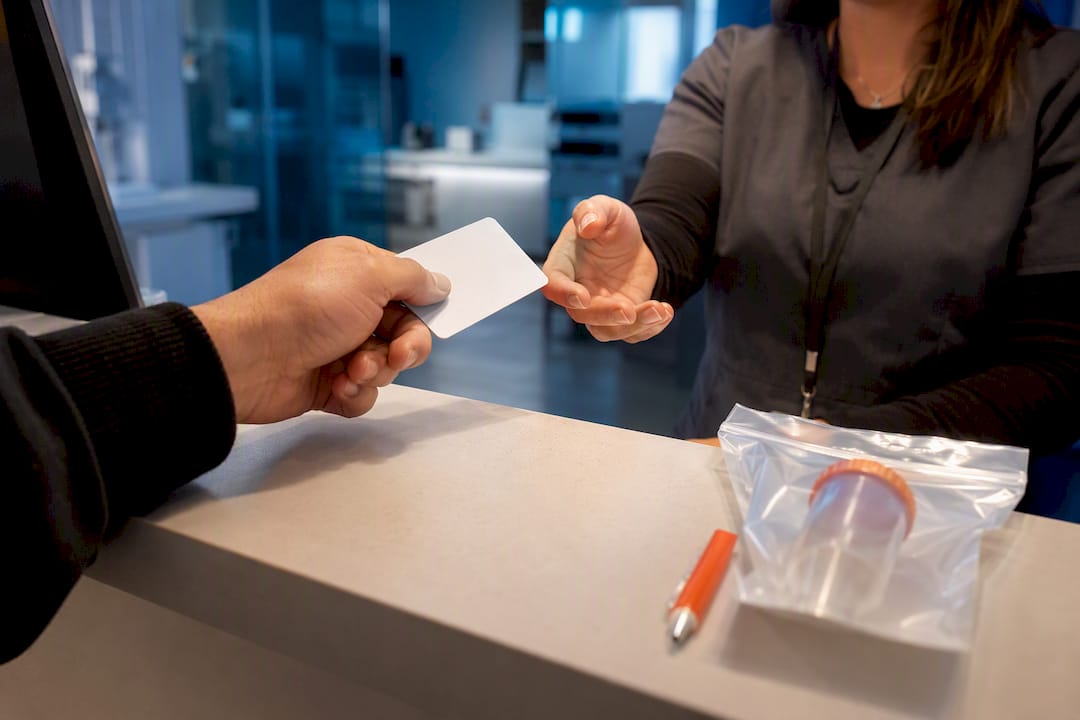
Check-in starts with ID verification against your paperwork or Web COC number. Staff confirm your identity matches the requisition, then walk you through the specimen collection process for your specific test type.
- Urine collections happen in a private restroom. LabCorp notes that observation depends on employer policy and applicable regulations, so some collections are unobserved while others, particularly for certain regulated industries, require direct observation.
- Oral fluid collections are always observed, since the collector needs to witness the swab going into your mouth.
- Hair collections involve cutting a small sample close to the scalp, typically from the crown, and are observed by nature of the method.
Once collected, the sample is sealed in front of you, labeled with tamper-evident tape, and you initial the seal to confirm it’s yours. From there, it’s logged into the chain-of-custody record and transported to the testing lab, with every handoff documented. Donors on dialysis or using an external urine bag should coordinate with LabCorp Occupational Testing Services beforehand, since standard collection steps don’t apply.
How LabCorp Tests Your Sample: Screening, Confirmation, and Turnaround Times
Every specimen starts with immunoassay screening, a fast chemical test that flags whether a substance is likely present above a set cutoff. It’s built for sensitivity, not certainty, which is why a “positive” at this stage is called presumptive, not confirmed.
Anything that screens presumptive positive moves to confirmatory testing using gas chromatography-mass spectrometry (GC/MS) or liquid chromatography-tandem mass spectrometry (LC/MS/MS). These methods identify the exact metabolite present and quantify it, which is why confirmation carries far more weight than a screen alone. Cutoff levels differ between the two stages too. Screening cutoffs are set low to catch anything possible; confirmation cutoffs are calibrated for precision.
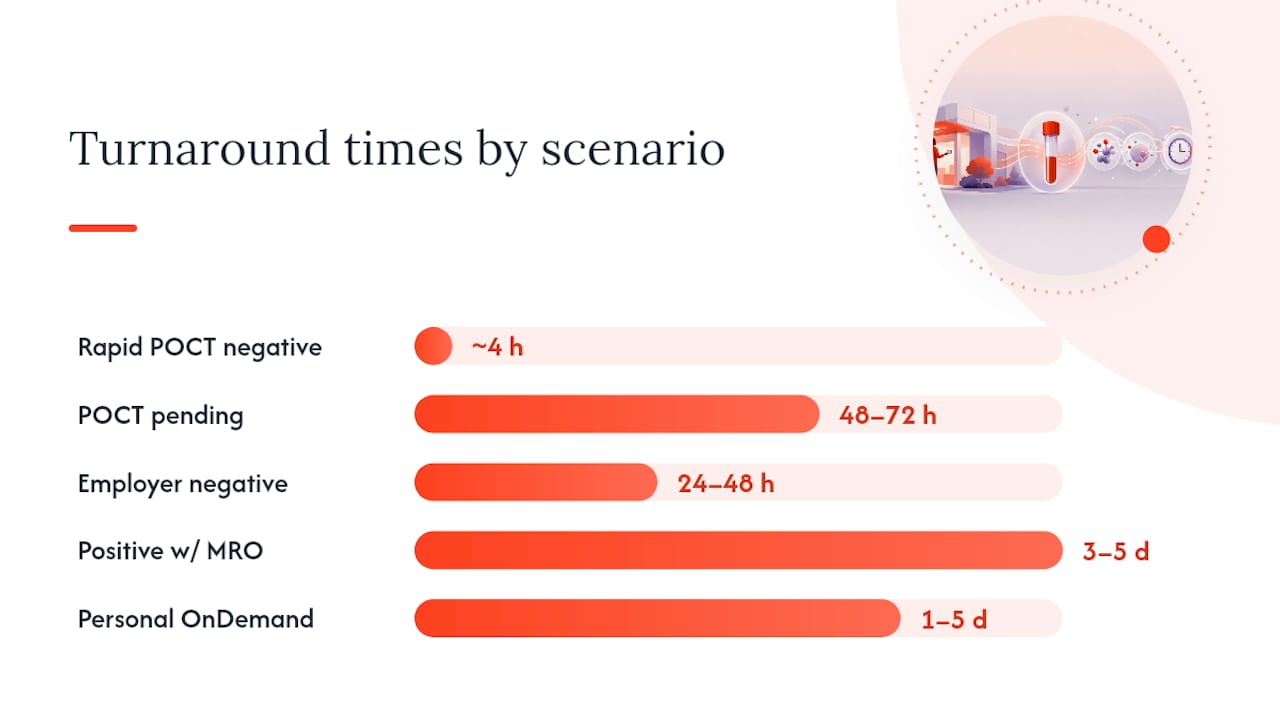
Turnaround time depends heavily on which pathway your test takes:
| Test scenario | Typical turnaround |
|---|---|
| Rapid POCT negative screen | About 4 hours |
| POCT non-negative, pending lab confirmation | 48–72 hours after lab receipt |
| Employer negative result | 24–48 hours |
| Positive result requiring MRO review | 3–5 days |
| Personal OnDemand test | 1–5 days |
Rapid point-of-collection testing gives employers same-day clearance on negatives, but anything non-negative still routes through full lab confirmation. Specimen validity testing runs alongside the primary screen and can add time if a sample comes back dilute or shows signs of adulteration.
What Your Results Mean and the MRO’s Role
Results fall into four categories: negative, presumptive positive, confirmed positive, and dilute or invalid. A negative closes the case. A presumptive positive triggers confirmation testing before anyone acts on it. A confirmed positive goes to a Medical Review Officer, a licensed physician whose job is to check for legitimate medical explanations, not to assume guilt.
- The MRO contacts the donor directly to discuss any prescriptions or medical conditions that could explain the result.
- If a valid explanation exists, the MRO can change the reported result to negative.
- Employers typically receive the final verified result within the standard 3 to 5 day window for positives.
- Confidentiality rules mean the MRO shares medical details only as needed to verify the result, not the underlying diagnosis.
- If you dispute a confirmed positive, you can request split-sample retesting at a different lab, provided your original specimen was split at collection.
Dilute results don’t automatically mean cheating. Overhydration is the most common cause, and depending on employer policy, a dilute negative may still stand or may require a retest.
Practical PSC Rules That Trip People Up
Most delays at a Patient Service Center come down to logistics, not the actual test. A few rules catch people off guard every time.
- Many PSCs accept walk-ins, but employer-scheduled appointments usually take priority, so calling ahead saves time.
- Children can’t wait unattended in the restroom or lobby during your collection. If no one can supervise them, staff may ask you to reschedule.
- Special accommodations, like extended time for certain medical conditions, need to be arranged with LabCorp before your visit, not at the counter.
- Forgetting your ID or requisition paperwork is the single most common reason people get turned away.
Pro Tip: Call the PSC the morning of your appointment to confirm they’re not backed up. A five-minute call beats sitting in a waiting room during a walk-in rush.
A Publisher’s Take on Preparing the Right Way
Honest disclosure and documentation beat shortcuts every time. If you’re worried about a result, check your status with an at-home test before your appointment instead of gambling on unproven detox tricks. Skip anything promising to mask results outright. If substance use is the real concern, treatment resources deserve a look before a workplace deadline forces the issue.
— MIchael
Check Your Status Before You Walk Into a PSC
Waiting until your LabCorp appointment to find out where you stand is a gamble most people don’t need to take. You can check your own status ahead of time with home test kits, detection time guides, and preparation products designed for this situation.
Browsing the site’s drug testing products shows you what’s available for personal readiness checks, while the drug testing method page breaks down screening and confirmation in plain terms so you know what a PSC will actually be looking for. None of this guarantees any specific outcome at a Patient Service Center. It’s a way to walk in informed instead of guessing. If you’re facing a pre-employment screen specifically, the pre-employment drug testing category page is the fastest place to start.
Where to Verify the Details
- LabCorp’s testing methodology overview covers screening and confirmation science.
- LabCorp’s employee testing page explains employer-side procedures and SAMHSA/CAP standards.
- LabCorp OnDemand details personal test ordering and prep guidance.
This article is general information, not a substitute for advice from a qualified doctor. Consult a qualified healthcare professional about your own circumstances before acting on anything here.
Sources
- Understanding the employee drug testing experience
- Testing methodology (LabCorp patient help center)
- How does a drug test work? Here’s what you need to know (LabCorp OnDemand blog)