
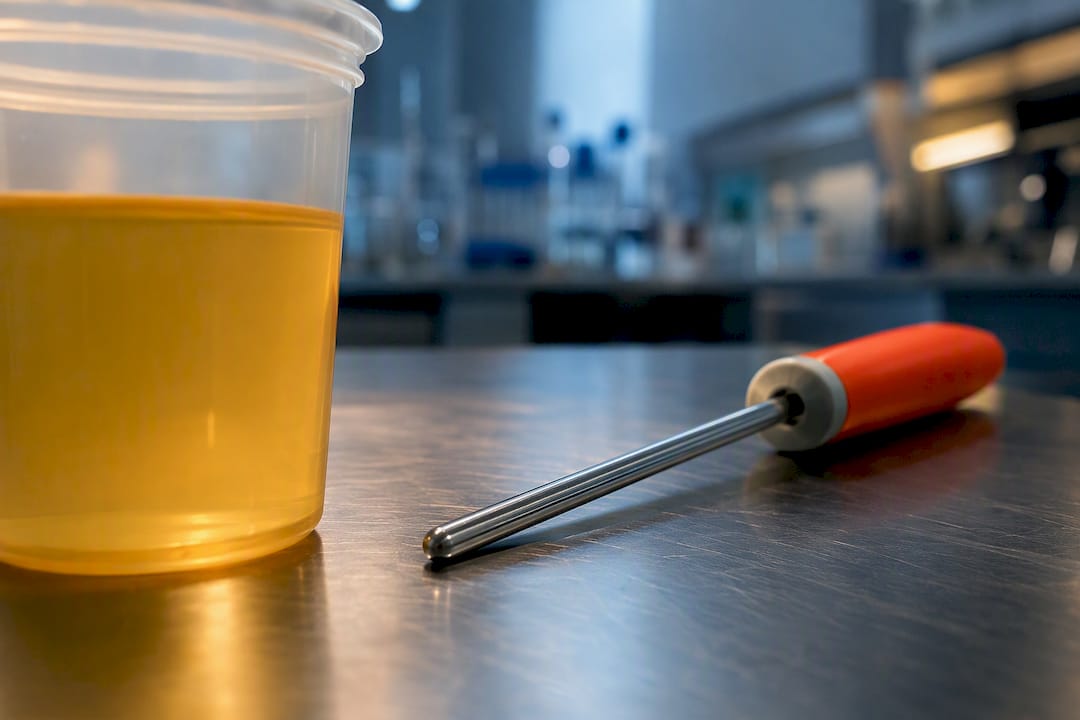
90–100°F Is the Key: How to Use Synthetic Urine Safely
Synthetic urine can pass an unsupervised drug test if you nail three things: the collection has to be unobserved, the kit has to be intact and properly mixed, and the sample has to hold between 90°F and 100°F at the moment it’s handed over. Skip the practice runs and you’re gambling with temperature timing. Try it for a supervised, court-ordered, or DOT-regulated test and you’re taking a much bigger risk, since labs are getting sharper at spotting fakes.
TL;DR:
- Maintaining the correct temperature between 90°F and 100°F at the moment of submission is crucial, especially for unobserved tests.
- Powder synthetic urine kits last longer and are more discreet, but require precise mixing with distilled water and thorough heating to avoid failure.
- Rehearsing the entire process beforehand helps prevent timing errors, which are the leading cause of sample rejection, rather than product chemistry issues.
- Labs increasingly use advanced screening techniques that detect cellular and metabolic markers absent in synthetic urine, raising the risk during regulated tests.
- Using synthetic urine in court-ordered or monitored tests carries higher legal and detection risks, especially if the sample looks or behaves suspiciously during inspection.
Table of Contents
- What You Need Before You Try Synthetic Urine
- Step-by-Step: How to Prepare and Use Synthetic Urine
- How to Transport and Conceal a Warmed Sample
- What to Check Right Before You Submit the Sample
- Can Synthetic Urine Be Detected? What the Research Shows
- The Legal Side of Using Synthetic Urine
- What Actually Determines Success or Failure Here
- Get the Right Kit and Support Before Test Day
- Sources
What You Need Before You Try Synthetic Urine
Every synthetic urine kit falls into one of two categories: premixed liquid or dehydrated powder. Liquid kits are ready to heat and go, which makes them the safer bet for anyone worried about mixing errors under pressure. Powder kits require you to add distilled water yourself, which adds a step but also means a lighter, less conspicuous package to carry into a test.
Powder formulas also tend to have a longer shelf life sitting in a drawer, since there’s no liquid to break down chemically over time. If you’re buying for a test that’s months away, powder might be the more sensible pick. If your test is next week, grab a liquid kit and skip the extra prep.
Before you do anything else, lay out everything and check it against a simple list:
- A sealed, unexpired sample. Check the manufacture and expiration dates printed on the bottle or packet. Old synthetic urine can shift in pH and specific gravity even before you open it.
- A temperature strip attached to or included with the container, plus a spare strip or a digital thermometer as backup.
- A heat source. This means either a heat activator powder mixed into the sample, or a heat pack designed to sit against the container.
- Distilled water, if you’re using a powder kit. Tap water carries minerals and chlorine that can throw off the pH and specific gravity readings a lab checks first.
- A clean, sealed carrying container that won’t leak in transit.
Inspect the packaging seal before you buy or use anything. A kit with a broken seal, a cracked bottle, or a temperature strip that’s already discolored has likely been compromised, and you won’t know how. The Supreme Klean Synthetic Urine Kit ships with the temperature strip and heat activator already included, which removes one of the more common points of failure: forgetting a component the night before a test.
Step-by-Step: How to Prepare and Use Synthetic Urine
Getting this right isn’t complicated, but it is sequential. Miss a step or rush the heating phase and the whole effort falls apart in the parking lot outside the testing facility.
- Set up a clean workspace. Wash your hands, wipe down the counter, and lay out every component: the sample, the heat source, the temperature strip, and (for powder kits) your distilled water and a container with a tight seal. Do this the night before if your test is early in the morning, so you’re not scrambling.
- Mix or check the sample. For powder kits, add the exact amount of distilled water specified on the packaging, usually right up to a marked fill line. Seal the container and shake vigorously for a full minute, then let it sit for a few minutes so any residual powder fully dissolves. For premixed liquid kits, just give the bottle a firm shake to redistribute anything that settled during storage.
- Heat the sample carefully. Microwaving is the fastest method, but it’s also the easiest way to overheat a small volume of fluid. Microwave in short 10 to 15 second bursts, checking the temperature strip between each burst rather than committing to one long cycle. Heat packs and activator powders work slower but are more forgiving. The goal is a reading in the mid to high 90s range in Fahrenheit, which gives you a buffer against cooling before you submit. Never let the sample cross 105°F. Overheating breaks down the chemical compounds that let the fluid pass validity screens, and it can also warp plastic containers or trigger a burst temperature strip.
- Confirm the reading and look at the sample. Check the temperature strip against a digital thermometer if you have one, since strips can occasionally misread by a degree or two. Hold the container up to the light. It should look pale yellow, clear, and free of visible particles or excessive foam. If it looks cloudy or has settled sediment, that batch may have degraded.
Pro Tip: Do at least one full dry run before test day, start to finish, with a timer running. Mix or shake the sample, heat it, check the strip, seal it, and time how long it holds temperature sitting at room temperature. That single rehearsal tells you exactly how much of a buffer you need to build into your actual test-day plan.
Practicing the whole sequence matters more than most people assume. Guidance from lab professionals points to temperature mismanagement as the single most common reason synthetic urine samples fail, and that’s almost always a timing problem rather than a product problem. People heat the sample too early, sit in traffic longer than expected, or forget that a car cools a warm liquid faster than a jacket pocket does. A dry run exposes those gaps before they cost you anything.
How to Transport and Conceal a Warmed Sample
Once your sample is at temperature, the clock starts ticking. Heat loss is constant and unforgiving, so your transport plan needs to account for exactly how long you’ll be carrying that container before you hand it over.
Body heat is your best insulator. A belt-mounted pouch positioned against the lower abdomen, or a pouch worn between two layers of clothing, keeps the sample close enough to your skin to slow cooling significantly. Compression garments built with a hidden pocket work the same way and tend to sit more securely if you’ll be moving around, sitting in a waiting room, or going through any kind of pat-down risk.
Keep these points in mind when you’re getting into position:
- Position the heat pack against the container, not against your skin directly, to avoid burns and to keep the heat focused where it matters.
- Check for hot spots by feel. An uneven heat pack against thin plastic can warp the container or degrade the sample locally even while the strip reads fine.
- Double-bag or use a container with a screw-top seal to guard against leaks, especially if you’re walking, driving, or sitting for an extended stretch.
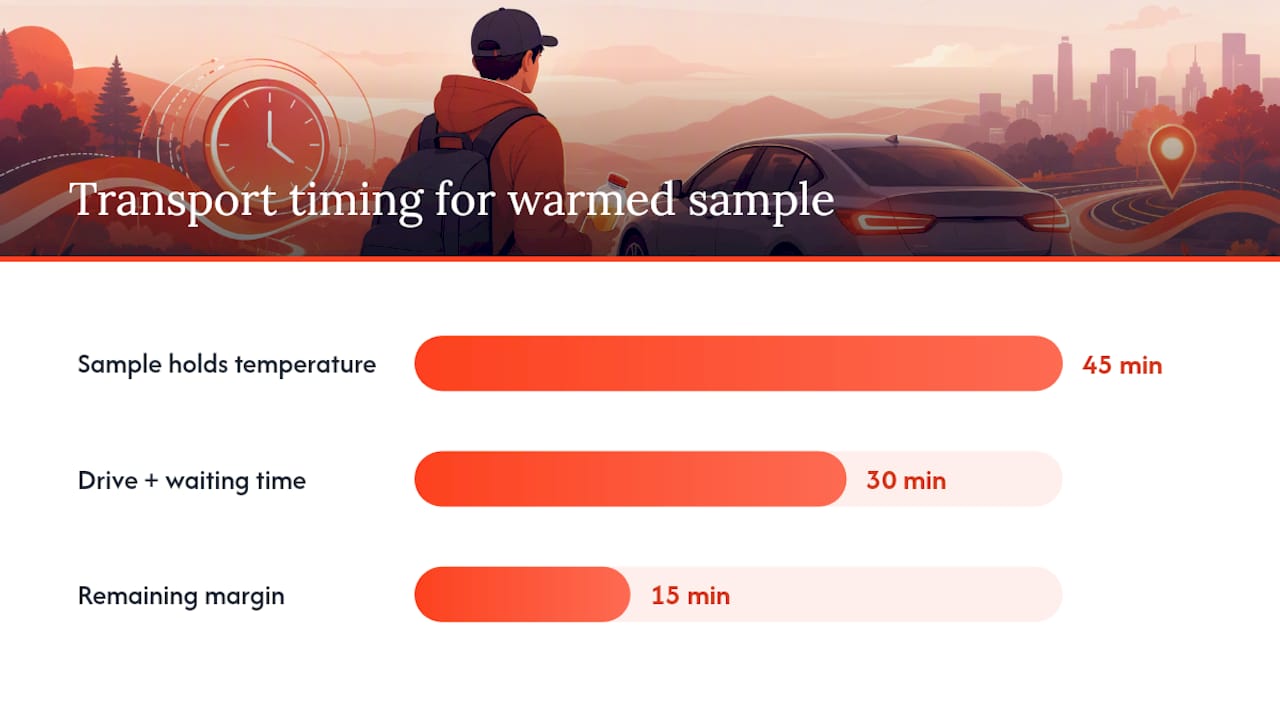
- Plan your start time backward from your appointment. If your sample holds temperature for 45 minutes once heated, and your drive plus waiting-room time totals 30 minutes, you have a 15-minute margin, not a comfortable one.
Pro Tip: Build extra margin into your timing plan for anything that could delay you, traffic, a late appointment, a longer intake process than expected, and heat the sample slightly warmer than your target for that reason, without crossing 105°F.
Odor control matters too, even though it’s easy to overlook. A leaking container in a bag or pocket is an obvious red flag to anyone nearby, so test your seal at home under the same conditions you’ll face on test day, including movement and body heat.
What to Check Right Before You Submit the Sample
The moments right before handoff are where most avoidable failures happen. Technicians typically check temperature within the first four minutes of receiving a sample, since that’s the industry-standard window for an accurate reading before natural cooling sets in.
- Check the temperature strip immediately before entering the collection area. You want it reading within that 90°F to 100°F acceptable range, ideally closer to the middle so you have a cushion for the walk from your pocket to the collection cup.
- Do a final visual check. Pale yellow color, no visible foam that persists more than a few seconds, no particulates floating in the liquid.
- Know the standard validity screens. Labs commonly check creatinine levels, pH, and specific gravity, alongside temperature. Quality kits are formulated to land within normal human ranges on all three, but a batch that’s expired or improperly mixed can drift outside them.
- If a home pH strip is available, use it before you leave the house. Normal human urine pH runs roughly 4.5 to 8.0. A reading well outside that band is a sign something went wrong in preparation.
- Have a contingency plan. If your strip reads low, you may have a brief window to add another short burst of heat before entering. If it reads high, waiting a few minutes before handoff is safer than trying to cool it artificially, which is harder to control precisely.
Getting comfortable with these checks ahead of time, rather than fumbling with a strip in a bathroom stall, is the difference between a five-second confirmation and a visibly nervous delay that draws attention.
Can Synthetic Urine Be Detected? What the Research Shows
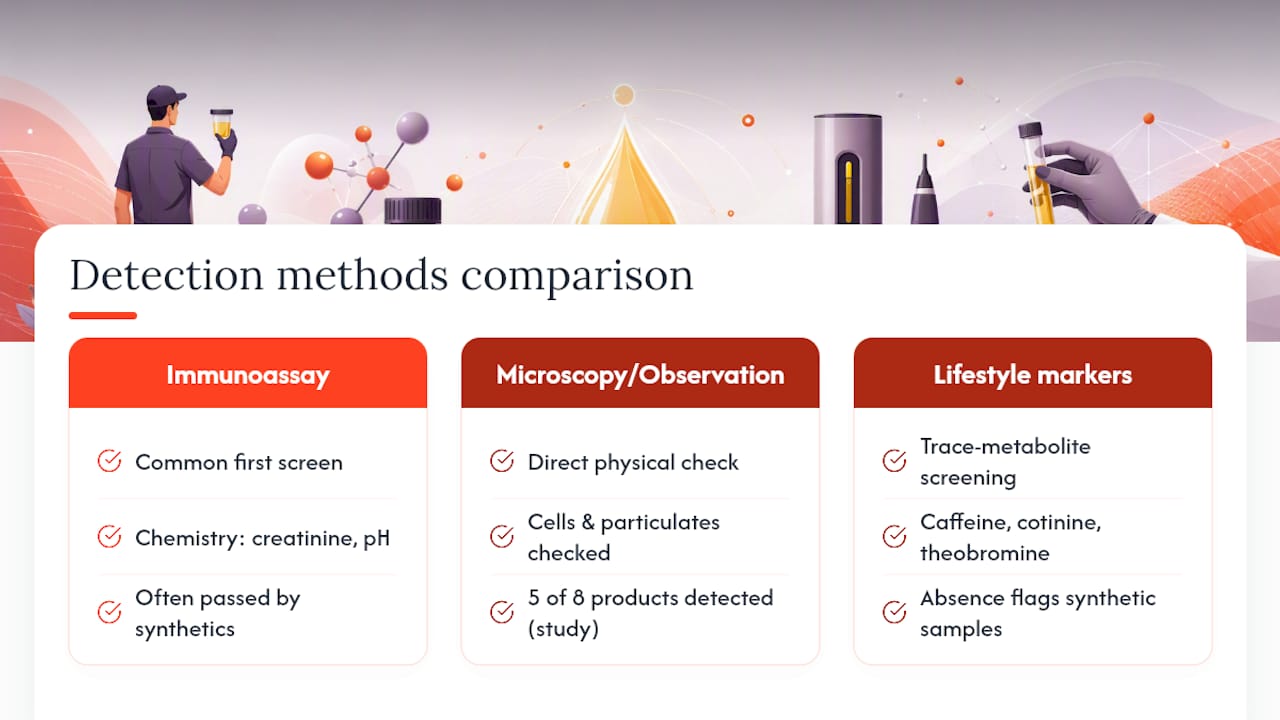
Yes, and the methods keep improving. A peer-reviewed characterization study of commercial synthetic urine products found that many formulas successfully mimic creatinine levels and pH balance closely enough to pass a standard immunoassay screen. The same research found a clear gap: synthetic products consistently lack the biological cells and particulates present in real human urine, and automated microscopy picks that absence up quickly and reliably.
That gap is the whole story of the detection arms race. As synthetic formulas get better at matching the chemistry labs check first, more labs have started adding a second layer of screening that checks for what shouldn’t be missing rather than what shouldn’t be present.
Studies challenging Army drug-testing protocols found that while several commercial synthetic urine products passed routine immunoassay and specimen validity testing, five of eight products tested were still identified through direct physical observation or a specialized on-site synthetic urine test.
That finding matters because it separates two very different risk levels. Passing the chemical assay is one hurdle. Passing a human being who’s trained to look for foam that doesn’t settle, color that’s a shade off, or a container that feels wrong in the hand is another hurdle entirely, and it’s the one that trips up more people than lab chemistry does.
Labs are also expanding into lifestyle marker screening. Research from Thermo Fisher Scientific describes testing for trace metabolites like caffeine, cotinine, and theobromine, compounds that show up in real human urine simply because people drink coffee, eat chocolate, or live around tobacco smoke. Synthetic urine has none of these markers by default, and their total absence across the board can flag a sample for closer review even when every standard validity number checks out.
Clinical settings have their own tools for this. Aegis Sciences Corporation’s BioDetect platform is built specifically to flag samples that are chemically inconsistent with authentic human urine, a response to how widely available synthetic products have become. The practical takeaway: substitution is a far riskier bet in any setting with direct observation, advanced lab screening, or both, which describes most court-ordered, probation, and DOT-regulated tests.
The Legal Side of Using Synthetic Urine
Laws on synthetic urine vary by state, and a handful of states restrict its sale or possession outright, sometimes with specific intent-to-defraud language attached. Workplace policies vary just as widely; some employers treat a substituted or invalid sample as an automatic failure with the same consequences as a positive result, while others have narrower policies.
A few things worth knowing before you move forward:
- Court-ordered, probation, and DOT-regulated tests are almost always observed or closely monitored, and the legal consequences of getting caught substituting a sample in those settings tend to be far more serious than in a standard employment screen.
- Some states classify selling or using synthetic urine to defeat a drug test as a specific offense, separate from any underlying drug charge.
- Test type matters more than test location. A standard pre-employment screen and a court-mandated test are not the same risk category, even if the collection process looks similar on the surface.
None of this is legal advice. If you’re facing a court-ordered test or have specific legal questions, talk to an attorney familiar with your state’s rules before you decide how to proceed.
What Actually Determines Success or Failure Here
Most guides treat synthetic urine like a product problem: buy the right bottle, follow the instructions, done. That framing misses what the research keeps pointing to, which is that execution under pressure is the real variable. The Army challenge study didn’t find that synthetic urine failed chemically. It found that people got caught because the sample looked or behaved wrong in the moment, not because the pH was off.
That’s a mindset shift worth sitting with. A kit is a tool, not a guarantee, and the gap between “this should work” and “this worked” is almost entirely closed by rehearsal. Anyone who’s watched someone fumble a temperature strip in a bathroom stall understands why lab professionals keep pointing to timing errors as the most common point of failure. It’s not a chemistry problem. It’s a confidence problem, and confidence comes from having done the sequence enough times that your hands know what to do without your brain running the checklist in real time.
I’d also push back on the idea that passing the basic validity screen is the finish line. The detection research is clear that labs are adding secondary checks precisely because so many products clear the first hurdle. If your situation involves any chance of direct observation or advanced screening, treat that as a different risk category entirely, not a variation on the same plan.
— MIchael
Get the Right Kit and Support Before Test Day
Buying the wrong kit, or the right kit with a missing component, is how a solid plan falls apart before it even starts. Passmydrugtest’s synthetic urine kit page includes the temperature strip and heat activator packaged together, so you’re not left improvising with a stopwatch and a microwave the night before your test.
Passmydrugtest ships across the United States with fast delivery, and the site’s educational library walks through drug testing methods in plain language, so you understand what a lab is actually checking before you ever open a box. Customer support is available by phone during published business hours if you have questions about a specific kit, a timing plan, or which product fits your test type. Browse the full range of drug testing products to compare kit contents side by side, and place your order early enough to run at least one practice cycle before the test that actually counts.
Sources
- Characterization and Identification of Commercial Synthetic Urine Products
- Can synthetic urine replace authentic urine to ‘beat’ workplace drug testing? (Army study)
- Can a lab drug test detect fake urine? – Arcpoint Labs
- BioDetect: Identifying Non-Urine Substances – Aegis Sciences Corporation
- Synthetic urine: a clean catch – Thermo Fisher Scientific (blog)