
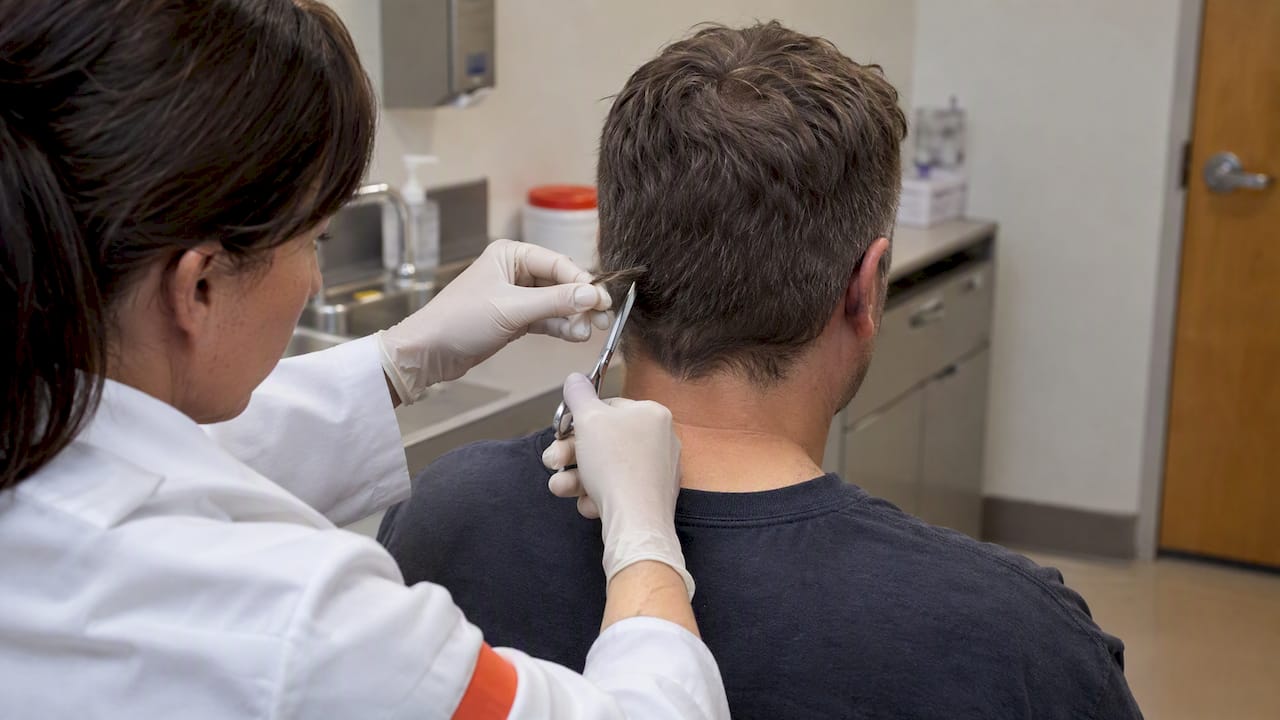
Hardest Drug Test: Hair Looks Back Months, but Has a 7–10 Day Lag
Hair follicle testing is generally the hardest drug test to pass, because it reaches back months and resists the usual tampering tricks. The trade-off is a lag of roughly 7–10 days before recent use shows up, while urine and oral fluid cover shorter windows with different weak points. Labs working under SAMHSA guidance and Medical Review Officer (MRO) review confirm positives with mass spectrometry.
TL;DR:
- Hair samples can represent up to about 90 days, but recent use may not appear for 7–10 days; shorter hair can shorten that window.
- Observed oral fluid collection limits tampering, but its window lasts minutes to about two days, so it rarely captures use from last week.
- Urine labs check creatinine, pH, specific gravity, temperature, and oxidants; adulterated, substituted, or invalid samples are not reported as clean negatives.
- A rapid immunoassay is only a screen; chromatography with mass spectrometry confirms nonnegative results, while an MRO checks prescriptions before reporting.
- Federal programs authorize urine and oral fluid, not hair; private employers may use hair under company and state rules, so ask HR which standard applies.
Table of Contents
- What makes one drug test harder to pass than another?
- Why hair follicle tests are usually the hardest to pass
- How urine tampering works and how labs catch it
- Why oral fluid is hard to tamper with but short on lookback
- How confirmatory lab methods close the gaps
- What privacy and legal rules apply to drug testing?
- Common myths about drug test difficulty
- Which technology is making tests harder or easier to beat?
- Which specimen types does federal guidance authorize?
- How detection sensitivity differs by drug and specimen
- How hair color, length and treatments affect hair tests
- What to do and expect if you have a test coming up
- What we offer if you are preparing for a screening
- FAQ
- Sources
What makes one drug test harder to pass than another?
“Hard” is not a feeling. You can judge any test on several axes: how far back it looks, whether the evidence is permanent once formed, how easy it is to tamper with, whether collection is watched, and how sensitive the confirmation step is. Here is how the main specimen types line up.
- Hair (follicle): metabolites move from blood into the shaft, so a segment of hair works as a months-long record. Windows can extend for up to about 90 days.
- Urine: the workhorse of workplace testing. Detection windows vary depending on the drug and how often it was used.
- Oral fluid (saliva): detects recent use, from minutes to about 2 days, and collection is typically monitored.
- Blood: a very short window, used mostly where impairment right now is the question.
- Sweat patch: worn on the skin and can reflect use for up to about 14 days.
Hair offers a long detection window and a record that persists once formed. Oral fluid wins on supervised collection. Urine sits in the middle on most axes, which is exactly why it is the most commonly used method in the U.S. and the one most associated with tampering attempts. Confirmatory lab sensitivity matters on every axis, and we cover it in its own section below.
Why hair follicle tests are usually the hardest to pass
Hair testing works differently from every other method. After use, drugs and their metabolites travel through the bloodstream into growing hair and stay in the shaft, so a hair test records use over months. There is no bathroom stall, no cup to swap and no clock running down in your favor.
The flip side is timing. Hair often needs about 7–10 days after use before a positive can appear, so a single recent use is unlikely to show up, while a pattern of use over time is what the test is built to catch. Cosmetic treatments such as bleaching or perming can change how a result is interpreted, but they are not a reliable way to erase a history.
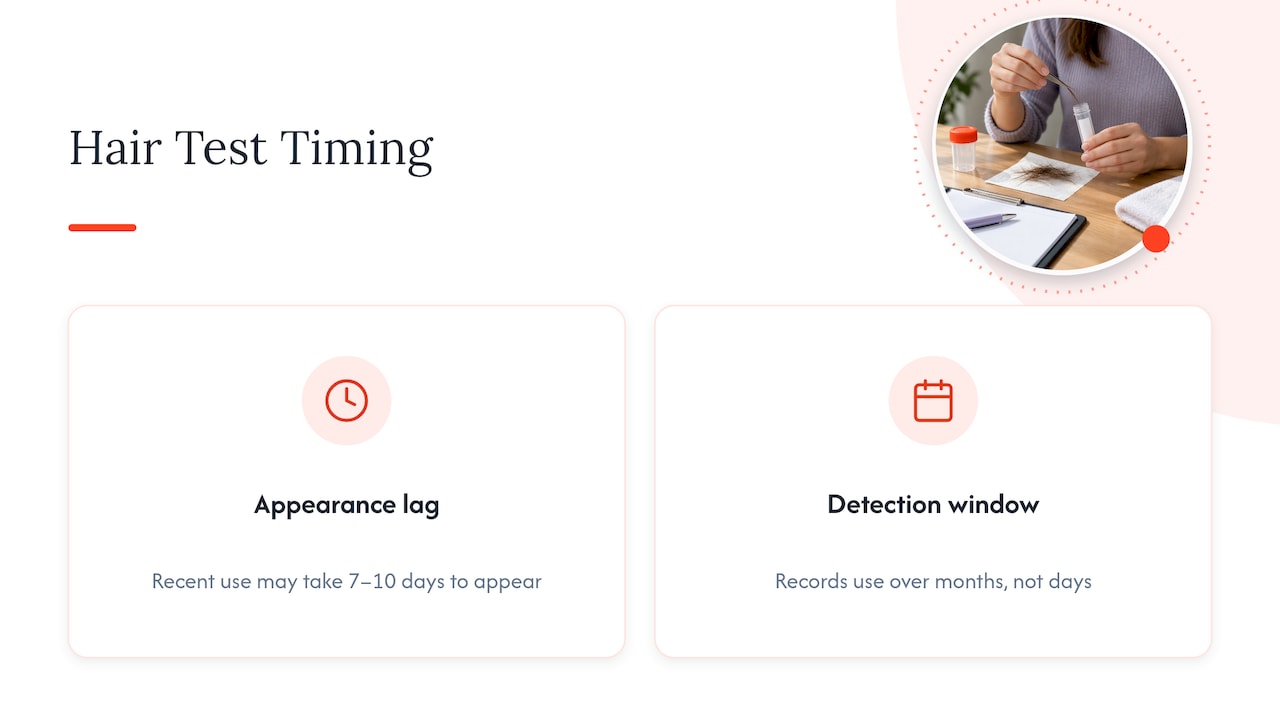
Labs back hair results with LC‑MS/MS, a method considered the gold standard for sensitivity and specificity, which also makes positives legally defensible.
Hair testing records use over months, not days, which is why it is the specimen that leaves the least room to maneuver.
How urine tampering works and how labs catch it
Urine is everywhere because it balances cost, speed and reliability. Routine urine collections are typically not observed, though, which is why it is the specimen most exposed to manipulation. Common attempts include:
- Dilution: drinking large amounts of fluid or adding water to lower concentration.
- Substitution: swapping in synthetic or someone else’s urine.
- Adulteration: adding chemicals meant to interfere with the test.
Labs answer with specimen validity testing (SVT): creatinine, pH, specific gravity and oxidant checks, plus temperature and visual inspection at collection. Forensic toxicology reviewers note that modern laboratory analyses increasingly identify these strategies, and labs are developing extra biomarkers to spot synthetic urine and adulterants more reliably. We break down one example in our piece on how biomarkers can expose synthetic urine, and in what the 20 mg/dL creatinine cutoff can miss.
Federal rules spell out the reporting categories: positive, adulterated, substituted or invalid. A flagged specimen is not treated as a clean pass. It is treated as a problem the donor has to explain.
Why oral fluid is hard to tamper with but short on lookback
Oral fluid collection is typically monitored or observed, which removes most of the substitution and dilution options that make urine vulnerable. There is no sample to swap and little to add.
- Window: minutes to about 2 days, depending on the substance and device.
- Best use: recent-use screening and impairment contexts such as drugged driving investigations.
- Analytical hurdles: sample volume varies, device recovery differs, and analyte concentrations are lower than in urine or hair, so labs lean on sensitive methods.
If your question is whether a test can see something from last week, oral fluid usually cannot. If your question is whether anyone can interfere with it, the answer is mostly no. Our guides on saliva detection time and how a saliva test works cover collection devices in more detail.
How confirmatory lab methods close the gaps
A rapid screen is often an immunoassay: quick and useful for flagging samples that need a closer look. Confirmation is a different class of test, using chromatography paired with mass spectrometry.
- Screening: immunoassay, fast, can cross-react.
- Confirmation: LC‑MS/MS or GC‑MS, which separate and identify specific compounds.
- Split specimen: a second portion is retained so a positive can be rechecked at another lab.
- MRO review: a licensed physician interprets results against legitimate medical explanations before anything is reported to the employer.
Clinical overviews such as Cleveland Clinic’s drug testing guide note that positive screens are typically confirmed by a more specific test. These methods can help identify substances that a rapid screen may not detect.
What privacy and legal rules apply to drug testing?
Rules differ by employer type, state and test purpose, so treat this as orientation, not legal advice. A few principles hold broadly:
- Consent and notice: employers typically need to tell you a test is part of the hiring or employment process.
- Federally regulated programs: these follow HHS/SAMHSA procedures, including chain of custody, certified labs and MRO review.
- Confidentiality: results go to the MRO and designated employer representatives, not to coworkers.
- Medications: legitimate prescriptions can cause positives, and the MRO’s job is to evaluate them before reporting.
- State law: rules on cannabis, off-duty conduct and testing triggers vary, so check your own state’s statutes.
If a result could affect a job or a legal case, ask for the written testing policy and the lab’s name. The SAMHSA drug-free workplace resources explain how certified laboratories and MRO review fit together. For anything contested, a qualified employment attorney is the right call.
Common myths about drug test difficulty
“Urine is always the easiest.” Urine is more susceptible to tampering than oral fluid or hair, but labs routinely run validity checks, and a substituted or adulterated report is worse than a negative would have been.
“Hair shows everything instantly.” It does not. Hair usually needs a 7–10 day lag before recent use appears, so a single recent use may not register.
“Cosmetic treatments wipe hair clean.” Treatments such as bleaching can affect interpretation, but they are not a dependable eraser.
“Oral fluid tests are easy because they are short.” The window is short, yet monitored collection makes them hard to manipulate. For recent use, they can be the toughest test to get around.
“A rapid screen is the final word.” It is the first word. Confirmation by LC‑MS/MS or GC‑MS decides most positives, and an MRO reviews them.
“A flat ‘cutoff’ protects you.” Cutoffs differ by drug, panel and specimen. Ask which cutoff applies to your test.
Which technology is making tests harder or easier to beat?
Both directions are moving at once. On the lab side, high-resolution mass spectrometry and refined LC‑MS/MS methods can detect low-level incorporation, which can matter in hair testing. Labs are also adding biomarkers aimed at synthetic urine and other adulterants, so specimen validity testing keeps tightening.
On the other side, synthetic urine formulations keep improving, and new adulterants appear faster than some screening checks update. Tampering methods and laboratory detection approaches continue to evolve, so results depend on the collection and testing process.
For you, the practical takeaway is that older advice ages quickly. A trick that sounded clever a few years ago may now be exactly what a validity panel looks for, which is why we point people toward understanding their specific test rather than chasing shortcuts.
Which specimen types does federal guidance authorize?
For federally regulated workplace testing, SAMHSA and HHS guidance authorizes urine and oral fluid, and it documents differences in detection windows and specimen validity requirements between the two. Transportation workers covered by DOT rules follow the same HHS framework for specimen handling.
What federal programs require, in plain terms:
- HHS-certified laboratories for both initial and confirmatory tests.
- Specimen validity testing on urine, covering creatinine, pH and specific gravity as applicable.
- Split specimens and defined reporting categories: positive, adulterated, substituted and invalid.
- MRO review of every non-negative result before it reaches the employer, as laid out in the MRO guidance manual.
Hair is not on the federal authorized list for these programs, but many private employers use it anyway, and their rules come from company policy and state law rather than federal regulation. If you are unsure which category you fall into, ask HR which standard governs your test.
How detection sensitivity differs by drug and specimen
No specimen is equally sensitive to every drug. Windows depend on the substance, how much and how often it was used, and the cutoff the lab applies.
- Hair: the longest lookback, up to about 90 days, and useful for detecting patterns of repeated use. Occasional single-use events are the least reliable to catch.
- Urine: broad coverage, with detection windows that vary by drug and use patterns. Frequent use extends the window considerably for some substances.
- Oral fluid: federal MRO reports show it reliably detects recent use of drugs such as cocaine, THC, opioids and methamphetamine, but only for a short period.
- Blood: very short windows, best for current impairment.
- Sweat patch: accumulates over about 7–14 days.
The comparison that surprises many people is positivity rate: in our own write-up, urine found far more positives than saliva because it simply sees further back. Ask which panel and cutoff your test uses, because a 5-panel and a 10-panel screen can answer very different questions.
How hair color, length and treatments affect hair tests
Hair is a physical record, so its characteristics matter.
- Length: hair length can affect the period represented by a sample. A hair test may detect use for up to about 90 days. Shorter hair means a shorter lookback, and labs may collect body hair when head hair is not available.
- Color: research has noted that some drugs bind more readily to darker, melanin-rich hair. That raises concerns about whether results are equally fair across hair types, and it is one reason interpretation by a qualified professional matters.
- Treatments: bleaching, perming and dyeing can affect interpretation, but peer-reviewed work on hair testing cautions against treating them as reliable erasers of a drug history.
- Washing: because metabolites incorporate from within, ordinary washing does not remove what is inside the shaft.
If you believe your hair characteristics or treatments skewed a result, raise it with the MRO. Documenting treatments, dates and products gives them something concrete to evaluate.
What to do and expect if you have a test coming up
Treat the collection as a process you are allowed to understand. Before the day, ask whether collection will be observed, whether a split specimen is retained, which panel is being run, and where confirmatory testing happens.
Match your expectations to the matrix. Hair has a long lookback and a 7–10 day lag. Oral fluid sees only recent use. Urine falls in between and gets validity checks on top.
If a result affects your job or a legal matter, request MRO review and ask for clarification in writing. Be ready to list prescriptions and supplements. A calm, informed question at collection beats a surprise afterward.
— MIchael
What we offer if you are preparing for a screening
We offer educational guides so you can understand your specific test before the day arrives. Orders ship fast within the United States, and you can reach our team by phone during published business hours. Once you know which test you face, start with our hair drug testing category or read our hair follicle drug test guide. No product or guide can guarantee a result, so we focus on clear information and sensible preparation. Browse everything at Passmydrugtest and pick the category that matches your screening.
This article is general information, not a substitute for advice from a qualified doctor. Consult a qualified healthcare professional about your own circumstances before acting on anything here.
FAQ
Which drug test is hardest to pass?
Hair follicle testing can be difficult to tamper with and reflects use over months. It does have a 7–10 day lag before recent use appears, so timing matters.
What is the highest panel drug test?
Panels are defined by how many drug classes they screen. A 10-panel test screens for a range of drug classes. Employers set the panel, so ask which substances your specific test covers.
What drug cannot be detected in urine?
No drug is universally undetectable. Detection depends on the substance, the lab’s cutoff and the panel used, and some substances are simply not on standard panels unless specifically requested.
How do labs handle a 10-panel drug screen?
Labs run a rapid screen first, then confirm any non-negative result with LC‑MS/MS or GC‑MS. In federally regulated programs, an MRO reviews the result before it is reported, as described in SAMHSA’s overview of urine and oral fluid testing.
Sources
- Advances in testing for sample manipulation in clinical and forensic toxicology – Part A: urine samples – PMC
- Pubmed
- Frontiers | Detection of drugs of abuse: evolving analytical strategies and emerging challenges
- Pubmed