

Illinois Marijuana Testing Law: Workers Can Challenge Impairment
Yes, Illinois law lets employers adopt reasonable drug-free workplace policies, require marijuana testing, and withdraw job offers after a failed test. They can also discipline you for on-the-job impairment. They must apply their policies without discrimination, and you must get a reasonable chance to contest an impairment finding under 410 ILCS 705/10-50.
TL;DR:
- The workplace privacy law generally protects lawful products used away from work, but Illinois cannabis law creates an exception; union agreements may add rules.
- A supervisor needs documented, specific signs such as poor coordination or unsafe work practices, and employees must receive a reasonable chance to challenge impairment findings.
- Urine screens detect inactive THC metabolites that may take about a month to leave the body, so a positive result cannot establish current impairment.
- Employers should publish policies and apply them consistently; unequal treatment of workers with matching roles and test results may support discrimination claims.
- After a positive result, promptly request the written report, lab identity, chain of custody, and contest deadline, then save notices and communications.
Table of Contents
- What the Cannabis Regulation and Tax Act says about workplace testing
- When employers can act: good faith belief, job offer withdrawal, and nondiscrimination
- How common drug tests work and why a positive may not mean impairment
- If you test positive or face discipline: what to do next
- What an enforceable employer drug policy looks like
- Our perspective: legal use does not mean protected from testing
- How we can help with home test kits and preparation resources
- FAQ
- Sources
What the Cannabis Regulation and Tax Act says about workplace testing
The Cannabis Regulation and Tax Act (CRTA) legalized adult use of marijuana, but it did not erase an employer’s right to set drug rules. Section 10-50 says employers may adopt reasonable zero-tolerance or drug-free workplace policies, require testing, and discipline or terminate employees who violate them. That covers use, possession, and impairment at work, and it covers being under the influence while on call.
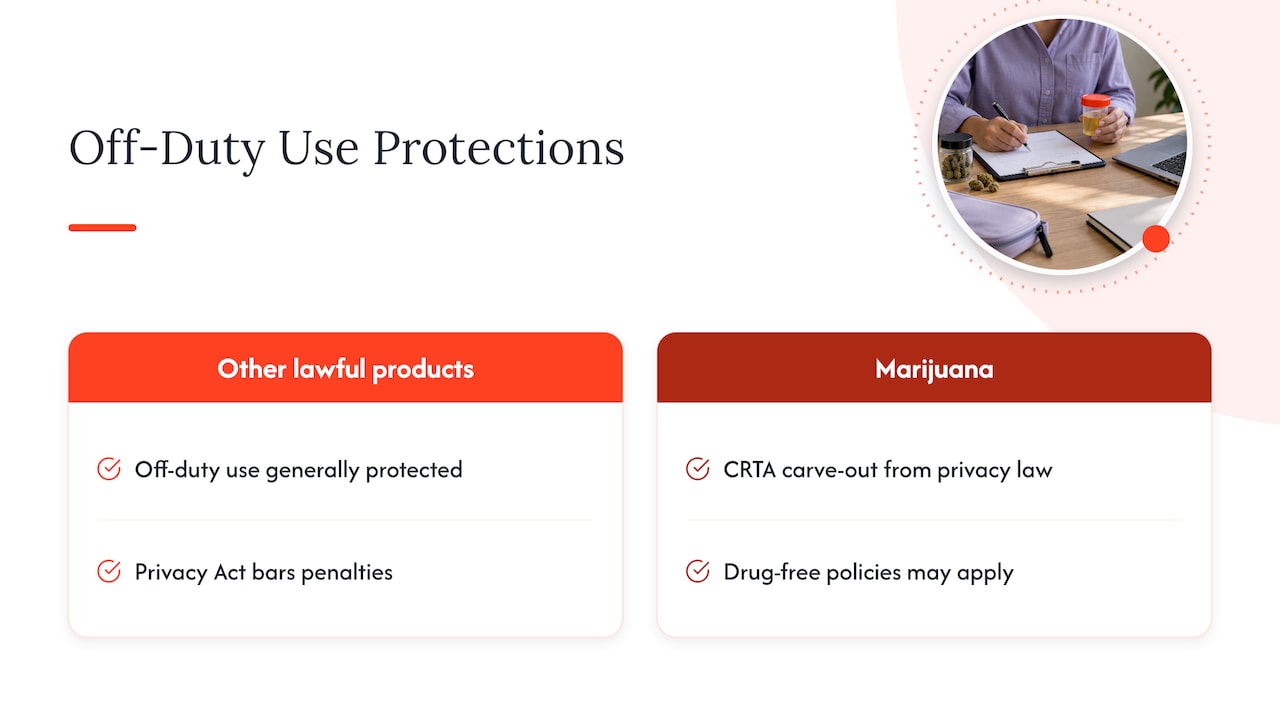
Many employees assume lawful off-duty use is protected. For most lawful products, it is. The Right to Privacy in the Workplace Act generally bars employers from penalizing workers for using lawful products away from work. But the CRTA works as a carve-out from that law. Because of it, an employer can enforce a drug-free policy against marijuana without breaking the privacy statute. If you work under a union contract, the collective bargaining agreement may add its own rules, so read it too.
The amendments clarified employers’ ability to set and enforce these policies, and they are not required to accommodate cannabis use.
State law is only one layer. If you believe additional rules apply to your job, check the requirements for your role.
When employers can act: good faith belief, job offer withdrawal, and nondiscrimination
Employers do not need a lab result to act on suspected impairment. Under the “good faith belief” standard, a supervisor can rely on documented observations, as long as they point to specific, articulable symptoms of impairment. Vague hunches do not qualify. Typical symptoms include:
- Changes in speech, such as slurring or unusual slowness
- Poor coordination or physical dexterity
- Irrational or unusual demeanor
- Accidents, near misses, or negligent work practices
- Unsafe handling of equipment or tasks
Whatever the employer relies on, the law requires that you be given a reasonable opportunity to contest the determination. A discipline notice that skips this step is a red flag.
Applicants may have fewer protections. Employers can set and enforce reasonable workplace drug policies, but check the policy and applicable rules to understand how a positive result could affect a job offer. Our guide to preemployment drug testing walks through what these screens usually look like.
Consistency is where employers often slip. Illinois Legal Aid notes that policies should be clearly communicated in handbooks and applied the same way to everyone. If one worker is fired for a positive test while another, in the same role with the same result, is not, the employer may be exposed to a discrimination claim. Written records of what was observed, when, and by whom strengthen a legitimate case and weaken an arbitrary one.
How common drug tests work and why a positive may not mean impairment
The core problem is simple: workplace tests may find evidence of past use without establishing current impairment. Here are some commonly used types:
- Urine: The most widely used screen. It picks up inactive THC metabolites, not the active compound, so it cannot show whether you are impaired right now.
- Hair: Employers may use hair testing as part of workplace screening.
- Saliva: Employers may also use saliva testing as part of workplace screening.
Our marijuana drug testing facts page covers detection windows in more detail.
Forensic reports note that urine typically shows THC metabolites rather than parent THC, and that metabolites can take up to approximately a month to excrete. A positive urine result can therefore reflect use weeks earlier, which is why it cannot reliably prove impairment on the job.
Do not confuse employment testing with state product testing. Under the CRTA, cannabis products sold to consumers must pass safety and potency testing for contaminants, solvents, and heavy metals. Approved labs follow Section 1300.700 of the administrative rules, and the state operates a Cannabis Reference Laboratory to verify accuracy. Those rules govern testing of cannabis products sold to consumers. Employment testing is a separate matter.
If you test positive or face discipline: what to do next
Move quickly and keep everything in writing. Ask promptly about the process for contesting the determination.
- Request your result and the paperwork. Ask for the written result, the chain-of-custody form, and the name of the lab that ran the test.
- Ask for the contest timeline. Find out in writing how long you have to dispute the finding and who receives your response.
- Seek independent confirmatory testing if available. Use the contest window to ask whether a second test is possible.
- Write down what happened. Record dates, times, who was present, and what was said while your memory is fresh.
- Save every document. Keep the handbook policy, disciplinary notices, emails, and texts.
- Consider legal counsel. If you suspect discrimination or a skipped procedure, a lawyer can review your situation.
Pro Tip: Ask whether the lab holds proper certification. The Illinois Department of Public Health explains when a CLIA certificate is required, and some pre-employment screening labs fall under different rules than clinical labs.
What an enforceable employer drug policy looks like
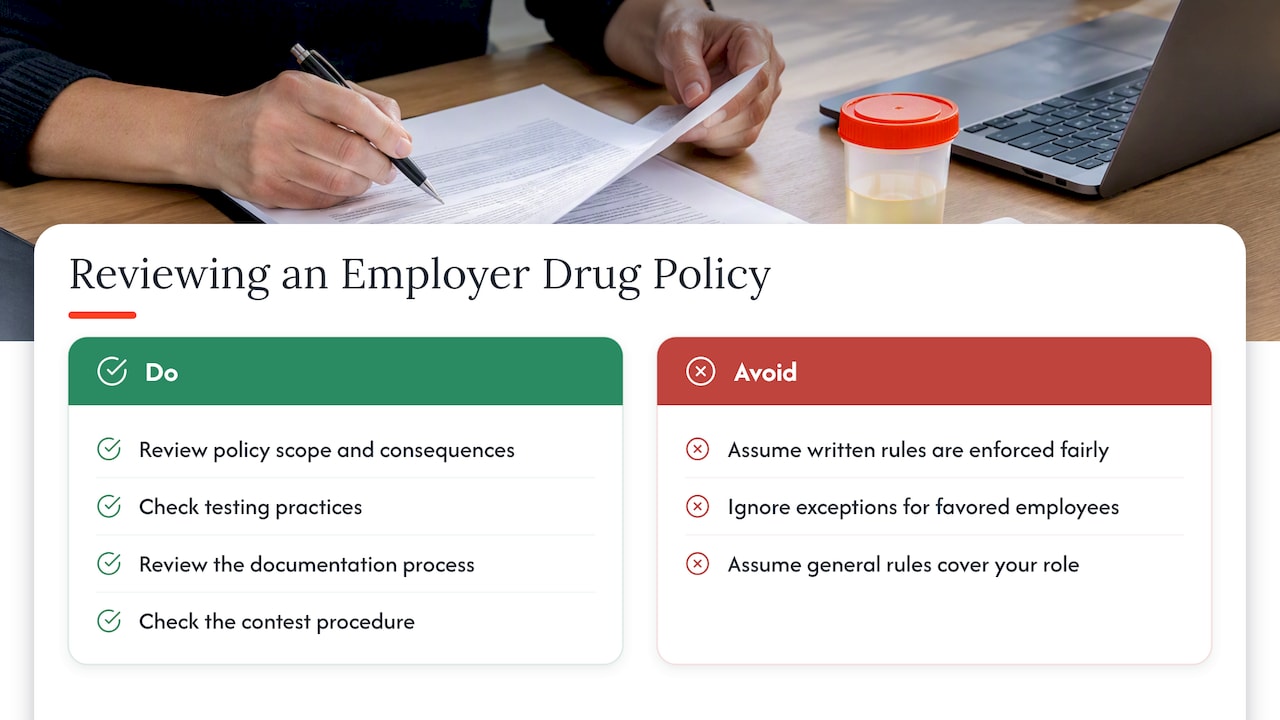
A “reasonable” policy is one you can read, understand, and check your employer against. Review your handbook for the policy’s scope, testing practices, documentation process, procedure for contesting an impairment finding, and possible consequences.
Consistency matters as much as the written text. If a policy exists on paper but managers enforce it only against certain people, that pattern can signal discrimination. Exceptions granted to favored employees are worth noting in your records.
Rules may differ depending on your role. Check whether any additional requirements apply before assuming the general Illinois rules govern your case.
Our perspective: legal use does not mean protected from testing
Legalization changed what adults can do on their own time. It did not take away an employer’s right to test, and I think too many people learn that the hard way, after an offer is pulled. At the same time, a positive urine result is a weak measure of whether someone was actually impaired at work, and you have a legal right to contest that conclusion. Document everything, use the contest process, and consider confirmatory testing. We publish educational guides and carry home test kits for people who want to understand where they stand before a screen.
— MIchael
How we can help with home test kits and preparation resources
If you want to check your own status before a screening, we carry home urine, saliva, and hair test kits, plus hair detox shampoos, alongside guides that explain each method. These are tools for personal preparation or independent confirmation, not legal advice. Browse our full shop or call our support team with product questions.
FAQ
What is the new law for drug testing in Illinois?
The key rule is Section 10-50 of the Cannabis Regulation and Tax Act. It lets employers adopt reasonable drug-free workplace policies, test employees, and discipline violations, while requiring a reasonable chance to contest impairment findings.
Do Illinois employers test for marijuana?
Many can and do, because state law permits it. Whether yours does depends on your handbook, your job type, and any federal rules covering your role.
What happens if you fail a drug test but have a medical card in Illinois?
A medical cannabis card does not necessarily resolve how a workplace policy applies. Employers may maintain reasonable drug policies, and an employee disciplined based on a good faith belief of impairment must have a reasonable opportunity to contest the determination.
How long does marijuana show up on a urine test?
Urine tests detect inactive metabolites, which forensic reports say can take up to about a month to excrete. That is why a positive result does not prove current impairment.