
Blue Dye at U.S. Drug Tests: What 49 CFR Part 40 Requires
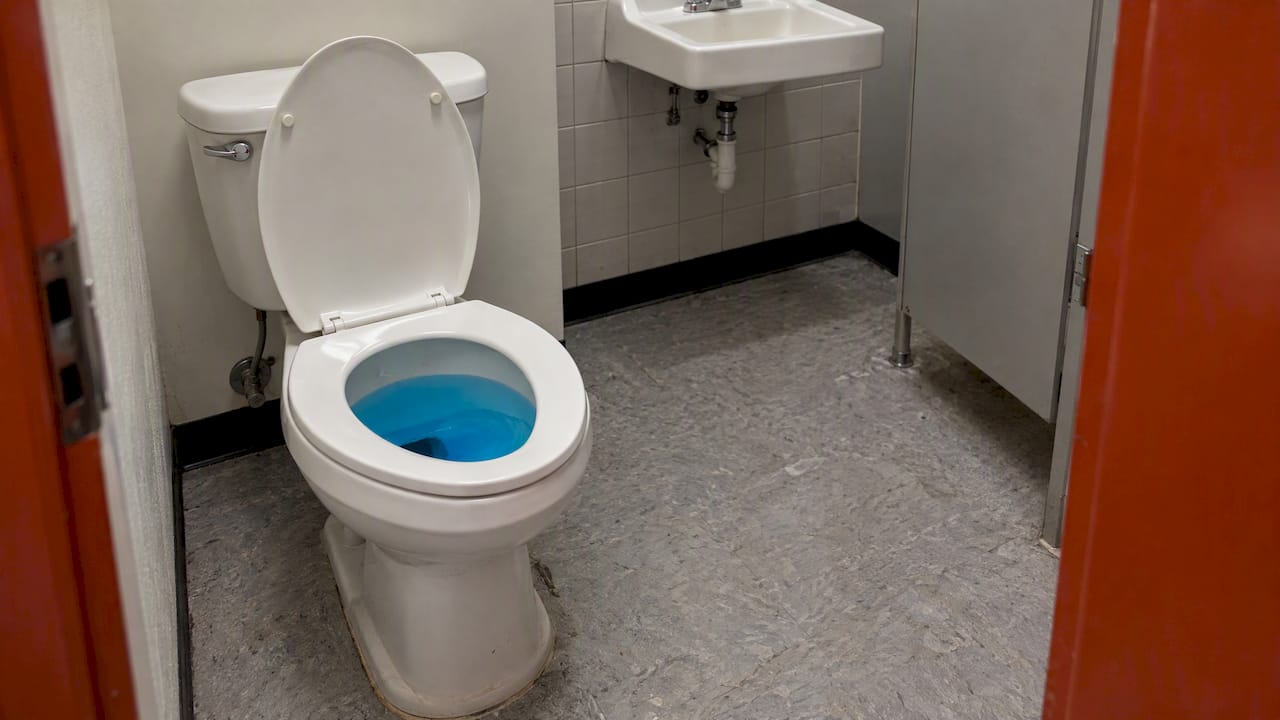
Toilet water is blue at a urine collection so that dilution or substitution with bowl or tank water is obvious. Federal DOT rules call for securing water sources and placing bluing agent in toilets when a site uses a multistall restroom. If blue dye shows up in a submitted specimen, collectors treat it as a sign of tampering, and the usual next step is a new collection under direct observation or an oral fluid collection.
TL;DR:
- For multistall restrooms, DOT rules require sites to secure water sources and either place bluing agent in every toilet or prevent access to them.
- If a collector sees blue dye, DOT procedures require an immediate observed urine recollection or oral fluid collection, with both specimens sent to the laboratory.
- Laboratories assess validity markers, with reference values including creatinine above 20 mg/dL and specific gravity above 1.001, though criteria vary by program and laboratory.
- Methylene blue can tint urine and interfere with some test interpretations; disclose its use and other coloring medications to the collector or MRO.
Table of Contents
- What toilet bluing is and how it works as a tamper deterrent
- What federal rules say about bluing and securing water
- What collectors check for and what happens when blue dye is present
- How labs test specimen validity and what the results mean
- Practical donor steps during collection
- Methods and products that may cause or mimic blue dye in urine
- How blue dye interacts with urine, hair and saliva tests
- Common myths and misconceptions about blue dye and drug test cheating
- Legal and workplace consequences of tampering with blue dye
- How to interpret test results when blue dye is present or suspected
- Guidance on choosing detox or preparation products when blue dye is in play
- Our perspective on blue dye and what to take from it
- Where to keep reading and what we offer
- FAQ
- Sources
What toilet bluing is and how it works as a tamper deterrent
A bluing agent is a dye added to the toilet bowl or tank so the water stays visibly blue. Collection sites use it for one reason: if someone tries to fill a cup from the toilet, the sample looks nothing like urine. The color does the work before any lab ever sees the specimen.
Here is how that plays out in practice:
- Visible contrast: Normal urine runs from pale yellow to amber. Blue water cannot pass for it.
- Deterrence before the fact: Most people never attempt substitution at all once they see the bowl is dyed.
- Easy inspection: The collector only has to look at the specimen to spot a problem, with no equipment needed.
- Layered with other controls: Bluing sits alongside securing faucets, removing soap and cleaning agents, and checking the specimen’s temperature.
It helps to be clear about what bluing is not. It is a site control, a deterrent built into the room. It does not detect chemical adulterants, it does not measure anything, and it says nothing about what the donor has or has not used. Those jobs belong to the laboratory’s validity testing, which we cover below.
Think of it like a tamper seal on a medicine bottle. The seal does not tell you what is inside, but a broken one tells you something is wrong. Blue water works the same way: it makes one specific kind of cheating hard to hide.
What federal rules say about bluing and securing water
Two sets of federal materials shape how a collection room is prepared: the DOT’s 49 CFR Part 40 rules and SAMHSA’s collection guidance.
The DOT rule on collection sites, 49 CFR §40.42, sets facility standards. A single-toilet room is preferred. When a site has to use a multistall restroom, it must secure water sources and either place bluing agent in all toilets or secure the toilets to prevent access. The broader Subpart D collection site requirements include checklists that tell collectors to place bluing agent in the toilet, or turn off the water supply and flush, secure other water sources, and make sure no soap or cleaning agents are in the collection enclosure.
SAMHSA’s Urine Specimen Collection Handbook covers the other half: how collectors inspect what comes out of the restroom. It tells them to look for abnormal characteristics, such as a blue specimen, to forward suspected invalid specimens to testing facilities, and to record unusual findings on the Federal Custody and Control Form (CCF).
In practice, sites meet these rules in a few ways:
- Placing bluing agent in the bowl and tank before the donor enters.
- Turning off the water supply, flushing, and taping or locking other fixtures.
- Removing anything the donor could use to alter a specimen, such as soap or cleaners.
- Using a monitored process when the room cannot be adequately secured.
What collectors check for and what happens when blue dye is present
Right after the donor hands over the specimen, the collector inspects it before anything is sealed. Under 49 CFR §40.65, the collector looks for signs of tampering. Typical checks run in this order:
- Color: Anything unusual, blue dye in particular, is flagged immediately.
- Foreign material: Floating objects or particles in the cup.
- Odor: A smell of bleach or another chemical.
- Foaming: Excessive foam that suggests soap or another additive.
- Volume and temperature: At least 45 mL, with a temperature check within four minutes of receiving the specimen.
If blue dye is present, the rule is specific. The collector must immediately conduct a new urine collection under direct observation, or an oral fluid collection. Under Subpart E, both specimens, the original and the observed one, go to the laboratory.
The paperwork matters as much as the collection. The collector records what was seen on the Federal CCF and notifies the designated employer representative as the regulation requires. A Medical Review Officer (MRO) may later review the file. If the original specimen is documented clearly, the MRO has what is needed to evaluate it.
How labs test specimen validity and what the results mean
Collection-site controls catch what a person can see. Laboratories catch what they cannot. Validity testing checks whether the specimen is actually normal human urine, and it complements the visual inspection.
SAMHSA describes validity testing built on creatinine and specific gravity, with pH and other checks alongside. According to a SAMHSA technical presentation, commonly referenced values include a temperature of 90–100°F (32–38°C), creatinine above 20 mg/dL and specific gravity above 1.001, while noting that criteria and interpretation depend on the program and the laboratory.
Reference ranges: A SAMHSA technical presentation lists temperature of 90–100°F (32–38°C), creatinine above 20 mg/dL and specific gravity above 1.001 as commonly referenced validity ranges. Those lines separate ordinary urine from specimens that look diluted or replaced.
What the markers tell a lab:
- Temperature: Checked at the collection site shortly after the specimen is given. A reading outside the range can point to substitution.
- Creatinine and specific gravity: Low values can suggest dilution. Values that do not look like human urine can suggest substitution.
- pH and oxidant checks: Unusual readings can suggest an added chemical.
- Reporting categories: Labs may report a specimen as dilute, substituted, adulterated or invalid.
- Split specimen: A second portion is retained so the result can be confirmed independently if the donor disputes it.
MRO case study guidance stresses documentation and procedural compliance, with an MRO following up when a verification question remains.
Practical donor steps during collection
Most problems at a collection site come from nerves or misunderstanding, not bad intent. A calm, by-the-book approach protects you.
- Arrive on time with valid ID and follow the collector’s instructions.
- Do not flush. 49 CFR §40.63 has the collector instruct you not to, and then examine the specimen.
- Provide at least 45 mL for a DOT test.
- Wash and dry your hands if instructed.
- Tell the collector about any medication or supplement that can color urine.
If you are told your specimen shows blue dye, expect a direct-observation re-collection or an oral fluid collection. After a first unsuccessful attempt, collectors may offer up to 40 ounces of fluids over up to 3 hours before you try again.
Pro Tip: Disclose medications and supplements before you provide the specimen, not after. A note on the form made at the time carries more weight than an explanation offered later.
Cooperation also matters because every step gets written down. A donor who stays calm and follows instructions leaves a clean record for the MRO.
Methods and products that may cause or mimic blue dye in urine
Not every blue-tinted specimen comes from a toilet. Some real sources are worth knowing about, because a donor who understands them can disclose them early.
The best documented one is a medication. FDA labeling for methylene blue, a drug used to treat a blood condition, says it passes into the urine and can interfere with the interpretation of urine tests that rely on a blue indicator. A donor taking it can produce urine that looks blue or green, and the label says medication-related color changes should be disclosed to the collector or MRO.
Other things can alter how a specimen looks or reads:
- Blue dye from the bowl or tank: Water from the toilet is the scenario bluing exists to expose.
- Medications and supplements that tint urine: Some change its color noticeably.
- Food dyes and vitamin supplements: They can change shade, though usually toward yellow, orange or green.
- Additives placed in a cup: Soap, bleach and similar products can show up as foam or odor, and they are the reason collectors inspect for those signs.
The point of disclosure is simple. A collector cannot tell, by looking alone, whether blue color comes from a prescription or from the toilet. Telling the collector and the MRO what you take gives them a documented reason to treat the specimen differently.
How blue dye interacts with urine, hair and saliva tests
Blue dye is a urine-collection issue. It exists because urine collections happen in restrooms, where a toilet is within reach.
For a urine test, the dye is a deterrent and an inspection cue. The specimen goes through the collector’s visual check, then validity testing at the lab.
For a hair test, there is no toilet in the process. A sample is cut from the head, so bluing does not apply. Hair collection has its own integrity concerns, handled through a different procedure. If you want background on that method, see our hair follicle drug test overview.
For a saliva test, the collection is an oral fluid sample, often taken while the collector observes. That is why oral fluid is the alternative offered when a urine specimen shows blue dye: it removes the restroom from the equation. Our page on how a saliva drug test works covers the basics.
A simple comparison:
| Test type | Where collected | Does bluing apply? |
|---|---|---|
| Urine | Restroom | Yes, bluing is a site control |
| Hair | Collector cuts a sample | No |
| Saliva | Mouth swab, often observed | No |
The takeaway is that the type of test changes which tamper controls make sense. Bluing is specific to the room where urine is produced.
Common myths and misconceptions about blue dye and drug test cheating
A few ideas about blue dye circulate online and cause real trouble for people who believe them.
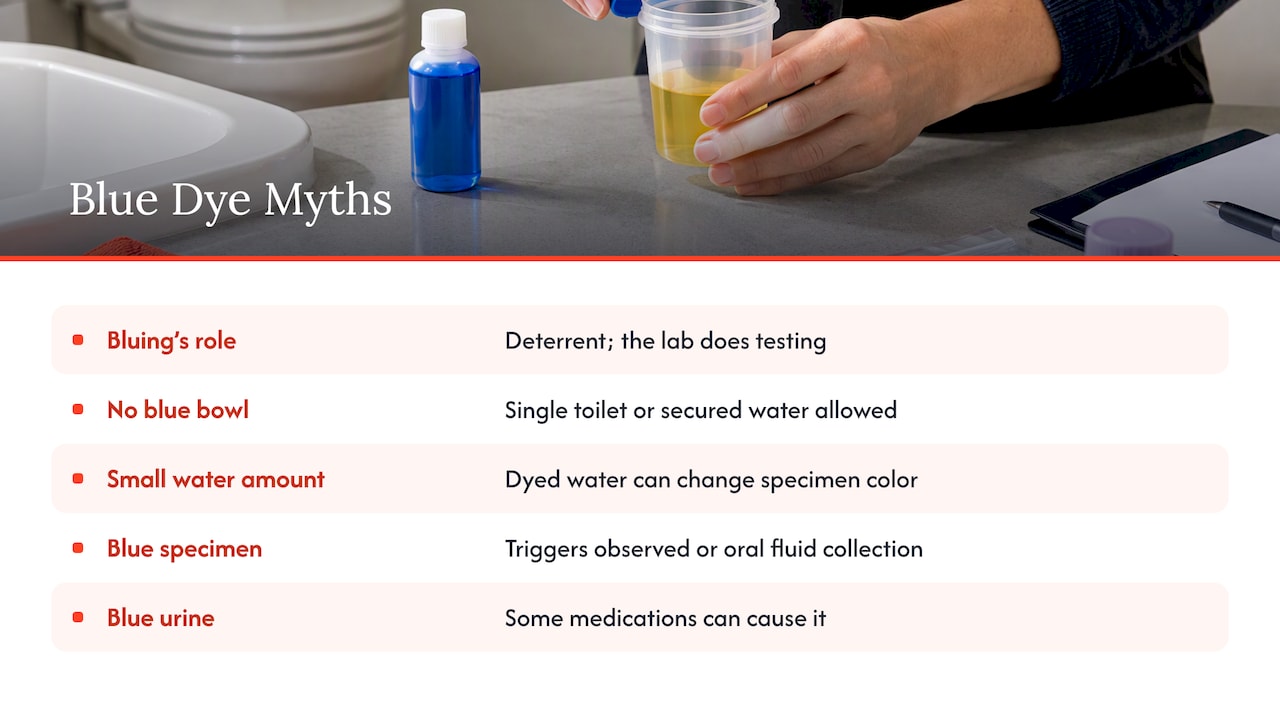
Myth: Blue dye is a drug test. It is not. It is a deterrent, a visual control. The lab does the testing.
Myth: If the toilet is not blue, the site is not following the rules. A site may use a single-toilet room or secure the water supply instead of using bluing. Federal rules allow a few ways to control access to water.
Myth: A small amount of toilet water will not be noticed. That is exactly the case bluing exists to catch. Because the water is dyed, even a small amount of it can change the specimen’s color, and collectors are trained to look.
Myth: Blue in the cup just means a retest. In a DOT collection, blue dye is a documented sign of tampering that triggers an observed or oral fluid collection and a record on the form.
Myth: Medications cannot cause blue urine. Some can, which is why disclosure matters.
Myth: Adding something to the cup is a harmless fix. Our explainer on why an adulterated drug test is treated as a refusal under 49 CFR 40.3 shows how serious that move can be. Likewise, substitution is not undetectable. We cover how synthetic urine can be exposed by biomarkers.
Most of these myths share a root. They treat the collection process as a single gate, when it is several overlapping checks.
Legal and workplace consequences of tampering with blue dye
The consequences depend on the type of test and the employer’s policy, so this section sticks to what the federal rules and our own pages support.
For DOT-regulated testing, an adulterated or substituted result is treated as a refusal to test under 49 CFR Part 40. Our guide to how the rules define it explains that an adulterated drug test is treated as a refusal. In DOT programs, a refusal is a serious outcome, comparable in consequence of a positive.
In ordinary workplace testing outside DOT, an employer sets its own policy. Common outcomes include:
- A withdrawn job offer in a pre-employment screen.
- Disciplinary action, up to termination, for current employees.
- A requirement to complete evaluation or follow-up testing before returning to duty.
The immediate steps at the site are the same for most programs that follow the federal model. The collector documents what they saw, collects a new specimen under direct observation or an oral fluid sample, and notifies the designated employer representative. Both specimens go to the lab.
The practical lesson is that an attempt to tamper does not stay at the collection site. It travels with the paperwork. If you are unsure what your employer’s policy says, ask for it in writing before the test, and ask the collector any procedure questions on the spot.
How to interpret test results when blue dye is present or suspected
Results in these cases come in layers, and it helps to read them in order.
First, the collector’s notes. If blue dye was seen, the Federal CCF records it and the collection is redone under observation or switched to oral fluid. Both specimens are processed.
Second, the lab’s validity findings. The lab may report a specimen as dilute, substituted, adulterated or invalid. MRO case study guidance notes that labs report validity markers and specific problems, with an MRO following up when verification is needed.
Third, the MRO’s review. The MRO looks at the paperwork, the lab result and any medical explanation. This is where a documented medication disclosure matters. If you take methylene blue or another medication that can color urine, the MRO is the person who can weigh that against the findings.
Some points to keep in mind:
- A blue specimen at collection is a procedural event, not a final verdict on drug use.
- The re-collected specimen is what typically carries the drug-testing result.
- The split specimen lets the result be checked at a second laboratory.
- Any medical explanation belongs with the MRO, not just the collector.
If you receive a result you do not understand, contact the MRO listed on your paperwork rather than guessing. They are the right person for test-specific questions.
Guidance on choosing detox or preparation products when blue dye is in play
Many readers who search this topic are really asking a different question: what can I do before a test? Here is a grounded way to think about it.
First, match the product to the test. A urine product does nothing for a hair test, and the reverse is also true. Our urine drug testing category and hair detox shampoo category are organized that way for exactly this reason.
Second, understand what blue dye detection means for any preparation plan. It means the room controls substitution. Whatever you choose, the specimen still has to be your own, produced in front of a collector’s controls, and still has to pass validity checks like creatinine, specific gravity and temperature.
Third, read product claims carefully and watch for anything that sounds absolute. Results depend on the person, the substance, the timing and the test. Our clean urine drug test page gives a broader overview of preparation steps.
Fourth, ask questions before you buy. Our support team answers product and shipping questions by phone during published business hours.
Finally, know the boundary. If you are in a DOT-regulated program, tampering and substitution carry the consequences described above, and no product changes the collection rules. For test-specific questions, your collector or MRO is the authority.
Our perspective on blue dye and what to take from it
Most coverage of this topic treats blue dye as a trick to outsmart, and that framing misses the real lesson. The dye is cheap, simple and old-fashioned, and it works because it makes one shortcut obvious without any technology. The conventional wisdom says the lab is where tests are won or lost. In practice, plenty of problems end at the collection site, long before a lab sees anything. Anyone planning for a test is better served by understanding the process than by hunting for a loophole in it. Read the rules, disclose what you take, follow the collector’s instructions and keep your paperwork clean. For anything test-specific, the MRO or the collector is your best check.
— MIchael
Where to keep reading and what we offer
We built our site for people researching drug testing, and we pair practical guides with product categories so you can go from reading to choosing in one place. If you want to keep learning, start with our urine drug testing resources, which cover how the test works and how to prepare. If you are ready to browse, our homepage links to our urine, hair and saliva categories.
Questions about a product or about shipping within the United States? Call our support team during our published business hours, and we will help you find the right fit for your situation. We keep our descriptions factual, because a good decision starts with accurate information.
FAQ
What is blue dye for in a drug test?
Blue dye is a bluing agent placed in the toilet so water from the bowl or tank cannot pass as urine. It is a visible deterrent used at collection sites, not a laboratory test. 49 CFR §40.42 describes placing it in all toilets of a multistall restroom or securing the toilets.
What color is a negative drug test?
Color of the urine does not indicate a result. A negative or positive result comes from laboratory testing, not from how the specimen looks. Collectors check color only to spot signs of tampering.
Will methylene blue cause you to fail a drug test?
Methylene blue can color urine, and FDA labeling says it may interfere with interpreting urine tests that rely on a blue indicator. Disclose the medication to the collector or MRO so the color can be documented and reviewed.
Can LabCorp tell if it’s fake pee?
Laboratories run validity checks such as creatinine, specific gravity and pH, and they can report a specimen as substituted or invalid. Our article on synthetic urine detection explains how biomarkers can expose a fake sample.
Sources
- Transportation
- eCFR :: 49 CFR 40.42 – Where does a urine collection for a DOT drug test take place?
- DOT Rule 49 CFR Part 40 Section 40.63 | US Department of Transportation