
Detox Shampoo Ingredients: What’s in the Bottle and What Works
Most detox shampoos are built from the same few parts: a strong surfactant to strip residue, an exfoliating acid, a chelating agent, an absorbent such as charcoal, and a solvent or humectant such as propylene glycol. They deep-clean the hair surface. That is useful, but it is not the same as erasing what a hair drug test measures. This guide goes through each ingredient, what it does, what the evidence says, and how to read a label if you have a hair test coming up.
TL;DR
- Detox shampoos work mainly through surfactants, acids and chelators that remove buildup from the outside of the hair shaft.
- Propylene glycol is a common solvent and humectant. It helps formulas feel smooth and spread evenly. It is not a magic detox agent.
- A 2022 forensic study found that commercial products cut THC concentrations in positive hair samples by a mean of 52% to 65%. Reduction is not the same as a guaranteed negative.
- Toxicologists focus on the THC metabolite carboxy-THC (THCA) in hair because outside contamination is less likely to explain it.
- Check the label for the cleansing system, the pH-adjusting and chelating ingredients, and the directions. Then plan around your test window.
Table of Contents
- What a detox shampoo is actually made of
- Surfactants: the real workhorse
- Salicylic acid, citric acid and other exfoliants
- Chelating agents and charcoal
- Propylene glycol in detox shampoo
- What the research says about shampoos and THC in hair
- Why carboxy-THC changes the picture
- How to read a detox shampoo label
- What we think, and how we approach this
- Where to find the right shampoo
- Preparing for a hair test: a realistic plan
- FAQ
- Sources
What a detox shampoo is actually made of
Open any detox or clarifying shampoo and you will find a handful of ingredient families. The brand names change. The chemistry mostly does not.
| Ingredient family | Common examples | What it does |
|---|---|---|
| Primary surfactants | Sodium C14-16 olefin sulfonate, sodium laureth sulfate, sodium lauroyl sarcosinate | Lift oil, product residue and debris off the hair so water can rinse them away |
| Secondary surfactants | Cocamidopropyl betaine, cocamidopropyl hydroxysultaine | Soften the cleansing action and build foam |
| Exfoliants and acids | Salicylic acid, citric acid, glycolic acid | Loosen scalp flakes and mineral or product film |
| Chelating agents | Sodium phytate, EDTA salts, citric acid | Bind minerals from hard water so they rinse out |
| Absorbents | Activated charcoal, clay | Soak up sebum and surface dirt |
| Solvents and humectants | Propylene glycol, glycerin, hexylene glycol | Dissolve actives, hold moisture, improve spreadability |
| Conditioning agents | Panthenol, guar derivatives, oils | Offset the dryness that strong cleansing causes |
| Botanicals and fragrance | Tea tree, peppermint, ginger, apple cider vinegar | Mostly scent, feel and marketing |
The top results for this topic confirm the pattern. Product pages list charcoal, peppermint oil and vitamin E in one, and olefin sulfonate surfactants with salicylic acid in another. Educational pages describe clarifying shampoos as relying on a surfactant blend plus a buildup remover. The common thread is surface cleaning.
Surfactants: the real workhorse
Surfactants are the reason a detox shampoo feels so different from a daily shampoo. Their molecules have a water-loving end and an oil-loving end, so they grab sebum, styling product and other residues and let water carry them off.
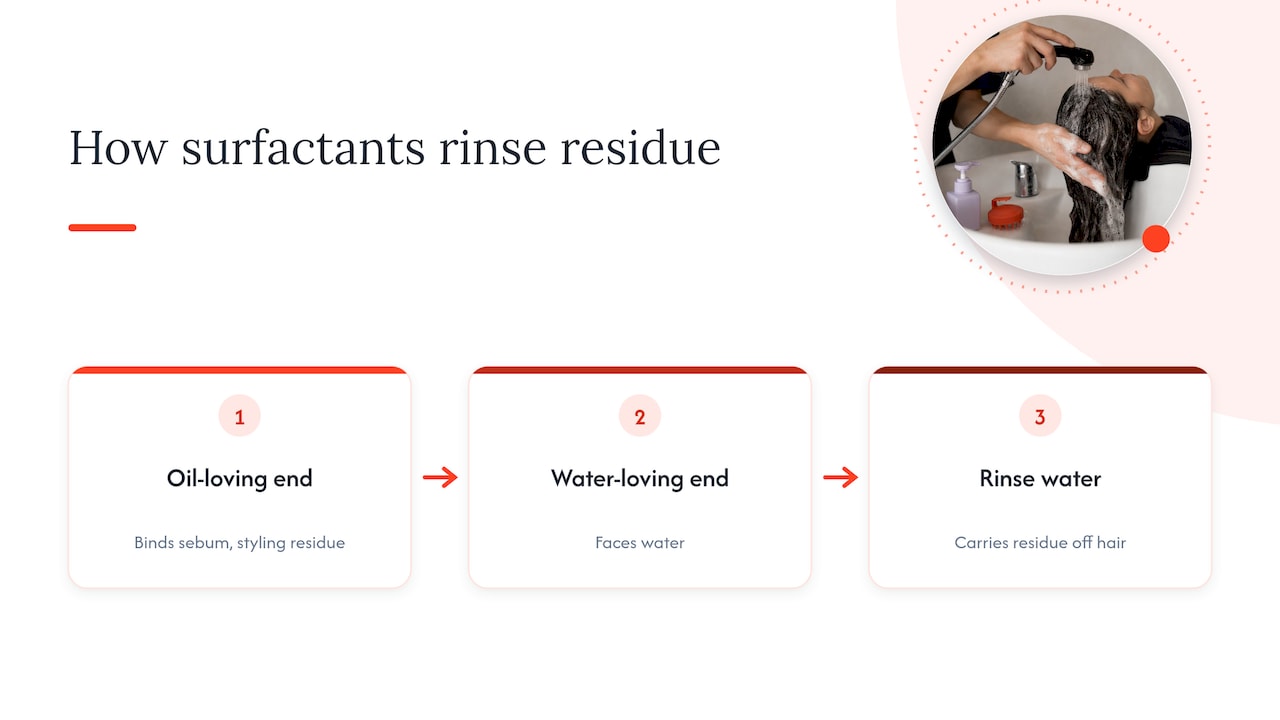
In a detox formula the surfactant system is stronger or more concentrated. Sodium C14-16 olefin sulfonate is a typical lead ingredient. Sulfates such as sodium laureth sulfate do the same job. Milder co-surfactants like cocamidopropyl betaine sit behind them to temper harshness.
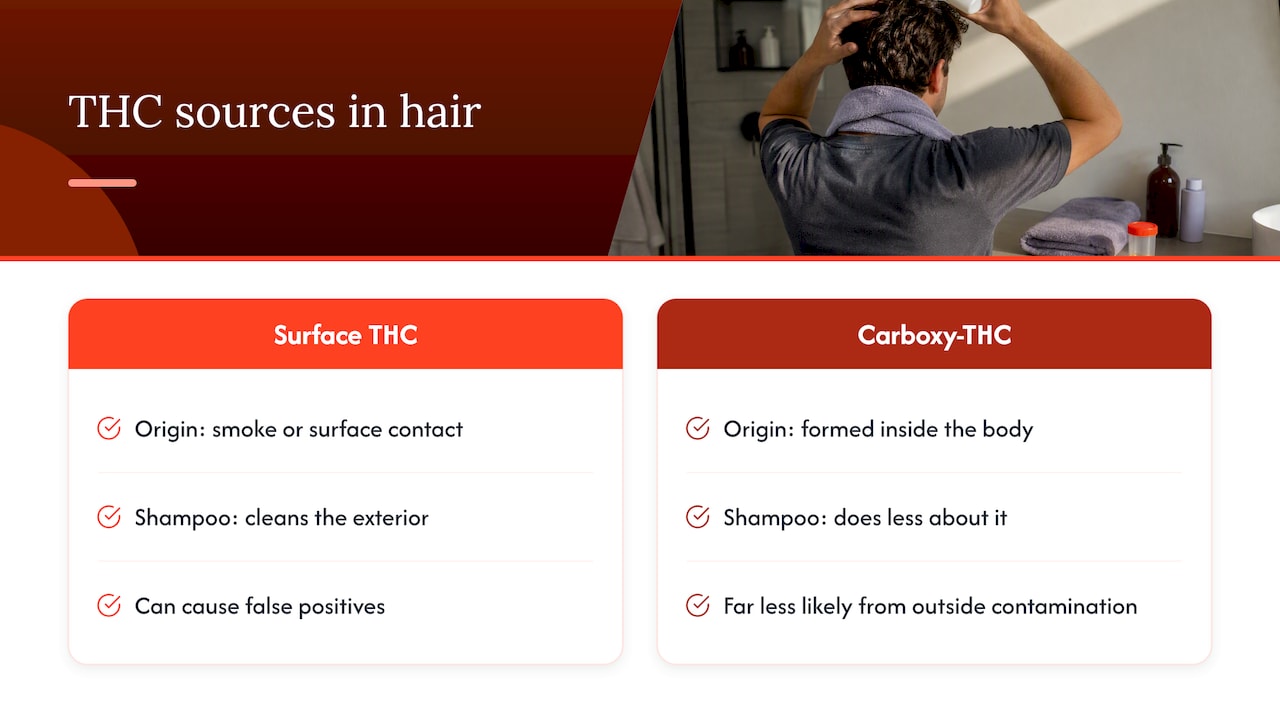
Why this matters for a drug test: THC and its metabolites reach hair through the bloodstream, through sweat and sebum, and through the outside environment such as smoke or surface contact, as a SAMHSA literature summary explains. A surfactant can only reach the last two. Anything from the first route is locked inside the hair’s keratin structure.
Salicylic acid, citric acid and other exfoliants
Salicylic acid is the best-known active in scalp-focused detox shampoos. It dissolves the bonds between dead skin cells and loosens oily, flaky buildup. Citric acid and glycolic acid appear in some formulas to lower pH and help rinse away mineral film.
These ingredients cleanse the scalp and the outside of the hair. They do not change what is inside the shaft. Because they can be drying, they are usually paired with conditioning agents like panthenol or glycerin.
Chelating agents and charcoal
Chelators such as sodium phytate or EDTA salts grab metal ions, mostly calcium and magnesium from hard water and sometimes copper from pools. Removing that film makes hair feel lighter and lets the surfactants work better.
Activated charcoal is an absorbent. It is porous and attracts oil and fine particles, which is why it shows up in many marketing images. In a rinse-off shampoo it has limited contact time, so think of it as a supporting ingredient rather than the engine of the formula.
Propylene glycol in detox shampoo
Readers ask about propylene glycol more than any single ingredient, so here is the plain answer.
Propylene glycol is a clear, nearly odorless liquid used across cosmetics as a humectant, solvent and emollient. In a shampoo it does three jobs:
- It dissolves other ingredients so the formula stays stable and clear.
- It attracts and holds water, which keeps hair from feeling stripped after a strong wash.
- It helps the product spread and rinse evenly.
What it does not do is pull THC out of hair. There is no research linking propylene glycol to removal of drug residue from the hair shaft. When you see it high on a label, read it as a sign of a conventional, moisture-conscious formula. Some people with sensitive scalps prefer to avoid it. If your scalp gets irritated by a product, stop using it and talk to a dermatologist.
You may also see related names such as hexylene glycol, caprylyl glycol or butylene glycol. They play similar solvent or conditioning roles.
What the research says about shampoos and THC in hair
Here is where marketing and science part ways. The most useful study for this topic is the 2022 paper on manipulation of THC hair concentrations. Researchers took THC-positive hair samples and treated them with everyday products and products advertised online, then measured the concentrations again.
What they reported:
- Mean THC reductions ranged from 52% to 65% across the products tested, including a detox shampoo, a dandruff shampoo and hair tonics.
- In some instances, concentrations dropped to non-detectable levels.
- Results were not uniform. They varied by product and by sample.
Two lessons follow. First, repeated washing with strong surfactants can lower measured THC, which is why a good cleansing routine is a reasonable part of preparation. Second, ordinary shampoos did something similar, which suggests much of the effect is mechanical washing and surfactant removal of surface material, not a special detox ingredient. The authors note that this also makes intentional manipulation hard to tell apart from normal grooming.
A reduction of half or two-thirds does not guarantee a result under a cutoff. It depends on how much was in the hair to begin with, hair type, how often you wash and which lab’s thresholds apply.
Why carboxy-THC changes the picture
Labs know that smoke and surface contact can leave THC on hair. To avoid false positives, toxicologists look for carboxy-THC (THCA), a metabolite formed inside the body, which is far less likely to come from outside contamination.
That helps explain why shampoo claims have limits. Cleaning the exterior addresses contamination. It does less about metabolites that arrived through blood and sweat and became part of the hair. Labs also wash samples before analysis, but a review of hair analysis methods notes there is no international consensus on the washing procedure and that removing all external contamination is widely considered impossible. So both sides of the process are imperfect.
How to read a detox shampoo label
You do not need a chemistry degree. Use this checklist.
- Look at the first five ingredients. They make up most of the formula. You want a real cleansing system (an olefin sulfonate, a sulfate or a sarcosinate) in there, not just botanical extracts.
- Find the acid and the chelator. Salicylic acid, citric acid, sodium phytate or similar show the formula is built for buildup, not just for scent.
- Treat botanicals as a bonus. Ginger, peppermint, tea tree or cactus extracts are pleasant but are not the reason a shampoo cleans.
- Check the directions. A serious product tells you how long to leave it on, how many times to repeat and whether to follow with conditioner.
- Be wary of absolute claims. Any label promising a guaranteed pass is promising something nobody can control. As the SAMHSA material explains, drug incorporation into hair is complex and varies from person to person.
- Match the product to your scalp. If you have color-treated hair, a dry scalp or sensitivities, check for fragrance and drying agents first.
Ingredients you may want to avoid
- Heavy silicones or oils right before a wash, since they leave film that blocks cleansing.
- Fragrance-heavy formulas if your scalp is reactive.
- Harsh sulfate blends with no conditioning agents, if your hair is already dry or damaged.
What we think, and how we approach this
We sell detox shampoo, and we still tell customers the same thing: a shampoo is a tool, not a guarantee. The evidence supports the idea that strong, repeated washing reduces THC measured in hair, and it does not support any claim of certainty. That is why our site pairs products with guides on hair drug test detection times and a frank piece on why hair detox shampoos can’t beat lab tests.
What we would tell a friend with a hair test in two weeks:
- Know what you are up against. Hair typically reflects up to about 90 days, and the SAMHSA summary puts growth at roughly 1.5 cm per month.
- Start washing routines as early as you can, and follow the directions on the product exactly.
- Be honest with yourself about heavy, recent or long-term use. Shampoo alone may not be enough.
- Call us if you are unsure which product fits your test. Our phone team can help you match a product to your situation during published business hours.
We would rather you leave with realistic expectations than a bottle and a promise.
— MIchael
Where to find the right shampoo
If you want a ready-made routine, our hair detox shampoo collection lists the shampoos we carry, including the Hair Follicle Shampoo Kit and Zydot Ultra Clean Shampoo. Orders ship fast within the United States. If you want to see what a lab-style test looks like first, our hair drug test information page explains the basics.
Preparing for a hair test: a realistic plan
Ingredients are only one part of the picture. Here is how the pieces fit together.
Know your window
Hair tests look back about 90 days, based on a standard 1.5 inch sample cut close to the scalp. Anything you used in that stretch can be in the sample. A shampoo does not shorten that window. Our guide to hair drug test detection times explains how it works.
Understand which sample you might face
Some employers and courts use hair, but many still use urine or saliva. If you are not sure which test applies, ask the employer or testing provider before you spend money. If it is urine or saliva, our guides on how a saliva drug test works and pre-employment drug testing are better starting points than a shampoo label.
Wash with intention
Use the shampoo as directed, rinse thoroughly and condition afterward, since strong cleansers can leave hair brittle. Avoid layering oils, gels or leave-in products right before your test, because buildup works against the wash.
Do not rely on a single trick
The research itself shows mixed results across products and samples. The honest framing is that cleansing may lower the measured level, and the outcome is not guaranteed. If a job, license or court order depends on the result, consider whether a delay or a different test is possible.
Consider testing yourself first
An at-home kit gives you a read on your situation before the real test. Our hair follicle drug test page shows what is available.
FAQ
What does a detox shampoo do?
It deep-cleans hair and scalp using strong surfactants, exfoliating acids, chelators and sometimes charcoal. This removes oil, product film and surface debris. It does not change what is bound inside the hair shaft.
What is the main ingredient in clarifying shampoos?
A surfactant system, usually sulfates, sulfonates or sarcosinates, is the main cleansing ingredient. Salicylic acid and chelating agents like sodium phytate or citric acid support it. Botanical extracts are generally secondary.
Is propylene glycol necessary in a detox shampoo?
No. It is a solvent and humectant that keeps the formula stable and moisturizing, and many effective shampoos work without it. It does not remove THC from hair. If you have a sensitive scalp, a formula without it may feel better.
Can a detox shampoo guarantee I pass a hair drug test?
No. A 2022 study found average THC reductions of 52% to 65%, with some samples falling to non-detectable levels, but results vary. Heavier use, hair type and lab thresholds all matter. No shampoo can promise an outcome.
Which ingredients should I avoid in a clarifying shampoo?
Skip heavy silicones and oils right before washing, and be careful with strong fragrance if your scalp is reactive. If your hair is dry or color-treated, avoid harsh sulfate blends with no conditioning agents. Stop using anything that burns or itches, and see a dermatologist if irritation continues.
Sources
- Manipulation of THC Hair Concentrations by Commercially Available Products (PMC, 2022)
- The science of hair testing: summary of literature review (SAMHSA)
- Current status of hair analysis in forensic toxicology in China (PMC)
- Propylene glycol: cosmetic ingredient (SpecialChem)
- Clean & Pure detox shampoo product page (Nexxus)