
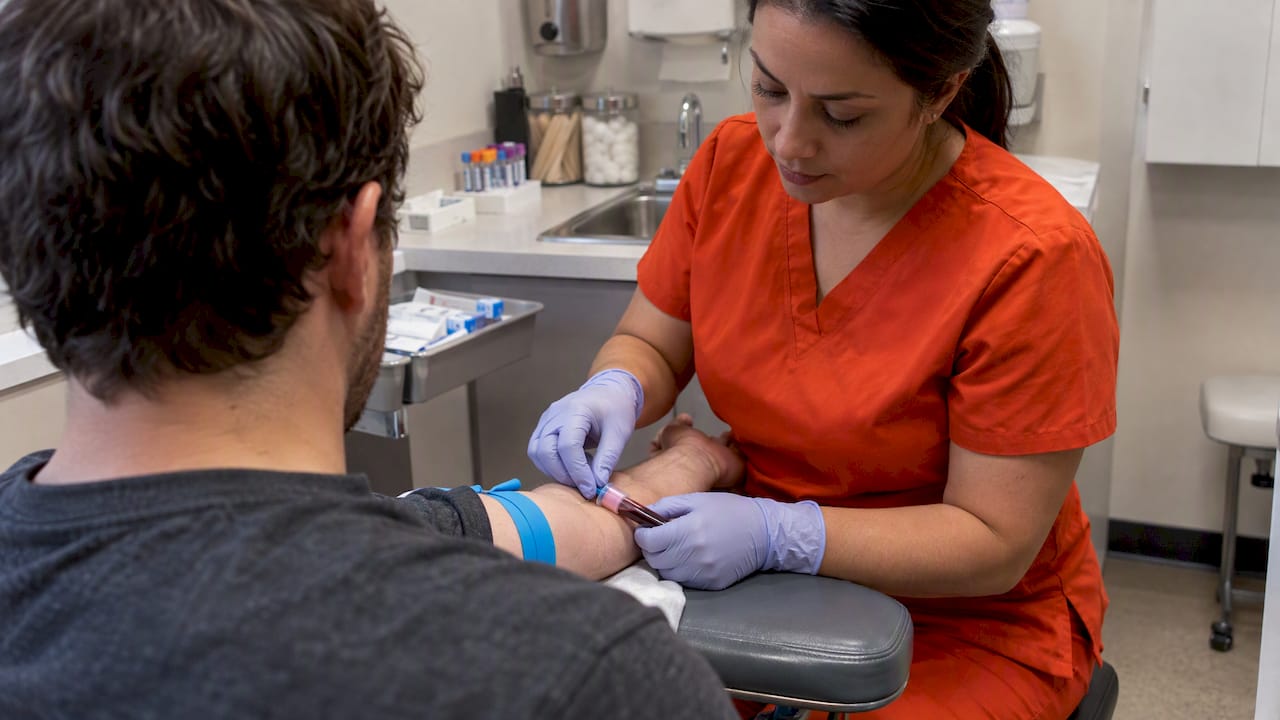
Blood THC Detection When a Test Is Coming: 7–13 Hours or 30 Days
If you smoked or vaped once, blood THC is typically detectable for a matter of hours, often under 24. If you use frequently, detection can stretch into days and in some documented cases weeks, depending on your assay’s sensitivity. The window shifts with route of use (inhaled versus edible), dose, and the lab’s cutoff, and a positive result tells you THC is present, not that you’re impaired. If a blood draw is coming, write down your last use time, the product type, and the exact collection time.
TL;DR:
- Controlled studies found mean blood detection of about 7 to 13 hours after occasional smoking, with some results extending to roughly 27 hours.
- Monitored abstinence studies documented detectable THC or metabolites for days among chronic daily users, with some results near the assay limit after 30 days.
- After 10, 25, or 50 mg edible doses, whole blood THC was detectable for up to 22 hours at a 0.5 ng/mL limit.
- Record your last use, product type, and draw time, then ask which compound and quantification limit the lab used; request confirmatory testing for consequential results.
Table of Contents
- How THC moves through your blood after you use it
- Detection windows by use pattern and route: what the studies actually found
- What actually changes your personal detection window
- How labs read a blood sample, and why a number isn’t the whole story
- What the research consistently shows, and where it runs out
- My take: document everything before you worry about the number
- Where PassMyDrugTest fits into your next steps
- FAQ
- Sources
How THC moves through your blood after you use it
When you inhale cannabis, THC hits your bloodstream within minutes because it crosses the lungs almost immediately. Peak plasma concentrations after smoking typically happen within 3 to 10 minutes, then fall fast as your body shuttles the drug into fat tissue. Edibles work differently: THC has to pass through your gut and liver first, so blood levels rise slowly and peak much later, often 1.5 to 3 hours after you eat it, according to a controlled oral-dosing study.
THC is lipophilic, meaning it dissolves readily into fat rather than staying suspended in blood. That’s why blood concentrations spike and crash quickly after smoking, then settle into a long, slow release as fat stores leak small amounts of THC back into circulation. This redistribution phase is also why a test’s timing matters so much. Our guide to THC half-life breaks down why blood levels don’t decline on a straight line.
Blood tests don’t just look for one chemical. Labs typically track three related compounds, and which one shows up, and for how long, depends on what the test is designed to catch:
- Parent THC, the active compound, clears from blood fastest and signals recent use.
- 11-OH-THC, an active metabolite formed by the liver, also has a relatively short window.
- THC-COOH, an inactive metabolite, lingers far longer and is often what distinguishes a one-time user from a daily one.
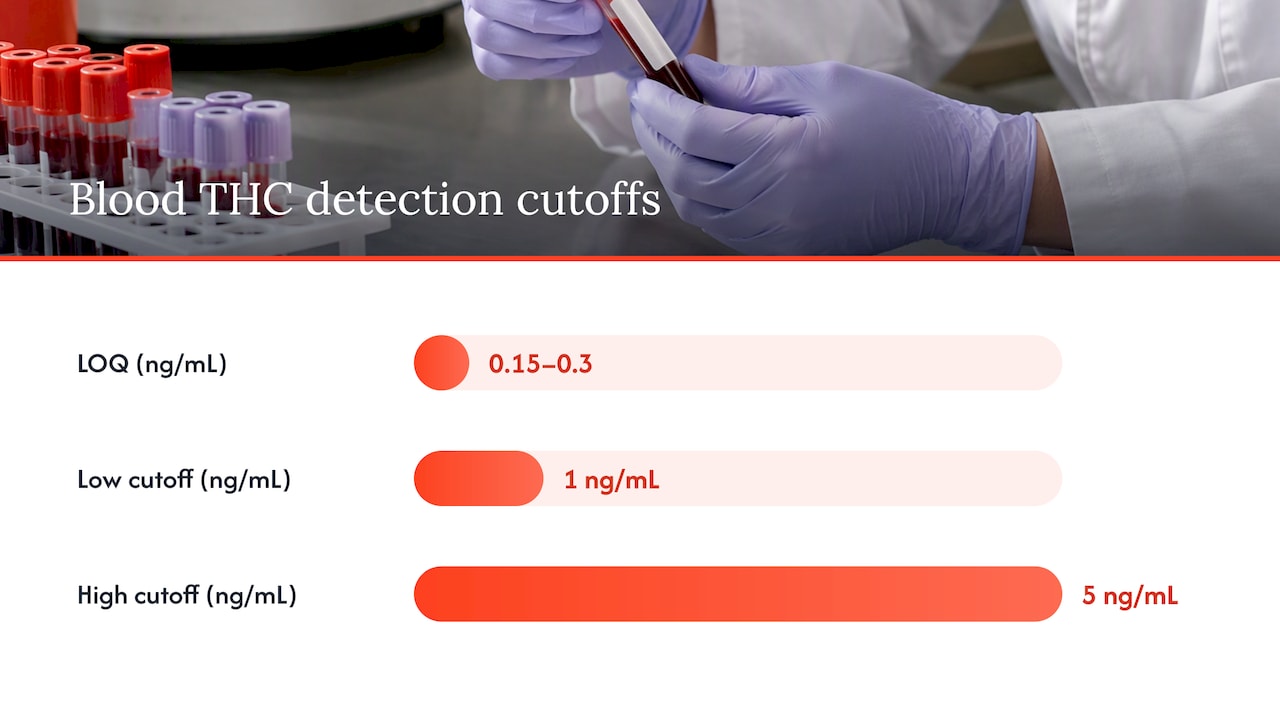
None of this matters without a baseline for what counts as “detectable.” Every lab sets a limit of quantification (LOQ), the lowest concentration its equipment can reliably measure. Validated methods report THC LOQs as low as 0.15 to 0.3 nanograms per milliliter, while THC-COOH LOQs often run higher, around 1.0 to 3.0 nanograms per milliliter, according to analytical validation research. A sample that would register as positive on a highly sensitive assay might come back clean on a less sensitive one, even drawn at the same moment from the same person.
That gap in sensitivity explains a lot of the conflicting numbers you’ll see online. A headline claiming THC is “gone in 4 hours” and another claiming “detectable for weeks” can both be accurate, they’re just describing different people, different routes of use, and different lab cutoffs.
Detection windows by use pattern and route: what the studies actually found
The clearest way to understand your own likely window is to match your situation, occasional versus frequent use, smoking versus edibles, to the closest controlled study.
For occasional or infrequent smokers, controlled inhalation studies put the detection window in the range of hours, not days. One frequently cited dataset reported mean plasma THC detection of roughly 7.2 hours after a lower-THC cigarette and about 12.5 hours after a higher-potency one, with some individual ranges extending to about 27 hours depending on dose and the assay’s LOQ, per controlled smoking research. Mean plasma THC detection after smoking ran from roughly 7 to 13 hours in controlled studies, a window that assumes a sensitive assay and a single, moderate dose.
Frequent and chronic users tell a very different story. In monitored-abstinence research, where participants were confirmed not to use cannabis during the study, chronic daily smokers showed detectable THC or its metabolites for days to weeks after their last confirmed use. Some participants still had measurable THC near the assay’s LOQ as late as 30 days into abstinence, according to research on prolonged cannabinoid excretion. That’s not the typical outcome for every chronic user, and the study authors were clear that these extended windows reflect accumulated body burden in heavy, long-term use rather than a predictable timeline anyone can count on.
Edibles complicate the picture further. Oral THC produces a lower peak blood concentration than smoking the same amount, but the effect lasts longer and the detection window doesn’t map cleanly onto inhalation data. In a controlled study using 10, 25, and 50 milligram oral doses, whole-blood THC was detectable anywhere from 0 to about 22 hours, using an LOQ of 0.5 nanograms per milliliter, with mean whole-blood peak concentrations of roughly 1 to 3.5 nanograms per milliliter and subjective effects lasting 6 to 8 hours even after blood levels dropped, per the oral cannabis pharmacokinetics study. If you’re trying to figure out how an edible specifically plays into a blood test, our edibles detection timeline walks through that route in more depth.
A few numbers worth holding onto:
- Occasional smokers: detection commonly measured in hours (around 7 to 13 hours on average, up to ~27 hours at some LOQs).
- Chronic daily smokers: detection can extend to days, with documented outliers near assay LOQ at 30 days.
- Oral/edible use: whole-blood detection windows up to roughly 22 hours at an LOQ of 0.5 ng/mL.
Every one of those ranges depends on the LOQ the lab used. A study (or a lab) running a more sensitive assay will report longer windows for the same person, same dose, same timing. That’s not inconsistency, it’s measurement precision doing exactly what it’s supposed to do.
What actually changes your personal detection window
Two people who smoke the same joint at the same time can test differently days later. Here’s what tends to drive that difference, roughly in order of impact:
- Frequency and duration of use. How often and how long you’ve used cannabis is the single strongest predictor of an extended detection window, because THC accumulates in fat stores with repeated exposure.
- Dose and product potency. Concentrates, dabs, and high-THC flower put more total THC into your system per session than lower-potency products, which raises your body’s overall THC burden.
- Body fat and metabolism. Because THC stores in fat, higher body fat percentage and slower metabolic clearance can extend how long residual THC keeps showing up in blood.
- Drug interactions. THC is metabolized partly through liver CYP enzymes, so other medications that compete for those same enzymes can theoretically slow or speed clearance, though this varies by individual and isn’t predictable from general rules.
- Specimen and collection variables. Venous versus capillary blood, how long the sample sits before processing, and the specific cutoff the lab applies can all shift whether a given sample reads positive.
On that last point, recent comparison research found that capillary blood often reads 30 to 40% lower than venous blood in the first couple of hours after smoking, according to venous-capillary comparison research. That matters if you’re trying to reconcile two test results drawn by different methods close together in time.
Pro Tip: If you’re a frequent user facing a scheduled blood draw, don’t assume a single negative test weeks ago means you’re clear now. Monitored studies document cases where a low positive appeared near the detection threshold after an earlier negative, simply because concentrations hover right around the LOQ.
How labs read a blood sample, and why a number isn’t the whole story
Most labs confirm THC presence using gas chromatography tandem mass spectrometry (GC-MS/MS) or liquid chromatography tandem mass spectrometry (LC-MS/MS), both of which can detect THC and its metabolites at very low concentrations with high specificity. These aren’t simple strip tests. They separate and identify each compound individually, which is part of why confirmatory lab results carry more legal weight than a rapid screening device.
The unit and cutoff a lab chooses to report matters as much as the method itself. A result expressed in nanograms per milliliter (ng/mL) versus micrograms per liter (μg/L) is the same underlying measurement, but the cutoff a jurisdiction or employer sets, say 1 ng/mL versus 5 ng/mL, determines whether a given sample gets called positive or negative. Validated assay methods report THC limits of quantification as low as 0.15 to 0.3 ng/mL, per method-validation research, which means a sample that’s “negative” at one lab’s cutoff could be “positive” at another’s.
This is where the detection-versus-impairment distinction becomes critical. Blood THC concentration correlates poorly with actual impairment, because THC’s pharmacokinetics don’t behave like alcohol’s. A heavy user can have measurable THC in blood days after their last use with no acute impairment, while an occasional user might be impaired at a lower concentration shortly after smoking. Policy analysis from federal research on marijuana-impaired driving specifically cautions against treating a blood THC number as a reliable stand-in for impairment, noting that low-level concentrations may simply reflect residual presence rather than recent, active use. That’s part of why per se legal limits for THC remain contested in traffic and workplace law: the same number can mean very different things for different people.
If you’re facing a result you need to understand or question, a few concrete steps help:
- Confirm the exact collection time and make sure it’s documented alongside your last reported use.
- Ask the lab which analyte they tested, parent THC, 11-OH-THC, or THC-COOH, and what method and LOQ they used.
- Request confirmatory testing (GC-MS/MS or LC-MS/MS) rather than relying on an initial screening result alone.
- Ask for chain-of-custody documentation if the result has legal or employment consequences.
What the research consistently shows, and where it runs out
Pulling together the controlled studies, a few patterns hold up. Occasional smokers clear detectable blood THC in hours, commonly within the 7 to 13 hour range reported in controlled dosing studies, though ranges extend further at more sensitive LOQs. Chronic daily users show a much wider and less predictable window, with monitored-abstinence research documenting detectable THC or THC-COOH for days and, in some participants, out to roughly 30 days near the assay’s LOQ.
- Sample sizes in these studies are small, often a few dozen participants, so individual results can fall well outside the reported averages.
- Every window is LOQ-dependent: a more sensitive method extends the window without changing anything about the person’s actual use.
- Monitored-abstinence settings control for confirmed non-use, which real-world self-reported abstinence can’t match.
What this evidence can’t do is predict your exact number. It can tell you the likely range for someone with your use pattern, not the hour your blood will read clean.
My take: document everything before you worry about the number
If a blood test is coming, your best move isn’t guessing at detection windows, it’s building a paper trail. Write down your last use, the product, and the exact draw time. Ask the lab which analyte and method they used and what their LOQ was, because that single detail explains more variation than anything else in this article. For anything with legal or employment stakes, push for confirmatory testing and talk to someone qualified to interpret the result in context, not just the raw number.
— MIchael
Where PassMyDrugTest fits into your next steps
Once you understand how blood detection actually works, the next question is usually practical: what do you do if a test is coming up or you need to verify where you stand. We built PassMyDrugTest around exactly that gap, pairing straightforward educational content with a curated selection of testing products so you’re not piecing together information from a dozen different sources.
Depending on what you’re trying to confirm, we carry at-home urine testing options for a quick personal check, saliva test supplies for shorter-window screening, and hair follicle testing products for situations where a longer look-back matters more than a blood or urine snapshot. Every order ships within the United States, and if you’re not sure which product category actually matches your situation, our phone support team can walk through the specifics with you during business hours.
Start by browsing our full product and testing information hub to find the option that matches your scenario, whether that’s a pre-employment screening, a personal check, or something with more riding on the outcome.
This article is general information, not a substitute for advice from a qualified doctor. Consult a qualified healthcare professional about your own circumstances before acting on anything here.
FAQ
How long will THC show up in bloodwork?
For occasional smokers, controlled studies report mean plasma detection times of roughly 7 to 13 hours, with some ranges extending further depending on dose and the lab’s sensitivity. Frequent, daily users can show detectable THC or metabolites for days, and in monitored studies, some participants tested positive near the assay’s limit up to about 30 days into confirmed abstinence.
Why did I test positive for THC if I don’t smoke?
Chronic, heavy use before a period of abstinence can leave residual THC or THC-COOH in fat stores that slowly release back into blood, sometimes producing a low positive even after weeks without use, as documented in monitored-abstinence research. A low positive near the assay’s limit of quantification can also reflect incidental exposure rather than active recent use, which is why confirmatory testing and context matter before drawing conclusions.
What is the best way to get THC out of my system?
There’s no instant fix for blood THC specifically, since it clears through natural metabolism and redistribution out of fat stores over time. Many people preparing for a specific test instead focus on the testing method itself, researching detection windows across specimen types and choosing products suited to their situation rather than trying to accelerate blood clearance directly.
Will I fail my drug test if I smoked 2 weeks ago?
For a blood test specifically, two weeks after a single or occasional use typically falls well outside the detection window reported in controlled studies, which cluster around 7 to 13 hours for occasional smokers. For frequent or daily users, two weeks is within the range where monitored studies have documented lingering low-level positives, so the honest answer depends heavily on your use pattern before that point.