
THC Half-Life: What It Really Means for Drug Tests
THC’s half-life is not a single number. The initial (distribution) half-life clears plasma in roughly 6 minutes, while the terminal elimination half-life runs anywhere from about 20 hours in occasional users to several days in chronic, heavy users. That difference matters enormously for anyone facing a urine screen, because the test doesn’t look for THC itself — it targets THCCOOH, the primary urinary metabolite, which lingers far longer than the parent compound.
Here’s the short version of what that means in practice:
- Occasional users (once or twice a week or less): urine positive for a few days; blood/plasma clears within a day; saliva within a few days; hair up to 90 days
- Regular users (several times a week): urine positive for about one to three weeks; blood detectable up to about a week; saliva 24–72 hours
- Daily/heavy users: urine positive for around a month or longer; blood detectable up to about a week; hair 90 days
- Chronic, long-term heavy users: urine positives can persist for several months in some controlled studies
The terminal THC half-life ranges from approximately 21.5 hours in population pharmacokinetic models to several days in chronic users, reflecting slow release from adipose tissue back into circulation. Population PK analyses confirm THC is still measurable in plasma between smoking sessions even in non-daily users.
Key Takeaways
THC’s terminal half-life ranges from roughly 21.5 hours in occasional users to several days in chronic users, and urine THCCOOH half-lives of 44–60 hours in extended studies explain why heavy users can test positive for months.
| Point | Details |
|---|---|
| Two very different half-lives | Initial plasma half-life is ~6 minutes; terminal elimination half-life ranges from ~21.5 hours to several days depending on use history. |
| Urine windows are the longest | THCCOOH half-lives of 28.6–31.5 hours (7-day studies) and 44–60 hours (14-day studies) mean heavy users can test positive for 30–90+ days. |
| Saliva clears fastest | Oral fluid THC half-life is 1.6 ± 0.4 hours; saliva tests detect recent use only, typically within 24–72 hours. |
| Cutoff level changes everything | The 50 ng/mL IA screen and ≥15 ng/mL GC/MS confirmatory threshold directly determine how many days a specimen tests positive. |
| Request GC/MS if a positive is unexpected | IA screens have cross-reactivity; a confirmed GC/MS result is required before a positive is legally actionable in U.S. workplace testing. |
This article is general information, not a substitute for advice from a qualified doctor. Consult a qualified healthcare professional about your own circumstances before acting on anything here.
Table of Contents
- How THC moves through your body: the ADME basics
- What the THC half-life numbers actually mean
- How detection windows differ by test matrix
- What makes your personal half-life longer or shorter
- Practical timelines: what to expect based on your use pattern
- How screening and confirmatory testing actually work
- What actually works and what doesn’t
- An evidence-based perspective on THC half-life and testing
- Sources
How THC moves through your body: the ADME basics
Understanding why detection windows stretch so long starts with how THC actually behaves after it enters the body. The four-stage pharmacokinetic framework — absorption, distribution, metabolism, elimination — explains every number in this article.
Absorption
Route of administration changes everything about the speed and peak concentration. Smoked or vaporized cannabis delivers THC to the bloodstream within seconds to minutes, with plasma concentrations peaking (Cmax) in under 10 minutes. Oral cannabis (edibles, capsules) is absorbed through the gut and undergoes first-pass hepatic metabolism, producing a delayed, blunted Cmax that typically arrives 1–4 hours after ingestion and a longer overall exposure window. That delay also shifts when THCCOOH appears in urine.
Distribution
THC is highly lipophilic — it dissolves readily in fat, not water. After absorption, it rapidly leaves the bloodstream and partitions into fatty tissues, including the brain, adipose, and organs. This redistribution is what drives the extremely short initial plasma half-life (roughly 6 minutes). The body is not “clearing” THC quickly; it’s hiding it in fat. That stored reservoir is what makes the terminal half-life so much longer.
Metabolism
The liver converts THC primarily via cytochrome P450 enzymes into 11-hydroxy-THC (active) and then into 11-nor-9-carboxy-Δ9-THC, better known as THCCOOH. THCCOOH is pharmacologically inactive and water-soluble enough to be excreted in urine. This is the compound that urine drug tests target — not THC itself. Because THCCOOH is produced continuously as stored THC slowly re-enters circulation from fat, its urinary presence can persist long after the last use.
Elimination
THCCOOH leaves the body primarily through urine (roughly 20%) and feces (roughly 65%), with the remainder accounting for other routes. The slow, continuous release of parent THC from adipose tissue back into blood — followed by hepatic conversion to THCCOOH — is the rate-limiting step for urine clearance in heavy users. Blood and saliva windows are shorter because they reflect circulating THC, not the fat-stored reservoir.
Practical implications at a glance:
- Smoked/vaped cannabis produces faster peak plasma THC but similar or higher urinary THCCOOH Cmax compared to oral routes in some conditions
- Oral cannabis delays urine detection onset by several hours
- High body fat percentage extends the terminal elimination phase
- Liver function and CYP enzyme activity affect how quickly THCCOOH is produced and cleared
What the THC half-life numbers actually mean
“Half-life” describes how long it takes for the concentration of a substance in the body to fall by 50%. For THC, that definition requires a qualifier, because THC follows multi-compartment kinetics — it behaves differently in plasma versus fatty tissue, and those two phases produce very different half-life numbers.
Distribution half-life vs terminal half-life
The distribution (initial) half-life reflects how fast THC leaves the central compartment (blood/plasma) and redistributes into tissues. Population pharmacokinetic analyses report this initial phase at approximately 6 minutes. That number sounds reassuring until you realize it doesn’t mean THC is gone — it means it moved.
The terminal (apparent) half-life reflects the slow re-release of THC from peripheral compartments (primarily adipose) back into blood for final clearance. This is the number that matters for detection windows. A population PK model places the apparent terminal half-life near 21.5 hours for some analyses, while extended-sampling studies in chronic users report terminal half-lives measured in days.
Why study values vary so widely
Short observation windows systematically underestimate terminal half-life. If a study only collects samples for 24–48 hours, it misses the slow tail of adipose re-release entirely. Longer sampling periods reveal a much longer terminal phase. A Johns Hopkins-affiliated controlled study illustrates this precisely: mean urinary THCCOOH half-lives were 31.5 ± 1.0 hours (low dose) and 28.6 ± 1.5 hours (high dose) over 7-day monitoring, but extending collection to 14 days pushed those estimates to 44.3–59.9 hours.
Commonly cited terminal THC half-life: around 21.5 hours in population models, extending to a longer duration in chronic users. The difference is not a discrepancy — it reflects how adipose accumulation changes the elimination math. Multi-compartment pharmacokinetic reviews confirm heavy users show longer terminal elimination due to equilibration with fatty tissues.
How detection windows differ by test matrix
Half-life values translate into detection windows differently depending on what the test measures and where it looks. Each matrix has its own analyte, cutoff, and biological rationale.
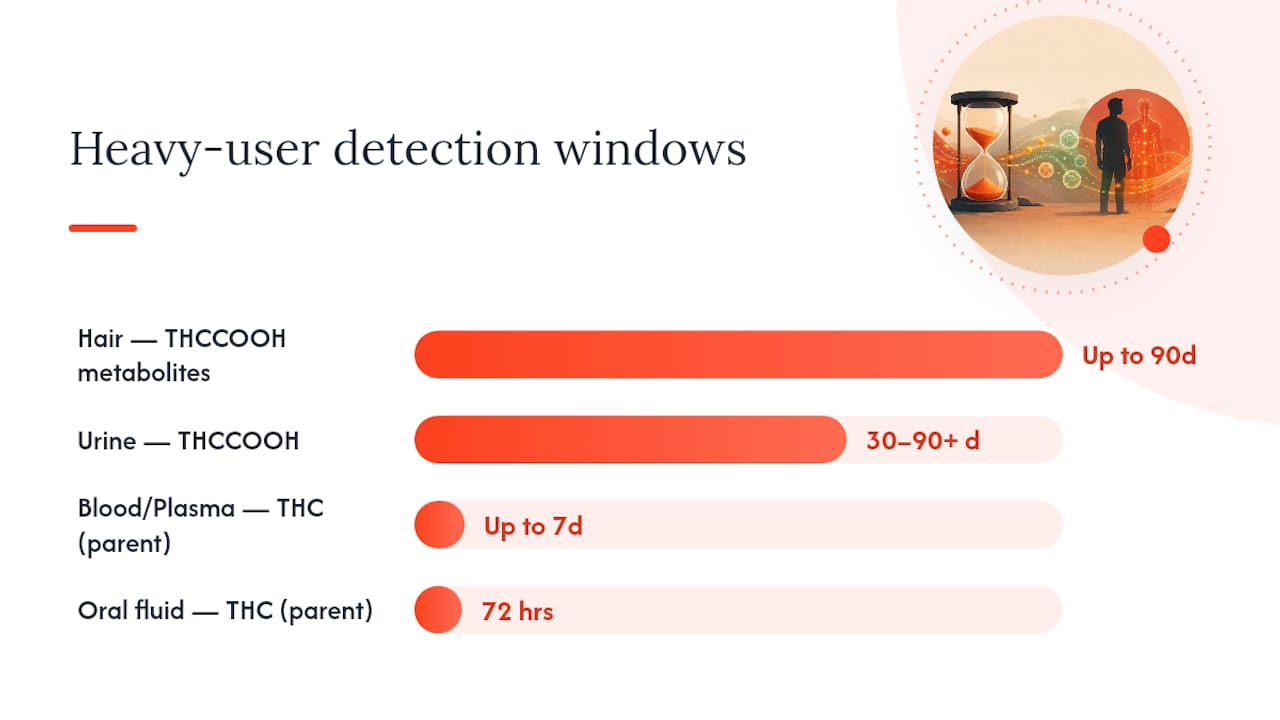
| Matrix | Analyte Measured | Occasional User Window | Regular User Window | Heavy/Chronic User Window | Key Factors Extending Window |
|---|---|---|---|---|---|
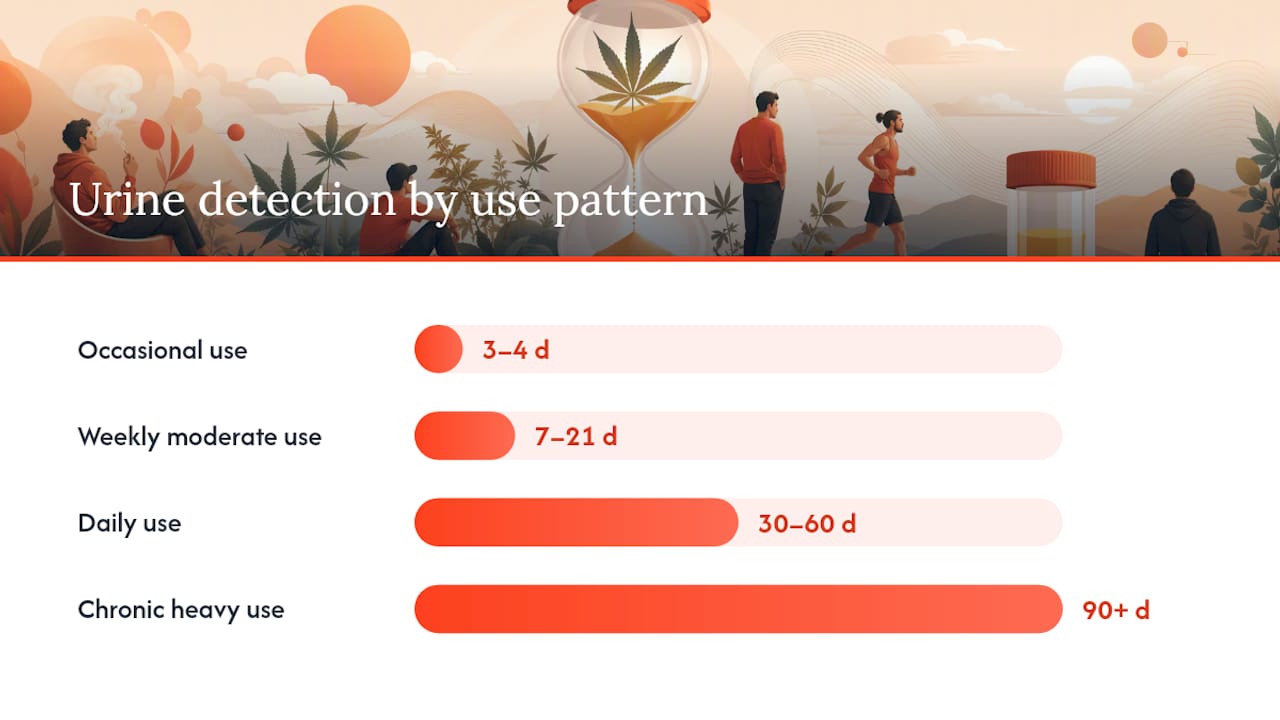
| Urine | THCCOOH | 3–4 days | 7–21 days | 30–90+ days | Body fat, dose, frequency, cutoff level |
| Blood/Plasma | THC (parent) | 12–24 hours | 2–7 days | Up to 7+ days | Frequency, recency of use |
| Oral fluid (saliva) | THC (parent) | 24–72 hours | 24–72 hours | 72 hours | Oral contamination, hygiene |
| Hair | THCCOOH metabolites | Up to 90 days | Up to 90 days | Up to 90 days | Hair growth rate, melanin content |
Urine
Urine testing is the most common method in U.S. workplace screening, and it targets THCCOOH rather than THC. Because THCCOOH is continuously produced as fat-stored THC re-enters circulation, urine windows are the longest of any matrix. Controlled studies in infrequent users found THCCOOH peaked in urine approximately 4–6 hours after smoked or vaporized cannabis. The federal workplace immunoassay (IA) cutoff is 50 ng/mL; the GC/MS confirmatory cutoff is ≥15 ng/mL. Using the 50 ng/mL IA cutoff, vaporized sessions produced positive specimens in 47% of active-dose conditions versus 21% for smoked sessions — a meaningful difference driven by route and dose, not just frequency.
For more detail on how urine cutoffs and sample validity checks work, Passmydrugtest’s urine drug test guide covers the procedural side.
Blood/plasma
Blood tests detect THC itself, not THCCOOH, so they reflect recent use much more directly. The short initial distribution half-life (~6 minutes) means plasma THC drops fast after a single session. In occasional users, THC typically falls below detection within 12–24 hours. In daily users, residual plasma THC between sessions is documented — the ScienceDirect study of non-daily users confirmed THC is still measurable in plasma between smoking sessions even in people who don’t use daily.
Oral fluid (saliva)
Saliva testing is increasingly used in roadside and workplace settings because it’s non-invasive and reflects very recent use. The elimination half-life of THC in oral fluid is approximately 1.6 ± 0.4 hours in both occasional and chronic users — one of the shortest half-lives of any matrix. Despite that rapid clearance, oral contamination from smoking can keep concentrations elevated for 1–2 hours after use, and detection windows typically run 24–72 hours depending on the cutoff used.
THC’s oral fluid half-life is just 1.6 ± 0.4 hours — far shorter than the urinary THCCOOH half-life. Saliva tests catch recent use, not historical exposure.
Hair
Hair testing doesn’t measure THC half-life in the pharmacokinetic sense. Instead, THCCOOH and other metabolites deposit into the hair shaft as it grows (roughly 0.5 inches per month), creating a historical record. A standard 1.5-inch sample covers approximately 90 days. Hair testing is the matrix least affected by abstinence in the short term. For detailed detection time guidance, Passmydrugtest has a dedicated hair drug test detection times resource.
Matrices ranked fastest to slowest for clearing THC:
- Oral fluid (saliva): hours
- Blood/plasma: hours to days
- Urine (THCCOOH): days to months
- Hair: up to 90 days regardless of abstinence
What makes your personal half-life longer or shorter
The study-derived ranges above are population averages. Individual results shift based on a cluster of biological, behavioral, and test-related variables.
Biological factors:
- Frequency and cumulative dose: the single strongest predictor of prolonged detection. Repeated use builds an adipose reservoir that takes weeks to deplete
- Body fat percentage: higher fat mass means more storage capacity for THC, extending the terminal elimination phase
- Age: hepatic metabolism slows with age, which can modestly extend clearance time
- Sex: some pharmacokinetic data suggest females may have slightly higher THC volume of distribution due to proportionally greater adipose tissue
- Liver function: impaired CYP enzyme activity slows conversion of THC to THCCOOH and reduces overall clearance
- Metabolic rate: faster basal metabolism generally correlates with faster clearance, though the adipose reservoir effect can override this in heavy users
Behavioral and administration factors:
- Route of administration: vaporized cannabis produced qualitatively higher median urinary THCCOOH Cmax than smoked cannabis in some controlled conditions, meaning vaping can produce longer detection windows than smoking at equivalent doses
- Potency: higher-THC products increase the total dose deposited in adipose per session
- Oral ingestion: delays THCCOOH appearance in urine by several hours compared to inhalation, but extends the overall detection window due to slower, more sustained absorption
- Co-ingested foods: high-fat meals increase oral THC bioavailability, raising peak plasma concentrations and potentially extending detection
Test-related factors:
- Assay cutoff: a 50 ng/mL IA cutoff misses low-level positives that a 20 ng/mL cutoff would catch; the choice of cutoff directly changes how many days a person tests positive
- Screening vs confirmatory method: IA screens have cross-reactivity with some non-cannabis compounds; GC/MS confirmation is specific to THCCOOH
- Specimen dilution: high fluid intake lowers urine creatinine and THCCOOH concentration, potentially pushing a borderline specimen below the cutoff — but labs check creatinine and specific gravity to flag dilute samples
Pro Tip: The single best predictor of a prolonged positive is repeated heavy use over weeks or months. Once THC saturates adipose tissue, even a week of abstinence may not clear the reservoir — the fat releases stored THC back into blood continuously, keeping THCCOOH production going long after the last use.
Practical timelines: what to expect based on your use pattern
These scenarios are grounded in controlled pharmacokinetic studies and represent realistic ranges, not guarantees. Individual variation is real.
Scenario 1: Single or occasional use (once or twice, no recent history)
A single smoked or vaporized session in someone with no recent cannabis history will typically clear urine below the 50 ng/mL IA cutoff within 3–4 days. Blood THC falls below most detection thresholds within 12–24 hours. Saliva clears within 24–72 hours. Hair is unaffected by a single use in most cases, though this depends on the lab’s sensitivity.
Scenario 2: Weekly/moderate use (1–3 times per week)
At this frequency, some adipose accumulation begins. Urine detection windows extend to 7–21 days after the last use. Blood may remain detectable for 2–7 days. Saliva windows stay similar (24–72 hours) because saliva reflects circulating THC, not stored metabolite.
Scenario 3: Daily use
Daily users build a substantial adipose reservoir. Urine positives commonly persist 30 days or more after stopping. Some daily users test positive at 45–60 days. Blood can remain detectable for up to a week. The Johns Hopkins urine monitoring data showing 44–60 hour THCCOOH half-lives with extended sampling helps explain why: even at that half-life, it takes many half-lives to clear a large reservoir.
Scenario 4: Chronic heavy use (multiple times daily for months or years)
This is where the pharmacokinetics become genuinely surprising. Extended-sampling studies report terminal THC half-lives of approximately 4.3 days in daily users, and documented urine positives beyond 90 days exist in the literature. A person with high body fat, slow metabolism, and years of heavy use could realistically test positive for THCCOOH three months after their last use.
Controlled studies have documented urinary THCCOOH detection beyond 30 days in chronic users, with terminal plasma half-lives reaching several days in daily users. The population PK data confirm that adipose redistribution, not recent use, drives these extended positives.
Why months-long positives happen:
- THC saturates adipose tissue over months of heavy use
- Fat cells release stored THC back into blood very slowly (days per half-life)
- Each release cycle produces more THCCOOH in urine
- High body fat percentage multiplies the reservoir size
- Caloric restriction or intense exercise can temporarily mobilize fat-stored THC, causing a transient spike in urine THCCOOH
How screening and confirmatory testing actually work
Most U.S. workplace and pre-employment drug tests follow a two-step process. Understanding both steps matters if you receive a positive result.
Step 1: Immunoassay (IA) screening
The initial screen uses an immunoassay — an antibody-based test that reacts to THCCOOH and structurally similar compounds. The federal workplace cutoff is 50 ng/mL. A result at or above that threshold is reported as a “preliminary positive” and sent for confirmation. IA screens are fast and inexpensive but have cross-reactivity: certain NSAIDs, hemp-derived CBD products, and other compounds can occasionally trigger a false positive at this stage.
Step 2: GC/MS or LC-MS/MS confirmation
Confirmatory testing uses gas chromatography/mass spectrometry (GC/MS) or liquid chromatography-tandem mass spectrometry (LC-MS/MS), which identify THCCOOH by its exact molecular signature. The federal confirmatory cutoff is ≥15 ng/mL. A specimen must exceed both the IA screen threshold and the GC/MS confirmatory cutoff to be reported as a confirmed positive. This two-step process dramatically reduces false positives.
In a controlled oral cannabis study, the 50 ng/mL IA cutoff showed high sensitivity and specificity relative to GC/MS confirmation at 15 ng/mL. That data shows the IA screen performs well but is not perfect — which is exactly why GC/MS confirmation exists.
Creatinine normalization and specimen validity
Labs measure urine creatinine and specific gravity to detect dilute or adulterated specimens. A creatinine below 2 mg/dL is considered substituted (not human urine). Between 2–20 mg/dL is dilute. Dilute specimens may be reported as dilute-negative or sent for retest, depending on the program. Specific gravity and pH checks catch common adulterants.
If you receive a positive result:
- Request GC/MS confirmatory testing immediately if only an IA screen was run
- Review any medications, supplements, or hemp products you’ve used recently — false positives do occur at the IA stage
- Check the collection chain-of-custody documentation for procedural errors
- Consult a Medical Review Officer (MRO) — they review confirmed positives before reporting to employers and can consider legitimate medical explanations
What actually works and what doesn’t
The internet is full of “guaranteed” detox methods. Most of them don’t hold up when tested against THCCOOH pharmacokinetics.
Common approaches and what the evidence shows:
- Excessive water/dilution: Drinking large amounts of water lowers urine THCCOOH concentration and can push a borderline specimen below the 50 ng/mL cutoff. Labs counter this with creatinine and specific gravity checks. A specimen flagged as dilute may require a retest, which eliminates the benefit.
- Cranberry juice and diuretics: These increase urine output but don’t accelerate THCCOOH production or clearance from the body. They produce the same dilution effect as water, with the same lab-detection risk.
- Exercise: Intense exercise mobilizes fat stores and can temporarily increase plasma THC and urinary THCCOOH concentrations. Exercising immediately before a test could actually raise your THCCOOH reading, not lower it.
- Commercial detox drinks: Most work by temporarily diluting urine and adding B vitamins and creatine to mask the dilution markers. They don’t remove THCCOOH from the body. The effect is a narrow window (typically 2–5 hours) during which the specimen may test below cutoff. Passmydrugtest’s home remedies guide covers the realistic limitations of these approaches.
- Detox kits (multi-day): Multi-day programs that combine dietary changes, hydration, and supplements may support natural clearance over time but don’t meaningfully accelerate THCCOOH elimination beyond what abstinence alone achieves. They work best when combined with sufficient abstinence time.
- Synthetic urine: Validated synthetic urine products that meet temperature, creatinine, specific gravity, and pH requirements can substitute for a real specimen in unsupervised collections. This is a substitution method, not a detox method, and it carries legal and procedural risks depending on the testing context. Passmydrugtest’s synthetic urine guide explains what to look for in a product.
Pro Tip: The only method that reliably eliminates a positive urine result is time combined with abstinence. Everything else either temporarily masks concentration or carries detection risk. If you know your test date, calculate your expected clearance window using your use frequency and the half-life ranges above — then use an at-home marijuana test kit to verify before the real test.
Myths worth dismissing outright:
- Niacin “flushes” THC: no controlled evidence supports this; high doses of niacin carry real toxicity risk
- Bleach or vinegar in the sample: modern labs test pH and specific gravity; adulteration is detectable and typically results in an automatic positive
- Zinc supplements: some early data suggested zinc could interfere with IA screens, but labs now test for zinc as an adulterant
An evidence-based perspective on THC half-life and testing
The pharmacokinetics of THC are genuinely more complex than most online guides acknowledge. The gap between a 6-minute distribution half-life and a multi-day terminal half-life isn’t a technicality — it’s the entire reason someone can test positive for cannabis weeks after their last use while feeling completely sober.
What strikes me most about the controlled study data is how strongly use frequency dominates every other variable. Body fat matters. Metabolism matters. But neither comes close to the effect of building an adipose reservoir through daily use over months. A person with 10% body fat who uses cannabis every day for a year will likely test positive far longer than someone with 30% body fat who used once. The reservoir effect overwhelms the individual biology in most realistic scenarios.
The other underappreciated point is how much the choice of cutoff changes the practical outcome. The difference between a 50 ng/mL IA screen and a 20 ng/mL screen isn’t just a number — it can mean the difference between a negative and a positive result for someone who used two weeks ago. Confirmatory GC/MS at 15 ng/mL is even more sensitive. Knowing which cutoff your test uses is as important as knowing your own use history.
The peer-reviewed pharmacokinetic studies cited throughout this article — from Johns Hopkins, PMC, and British Journal of Clinical Pharmacology — are the most reliable basis for these timelines. They’re controlled, they use verified doses, and they measure actual metabolite concentrations rather than relying on self-report. Apply their ranges to your situation, account for your specific variables, and test yourself before the real test.
Sources
- PubMed entry for oral fluid THC elimination half-life
- The pharmacokinetics and the pharmacodynamics of cannabinoids
- Δ9-tetrahydrocannabinol (THC) is present in the body between smoking sessions in occasional non-daily cannabis users
- Urinary excretion half-life of 11-nor-9-carboxy-Δ9-tetrahydrocannabinol in humans – Johns Hopkins University
- Urinary Excretion Profile of 11-Nor-9-Carboxy-Δ9-Tetrahydrocannabinol (THCCOOH) Following Smoked and Vaporized Cannabis Administration in Infrequent Cannabis Users – PMC