
Yes, Edibles Show Up on a Drug Test. Here’s the Timeline.
Edibles containing THC will trigger a positive drug test. Once THC is absorbed, the liver converts it into THC-COOH, the exact metabolite that urine screens are built to catch. There’s no version of “eating it instead of smoking it” that hides you from a standard panel.
Here’s the snapshot that matters most for employment screening:
- Urine: detectable for several days for single dose users, longer for moderate use, and for many weeks in chronic daily use, based on the standard 50 ng/mL screening cutoff.
- Blood: roughly 2 to 12 hours, since it measures active delta-9 THC rather than a stored metabolite.
- Saliva: generally shorter detection windows for edibles compared to smoking, often lasting a day or two, because oral fluid detects smoked THC more readily than swallowed THC.
- Hair: up to 90 days, regardless of whether THC entered your system through a gummy or a joint.
- Sweat: detectable for several days to about a week with a patch, though employers rarely use this method.
Urine is the test you actually need to worry about. It’s the SAMHSA-standard workplace method, and it’s built around a two-step process: an initial immunoassay screen, then confirmatory GC-MS or LC-MS/MS testing if that screen flags positive.
Key Takeaways
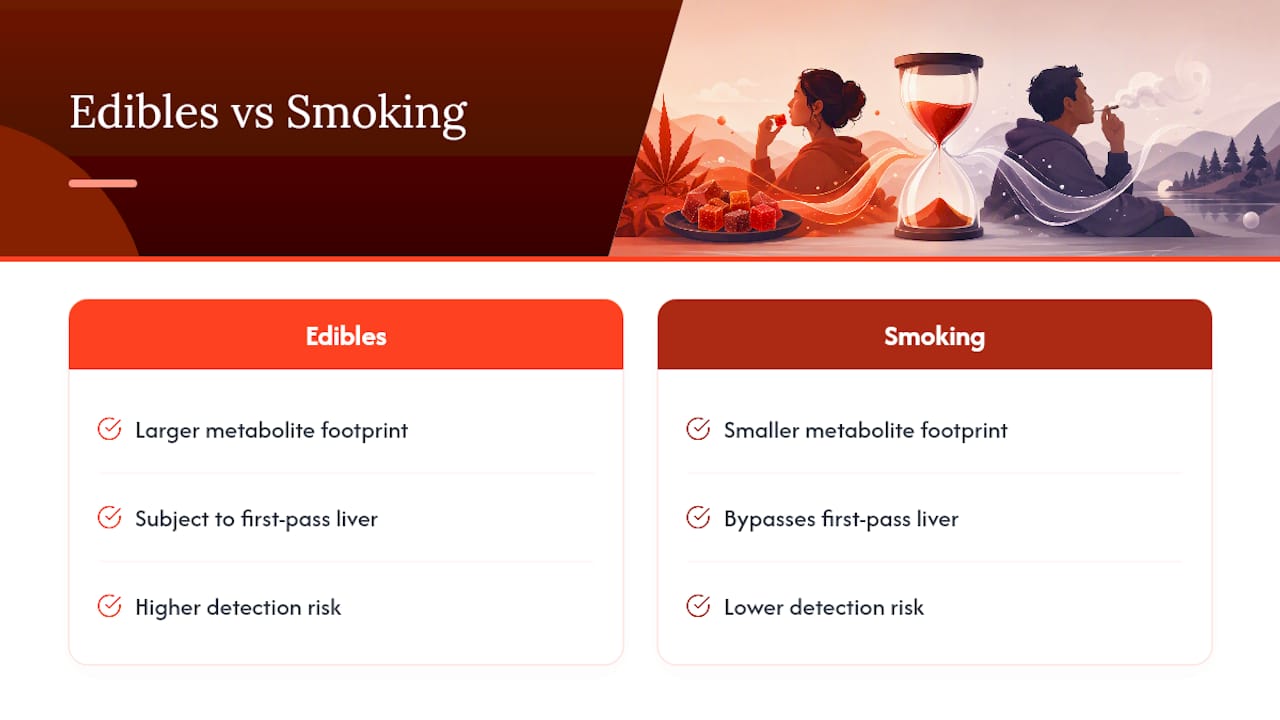
Edibles produce the same THC-COOH that urine tests detect, and first-pass liver metabolism can make that metabolite peak higher than an equivalent smoked dose.
| Point | Details |
|---|---|
| Edibles trigger the same test | THC-COOH is the metabolite urine tests target, regardless of whether THC was eaten or smoked. |
| Urine carries the longest risk | Single use clears in roughly 3 to 5 days; chronic use can remain detectable 30+ days. |
| Dose and frequency dominate | Total THC consumed and how often you use it matter more than body type or metabolism alone. |
| Dilution has limits | Labs check creatinine and specific gravity, so diluted samples often trigger a retest. |
| Practical next step | Passmydrugtest offers detox products and at-home test kits for readers preparing on a deadline. |
Table of Contents
- How Your Body Processes Edibles Differently Than Smoke
- What Do Urine, Blood, Saliva, Hair, and Sweat Tests Actually Detect?
- What Actually Changes How Long Edibles Stay Detectable?
- Are Edibles Actually Different From Smoking on a Drug Test?
- Do Detox Drinks and Dilution Tricks Actually Work?
- Sources
How Your Body Processes Edibles Differently Than Smoke
Edibles produce the same THC-COOH that urine tests are looking for, but the road to get there runs through your liver first, and that detour changes the whole timeline. When you smoke, THC hits your bloodstream almost instantly through the lungs. When you eat it, THC travels through your gut, then your liver, before it ever reaches general circulation. That’s called first-pass metabolism, and it’s the reason edibles hit differently, and linger differently, than a joint.
During that liver pass, THC converts into 11-hydroxy-THC, a more potent compound, before breaking down further into THC-COOH. The result: peak effects arrive later (often 60 to 90 minutes after eating, versus minutes with smoke), and the metabolite the lab is testing for can show up at higher concentrations than you’d expect.
- First-pass metabolism produces more 11-hydroxy-THC relative to inhaled use.
- That extra conversion step often pushes urinary THC-COOH concentrations higher, not lower.
- Slower onset frequently leads people to eat more, which compounds the metabolite load.
A controlled pharmacokinetic study found that a 25 mg oral dose produced substantially higher peak urinary THC-COOH than the same milligram amount delivered by vaporized cannabis. Bigger dose, slower absorption, higher lab numbers. That combination is exactly why “I only ate a gummy” doesn’t buy you the safety margin people assume.
What Do Urine, Blood, Saliva, Hair, and Sweat Tests Actually Detect?
Each test targets a different biological signal, and that difference is why detection windows swing so widely across the same person on the same day.
Urine looks for THC-COOH, an inactive metabolite that sticks around long after you’ve stopped feeling anything. Standard federal workplace screening uses a 50 ng/mL cutoff, with confirmatory GC-MS or LC-MS/MS testing run at a lower, lab-specific threshold if the initial screen flags positive. For a single edible dose, expect roughly 3 to 5 days of detectability. Moderate, recurring use pushes that to 5 to 15 days. Daily or near-daily use in a chronic user can mean 30 days or longer, since THC-COOH stores in fat tissue and releases gradually. This is the test almost every employer uses, and it’s the one edibles are least likely to slip past. Our breakdown of workplace testing norms covers how these cutoffs get applied in practice.
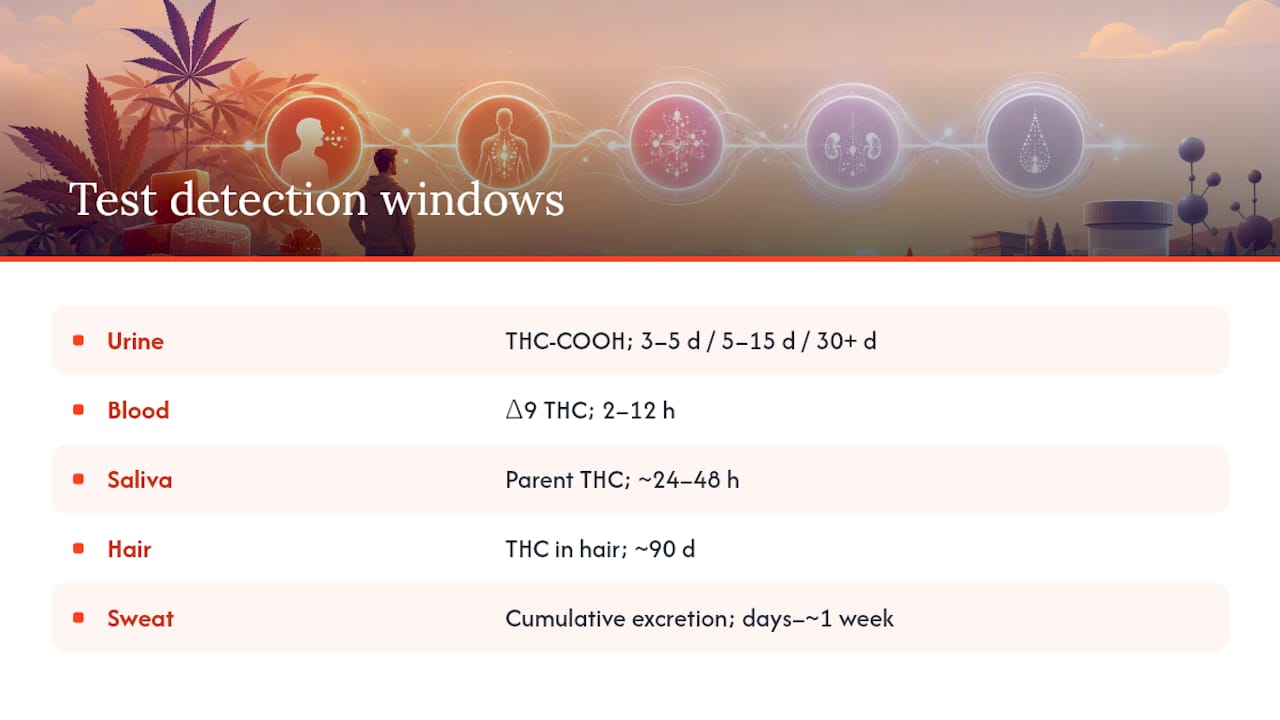
Blood measures active delta-9 THC, not the inactive metabolite, which means it reflects current impairment rather than past use. That window is short, generally 2 to 12 hours. Blood tests show up mostly in DUI investigations or post-accident workplace incidents, rarely in routine pre-employment screening.
Saliva (oral fluid) detects parent THC, and smoking deposits THC directly in the mouth, which spikes readings that swallowed THC simply doesn’t produce the same way. Edibles generally show up in saliva for a shorter window than smoked cannabis, though “shorter” doesn’t mean “safe.” Recent, heavy edible use can still register for a day or two.
Hair testing catches long-term patterns, not a single Tuesday-night gummy. THC-related compounds enter the hair shaft through the bloodstream, and a standard hair test covers roughly a 90-day window, regardless of whether the exposure came from smoking or eating. Route of administration doesn’t matter here. Total exposure over time does. For anyone facing this specific test, our hair testing detection guide walks through the timeline in more detail.
Sweat patches are the outlier: worn for days to about a week, they measure cumulative excretion through skin. Employers rarely use them outside of specific probation or monitoring programs, so most readers can treat this as background information rather than an active concern.
What Actually Changes How Long Edibles Stay Detectable?
Frequency of use and total dose drive detection timelines more than any other variable. A single 10 mg gummy and a nightly habit of 50 mg edibles put you in two completely different categories, even if your body weight and metabolism are identical.
- Dose and potency: bigger doses mean more THC to metabolize and store, full stop.
- Chronicity: THC-COOH accumulates in fat tissue with repeated use, extending the window well past what a single dose would produce.
- Body fat percentage: THC is fat-soluble, so higher body fat generally means slower release and a longer detection tail.
- Metabolic rate: faster metabolisms tend to clear metabolites somewhat quicker, though this varies significantly person to person.
- Hydration and urine dilution: drinking more water dilutes concentration temporarily but doesn’t actually remove metabolites from your system.
- Exercise and fat mobilization: burning fat releases stored THC-COOH back into your bloodstream, which can temporarily raise urine concentrations.
- Product potency variance: unregulated or mislabeled edibles can contain far more THC than the package states, throwing off any personal estimate you’ve made.
Pro Tip: If a drug test is on the calendar, skip the intense workout beforehand. Aggressive exercise mobilizes fat stores and can release previously banked THC-COOH back into circulation, temporarily pushing your urine concentration higher right when you need it lower.
One case people consistently underestimate: full-spectrum, hemp-derived CBD gummies. They’re legal under federal hemp rules, but they can carry trace amounts of delta-9 THC. Take them daily for weeks and that trace amount can accumulate to the point of a positive screen, even though nobody involved thought they were using THC at all.
Are Edibles Actually Different From Smoking on a Drug Test?
Not in any way that helps you. Urine and hair tests detect the same THC-COOH metabolite no matter how THC got into your body, so switching from a joint to a gummy doesn’t give you a reliable dodge on the tests employers actually run.
The differences that do exist show up in blood and oral fluid, where smoking briefly spikes readings that swallowed THC doesn’t replicate. That distinction matters for roadside or post-accident testing, but it’s mostly irrelevant to a standard employment urine panel.
- Urine and hair: no meaningful difference by route of administration.
- Blood and saliva: smoking produces higher immediate readings; edibles can still register, just less dramatically.
- Hemp-derived “full-spectrum” gummies: legal, but repeated use can still push trace THC above a screening threshold.
Do Detox Drinks and Dilution Tricks Actually Work?
Few over-the-counter detox products have peer-reviewed evidence showing they reliably alter a confirmatory lab result. That’s the honest starting point, and it’s worth sitting with before spending money on a promise a lab can see right through.
Here’s the mechanical reality: initial screening uses immunoassay technology, a fast but relatively blunt tool. Anything that flags positive there gets run again through GC-MS or LC-MS/MS confirmation, methods precise enough to identify the exact molecule and its concentration. Diluting urine with water might drop a screen’s reading, but labs routinely check creatinine levels and specific gravity to catch exactly that trick, and an abnormally dilute sample typically triggers a retest rather than a pass.
- Dilution can lower concentration but risks flagging the sample as invalid.
- Synthetic urine and adulterants carry legal and employment risk beyond the test itself, and many labs test specifically for the additives used to mask them.
- No detox product has strong published evidence of guaranteed confirmatory-test results.
Pro Tip: Labs don’t just look for THC. Validity checks like creatinine concentration and specific gravity exist specifically to catch tampered or overly diluted samples, so treat “just drink a gallon of water” as a strategy with a built-in failure mode.
A Straight Answer From Someone Who’s Looked at the Research
The biggest misconception I see repeated online is that edibles are somehow the “stealth mode” of cannabis use. They’re not. The pharmacokinetics actually work against you here. Because of first-pass liver metabolism, an edible dose can leave a bigger metabolite footprint in your urine than the same amount smoked, not a smaller one. If anything, edibles deserve more caution before a scheduled test, not less. The people who get blindsided are usually the ones who assumed “I didn’t smoke, so I’m fine,” and that assumption is exactly backward.
What To Do If a Test Is Coming Up
If you’re facing an employment screening on a timeline you can’t control, the smarter move is choosing validated preparation options rather than gambling on unverified shortcuts you read about in a forum thread.
Passmydrugtest built its catalog specifically around that gap: real detection science paired with product options, instead of vague promises. If you’re working against the clock, the detox products for passing a drug test category covers drinks and pills designed around actual elimination timelines rather than dilution guesswork. If you want to know where you stand before the official test, an at-home marijuana test kit gives you a private, low-cost data point. And if hair testing specifically is the concern, the hair strand test information page walks through what that method requires. Every order ships fast within the United States, and the support team is available by phone if you need help picking the right option for your specific timeline. Start by checking the detox product options while you still have days, not hours, to work with.
Sources
- Mayo Clinic Laboratories — Marijuana drug testing information
- PMC — Newmeyer et al. (pharmacokinetic study comparing oral vs inhaled THC)
Lab manuals and SAMHSA guidance go into far more depth on specific cutoff thresholds and confirmatory methods than any single article can cover.
This article is general information, not a substitute for advice from a qualified lawyer. Consult a qualified legal professional about your own circumstances before acting on anything here.