

Adulterated Drug Test: Why 49 CFR 40.3 Treats It as Refusal
An adulterated drug-test specimen is urine altered by substances or conditions that make it inconsistent with normal human urine, and in federally regulated testing programs, this finding is reported as a refusal to test rather than a simple failed result. Federal rules under 49 C.F.R. § 40.3 and SAMHSA guidance define the specific chemistry involved. The consequences can be immediate for anyone in a safety-sensitive role.
TL;DR:
- DOT and federal workplace programs use laboratories certified by HHS; private employers may adopt different panels and cutoffs, so consequences depend on the testing policy.
- Dilution lowers creatinine and specific gravity without changing chemistry; foreign chemicals or abnormal pH and oxidant readings indicate adulteration, while extreme values suggest substitution.
- Collectors check temperature within four minutes, while certified labs assess pH, creatinine, specific gravity, oxidants, and nitrite; confirmatory testing verifies abnormal screening results before reporting.
- The MRO must interview you and can cancel a result for an accepted medical explanation; otherwise, gather records, request lab values, and check appeal deadlines.
Table of Contents
- Regulatory definitions: what the rules say and where they apply
- Specimen validity testing: the lab checks that flag adulteration
- Common adulterants and how each is detected
- Types of tampering: external adulteration, dilution, and substitution
- MRO verification and reporting: how adulterated results are handled
- Consequences and practical next steps after an adulterated report
- Research and evidence: how modern labs detect adulteration and myths debunked
- What to do if your test is flagged
- FAQ
- Sources
- A note on preparing for any drug test
Regulatory definitions: what the rules say and where they apply
The word “adulterated” has a precise legal meaning in workplace drug testing, and it is not interchangeable with “diluted” or “failed.” Under 49 C.F.R. § 40.3, an adulterated specimen is one that contains a substance that is not expected to be present in human urine, or contains an endogenous substance at a concentration that is not consistent with normal human physiology. In plain terms, the lab finds either something foreign in the sample, like bleach or a nitrite salt, or something your body makes naturally, like creatinine, at a level that could not occur through normal kidney function.
This definition matters because it draws a hard line between tampering and a specimen that is simply low in concentration. A sample can be watery because someone drank a large volume of water before a test. That same sample can also be chemically altered because someone added a foreign oxidizer to the cup after collection. The lab, and later the Medical Review Officer, treats these two scenarios differently, even though both might initially raise suspicion.
SAMHSA’s collection and certification guidance works alongside the federal regulation to spell out exactly which tests a certified laboratory must run and what results count as adulteration versus a separate category called “invalid.” The Collection Site Manual sets specimen validity testing requirements, including pH, oxidant and nitrite screening, creatinine measurement, and specific gravity, and establishes the cutoffs that labs use to report a specimen as adulterated rather than merely questionable. These criteria apply specifically to specimens collected under federal and HHS-certified testing programs, including Department of Transportation safety-sensitive testing for truck drivers, pilots, and rail workers.
It’s worth understanding that not every drug test in the country follows this exact framework. DOT-regulated testing and most federal workplace programs use HHS-certified laboratories that are bound by these specific definitions and cutoffs. Many non-DOT employers, including private companies running their own drug-free workplace policies, choose to follow the same HHS guidelines voluntarily because the science is well established and legally defensible. Others use less rigorous panels or different cutoff levels, which means the practical consequences of an abnormal result can vary depending on who ordered the test and under what authority.
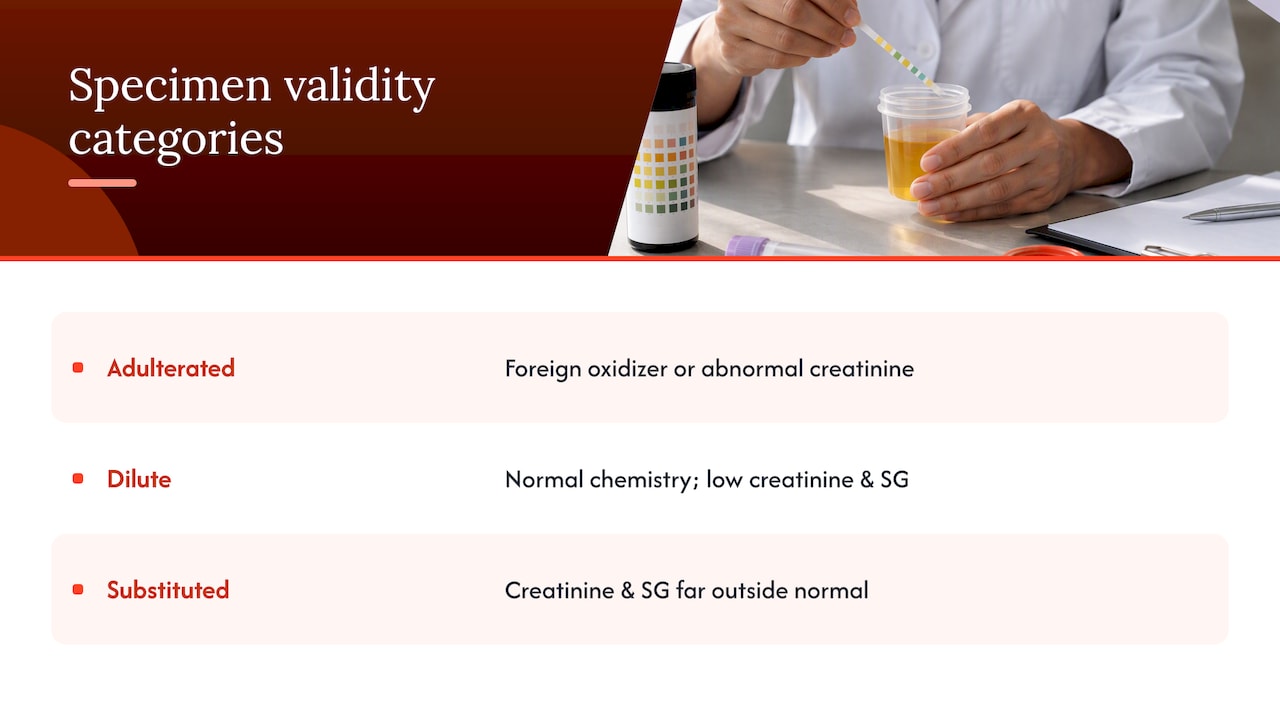
The regulatory taxonomy separates three distinct findings that often get confused in casual conversation. A “dilute” specimen has normal chemistry but lower-than-expected creatinine and specific gravity, usually from excess fluid intake, and is not automatically treated as tampering. A “substituted” specimen has creatinine and specific gravity so far outside the physiological range that the lab concludes the liquid submitted could not be human urine at all. An “adulterated” specimen, by contrast, shows the presence of a foreign chemical or an impossible pH or oxidant level, which points to something being added to a real urine sample rather than the sample being swapped out entirely. These categories are not academic. Each one triggers a different verification pathway and carries different documentation requirements once it reaches the Medical Review Officer.
Understanding which category applies to a given result also shapes what happens next procedurally. A dilute result might simply require a retest under direct observation in some programs. A substituted or adulterated result moves directly into the refusal-to-test pathway described later in federal guidance, because both findings suggest an active attempt to defeat the testing process rather than an innocent physiological variation.
Specimen validity testing: the lab checks that flag adulteration
Every urine specimen submitted to a certified laboratory goes through a panel of chemical checks before any drug screening even begins. This panel, known as specimen validity testing, exists specifically to catch tampering before it can compromise the accuracy of the drug results themselves.
The core SVT panel typically includes:
- Temperature, measured by the collector within four minutes of the void to confirm the specimen matches a plausible body temperature range.
- pH, which should fall within a narrowband consistent with normal urine chemistry; a reading far outside that range suggests a strong acid or base has been added.
- Creatinine, a waste product from muscle metabolism that should appear at a predictable concentration in real human urine.
- Specific gravity, a measure of how concentrated the urine is, which works alongside creatinine to detect both dilution and substitution.
- Oxidants and nitrite, screened specifically because several popular adulterant products rely on oxidizing chemicals or nitrite salts to interfere with drug detection.
These five checks work together rather than independently, because a single abnormal reading can have an innocent explanation, while a pattern of abnormal readings is much harder to explain away. SAMHSA’s Collection Site Manual sets the specific pH and oxidant testing requirements that certified labs must follow, and the same guidance allows labs to screen for additional adulterants beyond the baseline panel when circumstances call for it.
A verified adulterated result commonly arrives with specific numerical evidence attached, such as a nitrite concentration at a high level, a pH significantly below or above normal physiological range, or a creatinine reading near zero, and the Collection Site Manual establishes these program cutoffs as the thresholds that separate a borderline reading from a confirmed adulteration finding. A pH of 7 is roughly neutral and typical for fresh human urine, so a reading near either extreme end of the scale is a strong signal that something has been added.
When a screening-level SVT check comes back abnormal, the laboratory does not stop there. It moves into confirmatory testing, which uses a more specific and more sensitive analytical method to verify the initial finding and, where possible, to identify the actual adulterant present. This distinction between screening and confirmation mirrors the same two-tier process used for the drug tests themselves: an initial test flags a potential problem, and a confirmatory test using a different analytical technique either validates or rules out that flag before anyone reports a final result.
Peer-reviewed toxicology research backs up why this layered approach matters. Findings published in toxicology literature indexed on PubMed document that orthogonal, multi-layered laboratory methods detect many commercial and household adulterants, and that some oxidizing adulterants can actually destroy the drug analytes the test is trying to find in the first place. That second point matters because it means a successful adulteration attempt does not just mask a positive result. It can chemically break down the very compound the test is designed to detect, which is part of why labs treat any confirmed adulterant as grounds for an automatic refusal rather than trying to determine whether the underlying drug test would have been positive or negative.
Specific gravity and creatinine checks deserve particular attention because they do double duty, catching both substitution attempts and excessive dilution. A specific gravity reading below 1.0010 alongside very low creatinine suggests the liquid may not be real urine at all, while a specific gravity between that floor and the normal range, paired with low but not impossibly low creatinine, more often points to someone who simply drank a large amount of fluid before the test. The lab’s job is to apply the defined cutoffs consistently so that the distinction between “tampered with” and “unusually dilute” is based on chemistry rather than guesswork.
Common adulterants and how each is detected
People have tried a wide variety of household and commercial products to interfere with urine drug screens, and laboratory chemistry has kept pace with nearly all of them. Each adulterant leaves a distinct chemical signature that SVT or confirmatory testing is specifically designed to catch.
- Oxidizing agents (including some commercial “cleansing” products) raise oxidant levels detectable on the standard SVT panel and can chemically degrade certain drug metabolites.
- Nitrite, often introduced through products containing nitrite salts, shows up directly on the nitrite screen built into every certified lab’s SVT panel.
- Glutaraldehyde, a chemical historically used in some commercial adulterant products, is identified through targeted confirmatory assays once an initial screen raises suspicion.
- Chromium VI (hexavalent chromium), another oxidizing compound used in a handful of adulterant formulations, is detected through specific oxidant and confirmatory chemistry.
- Surfactants and detergents, sometimes used in an attempt to interfere with immunoassay screening, alter urine’s physical properties in ways that trained lab staff and SVT protocols are built to catch.
- Household bleach, occasionally used as an improvised adulterant, pushes pH to an extreme that the standard pH check flags almost immediately.
Practical forensic and clinical guidance on adulteration checks, including materials compiled for toxicology and legal training, lays out these same markers and explains the detection logic labs rely on: specific pH ranges, creatinine floors, specific gravity windows, and targeted assays for nitrite, glutaraldehyde, chromium VI, and surfactant residue, as detailed in guidance on adulteration and dilution checks. The overlap between these commercial products and simple kitchen or garage chemicals is part of why the SVT panel is run on every specimen as a matter of routine rather than only when adulteration is suspected.
One detail that surprises a lot of people: some of these adulterants do not just mask a positive result, they can actively destroy the drug metabolite itself during the chemical reaction. An oxidizer strong enough to shift pH to an extreme can also break down THC metabolites or other target compounds, which means a specimen that comes back “negative” after oxidant exposure may not reflect what was actually in the person’s system before the adulterant was added. This is one reason regulated programs do not treat a negative result on a flagged specimen as proof of a clean test. Our guide on false positive drug testing covers a related but distinct issue, cases where a specimen’s chemistry is normal but the result still needs context, which is worth understanding alongside adulteration itself.
It’s also worth noting that abnormal SVT results are not always evidence of intentional tampering. Specimen chemistry can shift due to improper storage, extended time between collection and lab receipt, or unusual but legitimate metabolic conditions. This is precisely why the verification process includes a documented opportunity for the donor to offer a medical explanation before any adulteration finding becomes final, a step covered in detail in the MRO section below.
Types of tampering: external adulteration, dilution, and substitution
People attempt to defeat urine drug tests in three broadly different ways, and each one leaves a different forensic trail.
- External adulteration means adding a chemical to the urine after it has already left the body, typically by smuggling a substance into the collection cup or onto the hands before or during the void. Detection relies heavily on the pH, oxidant, and nitrite components of the SVT panel, since these foreign chemicals almost always shift urine chemistry outside its normal physiological range.
- Internal adulteration, more commonly called dilution, involves drinking large amounts of water or taking diuretics before the test in an effort to lower the concentration of drug metabolites in the sample. Labs catch this through creatinine and specific gravity readings that fall below expected thresholds, even though the sample’s pH and oxidant levels remain normal because nothing foreign was added.
- Substitution means submitting a liquid that is not the donor’s own urine at all, whether synthetic or borrowed from another person. This is detected primarily through temperature, since a substituted sample often fails to match the narrow body-temperature window collectors check within four minutes of the void, along with creatinine and specific gravity values so far outside normal human range that the lab concludes the liquid cannot be real urine.
Collectors are trained to watch for behavioral and physical cues tied to all three categories, not just rely on lab chemistry after the fact. Measuring temperature within four minutes of collection is a required step precisely because body temperature drops quickly once urine leaves the body, making this one of the fastest and most reliable field indicators of substitution. Collectors also visually inspect the collection area for signs of tampering, such as hidden containers or unusual coloration, and are required to document any irregular observations in the remarks section of the Federal Custody and Control Form. Those written remarks become part of the official record that the Medical Review Officer reviews later, so a collector’s notes from the moment of collection can carry real weight in how a flagged result is ultimately verified.
MRO verification and reporting: how adulterated results are handled
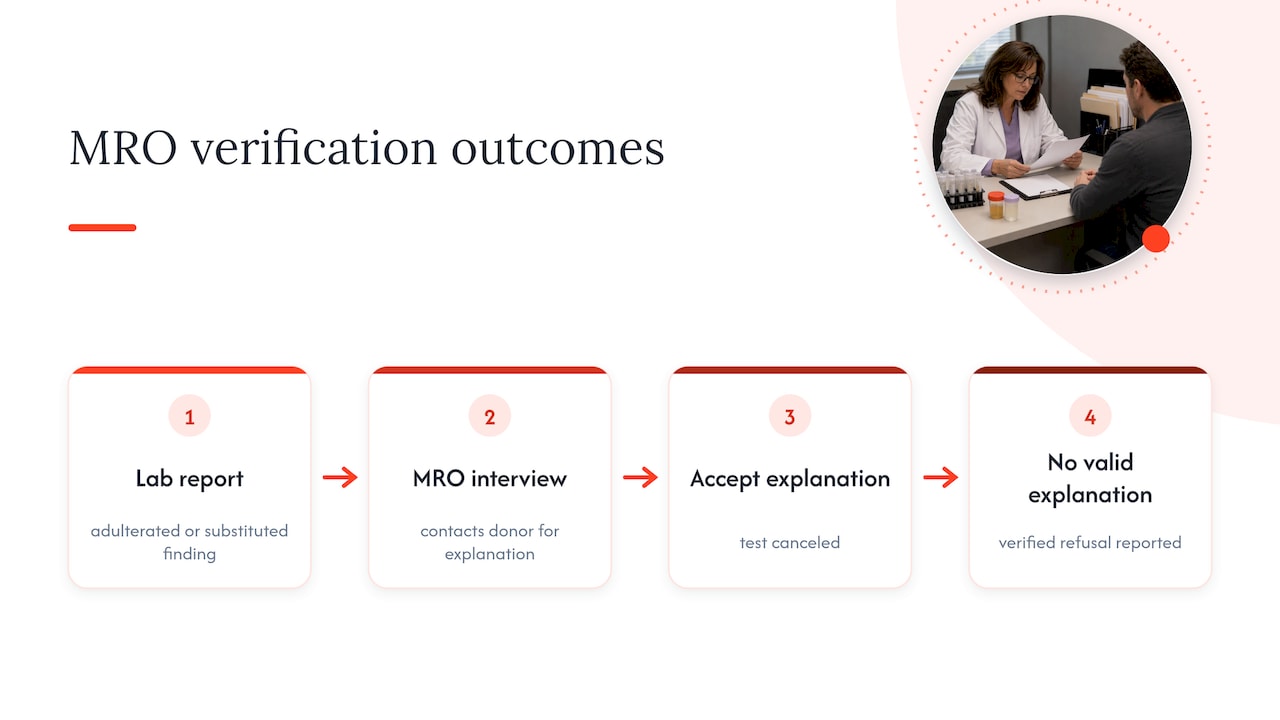
Once a laboratory reports an adulterated or substituted finding, the file moves to a Medical Review Officer, a licensed physician trained specifically in reviewing drug test results and determining whether there is a legitimate medical explanation for an abnormal finding. The MRO’s role here is not optional paperwork. It is a required, regulated step built directly into the verification process.
DOT guidance under § 40.145 instructs MROs to treat laboratory reports of adulteration or substitution with the same seriousness as a confirmed positive drug test, and to follow the same structured verification procedure. That procedure centers on a required interview with the donor. The MRO must contact the individual directly, explain the laboratory’s findings, and give them a genuine opportunity to offer a legitimate medical or physiological explanation before any final determination is reported to the employer.
What counts as a legitimate explanation is narrow by design. For a substitution finding, almost no medical condition can account for urine with creatinine and specific gravity values incompatible with human physiology, so acceptable explanations are rare. For adulteration findings tied to a foreign chemical, a medical explanation is similarly uncommon, since oxidizers, nitrites, and surfactants are not substances the human body produces or excretes under any known medical condition. The MRO documents whatever explanation the donor provides, along with the medical rationale for accepting or rejecting it, as part of the permanent record.
The outcome of this review falls into one of two paths. If the MRO accepts a legitimate medical explanation, which is uncommon but not impossible, the test result is canceled rather than reported as a refusal. If no acceptable explanation is provided, or the one offered does not hold up medically, the MRO reports a verified refusal to test to the employer. Section 40.145 is explicit that MROs must offer this chance to explain, but the absence of a valid explanation leads directly to a verified refusal rather than a simple negative or inconclusive result.
Every step of this process gets documented on the Federal Custody and Control Form alongside the laboratory’s own report. Regulations under §40.97 require laboratories to record and report the specific numerical values behind an adulteration or substitution finding, such as the pH, creatinine, or specific gravity readings that triggered the flag, rather than reporting a bare conclusion. This paper trail, collector remarks, lab numerical findings, and MRO documentation of the verification interview, is what gives a reported refusal its legal weight and what a donor or their attorney would review if the finding is ever challenged.
Consequences and practical next steps after an adulterated report
A verified refusal to test carries serious and immediate weight in any federally regulated safety-sensitive position, including commercial driving, aviation, and rail work. The practical result is typically removal from safety-sensitive duties right away, treated with the same severity as a confirmed positive drug test rather than as a lesser or ambiguous finding.
Non-federal employers are not bound by the same regulatory framework, but many private workplace drug policies mirror these same consequences voluntarily, since the underlying chemistry and legal reasoning are well established. A positive or adulterated finding under a company policy can still lead to termination, a failed pre-employment screen, or referral to a substance abuse professional, depending entirely on how that specific employer’s policy is written.
If you find yourself facing an adulterated result, a few concrete steps matter more than anything else:
- Cooperate fully with the MRO interview and be prepared to discuss your medications, supplements, or any medical conditions that could plausibly relate to the finding.
- Gather supporting medical records or prescriptions ahead of time rather than trying to locate them after the MRO has already requested an explanation.
- Request a copy of the laboratory documentation, including the specific SVT values that triggered the finding, so you understand exactly what was flagged and why.
- Ask about your program’s appeal or retest timelines, since these windows are often short and vary by employer and testing program.
Attempting to beat a test rather than simply showing up for one carries a much higher cost than most people expect. Rather than risking an ordinary negative or positive result, intentional tampering shifts the finding into refusal territory immediately, with consequences that are often harder to contest than a straightforward positive would have been.
Research and evidence: how modern labs detect adulteration and myths debunked
Toxicology research backs up what regulated testing programs have built into their procedures over the past two decades: layered, orthogonal testing methods make deliberate tampering far harder to conceal than it used to be. Findings published in peer-reviewed literature indexed on PubMed show that combining multiple analytical techniques, rather than relying on a single screening method, improves a lab’s ability to both detect adulterants and identify specifically which chemical was used.
A few persistent myths are worth addressing directly:
- The pectin-based home remedy myth. Products like Certo or Sure-Jell have circulated online for years as a supposed way to mask drug metabolites, but these methods have not held up against modern collection and testing protocols and are unreliable at best.
- The “synthetic urine is undetectable” myth. Modern SVT panels are specifically designed to catch substituted specimens through temperature, creatinine, and specific gravity checks that real synthetic products struggle to replicate convincingly under observed conditions.
- The “any abnormal reading means guilt” myth. A single borderline SVT value can have an innocent physiological cause, which is exactly why the MRO interview process exists before any refusal is finalized.
Pro Tip: The single most reliable signal that distinguishes intentional adulteration from an innocent physiological cause is a pattern across multiple SVT markers at once, rather than one borderline reading in isolation.
What to do if your test is flagged
If you are notified that your specimen came back adulterated, the single most useful thing you can do is stay factual during the MRO interview. Walk through your medications, supplements, and any relevant medical history calmly, and provide documentation rather than arguing about the chemistry itself, since the MRO’s decision rests on medical evidence, not persuasion.
Ask directly for a copy of the lab’s numerical findings and for a clear explanation of your program’s retest or appeal process, including deadlines. These documents matter if you ever need to revisit the finding with an employer, an attorney, or a substance abuse professional.
Going forward, a few simple habits reduce the odds of an accidental flag at a future collection: stay hydrated at a normal level rather than over- or under-drinking before a scheduled test, avoid any product marketed as a “cleanser” or “detoxifier” you have not researched, and disclose prescription medications to the collector ahead of time when your program allows it.
— MIchael
This article is general information, not a substitute for advice from a qualified lawyer. Consult a qualified legal professional about your own circumstances before acting on anything here.
FAQ
Can LabCorp tell if it’s fake pee?
Yes. Certified labs, including those used in LabCorp’s testing network, run specimen validity tests that check temperature, creatinine, specific gravity, and pH, all of which synthetic urine struggles to replicate convincingly under observed collection conditions. A substituted sample is typically flagged through these physiological checks rather than through the drug screen itself.
What does it mean when a drug test is adulterated?
An adulterated drug test means the laboratory found a substance that should not be in human urine, or found a normal urine component at a concentration inconsistent with human physiology, as defined under 49 C.F.R. § 40.3. In federally regulated testing, this finding is treated the same as a confirmed positive and reported as a refusal to test.
Is it illegal to use fake urine on a drug test?
Several states have laws specifically prohibiting the sale or use of synthetic urine to defeat a drug test, though rules vary significantly by state and by the type of testing program involved. Within federally regulated workplace testing, using a substituted specimen results in a verified refusal to test under § 40.145, separate from any state-level legal exposure.
Can synthetic urine be detected by a lab?
Yes. Certified labs check temperature at the collection site within four minutes of the void, then analyze creatinine, specific gravity, and pH once the sample reaches the lab, and synthetic products frequently fail one or more of these checks. Peer-reviewed research indexed on PubMed confirms that layered laboratory methods improve detection of substituted and adulterated specimens overall.
Sources
- 49 C.F.R. § 40.3
- § 40.145 On what basis does the MRO verify test results involving adulteration or substitution?
- Collection Site Manual 2024 – Urine
- Peer-reviewed research on adulteration detection (PubMed)
A note on preparing for any drug test
Whatever kind of screening you’re facing, understanding the chemistry labs actually check for matters more than chasing shortcuts that modern SVT panels are built to catch. We stock a researched selection of urine, saliva, and hair follicle testing products, paired with guidance to help you pick the option suited to your specific situation, backed by fast shipping within the United States and live phone support if you have questions before you order. Browse our full product lineup at Pass My Drug Test to find the right fit for your timeline and testing type.