
Labs: Why 5 Routine Checks Miss Biocides in Synthetic Urine
Biocides in synthetic urine can serve as definitive forensic markers when a lab specifically screens for them, but routine specimen validity testing at most collection sites will not catch a preservative on its own. Manufacturers add these chemicals to keep creatinine levels and pH stable over months of shelf storage. Detection depends almost entirely on whether the testing lab runs advanced biomarker panels instead of the standard four-point check.
TL;DR:
- Routine specimen validity tests do not detect biocides in synthetic urine because they focus on temperature, creatinine, pH, specific gravity, and appearance.
- Advanced laboratory panels use multiple biomarkers and chemical markers to identify preservatives like isothiazolinones and quats, with 84% of discrimination relying on combined evidence.
- The presence of preservatives such as benzisothiazolone or sodium azide in a sample strongly indicates it is synthetic urine, not human, as they are not naturally occurring.
- Biocides can keep synthetic urine stable for months, but they are formulated for storage safety and are not intended for human contact during handling.
- Detecting preservatives depends on specific, advanced tests, not routine checks, making it possible for synthetic samples with biocides to pass standard validity screening.
Table of Contents
- Why Manufacturers Add Biocides to Synthetic Urine
- Can Routine Specimen Validity Testing Detect Biocides or Synthetic Urine?
- How Advanced Lab Testing Finds Biocides and Synthetic Markers
- Common Biocide Chemicals and What a Positive Detection Implies
- Shelf Life, Safety, and Handling of Biocide-Containing Synthetic Urine
- Research Behind This Article and Where Our Expertise Comes In
- A Factual Approach to a Technical Subject
- Where to Learn More or Find Test-Prep Products
- FAQ
- Sources
Why Manufacturers Add Biocides to Synthetic Urine
Bacteria break down urea and shift pH the moment a liquid sample sits at room temperature for more than a few hours. Without a biocide, a bottle of synthetic urine would show inconsistent creatinine, drifting pH, and a foul odor within days, which is exactly what a lab screen is built to catch. Preservatives slow that microbial activity, keeping the chemical profile stable enough to pass through a shelf life measured in months rather than hours.
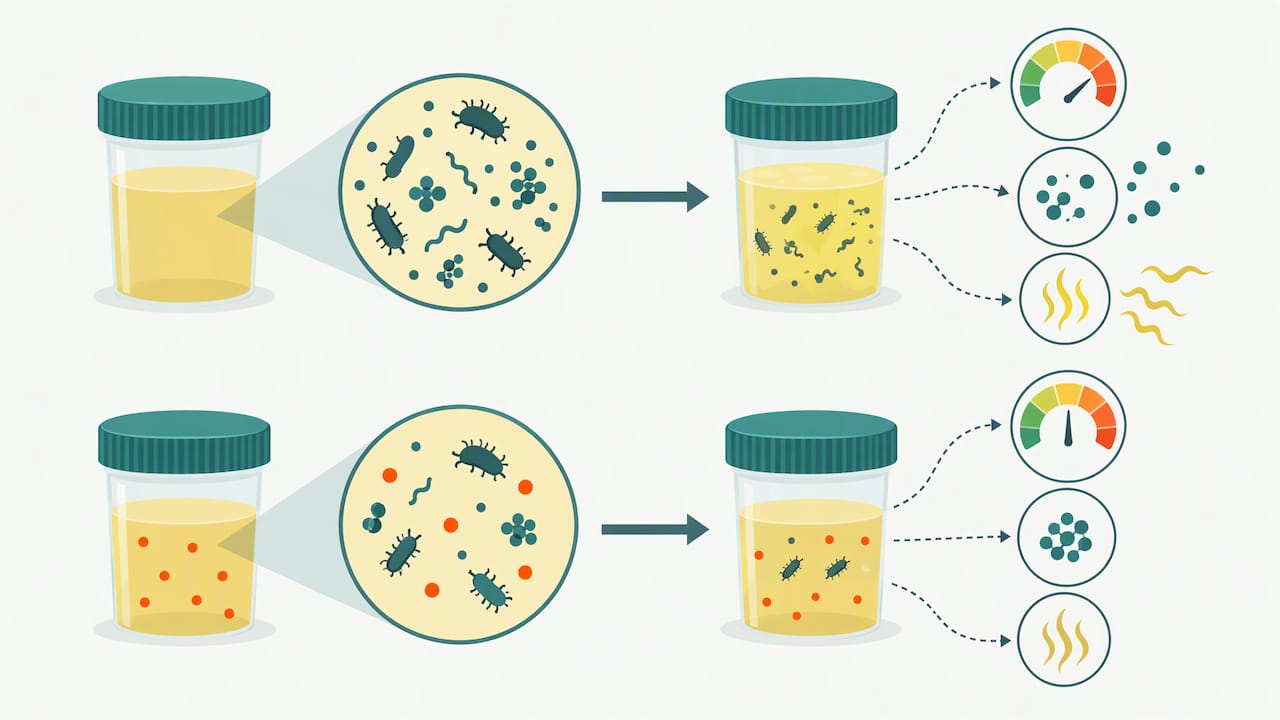
Formulators face a narrow constraint. A biocide has to control bacterial growth without altering the specific gravity, color, or pH range that routine testing checks. That balancing act is why patent filings describe specific preservative classes chosen for their low interference with urinalysis chemistry rather than raw killing power.
Common functions assigned to these additives include:
- Slowing bacterial breakdown of urea that would otherwise spike ammonia and shift pH.
- Stabilizing creatinine concentration so it stays within the expected clinical range.
- Preventing visible cloudiness, sediment, or odor changes during storage and shipping.
Can Routine Specimen Validity Testing Detect Biocides or Synthetic Urine?
Standard specimen validity testing (SVT) at a collection site checks a narrow set of physical markers, and synthetic formulas are built specifically to clear them.
- Temperature is checked within four minutes of collection and must fall between 90 and 100 degrees Fahrenheit, a range synthetic kits replicate with heat pads or activators.
- Creatinine levels are measured to rule out dilution, and biocide-stabilized formulas are designed to hold a steady, human-typical reading.
- pH is checked against a normal urine range, which most synthetic products are formulated to match out of the bottle.
- Specific gravity confirms the sample isn’t overly diluted with water, another parameter synthetic urine is engineered to mimic.
- Color and clarity are a visual check only, and a well-made synthetic sample looks indistinguishable from a real one.
None of these five checks are designed to detect a chemical preservative. They flag dilution, substitution with water, or an obviously out-of-range sample, not the presence of an exogenous compound. A sample that passes all five routine checks can still contain a biocide that would show up under a different kind of test.
What escalates a sample to deeper lab analysis is usually a pattern, not a single flag: a borderline creatinine value combined with an unusual pH, a collector’s suspicion during observed collection, or a workplace policy that mandates confirmatory lab analysis for safety-sensitive roles. Once a sample reaches that stage, the testing methodology changes entirely.
How Advanced Lab Testing Finds Biocides and Synthetic Markers
Forensic laboratories that suspect substitution rarely rely on one test. They use orthogonal testing and biomarker panels that combine several independent measurements, because any single marker can produce a false conclusion on its own.
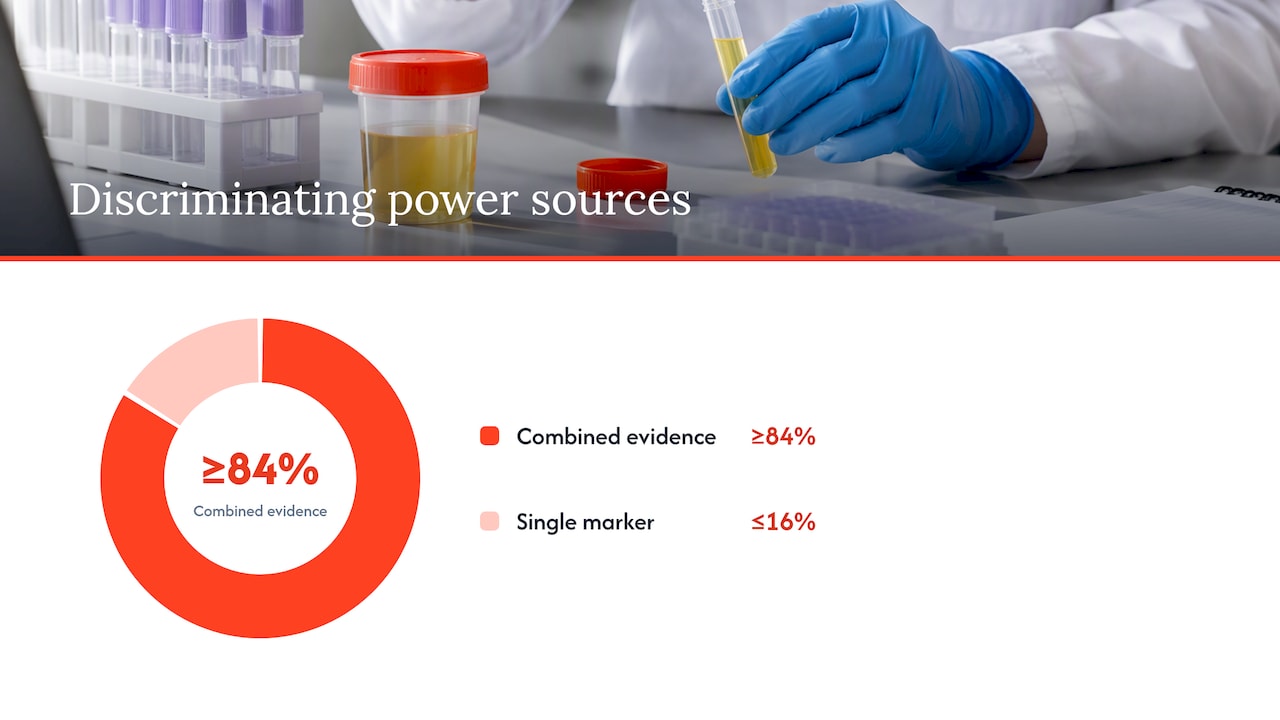
84% or more of the discriminating power in these cases comes from combining physical and chemical evidence rather than reading one result in isolation, based on the approach SAMHSA’s own validity-testing materials describe for orthogonal confirmation. That figure reflects how labs weigh combined evidence, not a universal pass or fail threshold.
Two categories of evidence matter here:
- Direct markers: finding an exogenous preservative such as benzisothiazolone, another isothiazolinone, sodium azide, or a glycol compound is close to definitive proof the sample isn’t human urine.
- Indirect markers: the absence or unusually low levels of human metabolites like hippurate and phenylacetylglutamine, paired with low enzyme activity (GGT, amylase) and no cellular material under a microscope, build a circumstantial but strong case.
Untargeted metabolomics using LC-MS compares a sample’s full chemical fingerprint against known human urine patterns, and multivariate statistical analysis helps labs separate real variation from suspicious anomalies. A single missing metabolite rarely proves anything on its own. A cluster of them, alongside a direct chemical marker, is what moves a lab from suspicion to a confirmed finding.
Common Biocide Chemicals and What a Positive Detection Implies
Patent filings and lab studies consistently point to a handful of preservative families used across synthetic urine formulations:
- Isothiazolinones, including benzisothiazolone, widely cited as common synthetic urine preservatives.
- Bronopols, a nitro-compound biocide used in cosmetics and some fluid preservation applications.
- Quaternary ammonium compounds (quats), antimicrobial agents chosen for mild, non-interfering chemistry.
- Glutaraldehydes, stronger sterilizing agents sometimes referenced in manufacturing patents.
- Oxidizing agents, used in some formulations to control microbial load during storage.
Pro Tip: A detected preservative is strong evidence a sample is not human urine, but a clean result on routine SVT never proves it is.
Finding any of these compounds in a sample is meaningful because none occur naturally in human urine. Their presence is a direct chemical clue, while their absence proves nothing by itself since a well-formulated product may use a preservative that a particular lab’s panel doesn’t screen for. Detection prevalence has shifted over time as manufacturers reformulate in response to newly publicized markers, which is part of why labs favor broad panels over chasing one compound.
Shelf Life, Safety, and Handling of Biocide-Containing Synthetic Urine
Biocides are what let a bottle of synthetic urine sit on a shelf for months without the creatinine drifting or bacteria taking over. Patent literature describing preservation research for stored urine has documented stabilization holding for extended periods under controlled testing conditions, as shown in applied stabilization research on non-oxidizing preservative combinations.
These chemicals are formulated for storage stability, not for human contact. Manufacturers’ own safety language treats these products as not for ingestion, and anyone handling a sample should avoid prolonged skin contact or exposure to eyes. Shelf-life claims referenced in patent filings often cite multi-month to multi-year stability windows tied to specific preservative concentrations, figures that vary by formulation rather than applying universally.
Research Behind This Article and Where Our Expertise Comes In
The detection landscape described here draws on a 2026 Journal of Analytical Toxicology study that found GGT and amylase effective at flagging synthetic urine in lab casework, and a 2025 LC-HRMS metabolomics analysis that distinguished synthetic products from human urine through missing metabolites and preservative residue. Both point the same direction: enzyme and metabolomic panels, not single checks, drive confident conclusions. We built our guide library around this kind of primary research so readers comparing products, including our synthetic urine kit overview, get facts grounded in what labs actually measure.
A Factual Approach to a Technical Subject
We write about biocide detection because readers deserve accurate information, not because the goal is helping anyone outsmart a lab. Detection science moves constantly: a marker that goes undetected this year may be exactly what a lab screens for next year, and manufacturers reformulate in response. Anyone facing a test with legal, custody, or employment consequences should talk to a qualified attorney or occupational health professional rather than treat an article like this as a substitute for that advice.
— MIchael
Where to Learn More or Find Test-Prep Products
We built Passmydrugtest around one simple idea: give people one place to research testing methods and find the product that fits their situation, instead of piecing it together from forums. Our catalog covers urine, saliva, and hair testing categories alongside detox shampoo options, with phone support available during business hours if you have questions before you buy.
Browse our urine drug testing category to compare options suited to your specific timeline and testing scenario.
FAQ
Can a drug test detect fake urine?
Yes, but only when the lab runs tests beyond the routine four-point check. Standard specimen validity testing often misses synthetic urine entirely, while orthogonal biomarker panels using enzyme and metabolite markers can identify it reliably.
Why would my urine sample be sent to a lab?
A sample typically goes to a confirmatory lab when an on-site or initial screen produces a borderline, unusual, or disputed result. Safety-sensitive jobs and certain legal or regulated testing programs also mandate lab-based confirmation as standard policy rather than waiting for a flagged result.
How long do you need to be clean to pass a urine drug test?
The window varies widely by substance, frequency of use, metabolism, and the specific test’s detection cutoffs, so there’s no single universal timeframe. Anyone facing a scheduled test should research the specific substance’s typical detection window and consider that routine SVT checks dilution and validity markers, not just drug metabolites.
What are the chemical components of synthetic urine?
A typical formula combines water, urea, creatinine, uric acid, and salts to mimic human urine chemistry, along with a pH buffer. Most formulas also include a biocide, commonly from the isothiazolinone or quaternary ammonium families, to prevent microbial breakdown during storage, as documented in manufacturing patents.
Sources
- PubMed: orthogonal testing and biomarkers for urine validity
- Use of urine biomarkers in validity testing (SAMHSA meeting materials)
- Journal of Analytical Toxicology (2026) — SVT and novel biomarkers
- Comparative chemical profiling of commercial synthetic urine and human urine — LC‑HRMS (2025)