

Keep Your Job: 30 Day Rebuttal Under Nevada Marijuana Testing Law
In most hiring situations in Nevada, a positive marijuana screening alone cannot legally cost you a job offer, but several exceptions can still sink you. If you’re screened during your first 30 days, you have the right to pay for an independent rebuttal test. Safety-sensitive roles, DOT-regulated jobs, and federal contracts operate under different rules entirely.
TL;DR:
- Nevada law prohibits employers from denying a job solely based on a positive marijuana test result, but exemptions apply for federal, safety-sensitive, and contract roles.
- Testing methods vary in detection windows from hours to 90 days, which significantly affects timing strategies for natural drug clearance.
- Employers can require testing after a conditional offer, but must follow strict procedures, including consent and chain-of-custody standards, to ensure result validity.
- During the first 30 days of employment, workers can request an independent rebuttal test if they test positive, which employers are legally required to consider.
- Federal regulations for transportation, healthcare, and federal contracts override Nevada protections, leaving some industries with no safeguards against positive marijuana results.
Table of Contents
- What Nevada Marijuana Testing Law Actually Says
- Which Jobs Are Exempt From These Protections?
- How Long Does Marijuana Stay Detectable in Each Test Type?
- Preparing Honestly: Timing, Products, and What to Avoid
- What to Do if You Test Positive During Your First 30 Days
- Who Actually Oversees Marijuana Testing in Nevada?
- What Standards Govern the Actual Testing Procedure?
- What Notice and Consent Are You Entitled to Before Testing?
- Do You Have Rights Beyond the Initial Hiring Decision?
- Medical Card Holders vs. Recreational Users: Does the Law Treat Them Differently?
- Has Legalization Actually Changed Workplace Testing in Nevada?
- An Editorial Take on Nevada’s Cannabis Testing Rules
- Where to Find Test-Prep Guides and Products for Nevada Testing
- Sources
What Nevada Marijuana Testing Law Actually Says
NRS 613.132 makes it unlawful for most Nevada employers to fail or refuse to hire a prospective employee solely because a screening test detects marijuana. That word “solely” carries a lot of weight. It doesn’t ban testing. It doesn’t ban hiring decisions based on other legitimate factors. It just stops an employer from using a positive marijuana result as the single standalone reason to walk away from you.
The statute’s “screening test” language covers the standard specimen types employers actually use:
- Urine screens, the most common pre-employment method
- Blood draws, typically reserved for specific industries or post-incident testing
- Hair follicle tests, used when employers want a longer look-back window
- Oral fluid (saliva) tests, increasingly common for rapid results
None of that means testing disappears once you’re hired. Employers can still require a screening as part of a conditional job offer, and they can still decline to move forward if you fail a background check, flunk a skills assessment, or show up with inconsistent work history. Nevada’s protection is narrow and specific to the marijuana result itself, not a shield against every other reason a hire might fall through.
In practice, the process usually runs like this: you get a conditional offer, you’re sent to a collection site, results come back within a few days, and if marijuana shows up as the only issue, the employer generally can’t use that alone to pull the offer. If anything else complicates the picture, the calculation changes fast.
Which Jobs Are Exempt From These Protections?
Federal law doesn’t recognize Nevada’s cannabis protections, and that gap creates real risk for certain categories of workers. If your job touches federal regulation in any way, assume the state law doesn’t apply to you the same way it applies to a retail or office job.
Positions most commonly excluded include:
- DOT-regulated roles — commercial drivers, pilots, railroad and transit workers subject to federal drug-testing mandates that override state cannabis law entirely.
- Federal contractors and grant-funded positions — jobs tied to federal funding streams often carry drug-free workplace requirements written into the contract itself.
- Public-safety positions — law enforcement, corrections, and certain emergency-response roles frequently fall under separate testing rules identified in Nevada’s administrative guidance.
Employers also retain discretion over what counts as “safety-sensitive” in roles that aren’t federally mandated, things like heavy equipment operation, healthcare, or anything involving public trust. That discretion is broad, and it’s rarely challenged in court.
Pro Tip: Read the job posting and conditional offer letter closely. Language like “safety-sensitive position,” “DOT-covered,” or “federal contract compliance” is a strong signal that Nevada’s hiring protection won’t apply to you.
How Long Does Marijuana Stay Detectable in Each Test Type?
Nevada’s hiring protection applies no matter which specimen an employer collects, but the test type determines how much history it can see, and that changes your entire preparation timeline.
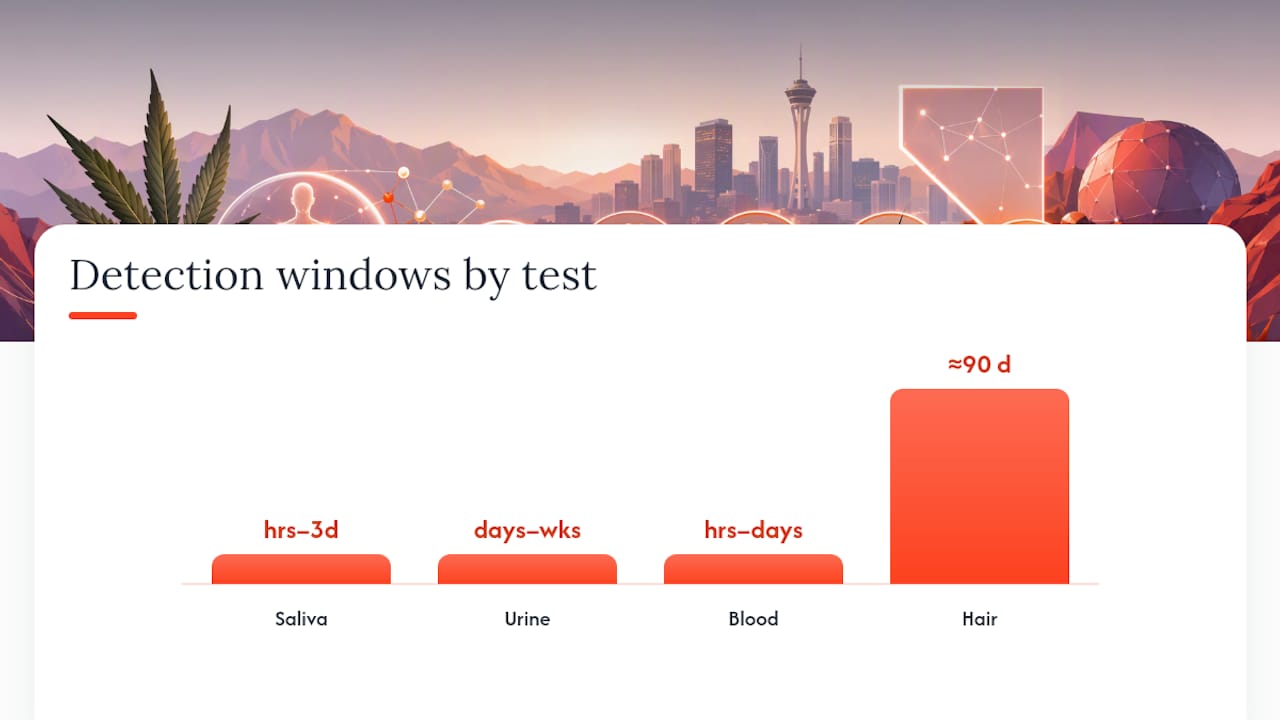
Urine tests measure THC metabolites, not the parent compound itself, which is part of why they can flag use from weeks earlier in regular users. Saliva tests are different: they primarily catch recent use, generally within a day or two, making them the closest thing to a “right now” impairment check. Hair follicle testing tells a longer story. Because the metabolite gets locked into the hair shaft as it grows, a standard 1.5 inch segment can reflect roughly 90 days of history. Blood tests sit somewhere in between, generally reflecting more recent exposure than hair but a narrower window than urine.
A rough breakdown looks like this:
- Saliva: hours to about 1 to 3 days for occasional use
- Urine: several days for occasional use, weeks for frequent or heavy use
- Blood: typically hours to a few days
- Hair: up to around 90 days, largely unaffected by recent abstinence
The detection-window gap between saliva and hair testing can span from a day or two to a full 90 days for the same person, depending only on which specimen the employer chooses to collect.
That range matters because individual metabolism, body fat percentage, hydration, and frequency of use all shift these numbers. Someone who used once a month will clear a urine test faster than a daily user, even on an identical timeline. None of this changes your legal protection, but it changes how much runway you have before a screening and how realistic any last-minute plan actually is.
Preparing Honestly: Timing, Products, and What to Avoid
The single biggest lever you control is time. Stopping use as early as possible after a job offer, or before applying, gives your body the longest runway to clear THC metabolites naturally, and frequency of past use is the biggest variable in how long that takes. Someone who smokes daily is working with a fundamentally different timeline than someone who used once at a party three weeks ago.
Once timing is locked in, evaluate any preparation product the same way you’d evaluate any other health purchase:
- Check for a transparent, full ingredient list, not a vague “proprietary blend”
- Look for real lab testing or verifiable batch data behind the product’s claims
- Confirm there’s a clear refund or guarantee policy in writing
- Verify the seller ships within the United States with tracked delivery
Passmydrugtest’s drug testing products category and detox product pages are built around exactly this kind of transparency, so you can compare options before you commit to one.
What you should never do is attempt to adulterate a specimen, dilute it, substitute it, or tamper with the sample in any way. Beyond the legal exposure, most labs now screen specifically for adulteration markers, and getting caught is often immediate grounds to revoke a job offer, protections under NRS 613.132 notwithstanding. That statute protects you from a marijuana result. It does nothing to protect you from a tampering finding.
Pro Tip: If you’re days away from a scheduled test with no time to detox naturally, be realistic about what short-notice products can and can’t do. Nothing sold online guarantees a clean result on demand, and any product claiming otherwise should raise your suspicion, not your confidence.
Short-notice options exist, and some people do use them, but they work best as a supplement to time and abstinence, not a replacement for either.
What to Do if You Test Positive During Your First 30 Days
If your marijuana-positive result comes during the first 30 days of employment, Nevada law gives you a specific, time-limited option: you can pay for an independent rebuttal test at your own expense, and the employer is required to accept it and give it appropriate consideration.
Move fast, because chain-of-custody and turnaround time both matter here.
- Request the original lab results and specimen details in writing immediately.
- Choose a certified, HHS or DOT-recognized lab with documented chain-of-custody procedures.
- Schedule the rebuttal test as soon as possible; delays weaken your position.
- If you hold a medical marijuana card, provide that documentation alongside your results.
- Keep every email, text, and letter connected to the process in one file.
If the employer ignores a properly submitted rebuttal test, that’s worth documenting and potentially escalating through a labor attorney or state complaint process.
Who Actually Oversees Marijuana Testing in Nevada?
No single agency runs Nevada’s drug-testing system the way, say, a state health board runs restaurant inspections. Instead, oversight is split across several bodies, each with a narrow lane.
The Nevada Legislature sets the underlying framework through statutes like NRS 613.132, while state HR and labor guidance, including the alcohol and drug program materials published for public employers, translates that framework into procedural detail: consent forms, retention periods, and testing protocols. For federally regulated jobs, the U.S. Department of Transportation sets its own testing rules that apply regardless of what Nevada says, and those rules take priority whenever they conflict with state protections.
Labs themselves operate under a separate layer of oversight. Facilities performing federally mandated testing typically need HHS or SAMHSA certification, which governs collection procedures, chain-of-custody documentation, and result reporting. Private employers doing non-federal testing have more flexibility in which lab they use, but reputable ones still follow similar chain-of-custody standards because sloppy documentation is the easiest way to lose a legal dispute.
There’s no single Nevada “drug testing board” a worker can call with a complaint. Disputes over hiring decisions typically route through Nevada’s labor commissioner or the courts, while lab-quality concerns are generally a matter between the employer and its testing vendor.
What Standards Govern the Actual Testing Procedure?
Nevada law doesn’t spell out a single universal testing protocol the way some states do, but state guidance points employers toward consistent, defensible procedures. That guidance emphasizes proper specimen collection, secure chain-of-custody documentation, and consistent handling from collection through lab reporting.
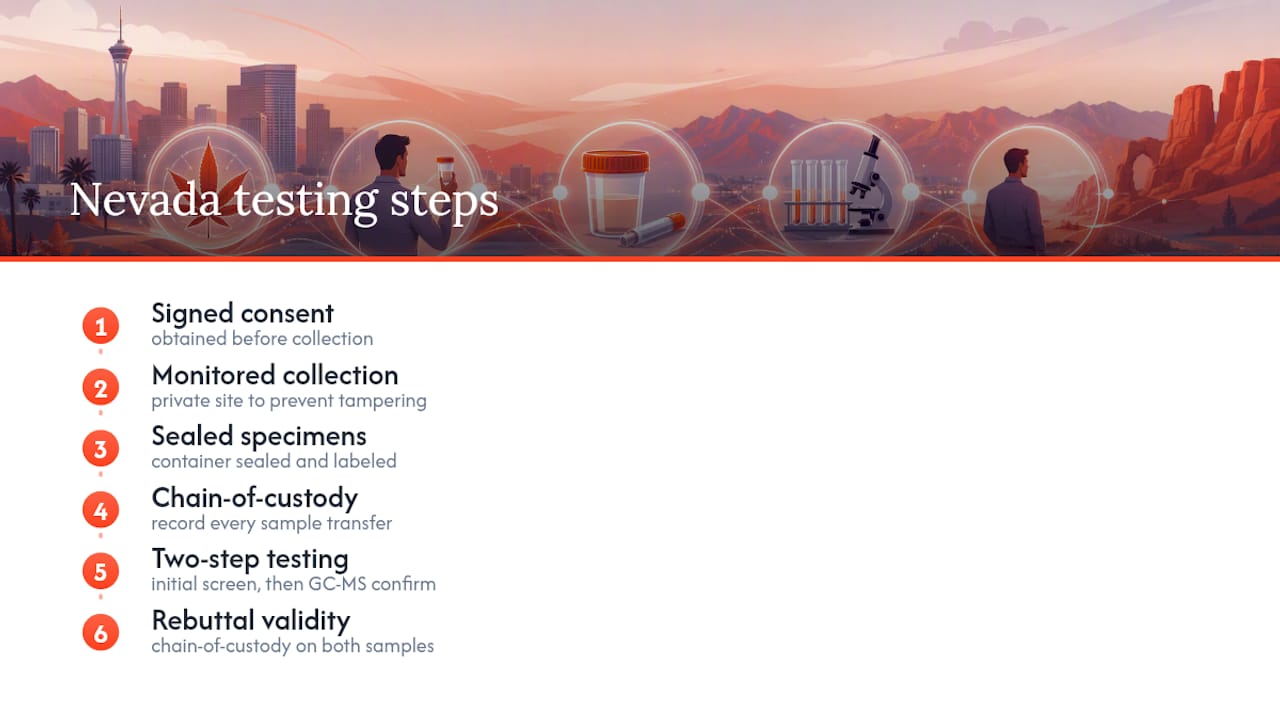
In practice, that means a compliant Nevada testing process usually includes a signed consent form before collection, a private and monitored collection site to prevent tampering, sealed and labeled specimen containers, and a documented transfer record every time the sample changes hands. Labs performing confirmation testing on a positive initial screen typically use gas chromatography-mass spectrometry (GC-MS) or similar confirmatory methods rather than relying on the cheaper immunoassay screen alone.
This two-step structure, initial screen followed by confirmatory testing, exists specifically to catch false positives before they cost someone a job. A poppy-seed-level metabolite reading on an initial immunoassay, for example, generally won’t survive a proper GC-MS confirmation. If you ever dispute a result, ask specifically whether confirmatory testing was performed, because a positive based on the screening step alone is far weaker evidence than one confirmed at the molecular level.
None of these procedural standards are optional window dressing. They’re what makes a rebuttal test meaningful in the first place. Without documented chain-of-custody on both the original and the rebuttal sample, an employer has no reliable way to compare results, which undercuts the entire point of the 30-day rebuttal right.
What Notice and Consent Are You Entitled to Before Testing?
Nevada employers generally can’t test you without your knowledge or agreement. Standard practice, reinforced by state guidance, requires a signed consent form before any specimen collection happens, and that form typically discloses what substances are being screened, which lab will process the sample, and how results will be used in the hiring decision.
You should also generally receive advance notice that testing is a condition of your offer, usually spelled out in the offer letter itself, rather than being surprised with a cup and a bathroom on your first day. If an employer skips consent entirely and tests you without disclosure, that’s a procedural red flag worth raising, either with the employer’s HR department or, if it goes nowhere, with Nevada’s labor commissioner.
Consent doesn’t mean you have leverage to negotiate the test away. Declining to sign the consent form is functionally the same as refusing the screening, and employers are generally within their rights to treat a refusal as a failed condition of employment. What consent does give you is a paper trail: proof of what you agreed to, what substances were tested, and what the employer told you about the process. That paper trail becomes valuable fast if you ever need to dispute a result or claim the employer skipped a required step.
Do You Have Rights Beyond the Initial Hiring Decision?
The 30-day rebuttal window is Nevada’s headline protection, but a few other practical rights matter once you’re actually in the testing pipeline. You generally have the right to know which lab is processing your sample and to request a copy of your own results once they’re finalized. You’re also entitled to a private, non-humiliating collection process; monitored collections exist for tampering concerns, but a poorly run one that strips away basic privacy protections is a legitimate complaint.
If you hold a valid medical marijuana card, you can provide that documentation as context for a positive result, though it’s worth being clear-eyed about what that actually accomplishes. It doesn’t automatically override an employer’s testing policy or the exceptions covered earlier, but it does create a documented record that can matter if a dispute escalates.
Retaliation protections apply here too, in a general sense: an employer generally cannot punish you for exercising your statutory right to a rebuttal test, and doing so would undercut the entire purpose of the protection. If you experience that kind of retaliation, that’s the point to start documenting everything and consider consulting a Nevada employment attorney rather than trying to resolve it alone.
Medical Card Holders vs. Recreational Users: Does the Law Treat Them Differently?
Nevada’s pre-employment testing statute doesn’t carve out a separate legal category for medical marijuana cardholders versus recreational users. The hiring protection under NRS 613.132 applies the same way regardless of whether your cannabis use is medical or recreational, because the statute is written around the test result itself, not the reason behind it.
Where the practical difference shows up is in documentation and, sometimes, employer discretion. A medical card gives you a paper trail that can support a rebuttal test or an internal appeal, especially if a company’s own policy makes an exception for documented medical use. Some employers do build that kind of accommodation into their internal drug policy voluntarily, but nothing in Nevada law requires them to.
Cardholders also aren’t exempt from the federal-override exceptions covered earlier. A DOT-regulated driver with a valid Nevada medical card is still subject to federal testing standards that don’t recognize state medical marijuana law at all. The same goes for federal contractors and most public-safety roles. If your job falls into one of those categories, a medical card provides essentially no additional legal shield.
The practical takeaway: don’t assume a medical card changes your risk profile in a meaningful legal sense. It’s useful documentation, and it’s worth disclosing during a rebuttal process, but it isn’t a separate legal status with stronger protections than recreational use carries under the same statute.
Has Legalization Actually Changed Workplace Testing in Nevada?
Legalization changed the criminal status of marijuana in Nevada. It did not eliminate workplace testing, and plenty of employers kept their drug-free workplace policies largely intact after recreational cannabis became legal. Testing programs persist for reasons that have little to do with the drug’s legal status: liability concerns, insurance requirements, industry-specific safety standards, and simple institutional inertia around policies that predate legalization by years, all of which state background research points to as ongoing motivations.
What did shift is the specific moment where legal protection kicks in: the hiring decision. NRS 613.132 closed a gap that used to let employers reject qualified applicants purely because of a positive marijuana screening, even in a state where using that substance was perfectly legal. That’s a meaningful change, but it’s a narrow one, confined to the hiring stage and the first 30 days of employment.
There’s also a slow, visible shift in how some employers frame their policies: emphasizing on-the-job impairment rather than the mere presence of metabolites in a screening. That distinction matters practically, since metabolites can linger for weeks after someone is no longer impaired at all. Whether that shift continues depends on individual employer policy, not any new statewide mandate, so don’t assume every Nevada employer has caught up to it yet.
An Editorial Take on Nevada’s Cannabis Testing Rules
Most articles on this topic treat NRS 613.132 like a broad cannabis shield for Nevada workers. It isn’t one, and treating it that way sets people up for a bad surprise. The protection is real, but it’s stitched onto one specific moment: the hiring decision, plus a 30-day rebuttal window after that. Everything before an offer and everything after that window operates under a completely different set of rules, mostly rules that still favor the employer.
What gets underestimated is how much the specimen type matters relative to the law itself. Two applicants with identical legal protections under NRS 613.132 can face wildly different practical risk depending on whether their employer collects saliva or hair. The statute treats every specimen type the same. Your body doesn’t. That gap between legal theory and biological reality is where most of the real decision-making happens, and it’s exactly where a product-neutral approach to timing and preparation earns its keep.
The other overlooked piece is how quietly the DOT and federal contractor exceptions swallow entire industries. If you work in transportation, logistics, healthcare, or anything touching federal funding, Nevada’s hiring protection is close to irrelevant to your situation. Anyone applying to those fields who’s leaning on NRS 613.132 as a safety net is leaning on something that likely doesn’t apply to them at all.
— MIchael
Where to Find Test-Prep Guides and Products for Nevada Testing
Various online retailers provide products intended to help prepare for drug tests and offer customer support during business hours; many ship within the United States.
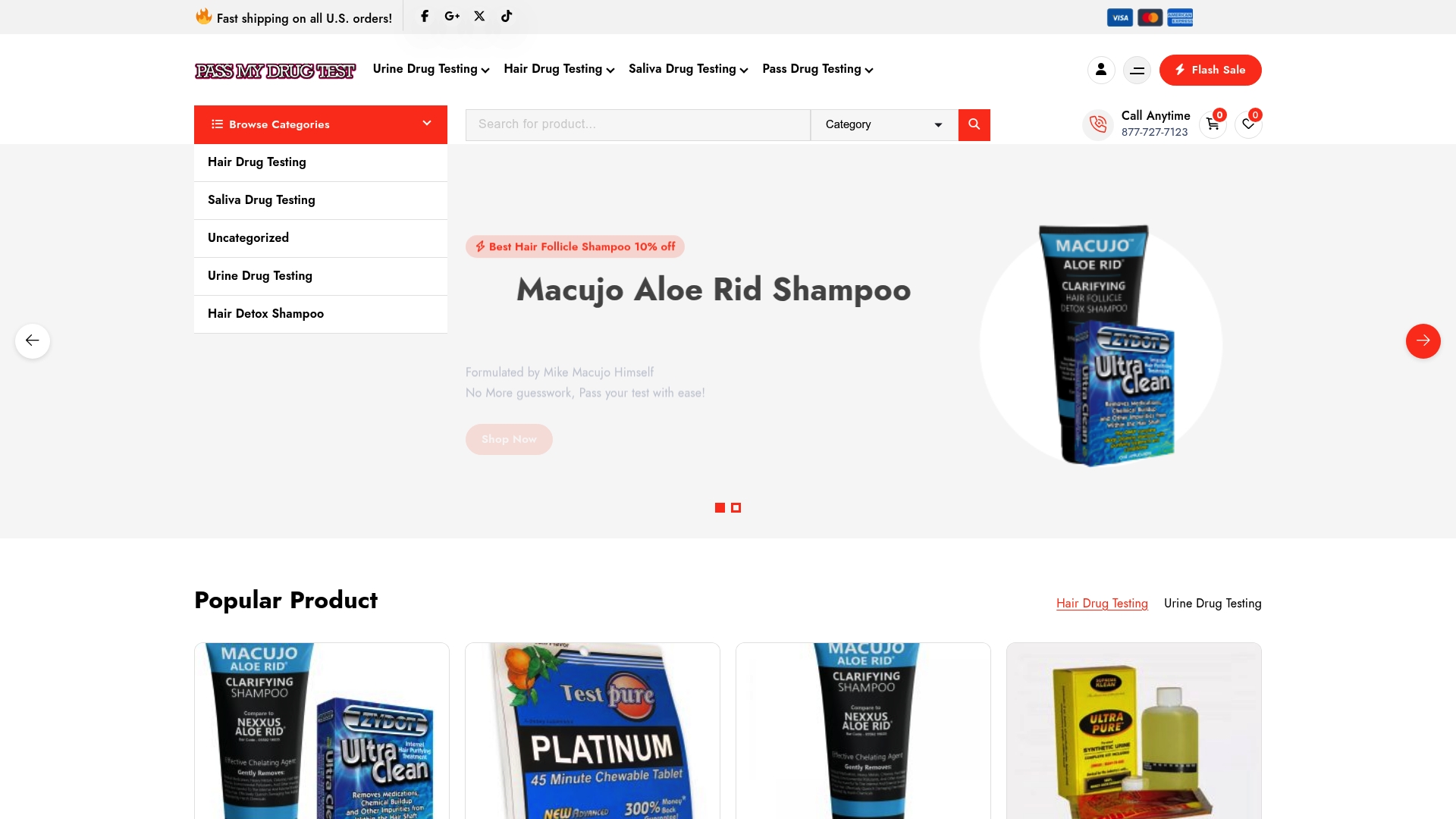
Start by reviewing the drug testing products catalog to see what’s available across urine, hair, and saliva categories, and check each product page for lab-compatibility notes and refund terms before you commit. If you’re facing a hair follicle test specifically, the hair testing information guide breaks down what that test actually measures and why timing matters more with hair than with any other specimen type. No product on the market guarantees a specific outcome, and any site claiming otherwise should make you skeptical, but comparing transparent options beats guessing blind. Browse the catalog, read the fine print on each guarantee policy, and pick the approach that actually matches your timeline.
Sources
- NRS 613.132 — Justia
- Nevada HR guidance and administrative summary (Alcohol and drug program)
- Can Nevada employers test for cannabis use? — Catalyst Legal
- Drug testing in Nevada — National Testing Services