
Flagged Specific Gravity on a Drug Test: 1.003–1.035 Explained
Specific gravity measures how concentrated your urine is compared to plain water, and drug-testing labs use it alongside creatinine to catch dilute or substituted samples. A result that falls outside the normal range, roughly 1.003 to 1.035, can flag a specimen for follow-up. That usually means a second collection, a review by the Medical Review Officer, or both, not an automatic accusation of cheating.
TL;DR:
- Specific gravity readings outside the normal range of 1.003 to 1.035 often trigger confirmatory testing, extra sample collection, or review, not immediate accusations of tampering.
- Labs commonly use dipsticks, refractometers, or automated analyzers to measure SG, with the latter two providing more accurate and reliable results, especially at range edges.
- Federal guidelines classify specimens as dilute if creatinine is between 2 and 20 mg/dL and SG is between 1.0010 and 1.0030, while substitution is indicated if creatinine is below 5 mg/dL with extreme SG values.
- Low SG can result from hydration, diuretic use, or diabetes insipidus, whereas high SG may indicate dehydration, glycosuria, or recent contrast media use, making abnormal results non-conclusive of drug tampering.
- Multiple validity markers, including creatinine, pH, and oxidant levels, alongside SG, are necessary to prevent false accusations and inform accurate specimen interpretation.
Table of Contents
- What urine specific gravity measures and common reference ranges
- How labs measure specific gravity: dipstick, refractometer, and automated chemistries
- How SG is used with creatinine and federal standards for dilute or substituted specimens
- Interpreting low or high specific gravity: causes and how to tell physiologic from tampering
- If your specimen is flagged as dilute or abnormal: typical lab/employer steps and what you should do
- Practical resources from PassMyDrugTest and how the site can help
- Why multiple validity checks and MRO involvement matter
- Sources
- FAQ
What urine specific gravity measures and common reference ranges
Specific gravity compares the density of urine to the density of water, which is set at 1.000. It is a rougher stand-in for osmolality, the more precise lab measure of dissolved particles in urine, but SG is faster and cheaper to run, which is why it shows up on nearly every routine urinalysis.
Clinical references list the typical range as roughly 1.003 to 1.035, though some labs use a tighter band of 1.005 to 1.030. The variation comes down to instrument calibration and each lab’s internal protocol, not a disagreement about physiology.
A reading near 1.000 means the urine is barely different from water. On its own that is not proof of anything specific, but paired with a low creatinine level, it is one of the signals labs use to flag a sample as dilute or, in more extreme cases, substituted.
How labs measure specific gravity: dipstick, refractometer, and automated chemistries
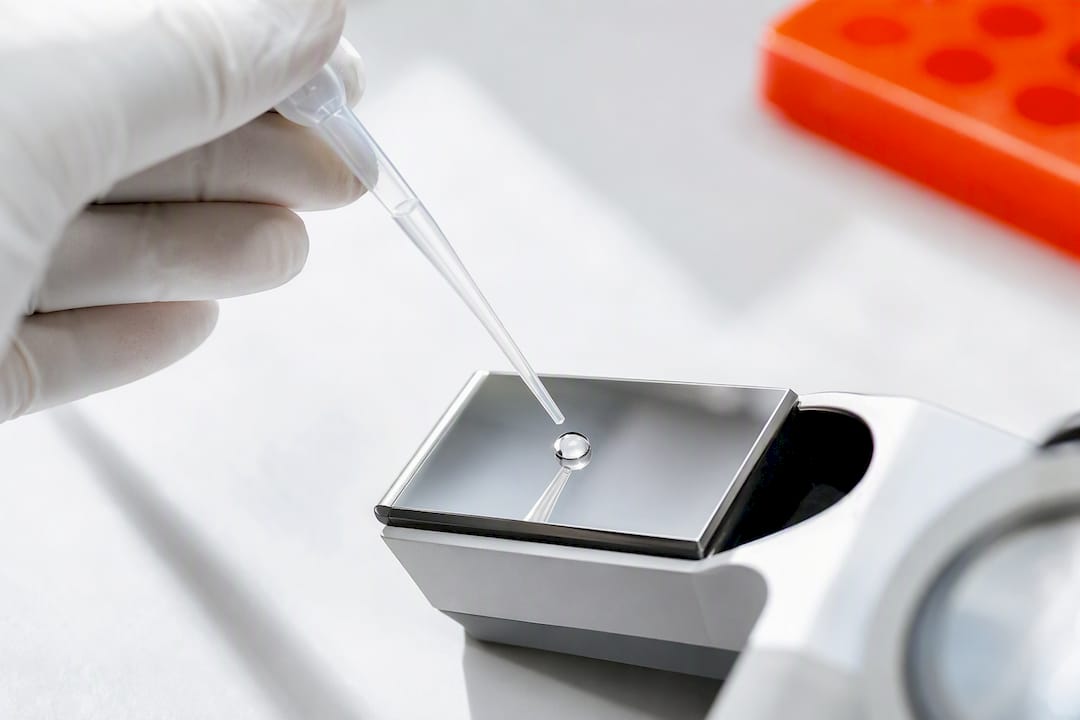
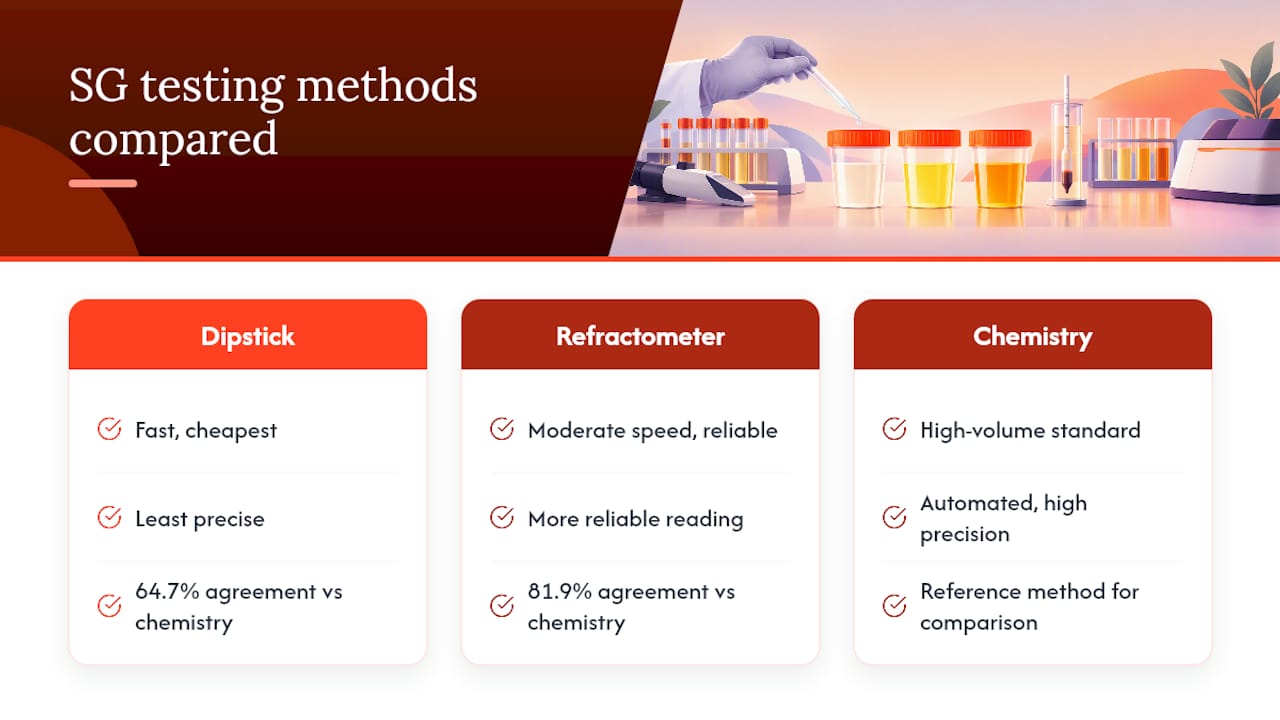
Three methods dominate specimen validity testing. The dipstick is the fastest and cheapest option, using a color-change reagent pad, but it is also the least precise. The refractometer measures how light bends passing through a urine sample and delivers a more reliable reading. Automated chemistry analyzers run the same chemical principle at high volume, which makes them the standard in busy reference labs.
The method matters because the numbers do not always agree. A comparative methods study found that chemistry-based SG methods correlated with refractometer results in about 81.9% of samples, while dipstick agreement with the same chemistry method dropped to roughly 64.7%. That gap means an SG reading pulled from a dipstick carries more uncertainty at the edges of the normal range.
This is also why labs rarely rely on SG by itself. Creatinine, pH, temperature, and oxidant assays run alongside it, giving a fuller picture before anyone calls a result dilute, substituted, or adulterated.
How SG is used with creatinine and federal standards for dilute or substituted specimens
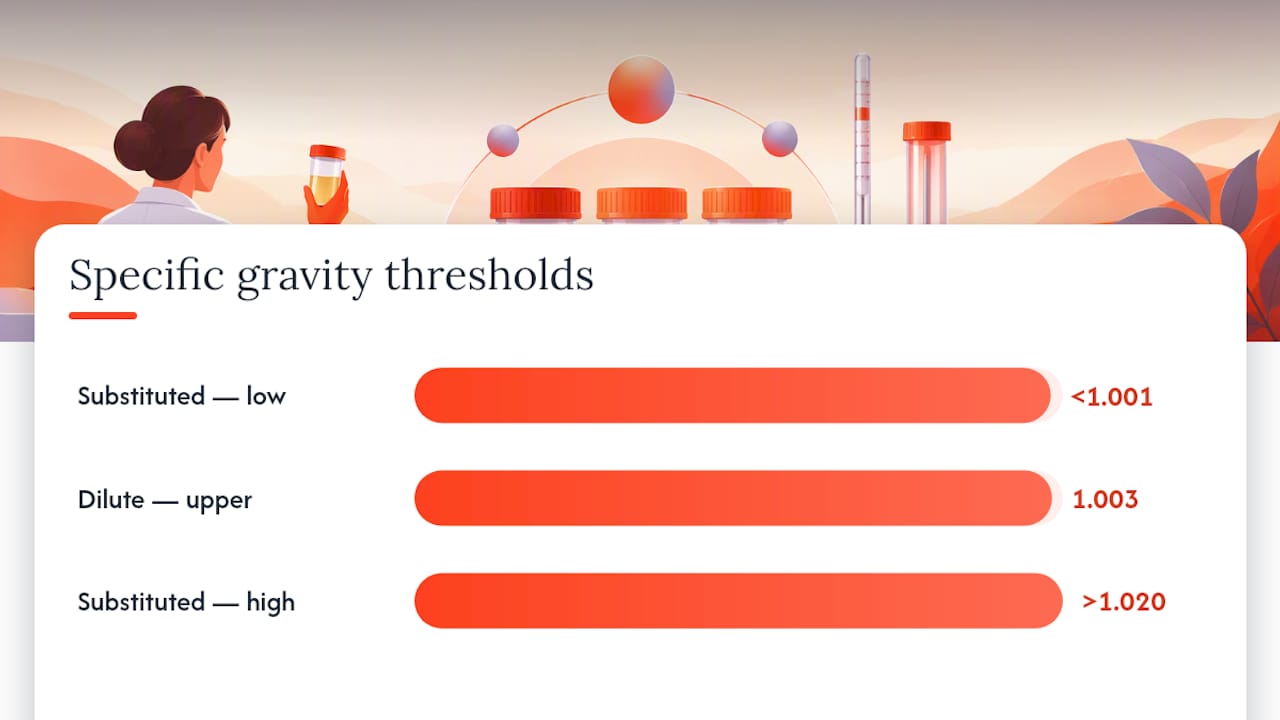
Federal workplace drug testing rules spell out exact cutoffs rather than leaving interpretation to guesswork. Under 49 CFR § 40.88, a specimen is classified as dilute when creatinine falls between 2 mg/dL and 20 mg/dL and specific gravity sits above 1.0010 but below 1.0030. A specimen is called substituted when creatinine drops below 5 mg/dL and specific gravity is either under 1.001 or over 1.020.
The rules pair the two markers deliberately:
- Creatinine and specific gravity normally move together, since both reflect how concentrated the urine is.
- Using both catches cases where one measurement alone might be misleading due to instrument error or borderline values.
- The wide gap between the dilute and substituted thresholds gives labs room to distinguish ordinary overhydration from a sample that looks nothing like human urine.
Controlled hydration research examined what happens when people intentionally drink large amounts of water before a test. Deliberate overhydration frequently pushed creatinine and SG into dilute territory, but it did not reproduce the far more extreme substituted criteria. That distinction supports treating a dilute result as a hydration issue to investigate, not a same tier as substitution, though the studies involved supervised conditions that do not capture every real-world scenario.
Interpreting low or high specific gravity: causes and how to tell physiologic from tampering
Low specific gravity has ordinary medical explanations. Drinking large volumes of water, taking diuretics, or having diabetes insipidus can all push SG toward 1.000 without any connection to drug use. High specific gravity has its own list of physiologic causes, including dehydration, glycosuria from unmanaged diabetes, and recent use of radiographic contrast media.
Because both directions have legitimate medical roots, a lab should not treat an abnormal SG as proof of tampering. A donor with low creatinine and low SG might simply have a kidney condition or have followed advice to drink more water before a doctor’s visit, which is exactly why clinical follow-up sometimes matters more than a testing sanction.
That is also why SG never stands alone in specimen validity testing. Temperature at collection, creatinine, pH, and oxidant assay results all get weighed together before anyone draws a conclusion about a specimen.
If your specimen is flagged as dilute or abnormal: typical lab/employer steps and what you should do
A flagged specimen triggers a fairly standard sequence rather than an immediate penalty. Reflex confirmatory testing usually runs first, followed by a request for a new sample, sometimes under observed collection conditions. The Medical Review Officer reviews the full picture, including your health history, before any outcome is finalized.
On your end, a few steps make the process smoother:
- Tell the collector or MRO about medications, supplements, or medical conditions that could affect urine concentration.
- Ask specifically which markers were out of range, since a dilute result and a substituted result carry very different implications.
- Follow instructions for recollection promptly rather than delaying, since delays can complicate the timeline an employer or agency is working with.
If you want a deeper look at how dilution affects a drug test result and what recollection typically involves, that guide walks through the process step by step. Readers weighing preparation strategies before a scheduled test may also find the piece on factors that affect a urine drug test useful for understanding what labs are actually checking for.
Practical resources from PassMyDrugTest and how the site can help
Passmydrugtest maintains educational pages that walk through dilution, specimen validity testing, and what a flagged result typically means for a donor. Alongside that content, the site organizes product categories including urine drug testing supplies and at-home test kits for people who want to check a sample before a scheduled screening.
Fast shipping on domestic orders and phone support during published business hours are practical conveniences offered by the site. Before using any preparation product, check with the lab or MRO handling your specific test, since interpretation of a validity result always comes down to their judgment, not a product’s marketing claims.
Why multiple validity checks and MRO involvement matter
Labs lean on several markers at once because no single number tells the whole story. A person with a kidney condition and a marathon runner who overhydrated before a collection can produce similar SG readings for entirely different reasons. Cross-checking creatinine, pH, and oxidant results against SG is what keeps a hydration habit from turning into a false accusation.
Clear communication with the MRO closes the gap that raw numbers cannot. A donor who explains a medical condition or a documented prescription gives the reviewer context that no test strip can provide on its own.
— MIchael
Sources
Passmydrugtest brings the same educational approach in this article to its product catalog, so readers can move from understanding specimen validity to browsing supplies without switching sites. The urine drug testing category covers at-home kits for people who want a read on their own sample ahead of a scheduled screening, while the hair drug testing and saliva drug testing sections cover the other two common collection methods.
None of these products substitute for a lab’s or MRO’s interpretation of your actual results. They are tools for preparation and self-checking, and the right one depends on your specific test type and timeline.
- 49 CFR § 40.88 – Laboratory testing for specific gravity and creatinine
- Comparison of different methods used in drugs of abuse for sample validity testing including pH methods, specific gravity methods, TECO™ Drug Adulteration Test Strip and oxidant assay — PMC
- Urine specific gravity test — MedlinePlus
Start by browsing the full product lineup to find the option that matches the specific test you are preparing for.
This article is general information, not a substitute for advice from a qualified doctor. Consult a qualified healthcare professional about your own circumstances before acting on anything here.
FAQ
What does specific gravity mean on a drug test?
Specific gravity measures how concentrated your urine is compared to water, and drug-testing labs use it to check whether a sample has been diluted or tampered with. A reading outside the normal range of roughly 1.003 to 1.035 can prompt additional review alongside creatinine and other markers.
Is a specific gravity of 1.000 in urine normal?
A specific gravity of 1.000 is at the very bottom of typical ranges and generally is not considered normal on a routine test. In drug screening, a value that low combined with low creatinine can meet the federal criteria for a substituted specimen under 49 CFR § 40.88.
How do you fix high specific gravity in urine?
High specific gravity usually reflects dehydration, so drinking water and rehydrating over several hours is the standard first step. If a medical condition like glycosuria is contributing to the reading, that needs evaluation from a healthcare provider rather than a quick fix.
What does a high specific gravity on a urine test indicate?
A high reading typically points to concentrated urine from dehydration, though glycosuria and recent contrast media use during imaging can also raise it. On its own, a high SG is not evidence of drug use or tampering, since it reflects hydration and medical factors that labs consider alongside other validity markers.