
How to Read Drug Test Results: Lines, Cutoffs & Reports
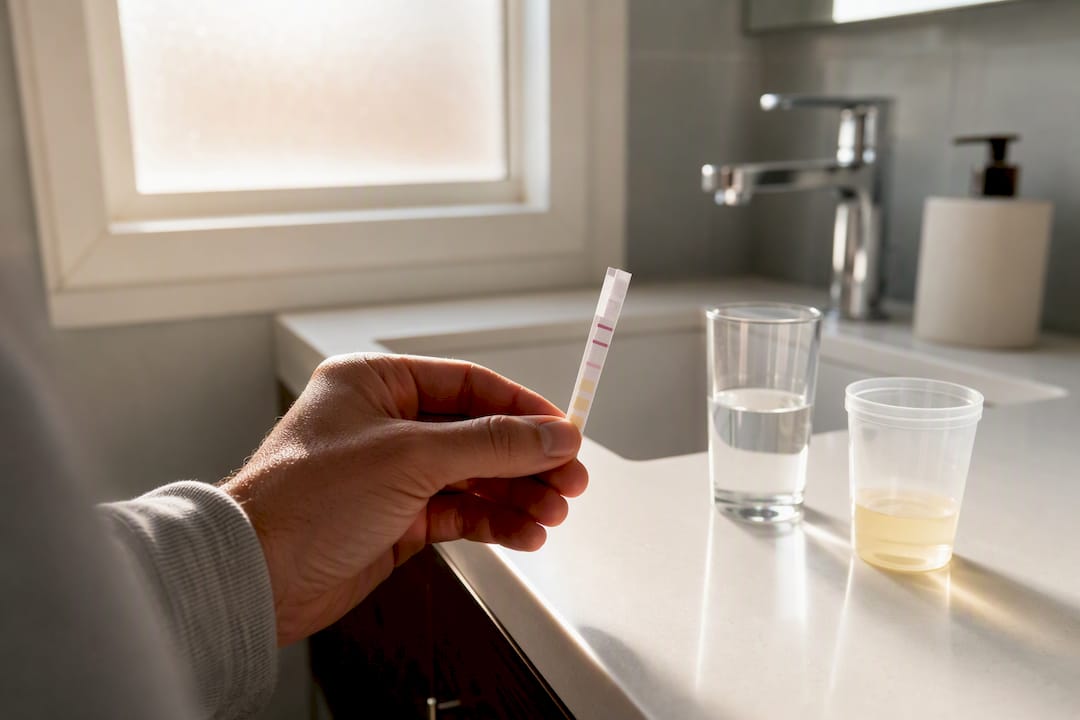
Two lines on a urine dip strip means negative. One line means presumptive positive. A “no line at all” reading is invalid and the test needs to be redone. Lab reports work differently: they list an analyte name, a reported concentration in ng/mL, and whether that number was confirmed by a second, more precise method.
A rapid test only screens. A lab confirmation, using GC‑MS or LC‑MS/MS, proves it.
Before you read any result, know what you’re looking for:
- Control line confirms the test itself worked.
- Test line determines negative versus presumptive positive.
- Analyte name tells you which drug or drug class was screened.
- Cutoff (ng/mL) is the threshold the result was measured against.
- Confirmation status tells you if a lab verified the screening result.
- MRO notes explain any medical or legal context added to a workplace result.
If you get a presumptive positive, don’t panic and don’t assume the worst. Request confirmatory testing. If you get an invalid result, the test failed, not you, and it needs to be repeated with a fresh sample.
Key Takeaways
Reading a drug test correctly means separating a presumptive screening result from a lab-confirmed one before drawing any conclusion.
| Point | Details |
|---|---|
| Line rule for rapid tests | Two lines mean negative, one line (control only) means presumptive positive, and no control line means invalid. |
| Faint lines still count | Any visible test line, no matter how faint, is read as negative, not a weak positive. |
| Cutoffs vary by method | Screening cutoffs like 50 ng/mL for THC are higher than confirmation cutoffs such as —. |
| Confirm before acting | A presumptive positive always needs GC‑MS or LC‑MS/MS confirmation before any real-world decision gets made. |
| Passmydrugtest supports prep | Passmydrugtest offers at-home test kits and detox products for readers who want a read on their status before an official screen. |
Table of Contents
- Core Terms Behind Every Drug Test Result
- How Do You Read a Rapid Urine Drug Test?
- How Do You Interpret a Laboratory Drug Test Report?
- What Cutoff Levels Do Labs Actually Use?
- How Long Do Drugs Stay Detectable in Different Sample Types?
- What Causes a False Positive Drug Test?
- What Should You Do After a Positive Drug Test?
- Quick Checklist for Reading Any Drug Test Report
- Sources
Core Terms Behind Every Drug Test Result
A cutoff level is the concentration, measured in nanograms per milliliter (ng/mL), that a sample has to clear before it counts as positive. If the screening cutoff for THC is 50 ng/mL and your sample comes back at 48 ng/mL, that’s reported negative, full stop, even though the drug is technically present.
A presumptive positive just means the screening test flagged something at or above that cutoff. It’s not proof of drug use, timing, or impairment, only that a follow-up look is warranted, according to NIDA. A confirmed positive is what you get after a lab reruns the sample using a more specific method. The Medical Review Officer (MRO) is the licensed physician who reviews confirmed positives in regulated testing, checks for legitimate prescriptions, and decides how the result gets reported. A metabolite is the byproduct your body creates after breaking a drug down, and it’s usually the metabolite, not the parent drug, that tests actually detect. Chain of custody is the paperwork trail proving your sample wasn’t swapped or tampered with.
Pro Tip: Cutoffs aren’t arbitrary. Labs set them high enough to filter out incidental exposure but low enough to catch genuine use, which is exactly why the same person can test negative on one panel and positive on a more sensitive one.
How Do You Read a Rapid Urine Drug Test?
The line rule is simple once you know it: two visible lines (control and test) mean negative. One line, control only, means presumptive positive. No control line at all means the test is invalid, regardless of what the test line shows.
Here’s the part that trips people up. A faint test line still counts as a full negative. Line darkness has nothing to do with drug concentration. Multiple sources, including American Screening Corp’s visual guide, confirm that any visible test line, faint or bold, reads as negative.
A faint line is not a “weak positive.” There’s no such category on a standard immunoassay strip. It’s either there or it isn’t, and if it’s there at all, the result is negative.
Timing matters more than most people expect. Read the strip inside the manufacturer’s window, usually 5 minutes, never after 10. Waiting too long invites evaporation lines that mimic a real result.
Common mistakes:
- Reading the strip too early or too late
- Using an expired kit
- Overhydrating before the test, which can dilute the sample enough to trigger an invalid or inconclusive reading
Pro Tip: If a line shows up faint but past the reading window, don’t trust it either way. Rerun the test with a fresh sample instead of guessing.
How Do You Interpret a Laboratory Drug Test Report?
A lab report has more fields than a rapid test, and each one changes what the result actually means.
- Confirm sample identity and chain of custody. Check that the ID number, date, and collector signature match your records before reading anything else.
- Read the result summary line first. It usually says “positive,” “negative,” “invalid,” or “dilute” in plain language.
- Check the analyte name. Reports list the specific substance or metabolite, not just a drug class, so “THC-COOH” is more precise than “marijuana.”
- Look at the reported concentration in ng/mL. This is the actual number measured in your sample.
- Compare it to the cutoff used. The report should state the exact ng/mL threshold applied.
- Check the confirmation method. If GC‑MS or LC‑MS/MS appears next to the result, it’s been confirmed, not just screened.
Screening (immunoassay) and confirmation are two different tests run at two different sensitivities. Confirmation cutoffs are almost always lower than screening cutoffs because the confirmatory method is far more specific, designed to catch a smaller signal with far less risk of a false match.
Common report fields you’ll see: result summary, specimen type, analyte, reported concentration, cutoff level, method (immunoassay versus GC‑MS/LC‑MS/MS), and a notes or flags section that documents anything unusual, like a dilute or substituted specimen.
Pro Tip: Before trusting any number on a report, verify the lab holds SAMHSA or CLIA accreditation. An unaccredited lab’s numbers carry far less weight in a legal or employment dispute.
What Cutoff Levels Do Labs Actually Use?
Cutoffs vary by lab, panel, and method, but certain numbers show up again and again in initial urine immunoassay screening.
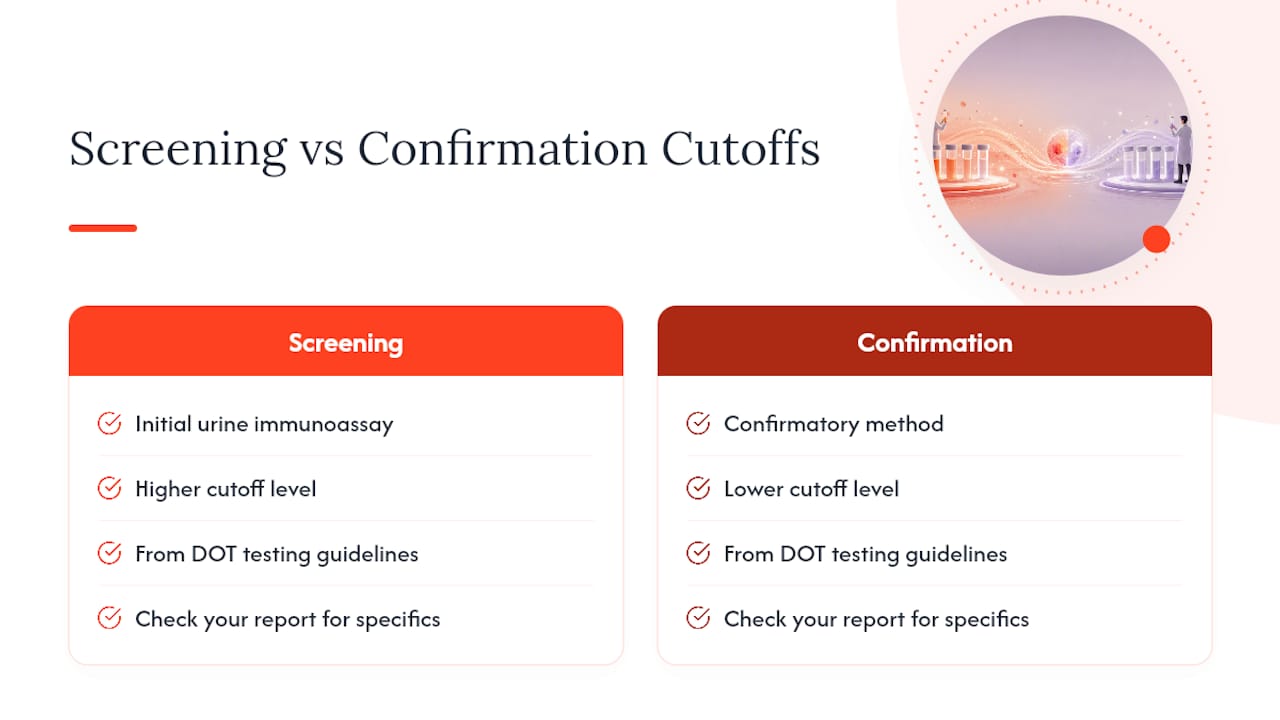
These figures come from federal DOT testing guidelines, which set the standard many workplace programs follow. Notice the pattern: confirmation cutoffs run lower than screening cutoffs, because the confirmatory method can reliably detect smaller amounts with far greater specificity.
Not every lab uses these exact numbers. Panels differ by employer, jurisdiction, and testing purpose, so always check the specific cutoff listed on your own report rather than assuming it matches a chart you found online.
How Long Do Drugs Stay Detectable in Different Sample Types?
A negative result only tells you the drug wasn’t detected above the cutoff during that specimen’s detection window, not that it was never used. NIDA’s detection window data shows just how much this varies by specimen type.
- Urine: typically 1 to 3 days for most drugs, though chronic heavy THC use can extend detectability well beyond that.
- Saliva: usually reflects very recent use, often within the past 24 to 48 hours.
- Blood: detects the shortest window of all specimen types, generally hours to a couple of days.
- Hair: can reveal a much longer detection history, often stretching back weeks or months.
- Sweat (patch testing): measures continuous exposure over the days the patch is worn.
Think of it as three tiers: short window (blood, saliva), medium window (urine), and long window (hair). A negative urine test taken three weeks after use can be entirely accurate and still miss something a hair test would catch.
What Causes a False Positive Drug Test?
Cross-reactivity is more common than most people assume, and it’s rarely the fault of the person taking the test.
- Certain cough medicines containing dextromethorphan can trigger false positives for PCP on some immunoassay panels.
- Pseudoephedrine and other decongestants have been linked to false amphetamine flags.
- Poppy seeds in food can push opiate screens above cutoff in rare cases.
- Some prescription medications and supplements cross-react with benzodiazepine or amphetamine panels depending on the immunoassay used.
Collection problems cause the opposite kind of confusion. Dilution from overhydration can push a real positive down to a false negative, while adulterants or improper storage can invalidate a sample outright.
Pro Tip: Keep a written list of every prescription and OTC medication you’re taking before any scheduled test. If a false positive comes back, that documentation is what your MRO will ask for first.
What Should You Do After a Positive Drug Test?
A presumptive positive is a starting point, not a verdict. Here’s the order to work through it.
- Don’t assume anything yet. A screening positive doesn’t prove impairment, timing, or even that a specific substance was used.
- Preserve the chain of custody. Don’t discard the original sample or paperwork.
- Request confirmatory testing. GC‑MS or LC‑MS/MS confirmation is the standard next step before any decision gets made.
- Wait for MRO review if this is a regulated workplace test. The Medical Review Officer will contact you about any prescriptions before finalizing the result.
- Provide documentation for any legitimate prescription that could explain the result.
- Ask about split-sample or retest options if you believe the result is wrong.
For confirmed positives in an employment context, the MRO is your first point of contact, followed by HR if the result affects your job status. Timelines vary, but confirmatory testing usually adds a few business days beyond the initial screen. Keep every document you receive along the way.
Quick Checklist for Reading Any Drug Test Report
Run through this list the moment you get a result, rapid or lab-based.
- Verify your name, ID, and date match the report exactly.
- Confirm the test was read inside the manufacturer’s stated time window (rapid tests only).
- Check that the control line or validity marker is present.
- Identify the exact analyte name, not just a general drug category.
- Find the cutoff level listed and compare it to the reported concentration.
- Determine whether this is a screening result or a lab-confirmed result.
- If it’s presumptive, ask directly: was GC‑MS or LC‑MS/MS confirmation performed?
- Ask what cutoff the confirming lab used, since it’s usually lower than the screening number.
If any answer is unclear, call the lab or MRO before drawing conclusions. It costs a phone call and saves a lot of second-guessing.
A Practical Note From the Author
Reading a drug test isn’t complicated once you know what each line and number actually represents. This guide is built to be practical first: skip the jargon, get you to the right next step, and keep you from panicking over a faint line that was never a real positive.
If You’re Preparing for a Test, Here’s an Option Worth Knowing About
Reading a result correctly matters just as much before a test as after one. If you’re heading into a scheduled screening and want to understand your standing beforehand, Passmydrugtest carries at-home test kits and detox products built for exactly that kind of prep work.
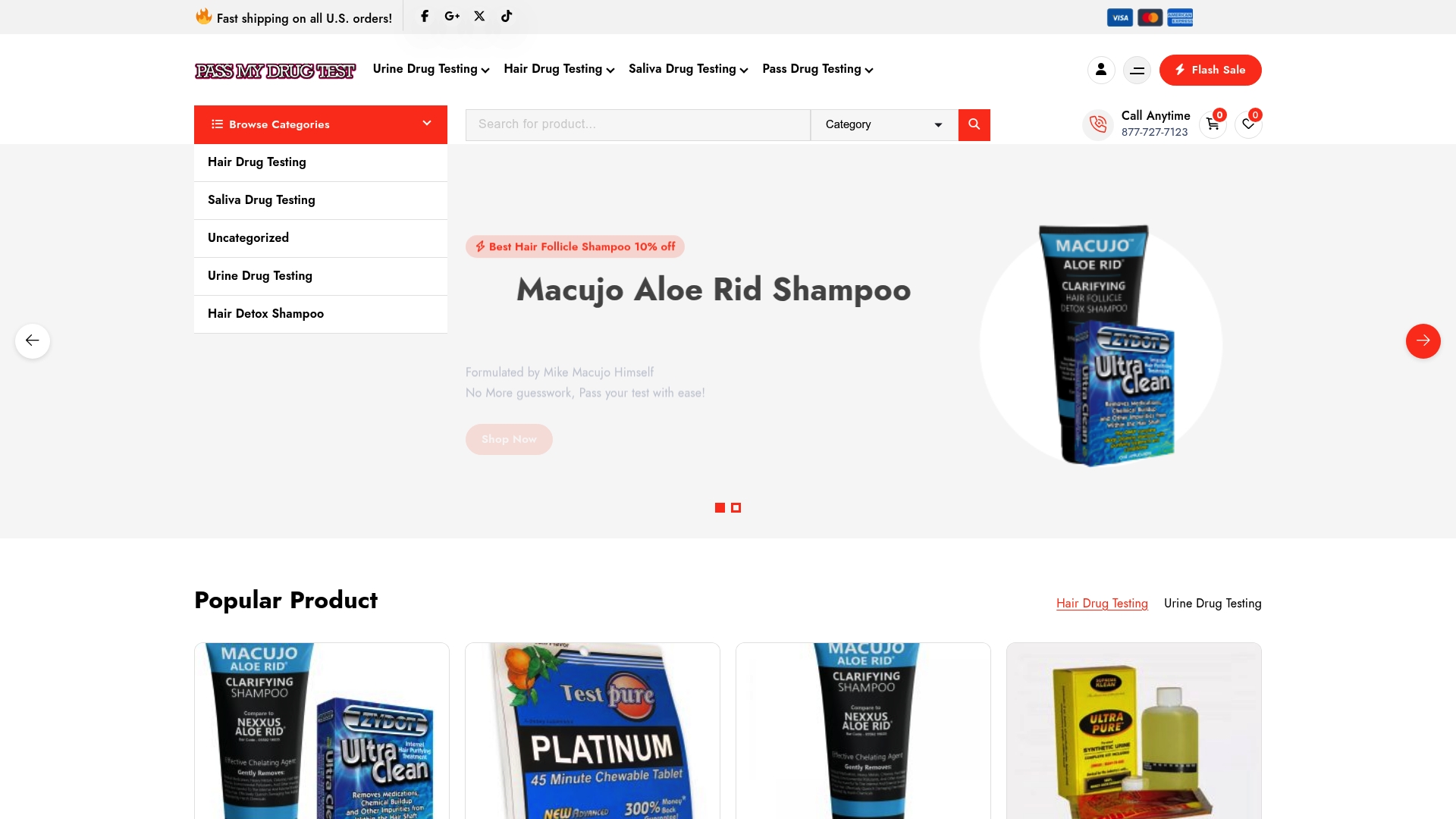
Browsing the detox product lineup or a marijuana-specific home test kit gives you a read on where you stand days before an official screen, not after. That said, none of this replaces confirmatory lab testing or MRO review when an official result is on the line. Treat these products as preparation tools, not a substitute for what a certified lab decides. If you’re getting ready for a specific screening, start by checking which kit matches your situation on the drug testing methods page.
Sources
For lab-specific cutoff numbers, check your own report or contact the testing lab directly, since panels and thresholds vary by employer and jurisdiction. For general standards and workplace-testing rules, these sources are the most reliable starting points:
- NIDA: Drug testing overview and limitations
- MedlinePlus: Drug testing — what positive and negative mean
- SAMHSA: workplace drug testing resources