
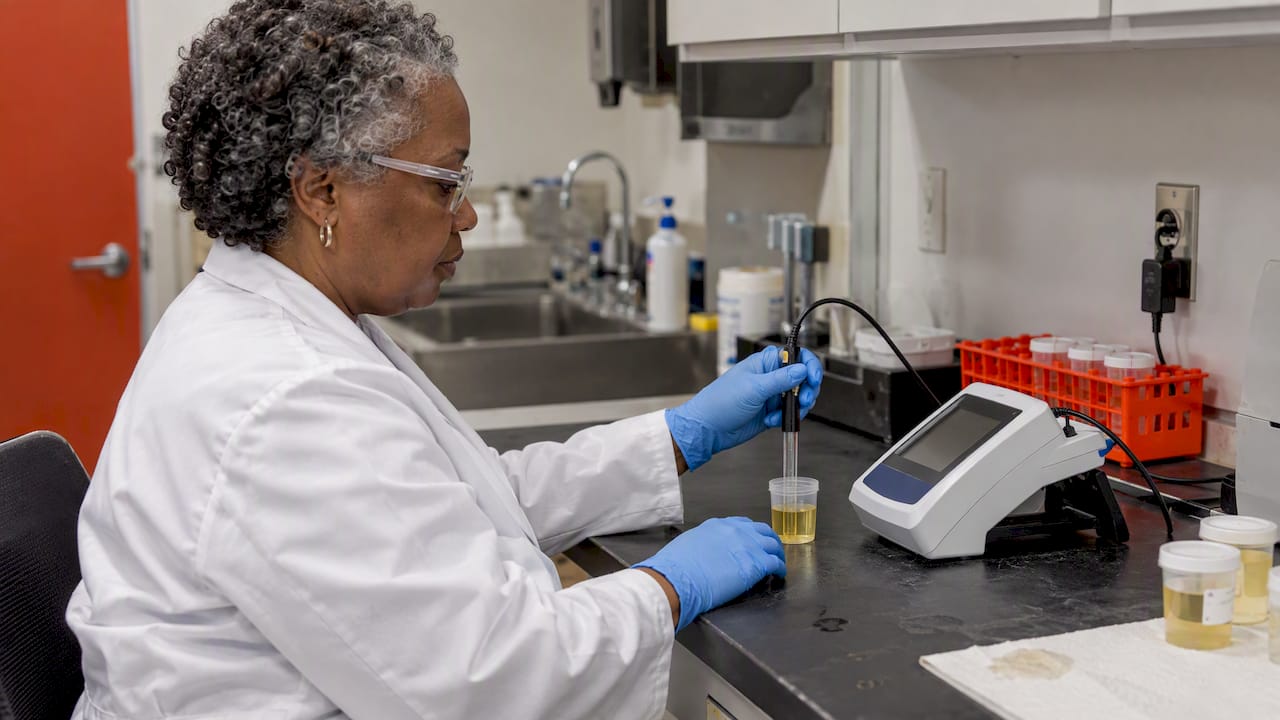
Urine pH Drug Test: Ranges, Cutoffs and What Happens
A urine pH check on a drug test is a validity check, not a drug screen. The lab measures how acidic or alkaline your sample is to confirm it looks like normal human urine. In federal workplace testing, a pH below 4 or at 11 and above is reported as adulterated, and a pH from 4 to under 4.5 or from 9 to under 11 is reported as invalid. Ordinary urine almost never lands in those zones.
This guide explains what the number means, what can push it around, what happens after a flagged result, and how to protect yourself.
TL;DR
- Urine pH tells the lab whether the sample is consistent with normal human urine. It does not detect any drug.
- Federal programs treat roughly 4.5 to 9 as the physiological range. Below 4 or 11 and above is adulterated. The bands just outside normal are invalid.
- Diet, some medications, infections and sample handling can shift pH, so an odd value is not proof of tampering.
- An invalid result usually triggers a Medical Review Officer (MRO) interview and, without a medical explanation, a directly observed recollection.
- Do not try to change your pH on purpose. It is the easiest thing for the lab to catch.
Table of Contents
- What urine pH measures on a drug test
- Federal pH cutoffs: invalid vs. adulterated
- What can push urine pH out of range
- What happens when your pH is flagged
- Why trying to change your pH backfires
- Does bright yellow urine mean you will fail?
- How to get a clean, ordinary sample
- Where our products fit
- Our perspective
- FAQ
- Sources
What urine pH measures on a drug test
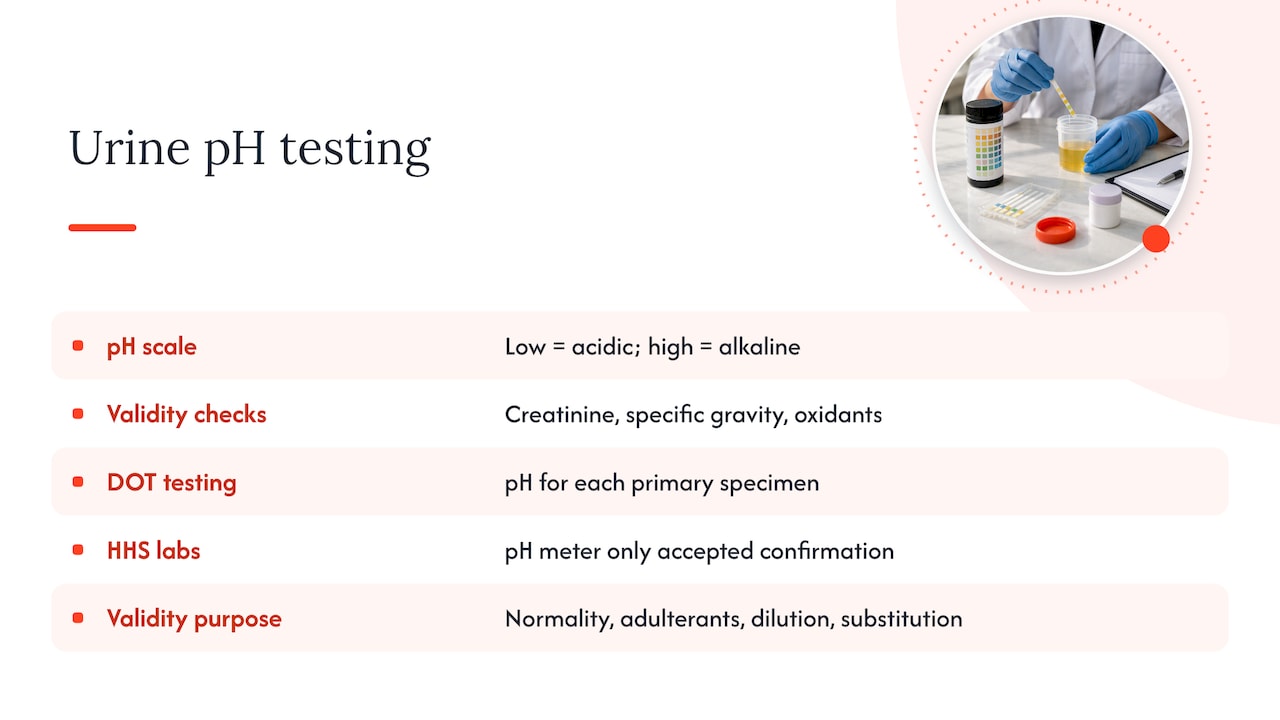
PH is a scale of acidity and alkalinity. A low number is acidic, a high number is alkaline. On a drug test, pH is one of several specimen validity tests, alongside creatinine, specific gravity, and checks for oxidants and other adulterants.
U.S. rules require it. Under 49 CFR §40.87, laboratories must determine the pH of each primary urine specimen in DOT testing. The 2024 HHS MRO Guidance Manual says the same for HHS-certified labs under the federal program, and it adds that the pH meter test is the only confirmatory method accepted for regulated testing.
The point of the check is stated in 49 CFR §40.86: specimen validity testing evaluates whether urine is consistent with normal human urine, and whether adulterants or foreign substances were added or the sample was diluted or substituted.
The normal range
In the clinical world, MedlinePlus gives a typical urine pH range of 4.6 to 8.0, noting that it can vary slightly by laboratory. Drug-testing programs are wider. According to Quest Diagnostics, HHS set program cutoffs from a physiological range of approximately 4.5 to 9.
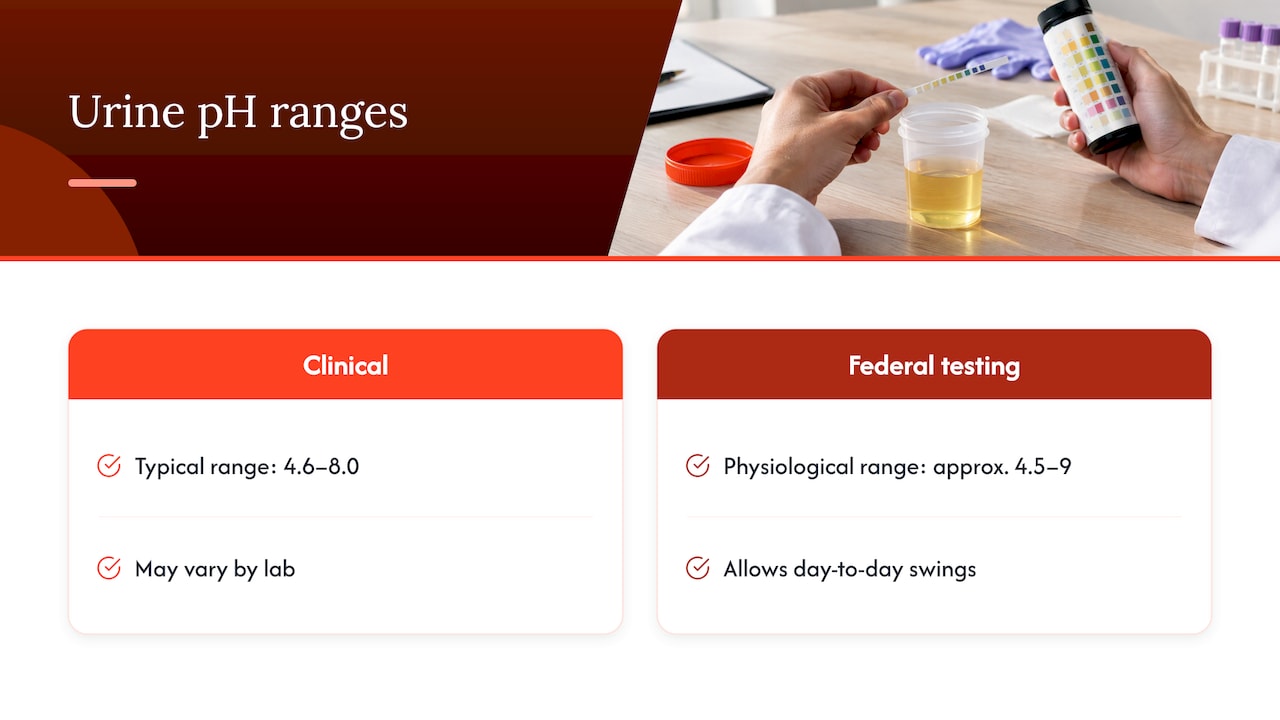
That wider window is deliberate. It leaves room for normal day-to-day swings so that only unusual samples get flagged.
Federal pH cutoffs: invalid vs. adulterated
The 2025 National Laboratory Certification Program newsletter on specimen validity testing lays out the bands used in federal workplace testing:
| Urine pH | Federal result |
|---|---|
| Below 4 | Adulterated |
| 4 to under 4.5 | Invalid |
| 4.5 to under 9 | Normal range |
| 9 to under 11 | Invalid |
| 11 and above | Adulterated |
The difference matters. An adulterated report means the lab found a value so far outside normal that something was likely added. An invalid report means the sample could not be reliably tested or the value is odd but not conclusive.
For a fuller look at how labs screen for other validity markers, our piece on urine validity checks and what the 20 mg/dL cutoff can miss covers creatinine and dilution.
What can push urine pH out of range
The NLCP newsletter explains that abnormal pH can come from adulteration, from disease states, or from microbial growth that depends on the time and temperature between collection and analysis. In other words, intentional tampering is only one of the explanations.
Diet
What you eat matters, though usually within the normal range. MedlinePlus notes that a diet high in fruits and vegetables can raise pH, making urine more alkaline, while heavy meat and cheese intake can lower it. These effects rarely push a result into the invalid band, but they explain why your pH is not the same every day.
Medical conditions
Per MedlinePlus, a high pH can be linked to renal tubular acidosis, kidney failure, gastric suction, a urinary tract infection or vomiting. A low pH can be linked to diarrhea, metabolic acidosis or starvation. If you have any of these, tell the MRO.
Medications that raise urine pH
This is the question behind “what drugs cause high urine pH.” A 2025 review of urinary pH modulators lists substances reported to raise it, including acetazolamide, topiramate, citrate, bicarbonate, NSAIDs, exenatide and sulfonylureas, and notes that several have not been studied extensively.
Two have solid mechanisms behind them:
- Acetazolamide inhibits renal carbonic anhydrase and bicarbonate reabsorption, which increases urinary pH, according to this peer-reviewed review of drug-induced urinary calculi.
- Topiramate increases urinary pH and bicarbonate excretion through carbonic-anhydrase inhibition and renal tubular acidosis, as reported in a review of its effect on acid-base balance.
Not everything goes the same way. The same 2025 review reports that ammonium chloride and furosemide lower urine pH, so they are not causes of a high reading. WebMD also lists potassium citrate and sodium bicarbonate among products that can affect urine pH.
If you take any prescription or over-the-counter product that could change urine chemistry, bring the name and dose to your MRO interview. Do not stop a prescribed medicine on your own. Talk to your prescriber first.
Storage and transport
The sample itself changes after you hand it over. The NLCP newsletter notes that bacterial growth during improper storage and high-temperature transport can shift pH, and that time and temperature between collection and analysis play a role. This is one reason a flagged pH is a prompt for review, not a verdict.
What happens when your pH is flagged
The process in federal and DOT testing is structured, and it gives you real rights.
- The lab reports the result. An out-of-range pH is reported as invalid or adulterated, depending on the value.
- The MRO contacts you. For an invalid result, 49 CFR §40.159 requires the MRO to determine whether you have a medical explanation and to ask about medications you may have taken.
- You explain. A documented condition or a valid prescription can resolve the question.
- If there is no explanation, and you deny adulterating the sample, the MRO must direct an immediate recollection under direct observation, per the same rule.
SAMHSA’s 2024 MRO case studies give an example of an invalid urine result at pH 9.4. When no legitimate explanation exists, the test is cancelled and another specimen is collected under direct observation.
One point from the MRO Guidance Manual is worth remembering: an invalid, adulterated or substituted lab result does not automatically identify a person as having tampered with a specimen. The MRO’s job is to look at the whole picture.
An adulterated report is a different story. In DOT testing it is treated as a refusal to test, which carries serious consequences. We explain the rule in why 49 CFR 40.3 treats an adulterated test as a refusal. If you want to know what to do in the days after a result comes back, read our guide to the 5-day and 72-hour MRO windows.
Why trying to change your pH backfires
Some people read that pH affects how drugs are excreted and conclude they can steer the test. Clinical literature does show that pH influences the excretion of some drugs, and the NLCP newsletter notes that high pH can degrade some analytes. But a lab does not only look for the drug. It also looks at whether the sample is a plausible human specimen.
If you drink or add something strong enough to move pH well outside the normal window, you do not hide anything. You create an invalid or adulterated result, which brings a directly observed recollection or worse. The NLCP newsletter also describes how specimen validity testing and collection protocols are used to catch subversion, including measuring specimen temperature. Our guide to urine drug test temperature rules covers that part.
The practical takeaway: the safest sample is a normal one. Your pH should be whatever your body produces on an ordinary day.
Does bright yellow urine mean you will fail?
No. Color is not a pass or fail factor and is not a drug result. Bright or neon yellow urine is commonly caused by B-vitamin supplements, because riboflavin (vitamin B2) is naturally fluorescent and excess is flushed in urine.
What the lab does examine are creatinine and specific gravity, which show how dilute a sample is. A very pale sample can be flagged as dilute for that reason. Color and pH are separate checks, so a vivid yellow sample with a normal pH is simply a normal sample from someone taking vitamins.
How to get a clean, ordinary sample
These steps keep your result predictable without altering anything:
- List your medications and supplements before you test, including over-the-counter products like antacids or bicarbonate-based products.
- Eat and drink normally the day of the test. Extreme changes in diet or fluid are what produce odd readings.
- Follow collection instructions exactly. Keep the cup in view, do not delay, and let the collector record temperature.
- Keep your paperwork. Prescriptions and doctor’s notes make the MRO interview quick.
- Answer the MRO’s call. Missing it can turn a medical question into a bigger problem.
If you also worry about a false reading on the drug panel itself, our page on false positive drug testing walks through common causes.
Where our products fit
If you are preparing for a screening and want to understand your options, we carry at-home urine drug test kits so you can check where you stand before the real test, along with detox products and guides for different test types. Browse the urine drug testing category or read how to prepare for a urine drug test. We ship fast within the United States, and our team is available by phone during published business hours to help you pick what suits your situation.
For the full range, start at our main shop.
Our perspective
Most people who land on a page like this are not trying to be clever. They are nervous. A test is coming, they have read that pH can matter, and they want to know whether something in their body or their routine could cause trouble.
Here is how we see it. The pH check is built to catch samples that do not look like human urine. A normal sample from a normal day passes it without effort. That is why we build our guides around understanding the process first: which test you face, what the lab looks at, what your rights are with the MRO, and what each type of product is designed to do.
We put the educational content next to the products on purpose. Our catalog covers urine, saliva and hair testing, detox products and at-home kits, and the right choice depends on the type of screening you face. A hair test calls for something completely different than a urine test. Our guides help you work that out, and our phone support helps you finish the job.
If you are unsure, start with an at-home kit to see where you stand, read the guide for your test type, and call us with questions.
MIchael
FAQ
What does it mean if the pH on my drug test is too high?
A federal lab reports a pH from 9 to under 11 as invalid and 11 or above as adulterated. Causes range from medications and medical conditions to sample storage and tampering. The MRO will ask about your medical history and prescriptions before drawing any conclusion.
What can throw off urine pH?
Diet, kidney or urinary conditions, vomiting or diarrhea, certain medications such as acetazolamide and topiramate, and bacterial growth in a poorly stored sample can all shift it. Intentional additives are the other cause, and labs are built to detect them.
What is the normal urine pH for a drug test?
Federal programs treat roughly 4.5 to 9 as the physiological range. Clinical references such as MedlinePlus cite 4.6 to 8.0. Most healthy people fall comfortably inside both.
Does an invalid result mean I failed?
No. An invalid result means the lab could not report a reliable result. The MRO looks for a medical explanation and, if none exists, usually cancels the test and orders a new directly observed collection.
Sources
- Specimen Validity Testing, Quest Diagnostics
- Urine pH test, MedlinePlus Medical Encyclopedia
- An Introduction to Specimen Validity Testing in Workplace Drug Testing, NLCP 2025
- Medical Review Officer Guidance Manual for Federal Workplace Drug Testing, 2024
- 2024 Medical Review Officer Case Studies, Urine
- 49 CFR §40.159, U.S. Department of Transportation
- 49 CFR §40.87, U.S. Department of Transportation
- 49 CFR §40.86, U.S. Department of Transportation
- Modulators of urinary pH in the context of urinary stone disease, 2025
- Drug-Induced Urinary Calculi, PMC
- Effect of topiramate on acid-base balance, 2009
- How a Urine pH Test Helps in the Diagnosis of Disease, WebMD
- Bright Yellow Urine After B-Vitamins