
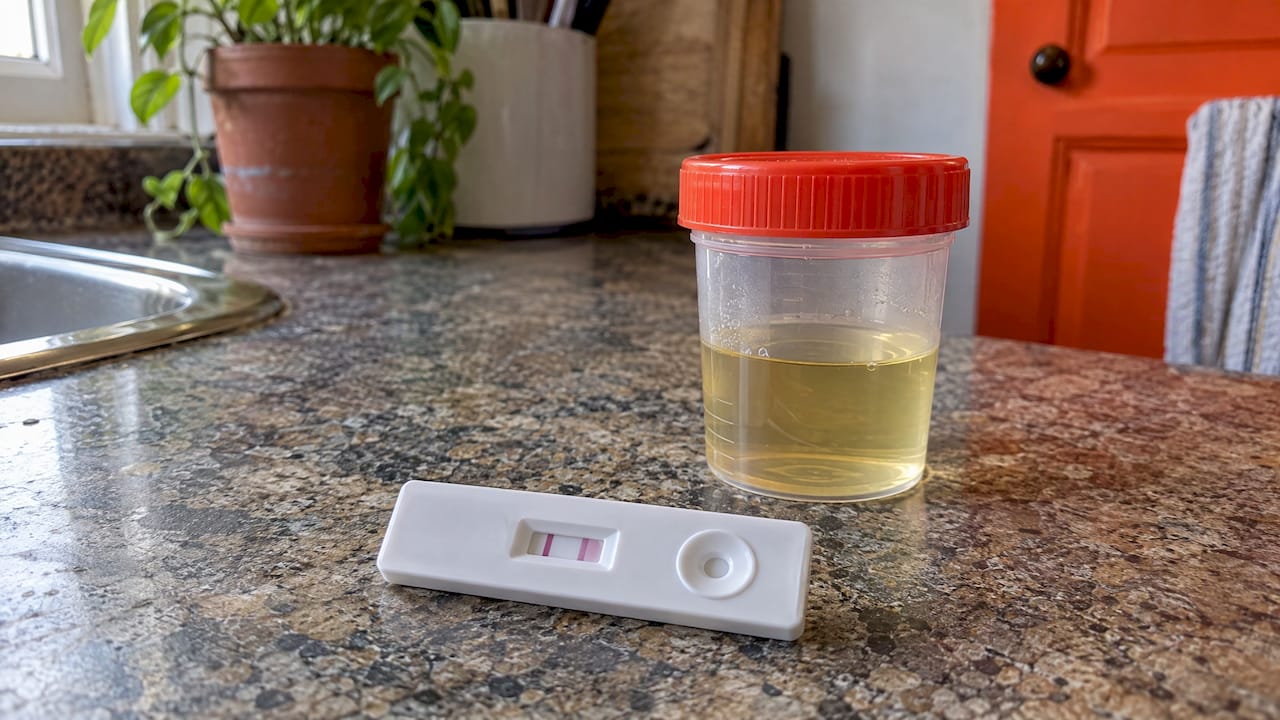
Home Drug Test vs. Lab Test: What Really Differs
A home drug test is a quick screen you read yourself in minutes. A lab test sends a specimen to a laboratory for analysis, and it is the one that settles disputes. Both can be useful. They answer different questions, and mixing them up is how people get surprised. A home result that looks clear does not guarantee a lab result will match, especially for THC.
This guide explains how the two work, why they can disagree, how THC fits in, and how to pick the right tool for your situation.
TL;DR
- Home tests are screens. The FDA says a positive result should go to a laboratory for a more specific chemical test, which is the most reliable way to confirm drug presence.
- Labs are generally more sensitive, so passing a home test and failing a lab test is possible with the same sample.
- For THC, urine tests look for a metabolite, not the active drug. Cutoff level, how often you use and your own body all change the result.
- Use a home test to check where you stand. Use the lab result as the one that counts when an employer, court or program is involved.
- Match the test type (urine, saliva or hair) to what your screening is likely to use.
Table of Contents
- The core difference in one minute
- Why a home test and a lab test can disagree
- What each test looks for
- THC detection windows: why timing matters more than the test brand
- Which one fits your situation
- Urine, saliva and hair: pick the right specimen
- Questions to ask before you test at home
- How long do results take?
- Our perspective
- Find the right kit or product for your screening
- Putting it together
- FAQ
- Sources
The core difference in one minute
An at-home drug test is a qualitative device. It tells you whether a substance appears to be above a preset level, not how much is present. The FDA’s guidance on home-use drug tests describes the results as preliminary and says a positive should be sent to a lab for a more specific test.
A lab works in two steps. NIDA explains that the first step is usually an immunoassay, which is fast. Anything flagged then goes to confirmatory testing with gas chromatography/mass spectrometry (GC/MS) or liquid chromatography/mass spectrometry (LC/MS), which is more specific and sensitive.
So the real comparison is not “cheap and fast vs. expensive and slow.” It is a screening step vs. a screening step plus confirmation.
| Home test | Lab test | |
|---|---|---|
| Who reads it | You | A laboratory |
| Result type | Preliminary, qualitative | Screen, then confirmation when needed |
| Speed | Minutes | Depends on the lab and the program |
| Sensitivity | Variable, generally lower | Generally higher |
| Confirmation | Needs a lab if positive | Built into the process |
| Best for | Checking where you stand | Official, legal or workplace outcomes |
Why a home test and a lab test can disagree
The Cleveland Clinic states that home test accuracy varies and is generally less sensitive than formal laboratory testing. A home test could come back negative while a lab test on the same sample is positive. That is the direct answer to the question many readers type: yes, you can pass at home and fail at a lab.
Three things drive most of the gap.
Cutoff levels
Every test has a threshold. Below it, the result reads negative, even if a trace is present. NIDA notes that false negatives on an initial screen can happen when the cutoff is set too high. A home cup with one cutoff and a lab panel with another can produce different answers from identical urine. Our guide to THC cutoff levels walks through what the 50 and 15 ng/mL numbers mean.
Method
A home device relies on a visual strip reaction. A lab uses instruments. The instrument step is why labs can separate one compound from a look-alike, and why confirmation exists at all.
Sample handling
NIDA also points out that contaminants added to a sample can interfere with a screen. Labs check specimens for validity as part of their process. A home kit has no such step, so a poorly collected sample is simply read as is.
What each test looks for
Standard workplace panels commonly cover amphetamines, cannabis, cocaine, opioids and PCP, according to NIDA. Federally regulated transportation testing is stricter in format. The FMCSA requires laboratory testing for five classes: marijuana, cocaine, opiates, amphetamines/methamphetamines and PCP, under 49 CFR Part 40. Home kits are not a substitute in those programs.
For cannabis, the target is not the compound that makes you feel high. A cannabis test looks for cannabinoid metabolites, including THC metabolites. The American College of Medical Toxicology adds that these tests are not designed to identify synthetic cannabinoids or CBD, and cannot by themselves establish impairment. If you want the chemistry, see why urine tests target THC-COOH.
The same ACMT statement notes that a positive urine result for cannabis exposure is defined by HHS as THC-COOH above 15 ng/mL measured by chromatography/spectroscopy. That is the confirmation-level figure, which is separate from the screening cutoff.
THC detection windows: why timing matters more than the test brand
Whichever route you take, how long THC stays detectable depends on you. The numbers vary by source and by person:
- The CDC reported that after smoking a single marijuana cigarette, metabolites are detectable for several days, that casual users may test positive for up to two weeks, and that chronic users may be positive longer.
- Labcorp lists a typical urine detection time of 2 to 7 days for single use, with chronic use potentially extending it.
- The Merck Manual notes that the urine window for marijuana can run over a month, longer than for most drugs, because cannabinoid metabolites persist.
The ACMT adds that results depend heavily on individual factors, including body fat, hydration and how long exposure lasted. That is why one friend’s “I was clean in five days” is not a plan for you. For more detail, see our marijuana urinalysis detection times page. Related reading includes what one study found about smoking once, whether a weekend’s use can trigger a 50 ng/mL result, and how exercise affects blood vs. urine tests.
Which one fits your situation
You want to know where you stand before a screening
A home test is the practical choice. It is private, immediate and gives you a rough read. Treat a negative as encouraging, not final. Because home devices are generally less sensitive, a negative leaves room for a different result at a lab, as the Cleveland Clinic explains. If you are close to your test date, that is useful to know early.
An employer or program will run the official test
Then the lab result is the one that counts. Many employers use an instant screen first and send non-negative results on for confirmation. Our home drug test accuracy breakdown looks at the numbers behind these devices.
You are in a federally regulated job
Transportation workers fall under 49 CFR Part 40 laboratory testing. A home kit can inform you, but the regulated test is what decides the outcome.
You have a positive on a home test
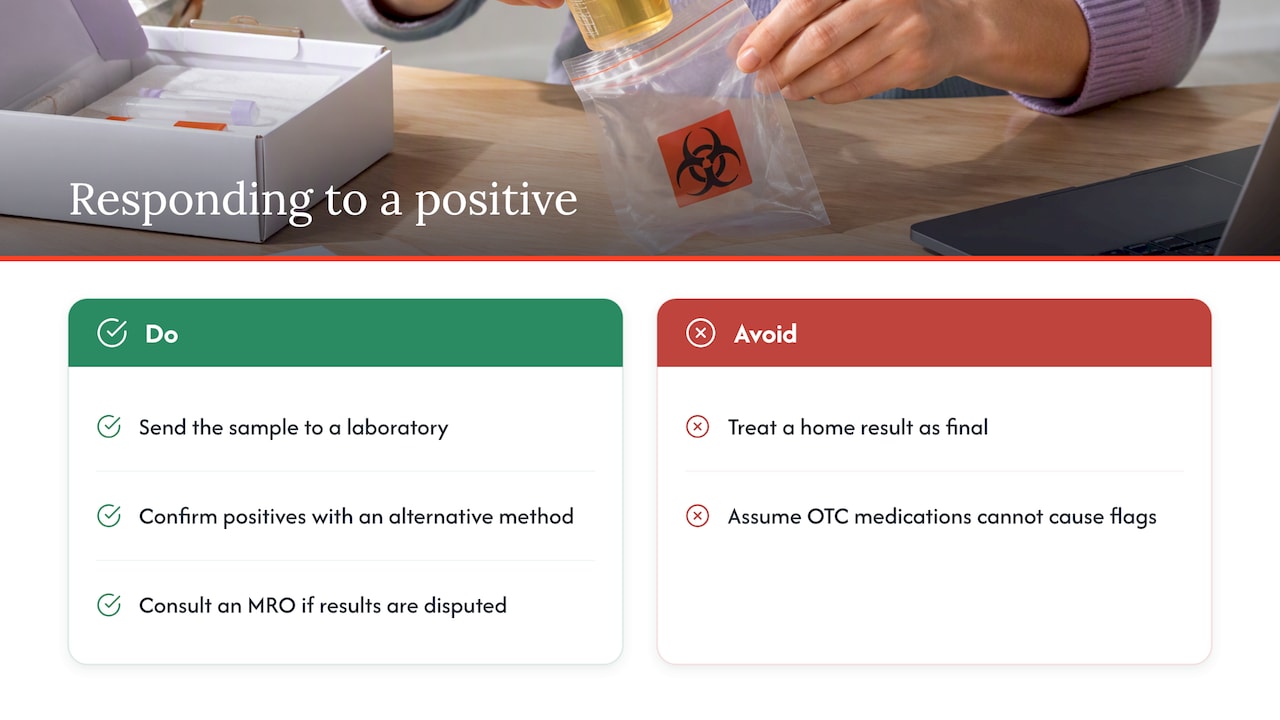
Do not treat it as final in either direction. The FDA advises sending the sample to a laboratory for a more specific test. It also warns that some over-the-counter medications can produce the same results as illegally abused amphetamines, which is another reason confirmation matters. The CDC likewise states that a positive screening result should be confirmed by an alternative method that is as sensitive as the screening test. If a lab result is disputed, NIDA notes that Medical Review Officers review lab results and speak with the person tested to resolve discrepancies. If you think a medication or food caused a flag, see our page on false positive urine tests.
Urine, saliva and hair: pick the right specimen
The home versus lab question is only half the picture. The specimen matters just as much, because each type covers a different look-back period and is used in different settings.
- Urine is the most common specimen. NIDA notes that urine is the most frequently used type for drug testing. It is the one most THC users are asking about.
- Saliva is common for recent use and for on-the-spot collection. Our guide on how to pass a saliva drug test covers preparation.
- Hair covers a much longer look-back and is a different kind of test entirely. See our hair follicle drug test page for how it works.
If you are not sure which one your employer or program will use, ask them directly before you prepare. Preparing for the wrong specimen is a common and avoidable mistake.
Questions to ask before you test at home
A few habits make a home test more informative, whichever kit you use.
- Check the cutoff. The package should state the cutoff for each drug. Compare it with the level your screening is likely to use.
- Read the expiry date and the instructions. Timing of the read matters. Reading too early or too late can change what you see.
- Collect properly. Use a clean sample and follow the collection steps exactly.
- Know your history. Frequency of use and body composition shift the timeline, per the ACMT.
- Plan for confirmation. If the result is anything but clearly negative, assume a lab step may follow.
For health questions, MedlinePlus recommends talking with a healthcare provider before using home drug testing, to decide whether it suits your situation. Parents should know that the American Academy of Pediatrics, as relayed by the Cleveland Clinic, cautions against home testing of children because it has not been shown to reduce drug use and results can be misread.
How long do results take?
The two routes differ most in speed. A home or instant screen gives a reading within minutes. A laboratory result takes longer because the specimen has to be shipped, analyzed and, if needed, confirmed. Exact turnaround depends on the lab, the specimen type and the program involved, so ask the testing party for their timeline instead of assuming one. If a positive screen goes to confirmation and a review officer, add time for that step too.
Our perspective
We built Pass My Drug Test around one idea: people make better decisions when they understand what a test can and cannot tell them.
A home test and a lab test are not rivals. A home screen is the fast first look. The lab is the final word. Most of the stress we hear about comes from people expecting one to behave like the other.
That is why we pair product selection with plain-language guides. Our selection covers urine, saliva and hair testing, plus hair detox shampoo, so you can match what you buy to the specimen you expect. We offer fast shipping on United States orders and phone support during our published business hours, so you can talk through your scenario with a person.
Our approach is simple: learn the test type, know your timeline, and choose products designed for your specific situation.
MIchael
Find the right kit or product for your screening
If you know which specimen you are facing, you can shop for it directly. We carry urine drug testing, saliva drug testing and hair drug testing options, along with hair detox shampoo designed for people preparing for a hair screening. Orders ship fast within the United States, and you can call us during published business hours if you want help choosing.
Browse everything in one place on the Pass My Drug Test home page.
Putting it together
Think of the choice as a sequence, not a contest. Start with the specimen your screening will use. Use a home test to get a quick, private read. Remember that a lab applies more sensitive methods and, when a screen is non-negative, a confirmation step. For THC especially, your own use pattern and body decide the timeline more than any device does. With that in mind, you can prepare for the test you will actually take.
FAQ
Can you pass a home drug test but fail a lab test?
Yes. The Cleveland Clinic explains that labs are more sensitive and use more precise methods, so they may detect substances a home screen misses. A home negative is a good sign, not a guarantee.
Are home drug tests accurate?
Accuracy varies by device. Home tests are qualitative screens, and the FDA describes the results as preliminary. A positive should be confirmed by a laboratory. Check the cutoff on the package and follow the instructions closely.
What does a THC urine test actually detect?
It detects cannabinoid metabolites, including THC metabolites, not impairment. The ACMT notes these tests are not designed to identify CBD or synthetic cannabinoids. For the confirmation level, HHS uses THC-COOH above 15 ng/mL.
What happens after a positive home test?
The FDA advises sending the sample to a laboratory for a more specific chemical test. In workplace programs, a Medical Review Officer may then review the lab result and speak with the person tested, as NIDA describes.
Sources
- Drugs of Abuse Home Use Test, FDA
- Drug Testing, National Institute on Drug Abuse
- What Substances Are Tested?, FMCSA
- ACMT Position Statement: Interpretation of Urine for Cannabinoids
- Drug Test: What It Is, Purpose, Procedure & Types, Cleveland Clinic
- Urine Testing for Detection of Marijuana: An Advisory, CDC
- Standard Drug Test, Labcorp OnDemand
- Drug Testing, Merck Manual Professional
- Drug Testing, MedlinePlus