
Urine Drug Test Temperature: What the Rules Actually Require
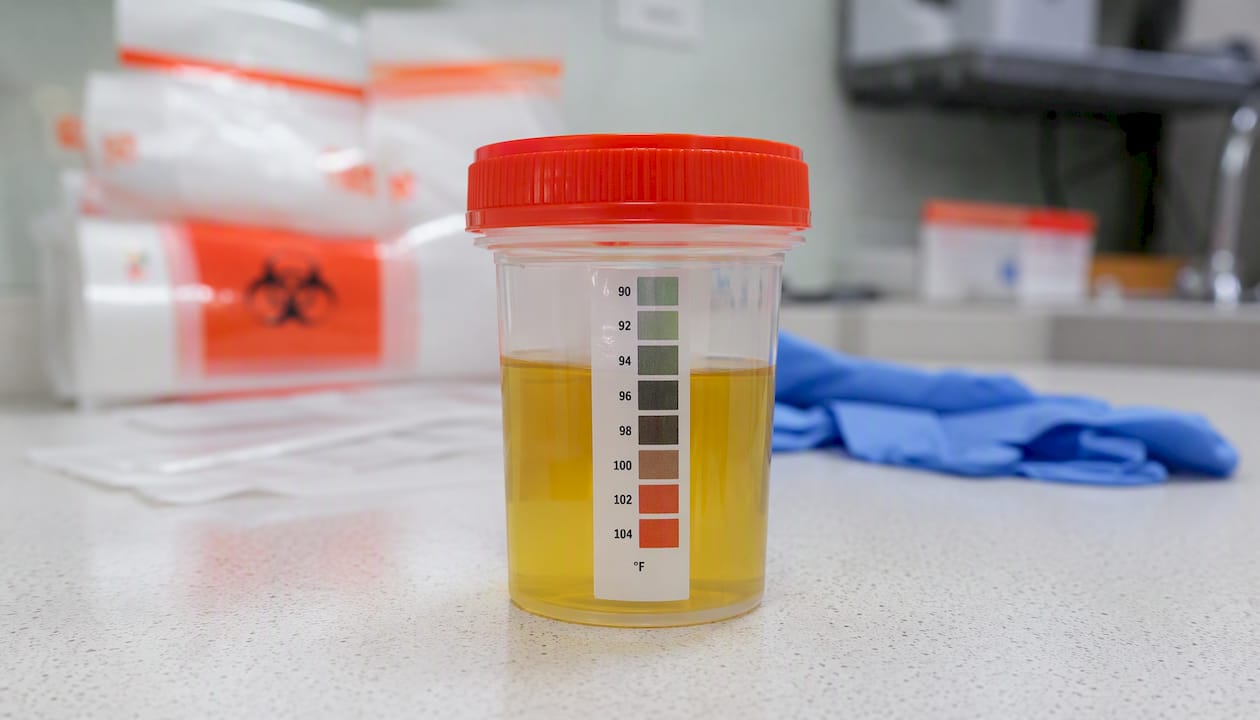
A valid urine specimen must read within the accepted temperature range when measured within four minutes of the donor handing it to the collector. That single requirement, codified in 49 CFR § 40.65, is the first thing a collector checks before any chemical screening begins.
- In range (90°F–100°F): The specimen proceeds to the next step.
- Out of range: The collector documents the reading, notifies the donor, and requires an immediate observed recollection.
The regulatory standard requires a urine specimen temperature to be within the accepted range when measured within four minutes after collection.
Most donors who void naturally and present their sample promptly will have a specimen temperature within the accepted range. The problems start when there’s a delay, a handling error, or an attempt to substitute the sample.
Key Takeaways
A urine specimen must read 90°F–100°F (32°C–38°C) within four minutes of collection — that single regulatory requirement determines whether your sample proceeds to chemical screening or triggers an observed recollection.
| Point | Details |
|---|---|
| Accepted temperature range | 90°F–100°F (32°C–38°C), measured within four minutes of handing the specimen to the collector. |
| Present your sample immediately | Every minute of delay drops the temperature; hand the cup to the collector as soon as you exit the restroom. |
| Out-of-range consequence | Collector documents the reading and requires an immediate observed recollection under direct supervision. |
| Other validity markers | Lab also checks creatinine (—), specific gravity (—), and pH (—). |
| Passmydrugtest resources | At-home test kits and educational guides help you practice the collection process before your official screening. |
Table of Contents
- What does urine drug test temperature actually measure?
- How collectors measure temperature at the collection site
- Why temperature is the first validity check
- Factors that can push a reading outside the normal range
- What happens when a specimen is outside 90°F–100°F
- Other specimen validity tests and their normal ranges
- The regulatory framework: what 49 CFR § 40.65 requires
- Lawful steps to make sure your specimen is accepted
- An honest look at what the temperature check really means
- Passmydrugtest can help you prepare the right way
- Sources
What does urine drug test temperature actually measure?
The accepted temperature window for urine specimens is defined with a specific range to account for normal physiological variation and cooling after voiding. Core body temperature sits around 98.6°F (37°C), but urine doesn’t leave the body at exactly that number. Bladder temperature runs slightly cooler than core temperature, and the specimen begins losing heat the moment it leaves the body. That’s why the acceptable range dips as low as 90°F: a freshly voided sample that has been sitting in a cup for a minute or two will have already shed a few degrees.
The Celsius equivalent, 32°C–38°C, is worth knowing because many lab forms and regulatory documents use it. Both scales describe the same window.
Why four minutes specifically? Fresh urine cools quickly after voiding — typically a few degrees in the first several minutes, depending on ambient temperature and cup material. The four-minute clock is a practical compromise: it captures the sample close enough to bladder temperature to be meaningful, while still giving collectors a workable window at a busy collection site. Wait much longer and even a legitimate sample could read low.
- The range accounts for normal physiological variation between donors.
- It also accounts for the brief, unavoidable cooling that happens between voiding and strip contact.
- Readings below 90°F almost always mean the sample has been outside the body for longer than a few minutes, or was never body-temperature to begin with.
How collectors measure temperature at the collection site
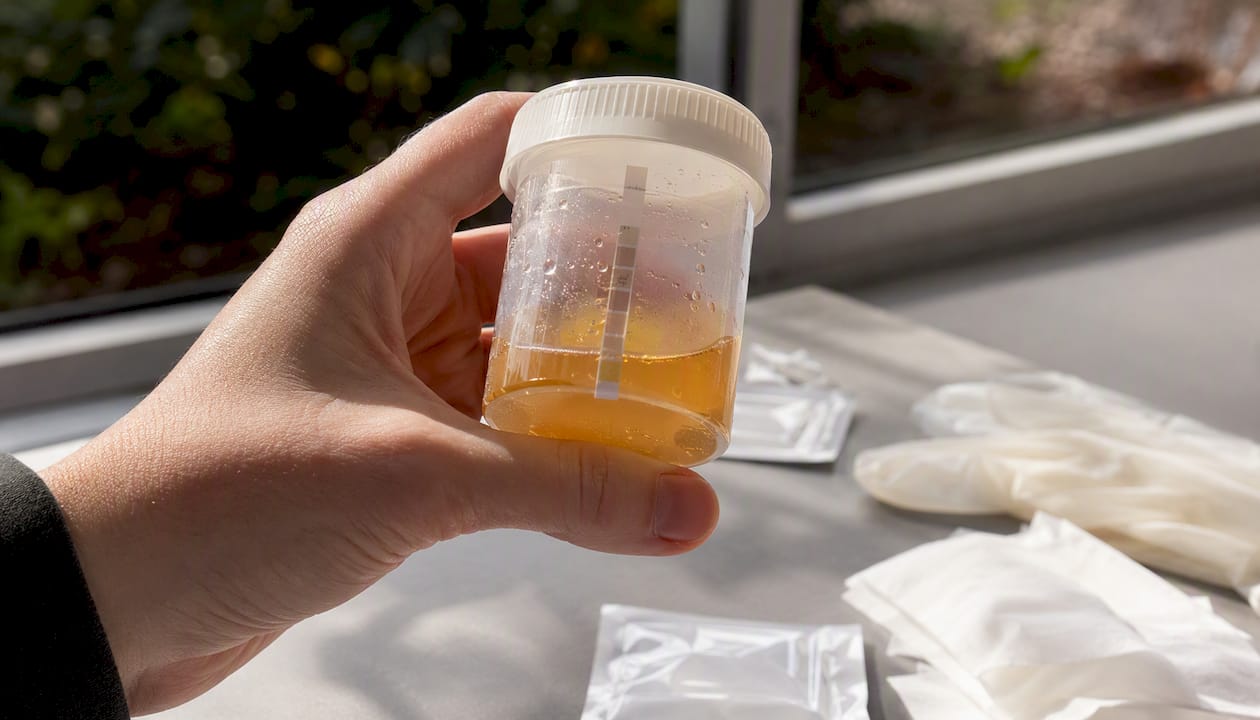
Temperature strips on collection cups are the standard tool. These are liquid crystal indicator strips bonded directly to the outside of the specimen cup, usually along a narrow vertical band. The strip changes color at the point that corresponds to the sample’s temperature, giving the collector a readable number within seconds of contact.
The procedure is straightforward:
- The collector checks the strip no later than four minutes after the donor hands over the specimen.
- The reading is recorded as “Yes” (in range) or “No” (out of range) on the Federal Custody and Control Form (CCF), along with the actual temperature if it’s readable.
- If the strip shows no color change at all, the collector notes that as well — it typically means the sample is either too cold or too hot for the strip’s detection range.
Strip accuracy is good but not laboratory-grade. Liquid crystal strips can carry a variation of roughly ±1–2°F, which is why the regulatory range is set wide enough to absorb minor measurement error without penalizing legitimate donors. The strip’s job is to screen, not to measure with clinical precision.
Temperature strips and prompt reading are standard practice across both DOT-regulated and non-regulated collection sites. The cup design has been refined over decades specifically to make this check fast and reliable.
Why temperature is the first validity check
Temperature doesn’t detect drugs. What it detects is whether the specimen is plausibly fresh human urine at body temperature. That’s a different question, and it comes first for a reason.
A substituted specimen — one that was collected elsewhere, stored, or purchased — will almost always be the wrong temperature. Either it’s too cold because it was carried in a pocket or bag, or it’s too hot because someone tried to warm it artificially and overshot. Both scenarios produce an out-of-range reading before a single chemical test is run.
- Temperatures below the accepted range may suggest the sample cooled before collection, meaning it wasn’t voided moments ago.
- Temperatures above the accepted range may suggest external heat was applied, indicating possible substitution.
- A specimen within the accepted range is plausible as fresh but doesn’t guarantee it is drug-free.
According to clinical guidance published in PMC, temperature is an immediate, low-cost indicator used on-site. It’s not definitive proof of tampering on its own, but it’s a strong enough screen to trigger the next step: observed recollection and documentation.
Temperature is also the only validity check the collector performs in real time. Every other marker — creatinine, specific gravity, pH — is handled by the laboratory after the specimen ships. That’s what makes the four-minute window so operationally important.
Factors that can push a reading outside the normal range
Not every out-of-range reading means tampering. Several legitimate factors can move a specimen’s temperature before or during collection.
Environmental factors:
- Cold ambient temperature in the restroom or collection area
- High airflow (open windows, strong HVAC) accelerating surface cooling
- Cup material — thinner plastic loses heat faster than thicker cups
- Any delay between voiding and presenting the sample to the collector
Physiological factors:
- Fever can raise urine temperature above 100°F
- Hypothyroidism or other conditions that lower core body temperature can produce readings at the low end of the range
- Intense exercise immediately before testing raises core temperature temporarily
- Extreme overhydration dilutes urine and can slightly lower its temperature
Handling factors:
- Pouring the specimen between containers before presenting it
- Leaving the cup on a cold surface
- Any attempt to use external heat sources (hand warmers, microwave) — these rarely produce a stable, in-range reading and often overshoot
Medical conditions such as hypothyroidism or fever are recognized as legitimate causes of an out-of-range reading. If you have such a condition, document it and bring that documentation to the Medical Review Officer (MRO).
What happens when a specimen is outside 90°F–100°F
The sequence is documented and consistent. DOT guidance under Part 40.65 specifies exactly what the collector must do, and non-regulated sites typically follow the same protocol.
- The collector records the actual temperature reading on the CCF and marks the temperature as out of range.
- The donor is notified immediately.
- A second specimen is collected under direct observation — meaning a same-gender collector or observer is present in the restroom during voiding.
- Both the original specimen and the observed specimen are sent to the laboratory.
- The collector notifies the Designated Employer Representative (DER) and the collection site supervisor of the reason for direct observation.
Refusing to provide an observed specimen is treated as a refusal to test in DOT-regulated collections, which carries the same consequences as a positive result. That’s not a technicality — it’s written into the regulation.
If the donor has a medical condition that makes immediate recollection impossible (a documented shy-bladder situation), the collector follows a specific waiting protocol before escalating to the MRO. Oral fluid collection may be used in some non-regulated settings as an alternative when urine collection fails.
For a broader look at what happens when a urine specimen is flagged or rejected, pass drug testing urine covers the outcomes in plain terms.
Other specimen validity tests and their normal ranges
Temperature is one check among several. Once the specimen reaches the laboratory, it goes through a full panel of validity tests. Passing the temperature check at the collection site doesn’t mean the lab won’t flag the sample on other grounds.
These ranges come from clinical guidance published in PMC, which covers the full spectrum of specimen-validity testing used in workplace drug monitoring programs.
A creatinine below 2 mg/dL with a specific gravity below 1.001 is reported as substituted, not dilute. A pH outside 3.0–11.0 is reported as adulterated. The lab considers all markers together, not in isolation.
The temperature check at the collection site is the first screen. The laboratory’s validity panel is the second, and it’s more granular.
The regulatory framework: what 49 CFR § 40.65 requires
The core rule is direct. Under 49 CFR § 40.65, collectors in DOT-regulated testing must:
- Check the specimen temperature no later than four minutes after the donor hands it over.
- Accept the specimen only if it reads within 32°C–38°C (90°F–100°F).
- Record “Yes” or “No” on the CCF, along with the actual reading when it’s readable.
- If out of range, immediately require a new collection under direct observation and notify the DER.
The four-minute window is not a suggestion. It is a regulatory requirement with documented consequences for non-compliance on both sides of the collection.
Non-DOT workplace testing programs often mirror these rules, though they aren’t legally bound to them. Federal agencies, safety-sensitive transportation roles, and many large employers follow the DOT framework by policy even when not required.
For formal questions about regulated testing procedures or to review the official rule text, the DOT’s ODAPC Part 40.65 guidance page is the primary reference.
Lawful steps to make sure your specimen is accepted
The simplest preparation is also the most effective: void naturally, present the sample immediately, and don’t interfere with it.
What to do:
- Arrive reasonably hydrated. Moderate hydration produces a normal-looking specimen; extreme overhydration dilutes creatinine and specific gravity into flagged territory.
- Avoid intense exercise in the hour before testing — it temporarily raises core temperature.
- Hand the specimen to the collector as soon as you exit the restroom. Don’t set it down, don’t carry it around, and don’t delay.
- If you have a medical condition that could affect temperature or other validity markers, bring documentation and ask to speak with the MRO.
What not to do:
- Don’t attempt to heat a specimen externally. Hand warmers and microwaves produce unstable temperatures that almost always read out of range.
- Don’t add anything to the specimen. Chemical adulterants are detected by the lab’s oxidant and pH screens.
- Don’t attempt to substitute a sample. Temperature is specifically designed to catch this, and a failed temperature check leads directly to an observed recollection.
For practical guidance on clean urine drug test preparation and what a valid specimen looks like, Passmydrugtest has educational resources that walk through each step without the regulatory jargon.
If you want to practice the collection process before your actual test, an at-home marijuana drug testing kit lets you run through the timing and procedure in a low-stakes setting.
An honest look at what the temperature check really means
The temperature check gets treated as a gotcha by a lot of people preparing for drug tests. It isn’t. It’s a 30-second authenticity screen that the vast majority of donors pass without thinking about it, because they voided naturally and handed the cup over promptly.
What the check actually reveals is this: the collection site cares whether the specimen is yours. That’s a reasonable thing to verify. The four-minute window exists because urine cools fast, and a legitimate sample presented immediately will almost always be in range. The donors who fail the temperature check are, in most cases, the ones who tried to game it.
The more useful thing to understand is that temperature is just the first layer. Creatinine, specific gravity, and pH are waiting at the lab, and they’re harder to fool than a temperature strip. Donors who focus all their energy on temperature and ignore the other validity markers often find out the hard way that the lab’s panel is more thorough than the collection site’s strip.
Transparent preparation — knowing what the test checks, arriving in normal physiological condition, and presenting your sample without delay — is the approach that holds up across every layer of validity testing.
Passmydrugtest can help you prepare the right way
Knowing the rules is half the battle. The other half is having the right tools to practice and prepare before the actual test day.
Passmydrugtest carries at-home urine drug test kits that let you run a real collection at home — same cup, same strip, same timing — so you know exactly what to expect when it counts. The site also has detailed educational guides on urine testing procedures, specimen validity markers, and what labs actually screen for. No guesswork, no surprises. Browse the product and guide pages at Passmydrugtest to find what fits your situation, and place your order with fast U.S. shipping available.
Sources
The sources below are the primary references for the rules and clinical guidance covered in this article.
For DOT-regulated testing (federal transportation employees, CDL holders, safety-sensitive roles):
- 49 CFR § 40.65 – What does the collector check for when the employee presents a urine specimen?
- A Practical Guide to Urine Drug Monitoring – PMC
- Transportation
- Urine Drug Test Temperature Explained — Normal Range, Rules, and Validity Checks – Griffin Faculty Physicians
For general workplace and clinical testing:
If you have a medical condition that could affect your specimen’s temperature or other validity markers, bring written documentation from your physician to the collection site and request that it be reviewed by the Medical Review Officer. The MRO is the appropriate channel for any medical dispute about a specimen result.
This article provides general educational information about urine drug testing procedures. It is not a substitute for legal, medical, or regulatory advice. Confirm current rules with the relevant regulatory authority or a qualified professional.