
Adderall Drug Test: Detection Windows and What to Do
Yes. Adderall will trigger an amphetamine-positive result on a standard drug screen, because it’s built from mixed amphetamine salts (amphetamine and dextroamphetamine), and every major test panel screens for that exact drug class. That’s the entire mystery solved in one sentence. The real question most people actually need answered is how long it stays detectable and what happens next if you’re the one holding a legitimate prescription.
Detection windows vary by test type, but the general ranges look like this: urine tests typically pick up amphetamines for a few days after the last dose, blood tests for about a day or two, saliva for a similar short duration, and hair testing can reach back several months. Chronic daily use or higher doses can stretch the urine window even longer, sometimes past the 4-day mark. These figures line up with clinical detection-time data from Healthline and half-life ranges published by ARUP Laboratories.
- Urine: the most common workplace test, detects amphetamines for several days.
- Blood: shorter window, mainly for very recent use.
- Saliva: similar duration as blood, often for on-site or roadside testing.
- Hair: longest window, suited to detecting usage patterns over months rather than recent doses.
| Test type | Typical detection window | Best for |
|---|---|---|
| Urine | 48–96 hours | Recent use, workplace/pre-employment screening |
| Blood | 1–2 days | Very recent use, clinical or legal cases |
| Saliva | 1–2 days | Recent use, roadside or on-site testing |
| Hair | Up to ~90 days | Historical use pattern, not recent single doses |
Organizations like SAMHSA set the federal framework for how workplace amphetamine screens get reviewed, and clinical labs such as the University of Rochester Medical Center publish the reference ranges labs actually use. Both matter, because the story doesn’t end at “does it show up.” It continues into why it shows up, and what a positive result actually proves.
Key Takeaways
Adderall reliably triggers amphetamine-positive drug screens because it contains amphetamine and dextroamphetamine, and confirmatory testing paired with prescription documentation is what resolves that result for legitimate users.
| Point | Details |
|---|---|
| Yes, it shows up | Adderall contains amphetamine salts that trigger standard amphetamine immunoassay screens. |
| Detection varies by test type | Urine (48–96 hours), blood (1–2 days), saliva (1–2 days), and hair (up to 90 days). |
| Screening isn’t the final word | Confirmatory GC-MS or LC-MS/MS testing and MRO review determine whether a result is medically explained. |
| Bring documentation immediately | A prescription bottle and pharmacy printout speed up MRO reconciliation after a positive screen. |
| Passmydrugtest supports preparation | Offers detection-window guidance and lawful preparation products across urine, hair, and other test types. |
Table of Contents
- Why Does Adderall Show Up on a Drug Test?
- How Long Does Adderall Stay in Your System by Test Type?
- What Factors Change How Long Adderall Is Detectable?
- How Does Confirmatory Testing Work After a Positive Screen?
- What Should You Do If You Test Positive With a Prescription?
- Do Other ADHD Medications Show Up on Amphetamine Screens?
- How Should You Prepare for a Scheduled Drug Test?
- A Practical Take on Prescriptions and Drug Testing
- Where Passmydrugtest Fits Into Test Preparation
- Frequently Asked Questions
- Sources
Why Does Adderall Show Up on a Drug Test?
Adderall is mixed amphetamine salts, meaning it’s a blend of amphetamine and dextroamphetamine compounds classified as a Schedule II controlled stimulant by the DEA. Once you swallow it, your body absorbs it into the bloodstream and metabolizes it into amphetamine and related byproducts, which get filtered by the kidneys and excreted primarily through urine. That’s the pathway every standard amphetamine immunoassay is built to catch.
Here’s the part that trips people up: the initial screen doesn’t detect “Adderall.” It detects the amphetamine class as a whole. A lab technician running an immunoassay panel sees a chemical signature consistent with amphetamines, not a brand name. The result comes back as “amphetamines positive,” full stop, whether the source was a legal prescription, an illicit pill, or another amphetamine-based medication entirely, according to detection research on urine amphetamine screening.
- Amphetamine and dextroamphetamine have half-lives generally in the range of several hours to over a day, depending on the individual and formulation.
- Metabolites remain in the bloodstream long enough to be filtered into urine, which is why urine is the primary matrix for standard screening.
- Hair testing works differently. It captures compounds that get incorporated into the hair shaft as it grows, which is why it can reach back for months instead of days.
Think of it as a simple chain: dose enters the bloodstream, the liver and kidneys process it into metabolites, and those metabolites travel into urine (and slowly into growing hair). Each test type is just sampling a different stop along that chain.
Pro Tip: A positive amphetamine screen only tells the lab that amphetamine-class compounds are present. It says nothing about dose, timing, or whether use was prescribed. That distinction is exactly why confirmatory testing exists.
How Long Does Adderall Stay in Your System by Test Type?
Every detection window has an asterisk attached. The numbers above are typical ranges, not guarantees, and the sensitivity of a test changes depending on when the sample gets collected relative to the last dose.
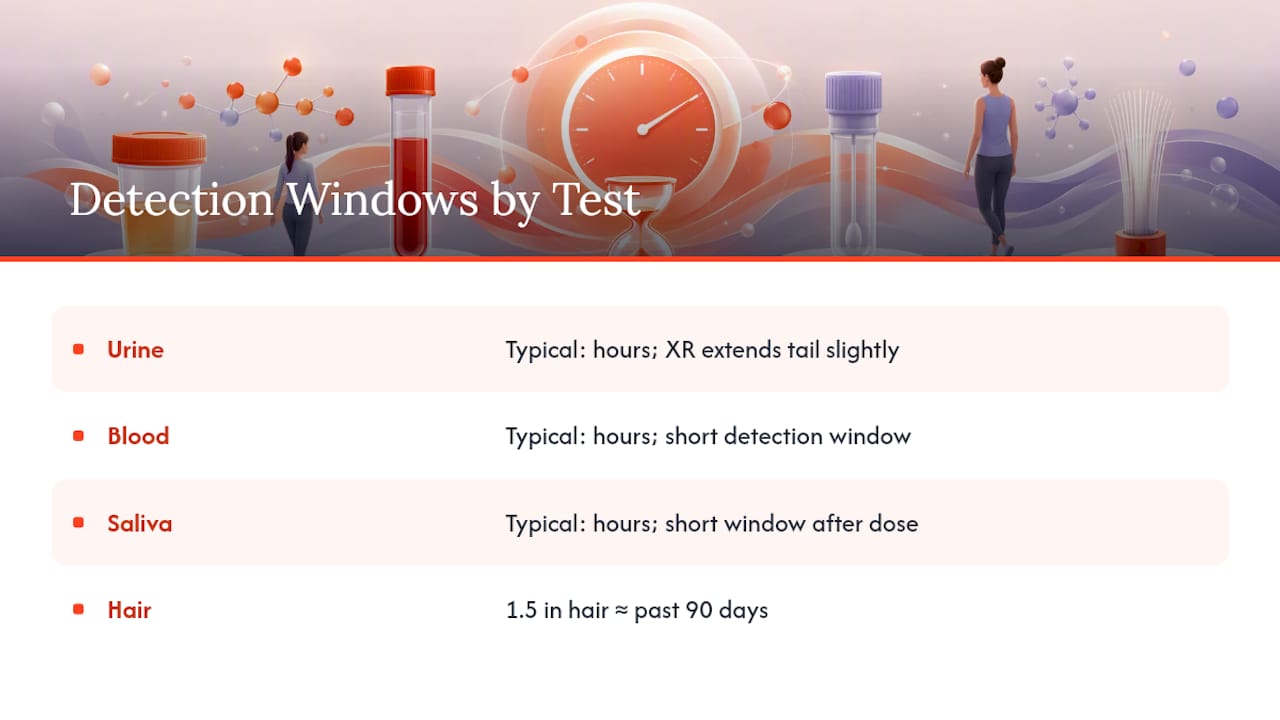
Immediate-release (IR) Adderall clears somewhat faster than extended-release (XR) formulations, because XR is engineered to release the medication gradually over many hours. That slower release can push the tail end of a urine detection window slightly later for XR users compared to someone taking an equivalent IR dose earlier in the day. If you took your last dose the night before an XR regimen versus an IR one, the urine concentration curve looks different, even if the total daily dose was similar.
Hair testing deserves its own callout because it plays by different rules entirely. A hair test isn’t measuring “did you take Adderall this week.” It’s measuring a rolling history of exposure, usually the most recent one and a half inches of hair growth, which roughly corresponds to the past 90 days. That makes hair testing far less useful for catching a single recent dose and far more useful for programs trying to establish a pattern of ongoing use, such as certain safety-sensitive employment screenings or legal monitoring programs.
According to the Indiana Department of Child Services detection-time reference, amphetamine detection windows can differ noticeably from methylphenidate windows, which matters if you’re comparing Adderall to other ADHD medications later in this guide. And peer-reviewed pharmacology research on immunoassay screening limitations confirms that initial screens are tuned for sensitivity, not precision. That tradeoff is intentional. Labs would rather flag a borderline result for confirmatory review than miss a true positive.
What Factors Change How Long Adderall Is Detectable?
No two people clear Adderall at the same rate, and detection windows shift based on a handful of variables that actually matter more than most people assume.
- Dose and frequency. A single 10mg dose clears faster than a chronic 30mg daily regimen, where metabolites can accumulate in tissue over time.
- Chronic use versus one-time use. Long-term daily users often show extended urine detection compared to someone who took one dose for the first time in months.
- Body mass and metabolism. Faster metabolic rates generally clear amphetamines quicker, though individual variation is substantial.
- Kidney and liver function. Since the kidneys excrete amphetamine metabolites, any impairment in renal function can meaningfully extend detection time.
- Urine pH and hydration. Acidic urine speeds amphetamine excretion, while alkaline urine slows it down, which is one reason detection windows aren’t fixed numbers.
- Formulation. IR versus XR release profiles change how the drug shows up in plasma and urine over the course of a day.
- Drug interactions. Other medications processed through the same liver pathways can alter clearance speed.
One overlooked wrinkle: certain common medications can cause false positives on an initial amphetamine immunoassay. Pseudoephedrine (found in many decongestants) and bupropion (an antidepressant) are both documented to sometimes cross-react on screening panels, according to a pharmacy resource on drugs that interfere with urine screens. If you’re taking anything else regularly, disclose it before testing rather than after a flagged result forces the conversation.
Pro Tip: Bring your prescription bottle and a pharmacy printout to the testing appointment, not after you’re asked for it. Reviewers move faster when documentation is already in hand, and it removes any ambiguity about timing. If you want to understand how false positives get disputed more broadly, Passmydrugtest’s guide on false positive drug testing walks through the documentation process in more detail.
How Does Confirmatory Testing Work After a Positive Screen?
Drug testing runs on a two-step system, and understanding both steps changes how you interpret a positive result. The first step is an immunoassay screen, which is fast, cheap, and built for broad sensitivity. It flags anything that looks like it belongs to the amphetamine class. The second step, triggered only when the first comes back positive, is confirmatory testing using gas chromatography-mass spectrometry (GC-MS) or liquid chromatography-tandem mass spectrometry (LC-MS/MS).

Confirmatory testing is where the real precision lives. GC-MS and LC-MS/MS can identify the exact molecular structure of what’s in the sample, including distinguishing between different amphetamine isomers. That’s the technology capable of confirming a result is consistent with prescribed Adderall rather than another substance entirely, a distinction immunoassay alone simply cannot make according to peer-reviewed comparisons of screening methods.
Here’s the typical sequence once a screen comes back positive:
- The lab holds the original sample and does not discard it after an initial positive.
- A confirmatory GC-MS or LC-MS/MS test runs on that same sample to verify the specific compound.
- A Medical Review Officer (MRO), a licensed physician trained in interpreting drug test results, reviews the confirmed finding alongside any prescription documentation.
- The MRO contacts the individual to discuss legitimate medical explanations before finalizing the report.
- The final report goes to the employer or requesting party, typically listing the result as either verified positive or medically explained.
Clinical commentary on ADHD patients points out something worth knowing upfront: testing policies for people on stimulant prescriptions vary a lot by institution, with some clinics testing rarely and others testing every few months depending on internal policy and payer requirements, according to a University of Delaware clinical commentary. There’s no single national standard for how often a prescribed patient gets screened, which is frustrating if you’re the one navigating it, but it’s the reality.
An immunoassay-positive amphetamine result does not, by itself, distinguish prescription Adderall from illicit amphetamine use. Confirmatory GC-MS or LC-MS/MS testing combined with prescription review is the accepted path to make that distinction, per guidance summarized in SAMHSA’s MRO manual.
What Should You Do If You Test Positive With a Prescription?
A positive result with a valid prescription is usually a paperwork problem, not a legal one. Here’s the sequence that resolves it fastest.
- Stay calm and don’t panic-react. A positive screen for someone on prescribed Adderall is common and expected; it’s not evidence of wrongdoing on its own.
- Confirm confirmatory testing is happening. Most legitimate workplace and clinical programs automatically run GC-MS or LC-MS/MS after any positive screen; ask if you’re unsure.
- Provide your prescription and pharmacy records. A current prescription bottle, along with a pharmacy printout showing fill dates and dosage, gives the MRO exactly what’s needed to reconcile the result.
- Get the MRO’s direct contact information. MROs are required to reach out and discuss legitimate medical explanations before finalizing any report, per SAMHSA’s guidance.
- Follow your employer or program’s specific process. Some workplaces have internal HR steps beyond the MRO conversation; ask what’s expected of you in writing.
Most MRO reviews resolve within a few business days once documentation is provided, though exact timelines depend on the testing program. According to MedSource MRO Services, a valid prescription combined with confirmatory testing and proper documentation typically clears the result and gets it marked as medically explained rather than a violation.
Pro Tip: Keep a digital photo of your prescription label and a recent pharmacy printout saved on your phone. It costs nothing and saves a scramble if you’re tested unexpectedly. This article is informational and not a substitute for advice from your prescribing clinician or a licensed MRO, who can address your specific situation.

Do Other ADHD Medications Show Up on Amphetamine Screens?
Not all stimulant medications behave the same way on a standard amphetamine panel, and the differences catch a lot of patients off guard.
| Medication | Drug class | Result on standard amphetamine immunoassay | Notes |
|---|---|---|---|
| Adderall (amphetamine/dextroamphetamine) | Amphetamine | Positive | Directly detected as amphetamine class |
| Vyvanse (lisdexamfetamine) | Amphetamine prodrug | Often positive | Converts to dextroamphetamine in the body, which triggers the same screen |
| Ritalin / Concerta (methylphenidate) | Methylphenidate (distinct class) | Often negative on amphetamine-specific panels | Chemically different from amphetamines; may require a separate targeted test to detect |
Methylphenidate, the active ingredient in Ritalin and Concerta, is chemically distinct from amphetamine, and standard amphetamine immunoassays are often not designed to catch it, according to detection-time comparisons from the Indiana detection-times reference. Vyvanse works differently. It’s a prodrug, meaning it’s inactive until the body converts it into dextroamphetamine, which means it can trigger the same amphetamine-positive result Adderall does.
- Confirmatory testing distinguishes these compounds even when the initial screen can’t, since GC-MS and LC-MS/MS identify exact molecular structures rather than a broad drug class.
- MRO review still applies for any prescribed stimulant, regardless of whether it’s Adderall, Vyvanse, or a methylphenidate product.
- If a specific panel is designed to catch methylphenidate separately, disclosing all current prescriptions upfront prevents surprises during confirmatory review.
How Should You Prepare for a Scheduled Drug Test?
Preparation for a legitimate, prescribed situation looks nothing like the “detox” myths circulating online. It looks like paperwork and honesty.
- Gather your prescription bottle and a current pharmacy printout showing fill dates and prescribing physician information.
- Make a list of every medication you’re currently taking, prescription and over-the-counter, since some can cross-react on initial screens.
- Know what type of test you’re facing. Urine, hair, saliva, and blood all have different windows and different practical implications.
- Time your last dose relative to the test only if your prescribing clinician advises it; never skip a medically necessary dose without medical guidance.
- Stay reasonably hydrated, but avoid extreme water-loading. Labs routinely flag oddly diluted samples, which can trigger a retest or scrutiny regardless of your actual result.
- Be skeptical of unverified “detox” products claiming to clear amphetamines instantly. Reliable, peer-reviewed evidence for guaranteed amphetamine clearance through detox drinks or supplements is limited, and tampering with a sample carries real consequences for employment or legal programs.
Pro Tip: If you’re worried about a result that has nothing to do with a legitimate prescription, understanding how false positive urine tests get flagged and disputed is worth ten minutes of reading before your test date, not after. For those navigating a mandatory test with a valid prescription in hand, Passmydrugtest’s guide on passing a mandatory drug test covers the documentation-first approach in more depth.
A Practical Take on Prescriptions and Drug Testing
Most of the anxiety around Adderall and drug testing comes from a false assumption: that a positive screen is the end of the story. It isn’t. It’s the beginning of a documentation process that, in the overwhelming majority of cases, resolves cleanly when a valid prescription exists.
What actually causes problems isn’t the positive result itself. It’s people showing up to a test without their paperwork, assuming the lab or employer already knows about their prescription, or panicking and saying something inconsistent during the MRO conversation. The system is built to distinguish legitimate use from illicit use, but it can only do that with information you provide. Transparency isn’t just the ethical move here. It’s the fastest path through the process.
I’d also push back gently on the framing some workplace policies use, treating any amphetamine-positive result as inherently suspicious before confirmatory testing even runs. That’s backwards. Confirmatory testing and MRO review exist precisely because a class-level screen was never meant to be the final word. If you’re prescribed Adderall, walk into a test expecting that process to work the way it’s designed to, and bring the paperwork that lets it.
Where Passmydrugtest Fits Into Test Preparation
If you’re navigating a scheduled test and want a clear picture of the different testing methods, product-side preparation, and detection realities across urine, hair, saliva, and blood, that’s exactly the kind of research Passmydrugtest was built to support. The site’s edge isn’t guesswork. It’s straight information about how each test type actually works, paired with product options suited to your specific situation.
If you’re facing a hair follicle test and want to understand realistic timelines before deciding on anything, the hair testing information page breaks down the 90-day window and what actually affects it. For readers exploring detox options as part of lawful, legitimate preparation, the detox products category covers cleanses, shampoos, and supplements, but none of that replaces documenting a valid prescription or following your employer’s or program’s specific rules. Products are a preparation tool, not a substitute for honesty with an MRO. If you’re ready to look at your options based on the exact test type you’re facing, start with the drug testing method overview to match the right approach to your situation.
Frequently Asked Questions
Does Adderall show up on a standard 5-panel drug test?
Yes. Standard panels include an amphetamine screen, and Adderall’s active ingredients are amphetamine-class compounds that will trigger a positive result.
How long does Adderall stay in your urine?
Typically 48 to 96 hours after the last dose, though chronic or high-dose use can extend that window somewhat longer.
Will Vyvanse or Ritalin show up the same way Adderall does?
Vyvanse (lisdexamfetamine) often does, since it converts to dextroamphetamine in the body. Ritalin and Concerta (methylphenidate) are chemically distinct and often don’t trigger standard amphetamine screens.
What should I do if I test positive and have a valid prescription?
Request confirmatory testing if it isn’t automatic, provide your prescription and pharmacy records to the MRO, and follow your employer or program’s specific process for medical review.
Can other medications cause a false positive for amphetamines?
Yes. Pseudoephedrine and bupropion are among the medications documented to occasionally cross-react on initial immunoassay screens, which confirmatory testing typically resolves.
Sources
- MRO guidance manual – SAMHSA
- Urmc
- Immunoassay screening vs confirmatory testing – PubMed
- Drug detection times – Indiana Department resource
Case-specific questions about your own prescription, testing schedule, or employer policy are best answered by your prescribing clinician or a licensed MRO, not a general guide.