
Facing a Workplace Drug Test? THCP Test by Test Risk and What to Do
Yes. THCP can trigger a positive result on a standard THC drug test because your body breaks it down into metabolites nearly identical to the ones delta-9 THC produces. Standard urine, blood, saliva, and hair panels aren’t built to tell THCP apart from regular THC. If you’ve used a THCP product recently, treat it as a real risk, not a technicality.
TL;DR:
- THCP metabolites are nearly identical to THC metabolites, allowing standard drug tests to detect it as positively for THC unless specifically targeted.
- Routine urine tests can detect THCP for up to three weeks with occasional use and over a month with daily use, but detection times vary widely based on individual factors.
- Blood and saliva tests detect recent THCP use within a few days, while hair tests can show cumulative use over several months.
- Factors like usage frequency, dose, body fat percentage, metabolism, and test sensitivity significantly influence how long metabolites remain detectable.
- For accurate results, it is best to self-test beforehand, consider confirmatory lab testing, and build your abstinence plan based on your specific usage pattern.
Table of Contents
- How Standard Drug Tests Detect THCP
- THCP Detection Windows by Test Type: Urine, Blood, Saliva, and Hair
- What Makes THCP Detection Windows Longer or Shorter
- How THCP Metabolizes and Why It Mimics THC
- How to Lower Your Risk Before a Scheduled Test
- How Passmydrugtest Supports Your Research and Prep
- What the Science Actually Tells You to Do
- Get Ahead of Your Test With the Right Tools
- Sources
How Standard Drug Tests Detect THCP
Most workplace and legal drug tests never look for “THCP” by name. They look for THC-COOH (11-nor-9-carboxy-THC), the main metabolite your liver produces after processing cannabinoids like delta-9 THC, and, as it turns out, THCP too.
Two-stage testing is the industry norm:
- Immunoassay screening first, a cheap, fast antibody test that flags anything structurally close enough to THC-COOH to bind the assay’s antibodies.
- Confirmatory testing second, using gas chromatography-mass spectrometry (GC-MS) or liquid chromatography-tandem mass spectrometry (LC-MS/MS) to pin down the exact compound and concentration if the screen comes back positive.
The reason THCP slips through as “THC” comes down to metabolism. Laboratory research on THC analogs found that THCP undergoes the same phase I hydroxylation and carboxylation steps as delta-9 THC, producing hydroxylated and carboxylated metabolites nearly identical to THC’s own breakdown products. The immunoassay antibodies don’t care about THCP’s longer molecular side chain. They bind to a chemical shape they recognize, and that shape looks close enough to trigger a positive.
THCP is roughly 30 times more potent at binding cannabinoid receptors than delta-9 THC, according to the compound’s original pharmacological profiling, which is part of why even small doses can leave a metabolic footprint significant enough to flag.
Labs can specifically test for THCP using validated chromatography methods when someone orders a targeted cannabinoid panel, but routine workplace screens are built around THC-COOH and rarely add THCP as a separate target. Unless an employer or lab specifically requests a broad-spectrum cannabinoid panel, THCP gets caught under the same net as ordinary THC use, not identified separately.
THCP Detection Windows by Test Type: Urine, Blood, Saliva, and Hair
Detection time is really a question about how long a specific test can still find measurable metabolites in a specific body fluid or tissue. That number moves a lot depending on how often you use THCP, how much, and how your body processes cannabinoids in general. Here’s how the major test types stack up.
Urine testing
Urine is the workhorse of workplace and legal drug screening. It’s also the specimen type with the widest detection window and the most variability between users.
- Single use: roughly 3 to 8 days for most people, though ultra-sensitive assays can sometimes catch a positive slightly longer.
- Occasional use (a few times a month): commonly 1 to 2 weeks.
- Chronic or daily use: 30 days or longer, since cannabinoids accumulate in fat tissue and release slowly back into the bloodstream over time.
Toxicology reviews on cannabinoid detection consistently note this wide spread, and industry testing sources generally converge on a broader estimate of 3 to 30 days for urine, depending on use pattern. Treat any single number you see online as a rough midpoint, not a guarantee.
Blood testing
Blood tests catch a much narrower window, generally up to a few days after use. Blood is used less for workplace screening and more in situations tied to impairment, like a post-accident test or a legal case, because it reflects what’s actively circulating rather than what’s stored in tissue. A blood positive tends to correlate more closely with recent use than a urine positive does.
Saliva (oral fluid) testing
Saliva testing catches very recent use, often within a few days, sometimes shorter for light users. It’s popular for roadside testing and same-day workplace incidents because collection is fast and hard to fake. If you used THCP within the last day, saliva is the test most likely to catch it; a week out, it’s the least likely.
Hair testing
Hair testing can detect cannabinoid use over a longer timeframe, often up to several months, reflecting cumulative exposure over time. A positive hair test tells an employer or tester about a pattern of use over months, not a specific use date. This makes hair testing a poor tool for catching an isolated incident but a strong one for identifying habitual use. It also means a single THCP session weeks ago can still show up long after urine and blood have cleared.
Sweat patches and specialty testing
Sweat patch testing is uncommon outside probation monitoring and certain clinical settings, but it deserves a mention because the collection method is unusual: a patch worn on the skin for days to weeks, continuously absorbing whatever cannabinoids pass through sweat glands. Detection windows track however long the patch stays on, sometimes extending monitoring to a week or more of continuous coverage. If you’re facing court-ordered or probation testing, ask specifically whether sweat patch monitoring is part of your requirements, since the risk profile is different from a one-time urine screen.
What Makes THCP Detection Windows Longer or Shorter
Two people who use the exact same THCP product on the exact same day can test very differently a week later. The published ranges above are population averages, not personal guarantees, and several variables push your actual window up or down.
- Frequency of use. Cannabinoids are fat-soluble, so they accumulate in adipose tissue with repeated use. Occasional use clears relatively fast; daily or near-daily use builds a reservoir that leaks metabolites back into your system for weeks, a mechanism documented in toxicology literature on cannabinoid storage.
- Dose and potency. THCP’s high receptor-binding potency means smaller amounts can still generate a meaningful metabolite load. Higher doses of any cannabinoid extend the timeline further.
- Route of administration. Inhaling (vaping or smoking) tends to clear faster than oral ingestion, since edibles pass through the liver’s first-pass metabolism and release metabolites more gradually over a longer period.
- Body composition and metabolism. Higher body fat percentage generally means more storage capacity for cannabinoids. Age, liver enzyme activity (especially cytochrome P450 pathways), and overall metabolic rate all shift how fast metabolites clear.
- Testing sensitivity. Not every lab uses the same cutoff. A standard immunoassay might use a 50 ng/mL cutoff for THC-COOH, while some employer panels use more sensitive 20 ng/mL thresholds that catch lower concentrations and effectively extend the detectable window.
Pro Tip: If you’re weighing risk ahead of a scheduled test, don’t just Google “THCP detection time” and take the shortest number you find. Build your estimate around your actual use pattern (frequency, dose, method) and lean conservative. Underestimating your own detection window is the single most common mistake people make before a screening.
How THCP Metabolizes and Why It Mimics THC
Once THCP enters your bloodstream, your liver treats it much like it treats delta-9 THC. The process runs in two phases. Phase I involves cytochrome P450 enzymes hydroxylating the molecule, essentially attaching an oxygen-hydrogen group to specific carbon positions. That hydroxylated intermediate then gets oxidized further into a carboxylated metabolite, the THC-COOH-like compound that most immunoassays are designed to detect.
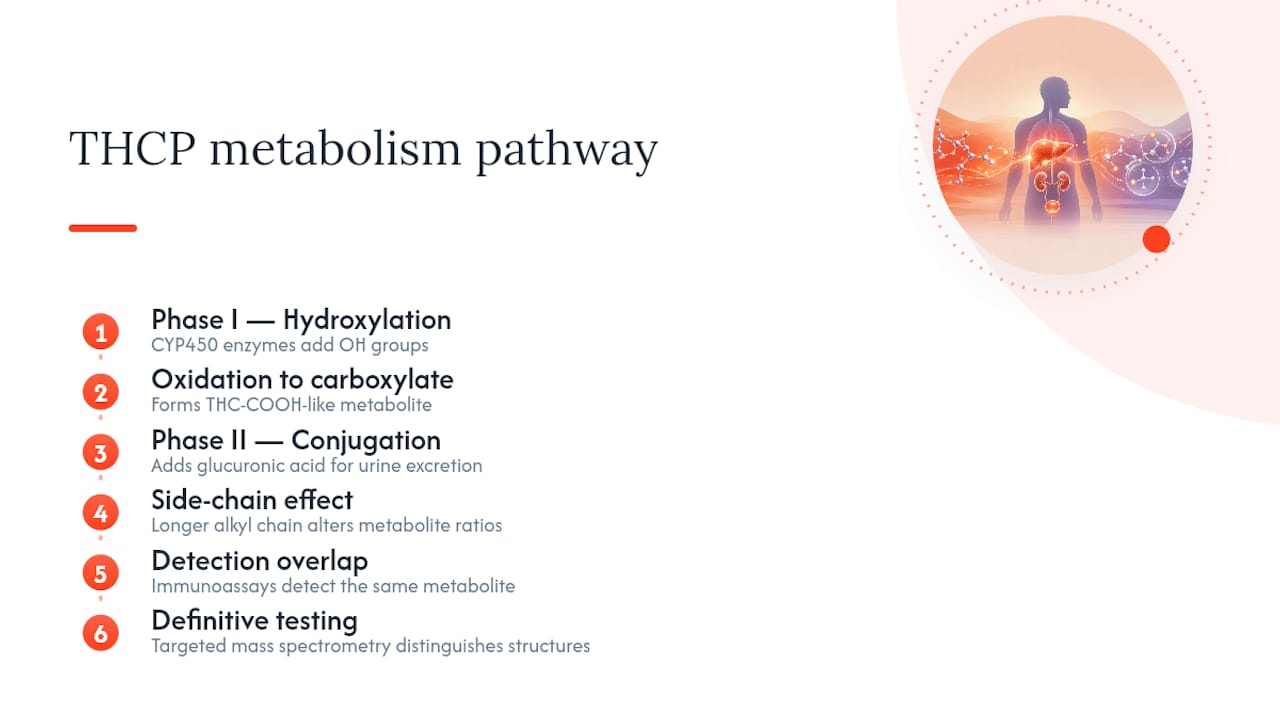
Phase II conjugation follows, where the body attaches glucuronic acid to make the metabolite water-soluble enough to excrete in urine.
What’s genuinely interesting to researchers is how THCP’s longer alkyl side chain (seven carbons versus delta-9 THC’s five) changes this picture. In vitro metabolism research found that side-chain length alters the ratio of hydroxylated to carboxylated metabolites produced, which likely explains some of THCP’s potency differences and possibly its persistence in the body, though researchers haven’t fully mapped out exactly how long THCP-specific metabolites linger compared to standard THC metabolites.
This metabolic overlap is exactly why routine tests can’t reliably separate THCP use from THC use. Only targeted mass spectrometry methods, run specifically to distinguish molecular structures, can make that distinction. Standard immunoassays simply aren’t built for it. Worth noting: the research base here is still thin. Most of what’s known comes from in vitro (lab-based) metabolism studies rather than large human trials, so some of the finer details of THCP’s actual persistence timeline in real users remain unsettled.
How to Lower Your Risk Before a Scheduled Test
If you know a test is coming, the smartest move is treating your timeline conservatively and verifying your own status before it counts.
- Estimate your abstinence window honestly. A single, light THCP use might clear a standard urine screen inside a week or two. Occasional use pushes that closer to two to three weeks. Regular or heavy use should be planned around a month or more of abstinence, given how cannabinoids accumulate in fat tissue.
- Skip the “instant detox” myths. Products claiming to flush your system in a few hours generally don’t hold up, and aggressive water-loading or diluting a urine sample can backfire badly. Labs routinely check specific gravity and creatinine levels specifically to catch dilution, and an out-of-range result can trigger a retest or an automatic “invalid” flag that draws more scrutiny than a straightforward positive.
- Test yourself before the official screen. An at-home test kit gives you a realistic read on where you stand days before the real thing, so you’re not walking in blind. Pair that with the same detection-window math from earlier in this guide.
- Consider a confirmatory lab check if the stakes are high. For something like a pre-employment offer or a legal matter, a private lab test using GC-MS or LC-MS/MS gives you a far more reliable answer than a screening-only kit.
- If you do test positive, know your options. Request confirmatory testing rather than accepting a screening result at face value. Gather any documentation you have, product certificates of analysis (COAs), receipts, anything showing what you actually used, since a COA reflects product content at the time of testing but can’t predict how your body will metabolize it. Then follow your employer’s or testing program’s official dispute process rather than trying to explain it away informally.
Pro Tip: Never assume a negative on a cheap screening kit means you’re clear for an official lab test. Screening kits and confirmatory lab methods use different sensitivity thresholds, and a borderline result on one can flip on the other.
How Passmydrugtest Supports Your Research and Prep
This guide is part of a larger library covering THC detection times, THC half-life, and hair drug test detection windows, each exploring a different aspect of how long cannabinoid use can be detected.
Beyond the articles, the product catalog covers categories frequently asked about: at-home test kits for self-screening before an official test, detox products for managing a known timeline, and synthetic urine kits for specific legitimate use cases. The broader marijuana testing resource library rounds out the education side.
Orders ship within the United States, and phone support is available during published business hours for help with picking products that match specific timelines and test types.
What the Science Actually Tells You to Do
Most articles on THCP testing stop at “it might show up,” which is true but useless without a plan attached. The metabolism research is clear enough: THCP breaks down into THC-like compounds, and standard tests can’t distinguish the two. That part isn’t really in dispute.
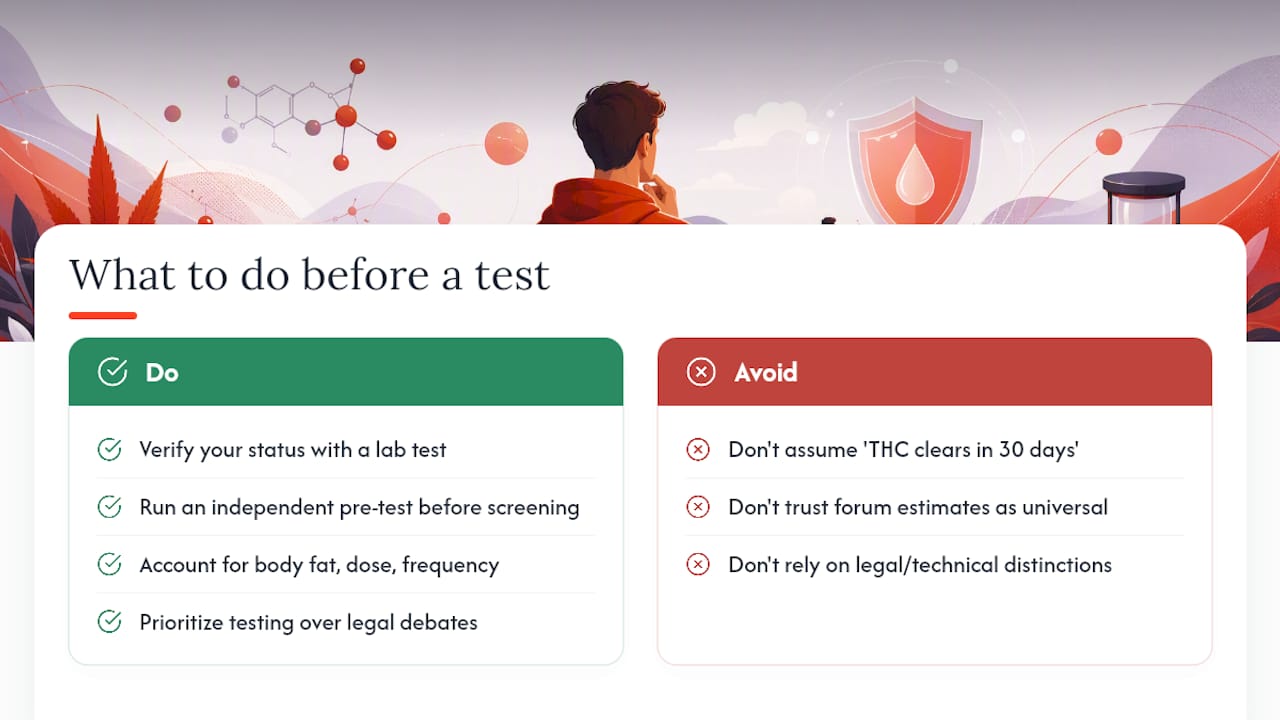
Where conventional advice falls short is the false confidence around round numbers. “THC clears in 30 days” gets repeated so often it starts sounding like a law of biology. It isn’t. Body fat, dose, frequency, and even which lab processes your sample all shift that number meaningfully in either direction.
My honest read: skip the debate over whether THCP is “technically legal” or “different from THC,” because your drug test doesn’t care about that distinction, and prioritize verifying your own status with real testing rather than trusting a forum estimate. The people who get burned are usually the ones who did the math once, assumed it was universal, and never checked their actual result before the test that mattered.
— MIchael
Get Ahead of Your Test With the Right Tools
Guesswork is the expensive part of drug testing, not the products themselves. This resource exists to help people avoid relying on uncertain information the night before a screening that could affect their job or a legal outcome.
The drug testing product catalog includes at-home test kits, detox options, and preparation products organized by different testing situations such as pre-employment screens, workplace random tests, or court-ordered checks. If you’re not sure which testing method applies to your situation, the drug testing method overview breaks down urine, saliva, hair, and blood testing side by side so you can match a product to your actual risk instead of a generic one.
Shipping within the US aims to be timely for short-notice test dates, and phone support is available during business hours for direct assistance. Start by checking the product catalog for the test type you’re facing, and order with enough lead time to actually use what you buy before the day it matters.
Sources
- Delta-9-tetrahydrocannabutol (Δ9-THCB), Delta-9-tetrahydrocannabihexol (Δ9-THCH), and Delta-9-tetrahydrocannabiphorol (Δ9-THCP): the Impact of Varying Alkyl Chain Length on Δ9-THC Analog Metabolism
- Open-access toxicology review on cannabinoid detection windows (PMC)