
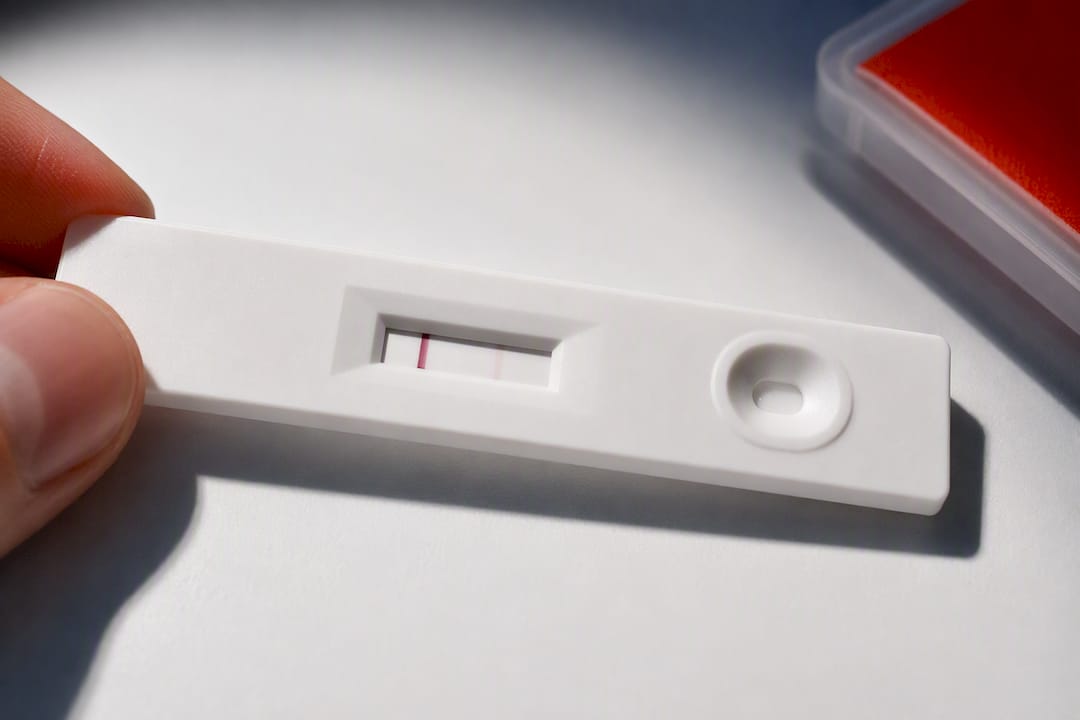
Usually Negative: Faint Drug Test Line and When to Confirm
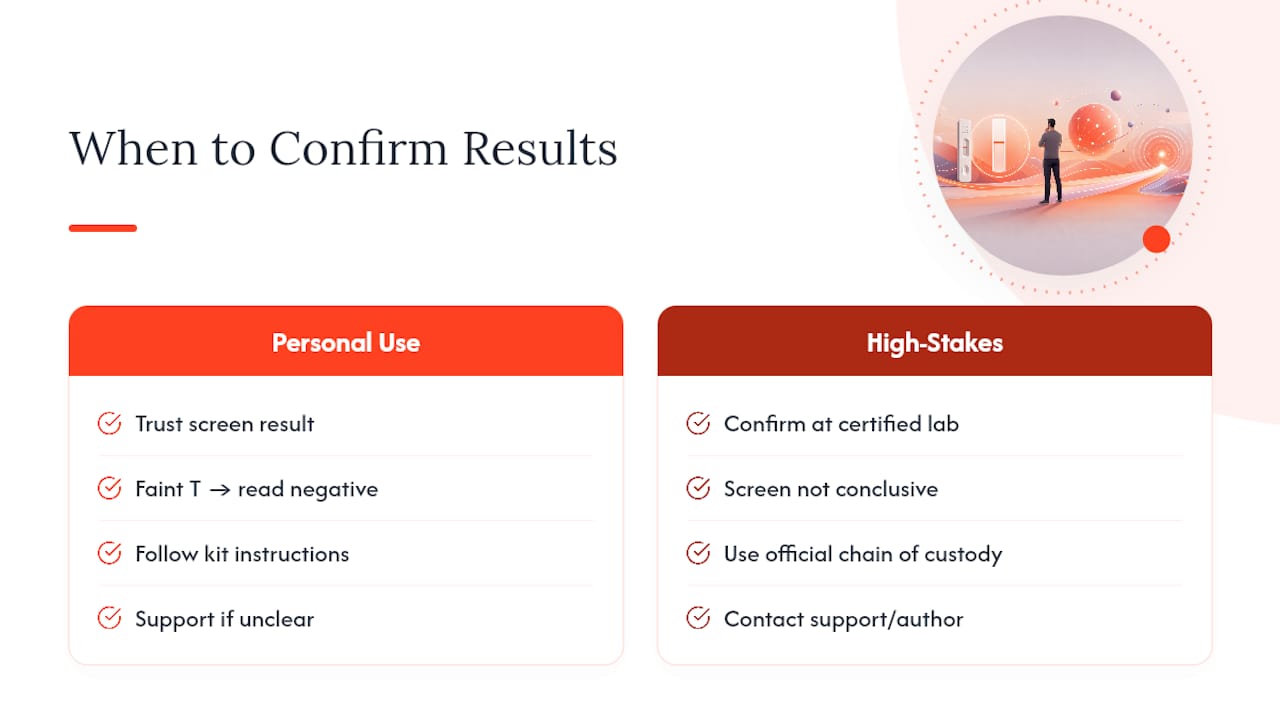
A faint line in the test (T) region, sitting alongside a visible control © line, means the screen is negative on almost every rapid drug testing kit. The line’s darkness has nothing to do with how much drug is in your system. If the T line is missing entirely, that’s a preliminary positive, and it needs confirmation at a certified lab before anyone treats it as final, especially for a job, a court case, or a formal program.
TL;DR:
- A faint test line indicates the metabolite level is below the cutoff, meaning the result is negative, regardless of line darkness.
- Line intensity can be affected by urine dilution, proximity to cutoff levels, device variability, and the timing of the test after drug use.
- Confirmatory laboratory testing using GC-MS or LC-MS/MS is essential for legal, employment, or legal challenges involving positive or faint results.
- Reading the test within the specified time window under natural light, and avoiding interpretation after evaporation or outside the window, is crucial for accuracy.
- Retesting with first-morning urine, documenting the original test details, and seeking lab confirmation are recommended steps if a faint line raises concerns.
Table of Contents
- How a Faint Line Drug Test Actually Works
- Why Do Some Test Lines Come Out Faint?
- When a Faint Line Deserves a Lab Confirmation
- Ghost Lines and Other Reading Mistakes
- What To Do Next After Seeing a Faint Line
- Why We Recommend Confirmation When the Result Matters
- Get the Right Test Kit and Support for Retesting
- Where to Verify This Information Yourself
- Sources
How a Faint Line Drug Test Actually Works
Rapid drug tests use a method called competitive immunoassay, and the name explains almost everything about why lines show up faint or dark. Antibodies on the test strip are built to bind to a specific drug metabolite. Your urine sample competes with that antibody supply.
Here’s the part most people never get told: a faint T line does not mean “a little bit positive.” It means the opposite. If your sample has enough drug metabolite to overwhelm the antibodies, no colored line forms at all, because the metabolite bound where the color-producing complex normally would. A faint or strong T line means the metabolite level stayed below the cutoff, so the antibodies stayed free to grab the dye and light up the strip. Line darkness reflects how much of the strip’s chemistry got used up, not how much drug is in your body.
That’s why manufacturers and independent labs consistently point out that line intensity is not used to quantify drug level. The test gives a binary answer, negative or non-negative, based on a fixed cutoff concentration.
Two things determine a valid read:
- A control line must appear, confirming the test itself worked correctly.
- Any test line, faint or bold, must appear within the manufacturer’s specified reading window, typically 5 to 10 minutes depending on the brand.
For a full walkthrough of cutoffs and reporting, see this guide on how to read drug test results.
Why Do Some Test Lines Come Out Faint?
Several things can push a line toward faint instead of bold, and most of them have nothing to do with recent drug use being heavier or lighter than usual.
- Near-cutoff concentration. When metabolite levels sit close to the test’s cutoff threshold, the antibody competition is tighter, and the resulting line often looks lighter than a clean negative would.
- Dilute urine. Drinking a lot of fluid, or testing with urine that has low creatinine and specific gravity, thins out metabolite concentration and lightens the line even when the underlying result would otherwise read the same.
- Timing since last use. Metabolites clear at different rates. Testing several days after use, as clearance approaches completion, tends to produce fainter lines than testing on day one.
- Device variability. Membrane inconsistencies, dye batch differences, or a kit that’s expired or was stored somewhere hot or humid can all weaken the color reaction regardless of the sample.
- Interfering substances. Certain over-the-counter medications and supplements occasionally cross-react with the antibody strip, though true cross-reactivity is uncommon and drug-specific. Faint lines often trace back to near-cutoff levels, dilution, or device variability rather than anything unusual about the person testing.
Pro Tip: If you suspect dilution, don’t just retest immediately. Wait for a first-morning urine sample, when concentration is naturally highest, instead of testing again after drinking more water.
When a Faint Line Deserves a Lab Confirmation
A rapid test is a screening tool, not a verdict. It’s built for speed and low cost, not for legal or clinical certainty. Laboratory confirmation uses gas chromatography-mass spectrometry (GC-MS) or liquid chromatography-tandem mass spectrometry (LC-MS/MS), methods that identify and quantify the exact compound present rather than reacting to a general drug class.
That distinction matters most in a handful of situations:
- Employment decisions, including pre-employment or random workplace screening
- Court-ordered, probation, or parole testing
- U.S. Department of Transportation (DOT) regulated testing
- Any result you plan to dispute or that carries a consequence beyond personal knowledge
SAMHSA maintains a certified laboratory list specifically for arranging this kind of confirmation, and SAMHSA’s broader workplace resources explain how screening and confirmatory testing fit together in formal drug-testing programs. Lab turnaround typically runs one to five business days, depending on the lab’s volume and the panel requested.
What you get back from a lab is fundamentally different from a strip. Confirmatory testing reports identification (which specific substance was detected) and quantitation (how much, in nanograms per milliliter). That number resolves the ambiguity a rapid screen can’t touch. A screening device only tells you above or below cutoff; a lab tells you the actual figure, which is why accredited laboratory confirmation is the accepted standard whenever a screening result has real consequences attached. If you’re navigating a disputed result, this breakdown of clean urine drug test procedures and confirmatory options covers what typically happens next.
Ghost Lines and Other Reading Mistakes
Plenty of “faint positive” panic starts with a reading error, not an actual result. A few things to rule out before you trust what you’re seeing:
- Evaporation lines show up after the reading window closes, usually as a colorless indent rather than a true dye line. They don’t count.
- No control line at all means the test is invalid, period. Discard it and retest with a new kit rather than trying to interpret anything from it.
- Bad lighting or an extreme angle can make a faint line look stronger or weaker than it is, and photo filters or screen brightness distort colors further.
- Heat, cold, or expired kits can degrade the membrane’s reagents, producing an unreliable line regardless of the actual sample.
Read the strip flat, under natural light, inside the printed time window. Nothing after that window counts.
What To Do Next After Seeing a Faint Line
What happens next depends entirely on the stakes.
- If the result carries consequences (a job, a legal matter, a monitored program), don’t discard the sample or the test strip. Request certified lab confirmation and preserve chain-of-custody documentation, meaning the sample stays sealed, labeled, and logged from collection through delivery to the lab.
- If this is personal screening, retest using first-morning urine, or wait 24 to 72 hours per the kit’s instructions before testing again, since metabolite concentration shifts throughout the day.
- Document everything, including the brand, lot number, and expiration date, and photograph the strip within the reading window if you think the result might get questioned later.
- Reach out for support if the faint line reflects a pattern you’re worried about. Substance-use counseling and medical guidance are worth pursuing separately from the testing question itself.
Pro Tip: Keep the box the test came in until you’re confident in the result. Lot numbers and expiration dates printed on the packaging are exactly what a lab or an employer will ask for if the reading gets disputed.
If you’re troubleshooting a specific medication or supplement that might be interfering, this resource on false positive drug testing causes walks through the more common culprits.
Why We Recommend Confirmation When the Result Matters
The site aims to help people understand test results correctly, not just sell test kits. A faint T line next to a clear C line reads as negative, and we say that plainly. But screening devices weren’t built to be the final word once a job, a legal case, or a monitoring program is on the line, so our stance stays conservative: trust the screen for personal use, confirm at a certified lab when consequences follow. If a product’s instructions are unclear, our customer support team and site author Michael are available to walk through it.
Get the Right Test Kit and Support for Retesting
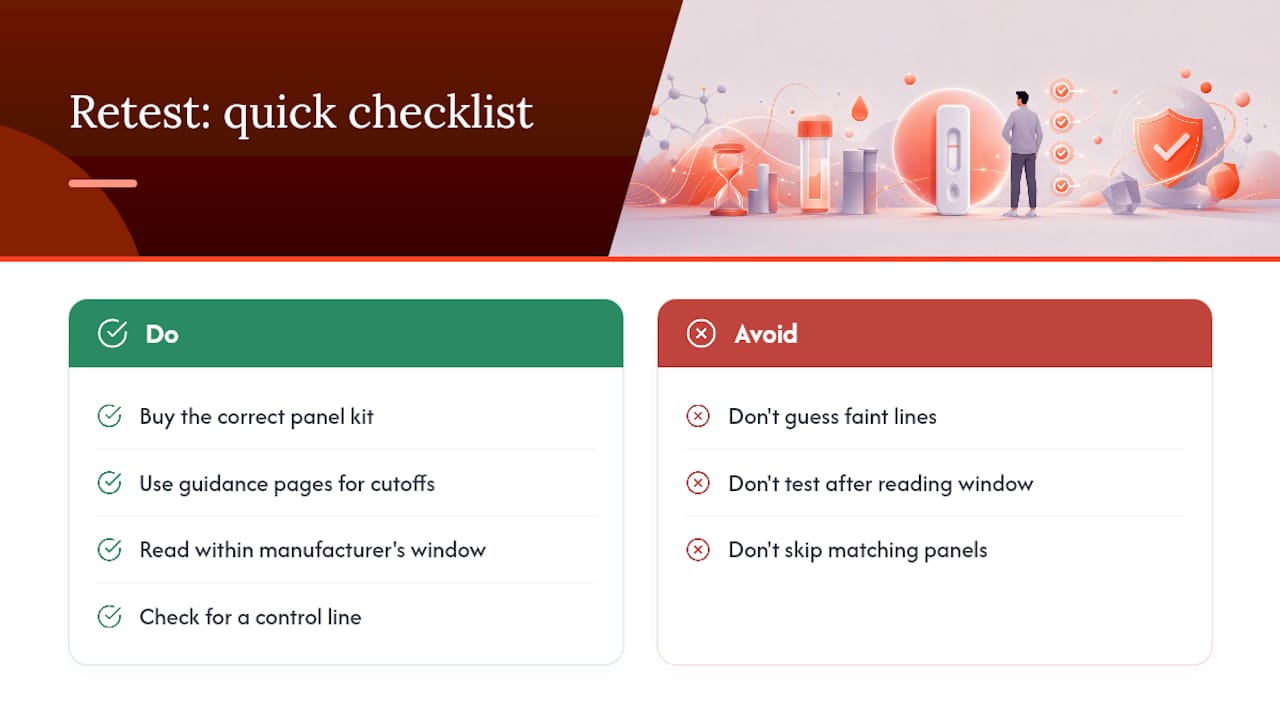
If your faint line has you second-guessing your kit, or you need a second test to confirm what you’re seeing, the fastest fix is starting with a kit built for your exact panel. Passmydrugtest carries home test kits across single-panel and multi-panel options, including marijuana-specific test kits for readers whose faint-line question centers on THC, along with detailed guidance pages that walk through reading windows and cutoff levels so you’re not guessing at what the strip is telling you.
Orders ship within the United States, and phone support during business hours is available to help with questions about test strips. Before you retest, check the full range of drug testing products to confirm you’re matching the panel to what you actually need to screen for, then follow the manufacturer’s reading window exactly. That single habit, reading on time and checking for a control line, prevents most of the confusion faint lines cause in the first place.
Where to Verify This Information Yourself
For primary references beyond this guide, check the FDA’s page on over-the-counter drug tests, SAMHSA’s certified lab directory, and independent explainers like American Screening Corp’s breakdown of faint line meaning.
Sources
- FDA — Drugs of Abuse: Home Use Tests
- Test Smartly Labs — Faint Line on a Drug Screen: What Does It Mean?
- American Screening Corp — Faint Line on a Drug Test? Here’s What It Really Means
- 12PanelNow — Faint lines on a drug test: negative vs positive