

Resolve an Inconclusive Drug Test in 1–2 Weeks with DOT Friendly Steps
An inconclusive drug test, technically reported as an “invalid” result, is neither a confirmed positive nor a confirmed negative. It usually means a specimen problem or lab anomaly got in the way of a clean read, not that you failed. The standard response is a Medical Review Officer (MRO) review followed by a retest, not automatic discipline, and under 49 CFR §40.207, a DOT-regulated test in this category is officially cancelled rather than counted against you.
TL;DR:
- An invalid drug test does not mean you failed; it results from specimen or lab issues and is typically reset with a retest or review.
- Causes include specimen overhydration, interfering medications, or lab process failures, often unrelated to drug use.
- DOT tests cancel invalid results without disciplinary action, requiring a subsequent recollection if explanations are insufficient.
- Outside DOT rules, policies vary, and an invalid result can delay licensing, employment, or legal proceedings until retesting confirms the outcome.
- Preparing by documenting medications and following collection instructions can reduce the risk of invalid results.
Table of Contents
- What Does Inconclusive Drug Test Mean in Lab Terms?
- Common Causes of an Inconclusive or Invalid Drug Screening
- How Context Changes What an Inconclusive Result Means for You
- What Happens After an Invalid Result: MRO Review and Retesting
- How to Respond When You Get an Inconclusive Result
- Why Screening Tests Can Be Ambiguous: Immunoassay vs. Confirmatory Testing
- Does an Inconclusive Drug Test Affect Insurance Claims or Benefits?
- How Long Does It Take to Resolve an Inconclusive Drug Test?
- Can You Get an Independent Confirmation From a Third-Party Lab?
- What Legal Protections Exist After an Inconclusive Result?
- How to Avoid an Inconclusive Result the Next Time You’re Tested
- An Editor’s Take: Don’t Panic, Document Everything
- Where PassMyDrugTest Fits Into Your Preparation
- Sources
What Does Inconclusive Drug Test Mean in Lab Terms?
Laboratories don’t actually use the word “inconclusive.” They use “invalid,” and it sits in its own category alongside positive, negative, dilute, adulterated, and substituted. Each label means something specific and triggers a different response.
- Negative: No target substances detected above the cutoff level.
- Positive: Confirmed presence of a substance above the cutoff, verified by a second method.
- Dilute: Creatinine and specific gravity are low, suggesting excess fluid intake, but the test still produced a readable result.
- Adulterated: The specimen contains a substance (bleach, other oxidizers) that shouldn’t be present in human urine.
- Substituted: Creatinine and specific gravity fall outside the range possible for human urine.
- Invalid: The lab’s validity checks, pH, creatinine, specific gravity, and oxidant levels, produced conflicting or unreadable results, so no reliable call can be made either way.
A cancelled or invalid test is not evidence of drug use. It’s also not a negative, which matters if you need a documented negative for licensing, custody proceedings, or a job offer contingent on clearance under MRO guidance.
Common Causes of an Inconclusive or Invalid Drug Screening
Most invalid results trace back to one of three sources: the specimen itself, something interfering with the chemistry, or a process failure at the lab.
- Specimen factors. Low creatinine from overhydration, an abnormal pH from diet or timing, or visible anomalies like unusual color or temperature outside the accepted range.
- Interfering substances. Oxidizing adulterants (sometimes added intentionally, sometimes present from cleaning residue) or legitimate medications and supplements that cross-react with the screening chemistry, a documented issue across common immunoassay panels.
- Process issues. Expired reagents, equipment miscalibration, or a specimen that sat too long during transport or storage before testing.
Some of these causes are entirely innocent. Dehydration timing, a new blood pressure medication, or a lab running behind on quality control checks can all produce an invalid flag with zero connection to drug use. Others, like clear evidence of an added oxidizer, point toward intentional tampering and get treated far more seriously by an MRO.
Pro Tip: Write down every prescription, supplement, and over-the-counter medication you’ve taken in the past two weeks before your test, not after you get the invalid result. Trying to reconstruct that list under pressure during an MRO call is harder than it sounds.
How Context Changes What an Inconclusive Result Means for You
The consequences of an invalid result depend heavily on who ordered the test and which rules govern it.
- DOT-regulated jobs. An invalid result equals a cancelled test under 49 CFR Part 40. It can’t be used as grounds for discipline on its own. If the MRO can’t identify an acceptable medical explanation, a recollection under direct observation is typically ordered.
- Private, non-DOT employers. Policy varies widely here. Some employers follow the same SAMHSA-certified lab protocols voluntarily; others have broad latitude under at-will employment and state law to set their own rules for handling an invalid specimen. Check your handbook, union contract, or offer letter language before assuming either outcome.
- Clinical settings. A treating clinician interprets an invalid urine drug screen in the context of your health history, and the decision to pursue confirmatory testing depends on what the result is being used for, pain management monitoring versus a routine wellness check, for example.
- Legal and probation contexts. A retest is the likely path, but supervising officers or courts retain discretion over sanctions. Thorough documentation of medications and circumstances matters more here than almost anywhere else, since the stakes for a wrong call are higher.
What Happens After an Invalid Result: MRO Review and Retesting
Once a lab reports an invalid result, the file goes to a Medical Review Officer, a physician trained specifically to interpret drug test data under federal guidelines.
- The MRO interview. You’ll be contacted to explain the result. Bring prescriptions, medical records, or documentation of any condition that could explain abnormal pH or creatinine readings.
- Recollection decision. If your explanation satisfies the MRO, the process may end there. If not, a second specimen is usually collected under direct observation, a trained monitor watches the collection to rule out further tampering, per DOT direct observation rules.
- No split-specimen option. Split-specimen retesting at an independent lab applies only to verified positive, adulterated, or substituted results, not to invalid ones. There’s no second-lab appeal path for an invalid call itself.
- Refusal consequences. Declining a directed recollection is generally treated the same as refusing the original test, which can carry the same consequences as a confirmed positive in DOT-regulated roles.
Timing varies, but most MRO reviews and recollections resolve within a few business days to two weeks. The employer or ordering party typically covers the cost of the retest itself, though policies on this differ outside DOT-regulated employment.
How to Respond When You Get an Inconclusive Result
Your response in the first 24 to 48 hours matters more than almost anything else in this process.
- Gather every prescription bottle, pharmacy printout, or supplement label that could explain an abnormal reading.
- Write down the date, time, and specimen ID from your original test while the details are fresh.
- Read your employer’s drug testing policy or your program’s guidelines before the MRO calls, not during.
- Stay cooperative and responsive. Missed calls or delayed paperwork from you can be read as evasiveness, even when that’s not the intent.
- If a recollection is ordered, show up on time and expect direct observation if the MRO couldn’t accept your explanation.
- Consult a workplace attorney or your union representative if you’re facing termination or a licensing action tied to the result.
Pro Tip: Ask the MRO’s office, in writing if possible, exactly what documentation they need and by when. A verbal request you half remember later is much harder to prove you complied with than an email you can point back to.
Why Screening Tests Can Be Ambiguous: Immunoassay vs. Confirmatory Testing
Most initial drug screens use immunoassay technology, which is fast, cheap, and presumptive by design. It flags likely matches above a cutoff concentration but can’t definitively identify a specific compound. That’s why clinical guidance for drug testing interpretation treats immunoassay results as a starting point, not a final answer.
Confirmatory testing with gas chromatography-mass spectrometry (GC-MS) or liquid chromatography-tandem mass spectrometry (LC-MS/MS) identifies the exact molecular structure of a substance, which is why it’s the standard whenever real consequences, employment, legal, or medical decisions, ride on the outcome.
Cutoff values exist to separate incidental exposure from meaningful use, but they also mean immunoassays sit closer to a probability estimate than a yes-or-no answer, especially when common medications produce a documented cross-reactivity with the screening antibodies.
Understanding this distinction is exactly why an invalid or ambiguous screen shouldn’t be treated as an accusation. It’s a signal that more precise testing, not more suspicion, is the appropriate next step.
Does an Inconclusive Drug Test Affect Insurance Claims or Benefits?
An invalid result can complicate an insurance claim, but it rarely resolves anything on its own. Life insurance underwriters, workers’ compensation carriers, and disability benefit administrators often require a valid drug screen as part of the application or claims process, and an invalid result simply restarts that requirement rather than settling it either way.
For workers’ compensation specifically, an invalid post-accident drug test can delay a claim determination while the employer or insurer requests a recollection. Some state workers’ comp statutes include a presumption against benefits if a worker tests positive for impairment at the time of an injury, but that presumption generally doesn’t apply to an invalid or cancelled result, since there’s no confirmed positive to trigger it. The claim typically stays open pending the retest outcome.
Disability and life insurance underwriting works similarly. An invalid result on a paramedical exam usually means the insurer orders a new collection rather than denying coverage outright. Where this gets complicated is timing: insurance underwriting has deadlines, and a delayed retest can push back a policy’s effective date or a claim’s payout schedule. If you’re in the middle of an underwriting process and get an invalid result, contact the insurer’s underwriting department directly to confirm what documentation they need and how quickly you need to act. Silence on your end is far more likely to hurt a claim than the invalid result itself.
How Long Does It Take to Resolve an Inconclusive Drug Test?
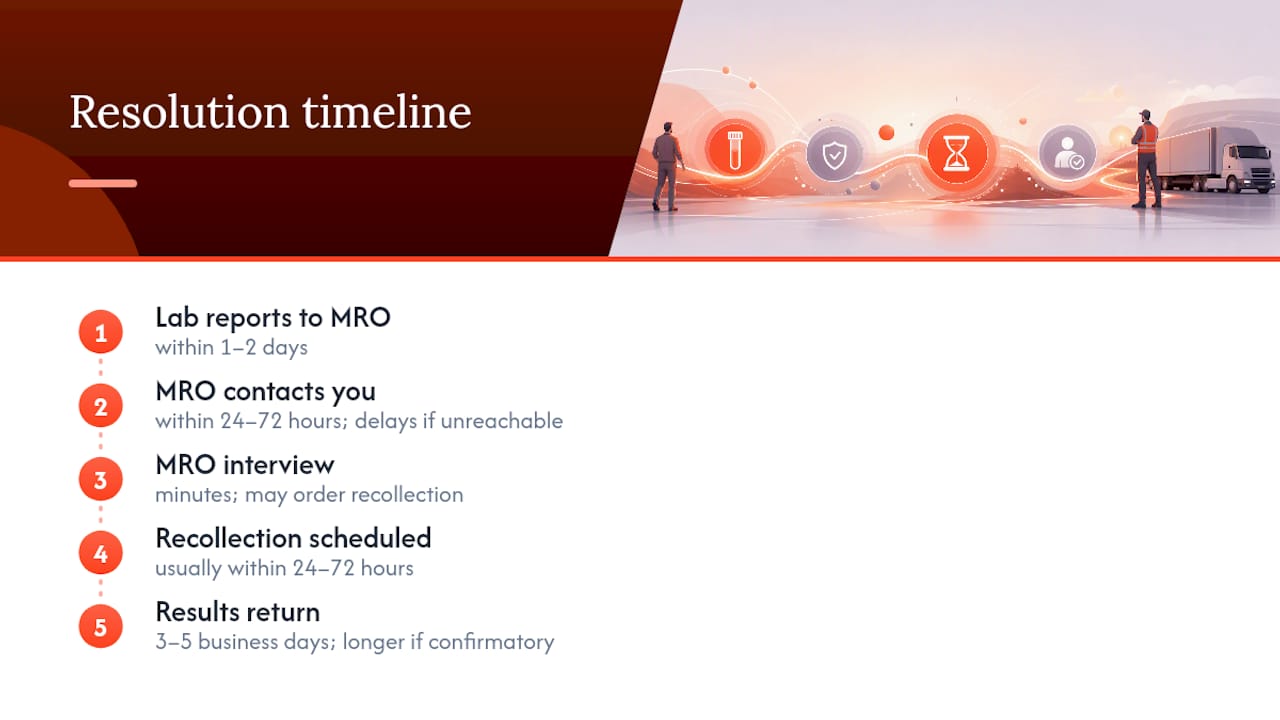
Most invalid results resolve within one to two weeks, though the exact timeline depends on who’s involved and how quickly each party responds.
The lab typically reports an invalid finding to the MRO within a day or two of running the specimen. From there, the MRO’s office usually attempts contact within 24 to 72 hours. This is often the biggest variable in the whole timeline: an MRO office that can’t reach you promptly, because of a wrong phone number on file or a missed call, can stretch a same-week resolution into two or three weeks.
Once you’re in contact with the MRO, the interview itself takes minutes, not days. If a recollection under direct observation is ordered, most employers schedule it within 24 to 72 hours of that decision, and results from the new specimen typically come back in three to five business days for a standard immunoassay screen, longer if confirmatory GC-MS or LC-MS/MS testing is needed on top of it.
Legal and probation contexts sometimes move slower, since court calendars and supervising officer caseloads add scheduling friction that a workplace test doesn’t have. If you’re waiting on a result tied to a court date or probation check-in, ask your supervising officer directly what their standard turnaround is rather than assuming it matches employment timelines.
Can You Get an Independent Confirmation From a Third-Party Lab?
Not in the way most people expect. Split-specimen testing, where a portion of your original sample goes to a second, independent lab, exists specifically for verified positive, adulterated, or substituted results. It doesn’t apply to invalid findings, since there’s no confirmed adverse result to contest through a split-specimen challenge.
What you can do instead is request that any recollection or retest happen at a different SAMHSA-certified laboratory than the one that produced the original invalid result, particularly if you suspect equipment error rather than a specimen issue. Employers and MROs aren’t always obligated to grant this, but it’s a reasonable request, especially if the invalid finding seems to stem from a lab-side process problem rather than something about your specimen.
Independent, privately ordered confirmation testing is also an option outside the official chain of custody, though it carries a caveat: a self-ordered test at an outside lab has no bearing on the official record and won’t substitute for the MRO-directed process. It can, however, give you useful information about your own body chemistry, medications, or hydration status before you go into a directed recollection, which is where a resource like understanding what makes a urine specimen valid becomes genuinely useful for preparation rather than dispute.
What Legal Protections Exist After an Inconclusive Result?
Your protections depend heavily on which regulatory framework governs your test, and that distinction matters more than most people realize going into this process.
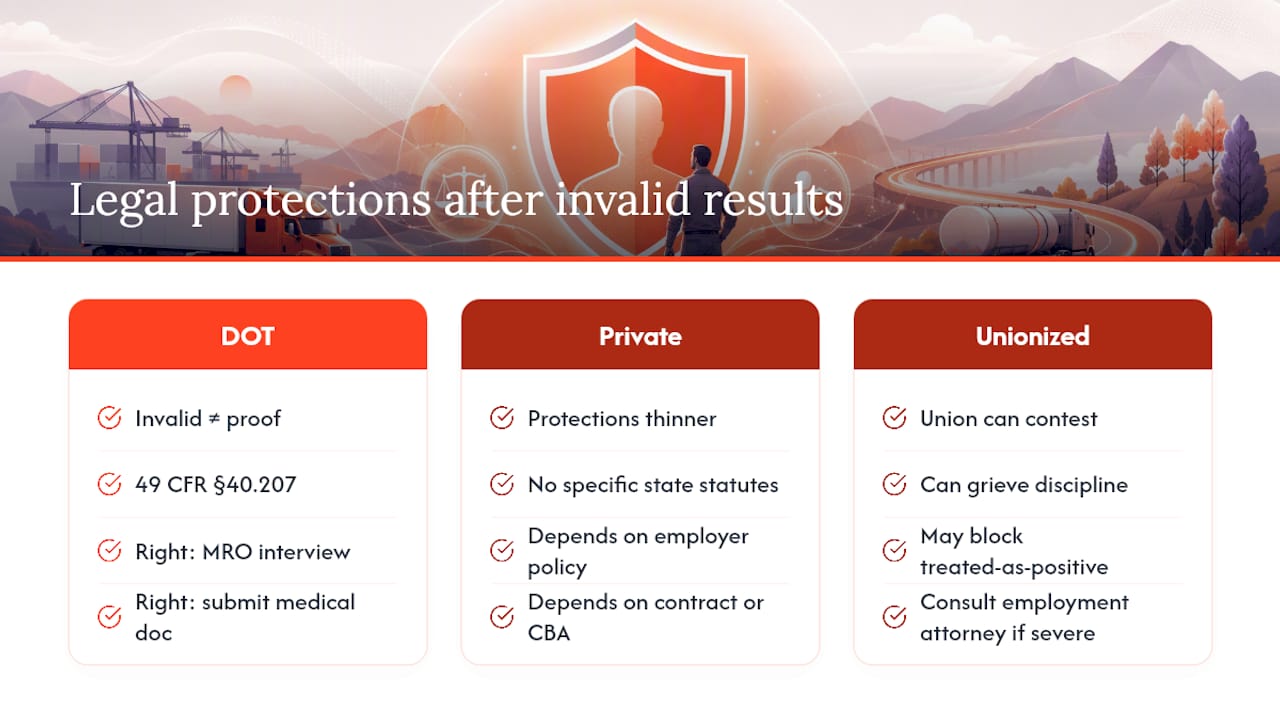
Under DOT rules, an invalid result cannot be treated as evidence of drug use, and 49 CFR §40.207 prohibits using it as sole grounds for discipline. You have a right to an MRO interview, a right to submit medical documentation, and, in many cases, a right to a recollection rather than an automatic adverse action. These are federal protections that apply regardless of state.
Outside DOT-regulated employment, protections get thinner and more state-dependent. Most states don’t have specific statutes governing how private employers must handle an invalid drug test result, which means your protection often comes down to your employer’s own written policy, your employment contract, or a collective bargaining agreement rather than any external law. This is exactly why reading your employer’s drug testing policy before, not after, a result comes back matters as much as it does.
If you’re in a unionized workplace, your union representative can often push back on an employer trying to treat an invalid result as equivalent to a positive. If you’re facing termination, licensing action, or a probation sanction tied to an invalid result, a consultation with an employment attorney is worth the cost, particularly if your employer’s response seems inconsistent with its own written policy or with how it has handled similar cases for other employees.
How to Avoid an Inconclusive Result the Next Time You’re Tested
Most invalid results are preventable with a few practical habits in the days leading up to a test.
Avoid excessive water intake in the hours before your appointment. Overhydration is one of the most common, and most innocent, causes of a dilute or invalid reading, since it artificially lowers creatinine and specific gravity below the range labs consider valid. Drink normally, not aggressively.
Keep a written list of every prescription and supplement you’re taking, along with dosages, and bring it with you to the collection site if your testing program allows it. Several common medications produce cross-reactivity with immunoassay screening panels, and having documentation ready before a result comes back saves days of delay later.
Follow the collection site’s instructions exactly, including any required waiting period before providing a specimen and any restrictions on what you can bring into the collection area. Rushed or improperly supervised collections are a disproportionate source of process-related invalid results.
If you’re using an at-home test kit to check your own specimen before an official screen, understand what the kit is actually measuring. A tool built around proper specimen validity checks can flag the same pH, creatinine, and specific gravity issues a lab checks for, giving you a chance to correct course before the appointment that actually counts.
An Editor’s Take: Don’t Panic, Document Everything
An invalid result feels like an accusation. It isn’t one. In every regulatory framework this article covers, the default response is retesting, not punishment, and the biggest mistake people make is treating the MRO call like an interrogation instead of a paperwork exercise. Bring your documentation, answer honestly, and cooperate with a recollection if it’s ordered. For readers who want to understand what a lab is actually checking for before they walk into a collection site, our educational guides on urine specimen validity are a reasonable starting point.
— MIchael
Where PassMyDrugTest Fits Into Your Preparation
There are ways to check your own specimen’s basic validity markers before an official test, something a courthouse hallway or an HR office five minutes before your appointment simply can’t offer you. Some at-home kits are built around the same pH, creatinine, and specific gravity checks labs use, so you can see a potential dilution or pH issue before it becomes an invalid result on the official record.
These kits check your own specimen for informational purposes. They don’t replace laboratory confirmation, and no product changes what a certified lab or an MRO ultimately reports. Use them responsibly, understand your employer’s or program’s specific policy before you rely on any self-check, and never use a preparation product to defeat a legally mandated test where doing so would violate your employer’s policy or the law in your jurisdiction. If you’re heading into a marijuana-specific screen and want to understand what the panel is actually looking for, our marijuana test kit page is a good next stop before your appointment.
This article is general information, not a substitute for advice from a qualified doctor. Consult a qualified healthcare professional about your own circumstances before acting on anything here.
Sources
- 49 CFR §40.207 — Refusal to take or cooperate in drug test procedures; cancellation and invalid results
- 49 CFR 40.159 — What Does the MRO Do When a Drug Test Result Is Invalid
- Mayo Clinic Proceedings — Urine Drug Testing: Practical Guide for Clinicians
- Journal of Analytical Toxicology — False-Positive Interferences of Common Urine Drug Screen Immunoassays: A Review