

Protect Your Rights After a U.S. MRO Drug Test: 5 Days and 72 Hours
A Medical Review Officer is the licensed physician who stands between a lab’s raw result and your employer, checking the paperwork, calling you directly, and deciding whether a non-negative result gets verified or thrown out. That physician cannot report a positive result without trying to reach you first. You get 5 business days to produce prescription records if you claim a legitimate medication caused the result, and 72 hours from notification to request testing of your backup sample if the result stands.
TL;DR:
- The MRO has 5 business days to receive and verify prescription records if you claim medication caused a positive test result, with a 72-hour window to request split-sample testing.
- Contact attempts by the MRO begin immediately after a non-negative result is reported, but they can verify results without an interview if 10 days pass with no response.
- A verified positive can be challenged within 60 days if you later obtain new medical documentation or explanations.
- Federal rules do not recognize state medical marijuana or hemp products as valid explanations for positive results, regardless of your state laws.
- Private employers may alter testing or review procedures, so it’s essential to clarify your situation and which rules apply before testing occurs.
Table of Contents
- What Is an MRO and Why Does the Process Exist?
- How the MRO Review Actually Unfolds, Step by Step
- Requesting a Split-Specimen Test (Bottle B)
- When the MRO Can Skip the Interview Entirely
- What to Expect Timeline-Wise, and What to Have Ready
- Federal Testing Rules vs. Private Employer Policies
- PassMyDrugTest’s Take on the MRO Process
- Preparing for a Screening? Here’s What Passmydrugtest Offers
- Primary Sources Worth Bookmarking
- Sources
- FAQ
What Is an MRO and Why Does the Process Exist?
An MRO is a licensed physician, either an M.D. or a D.O., who has completed specific MRO training recognized by the U.S. Department of Transportation and HHS. This isn’t a rubber stamp job. The physician has to understand pharmacology, chain-of-custody procedure, and the exact regulatory language in 49 CFR Part 40 well enough to defend a decision if it’s ever challenged in arbitration or court.
Independence is the whole point of the role. An MRO cannot have a financial relationship with the testing laboratory or the collection site handling the sample, because a physician with skin in the game isn’t a neutral reviewer.
Day to day, the MRO’s job breaks down into three core duties:
- Reviewing every positive, adulterated, substituted, or invalid laboratory result before it reaches an employer
- Verifying the paperwork on the Federal Custody and Control Form for accuracy and completeness
- Reporting verified outcomes through secure, confidential channels to the Designated Employer Representative
The SAMHSA MRO Guidance Manual sets the recommended review sequence physicians follow, and it’s worth knowing that sequence if you want to understand where your case sits at any given moment.
How the MRO Review Actually Unfolds, Step by Step
The review starts before the MRO ever picks up the phone. Once a lab reports a non-negative result, here’s the order of operations:
- Administrative review. The MRO examines the Federal Custody and Control Form for what regulators call “fatal flaws,” things like a missing donor signature or a broken chain of custody, that could void the test outright.
- Contact attempts. The MRO or trained staff try to reach you directly, using contact information your employer provides.
- The verification interview. If you answer, the MRO explains the lab finding and asks whether you have a legitimate medical explanation. This conversation happens under specific disclosure rules, so the MRO has to tell you what substance was detected and give you a real chance to respond.
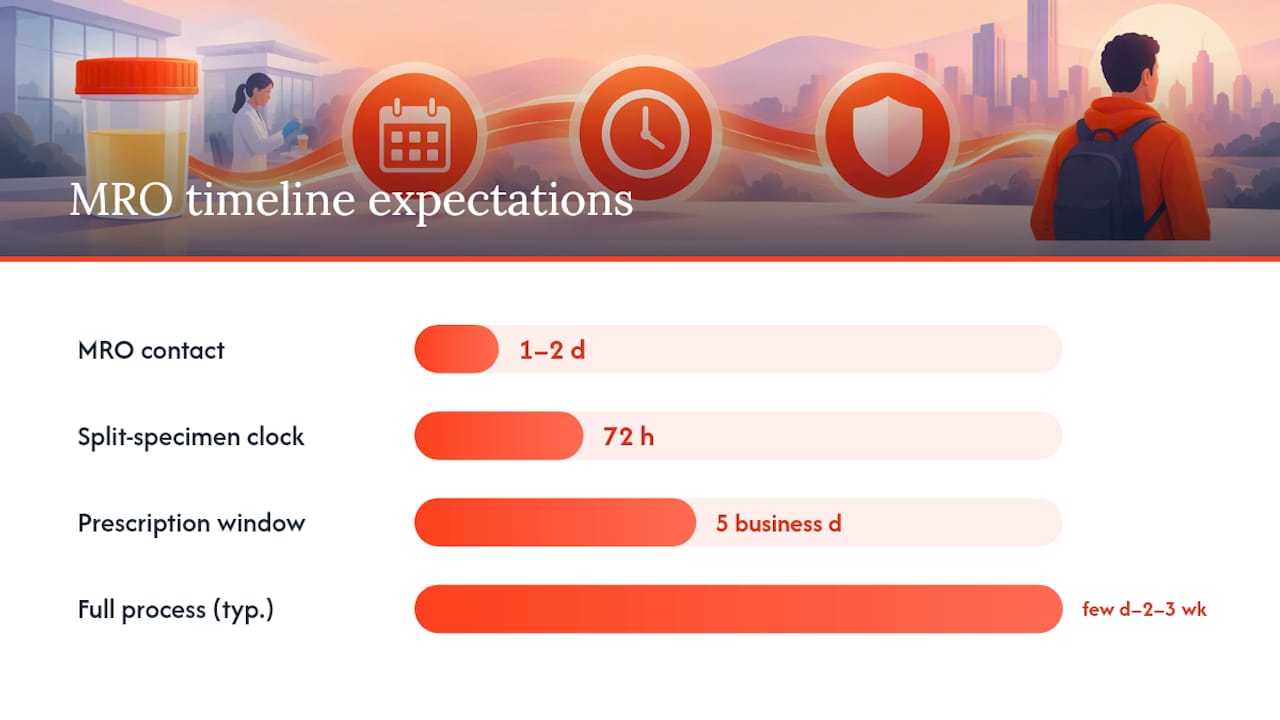
- Prescription documentation, if claimed. Say a prescription explains the result. You then have 5 business days to provide prescription and dispensing records from your pharmacy or prescriber.
- Final determination and reporting. The MRO lands on one of four outcomes: verified negative, verified positive, cancelled, or refusal to test, then reports that outcome to the Designated Employer Representative through a secure channel.
Pro Tip: Call your pharmacy the same day you learn about a non-negative result and ask for a printed dispensing history. Having that document ready before the MRO calls back can shave days off the verification timeline.
One detail people miss: the MRO isn’t required to accept just any explanation. State medical marijuana authorizations, hemp products, or a doctor’s informal recommendation to use a Schedule I substance don’t count as legitimate medical explanations under federal MRO rules, no matter what your state law says.
Requesting a Split-Specimen Test (Bottle B)
Every donor sample gets split into two bottles at collection, Bottle A and Bottle B. Only Bottle A gets tested first. If that test comes back non-negative and the MRO verifies it, you still have one more move available.
You have 72 hours from the moment you’re notified of a verified positive or a refusal to test to request that Bottle B be sent to a second HHS-certified laboratory for independent testing. Miss that window and the request typically gets denied, so don’t sit on the decision.
Once you request it:
- The MRO directs the original lab to forward Bottle B to a different certified facility.
- Your employer has to facilitate the test, and you’re not required to pay anything up front.
- The second lab reports back with one of several outcomes: reconfirmed, failed to reconfirm, invalid, adulterated, substituted, or a partial reconfirmation covering only some of the drugs found in Bottle A.
Each split outcome changes the final verified result differently. A “failed to reconfirm” outcome, for instance, can cancel the original positive entirely, while a “reconfirmed” result locks the verified positive in place.
When the MRO Can Skip the Interview Entirely
Federal rules assume the MRO will talk to you before verifying anything, but three narrow exceptions let a physician move forward without a conversation:
- You explicitly decline to discuss the result with the MRO.
- Your Designated Employer Representative contacts you directly, and 72 hours pass with no response back to the MRO.
- The MRO and DER both make documented, reasonable attempts to reach you, and 10 days pass with no contact established.
In every one of these scenarios, the MRO has to document exactly what attempts were made and when. That paperwork matters, because you still get a 60-day window after verification to come forward with new information, a medical explanation you couldn’t provide earlier, for example, and ask the MRO to reopen the case.
What to Expect Timeline-Wise, and What to Have Ready
Most donors hear from an MRO within a day or two of the lab flagging a non-negative result, though contact attempts can stretch longer if your phone number on file is outdated. The 72-hour split-specimen clock and the 5 business day prescription window run independently of each other, so the full process, from lab flag to final verified report, often lands somewhere between a few days and two to three weeks depending on how quickly documentation moves.
Three things speed this along:
- A current prescription bottle or pharmacy printout with your name, drug name, and dosage
- Physician notes if the prescribing doctor needs to confirm anything directly with the MRO
- A callback number you’ll actually answer during business hours
Pro Tip: Keep your pharmacy’s direct fax or portal login handy. MROs often need records sent fast, and a phone call to a pharmacist who can email records same day beats waiting on postal mail.
If the MRO verifies a positive, what happens next depends on whether you’re in a DOT-regulated safety position or working under a private employer’s policy, which brings up an important distinction.
Federal Testing Rules vs. Private Employer Policies
DOT-regulated positions, truck drivers, pilots, and other safety-sensitive transportation roles, fall under 49 CFR Part 40 and HHS Mandatory Guidelines without exception. Every step described above, the interview requirements, the 72-hour split window, the documentation rules, applies as federal law.
Private employers running their own pre-employment drug testing programs often mirror these same procedures for consistency and fairness. But they’re not legally required to. A private employer’s policy might skip the split-specimen option or use a different review timeline entirely. If you’re not sure which set of rules governs your test, ask your employer directly and request MRO involvement if the process seems unclear.
PassMyDrugTest’s Take on the MRO Process
Michael, who writes the educational content and product guidance for Passmydrugtest, has spent years watching people research drug testing under pressure, usually right after getting a call they didn’t expect.
Here’s the point most guides miss: the 5 business day prescription window and the 72-hour split-specimen window don’t pause for confusion. Waiting to “figure out what to do” is the single most common way donors lose rights they actually had. If you have a legitimate prescription, get the documentation moving the same day you learn about a non-negative result, not after you’ve talked to a lawyer or an HR representative.
Passmydrugtest publishes practical guides on topics like resolving inconclusive results precisely because the regulatory language in Part 40 doesn’t translate into action on its own. Read the rule, then do the thing the rule allows you to do, quickly.
— Michael
Preparing for a Screening? Here’s What Passmydrugtest Offers
If you’re facing a non-DOT screening, a private employer’s policy, a legal requirement, or a personal test, the rules above may not fully apply to your situation, and that’s exactly where having the right product on hand matters more than knowing every regulatory citation.
Passmydrugtest carries hair, saliva, and urine testing products built for exactly these scenarios, along with detox shampoos for donors dealing with hair-follicle screening concerns. Fast shipping on U.S. orders means you’re not left waiting when a test date is already on the calendar. If you’re trying to figure out which product actually fits your situation, whether that’s a hair follicle test coming up or questions about saliva screening prep, call customer support during published business hours and talk through your specific circumstances before you buy anything. Browse the current product lineup and reach out with questions before your test date gets closer than you’d like.
Primary Sources Worth Bookmarking
Skip the secondary blog posts when you need the actual rule. The DOT’s MRO overview page covers physician duties and independence requirements. The eCFR’s Part 40 Subpart G lays out interview exceptions in exact regulatory language. SAMHSA’s MRO Guidance Manual details the recommended review checklist physicians actually follow.
Sources
- Medical Review Officers
- 49 CFR §40.131 — How does the MRO or DER notify an employee of the verification process after receiving laboratory confirmed non-negative drug test results?
- MRO Guidance Manual (SAMHSA)
FAQ
How long after a drug test does the MRO call?
Most MROs attempt contact within a day or two of receiving a non-negative lab result, though the exact timing depends on how quickly your employer supplies accurate contact information. If contact attempts fail, the MRO and DER must document their efforts, and after 10 days without contact, the MRO can verify the result without an interview.
How long does a urine test take to process through an MRO?
The lab typically reports results to the MRO within a few days of collection, but the full MRO verification, including contact attempts, the interview, and any prescription documentation window, can add anywhere from a few days to two or three weeks. The 5 business day prescription rule and the 72 hour split-specimen window are the two clocks that most often extend the timeline.
Do MROs only call if you fail the test?
Generally, yes. MROs get involved specifically to review non-negative results, meaning positive, adulterated, substituted, or invalid findings. A straightforward negative result usually goes straight to your employer without an MRO phone call, though MROs do randomly audit a portion of negative results for quality control.
What if I can’t be reached within 72 hours?
The 72 hour window applies specifically to requesting split-specimen testing after a verified positive, not to the MRO’s initial contact attempts. If you don’t respond to contact attempts at all, the MRO can eventually verify the result without an interview once 10 days pass with documented, reasonable efforts to reach you.
Can I dispute an MRO’s verified positive result later?
Yes, within limits. Federal rules give you a 60 day window after verification to bring forward new information or a medical explanation you weren’t able to provide earlier, and the MRO can reopen the case if that information is valid. Beyond that window, disputes typically move into your employer’s internal appeal process or arbitration.