
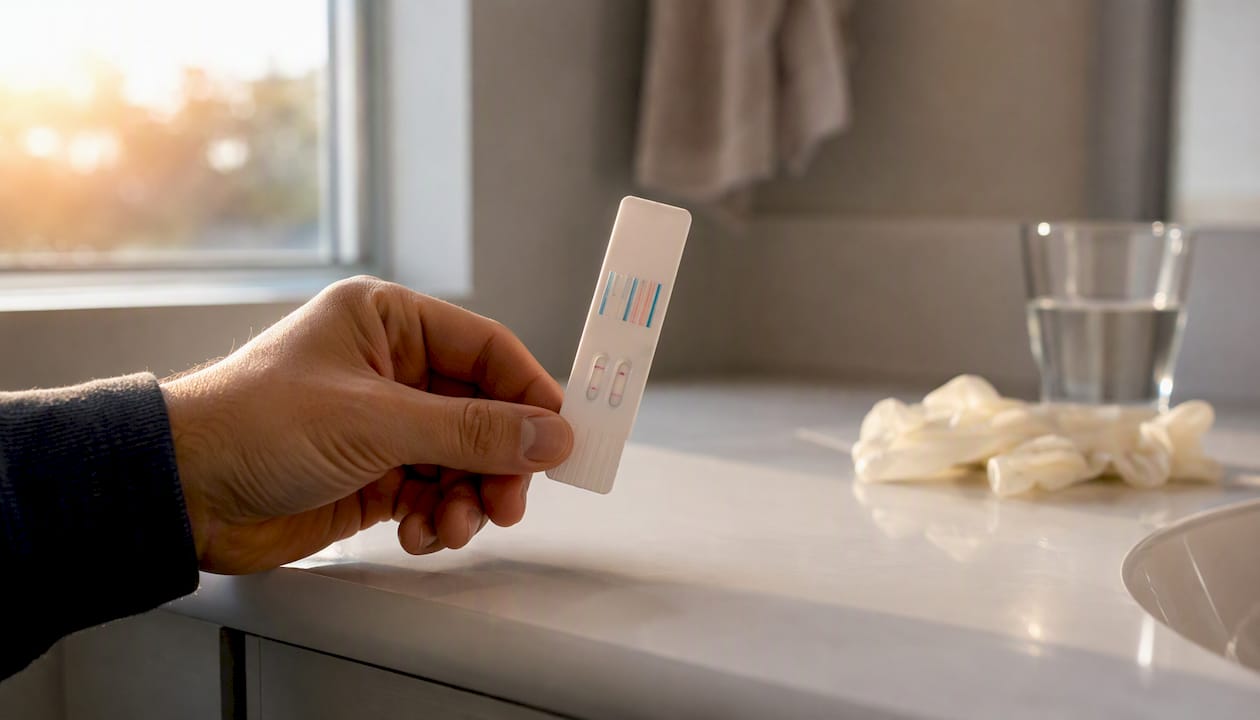
K2 Drug Test: What Actually Detects Synthetic Cannabinoids
K2 and Spice can be detected, but not by the standard 5-panel or 10-panel drug test most workplaces and courts use. Catching synthetic cannabinoids requires a specialized K2 drug test, and even those come with real limitations you need to understand before you buy.
Here’s the short version of what matters most:
- Standard THC panels miss K2 entirely. As NYC Health confirms, routine toxicology screens used in healthcare, criminal justice, probation, and correctional settings do not reliably detect synthetic cannabinoids.
- Rapid K2 urine screens exist and typically use a cutoff around 25 ng/mL for specific metabolites, delivering a qualitative result in minutes.
- Substance-ID kits can identify synthetic cannabinoid compounds in plant or powder samples but cannot confirm metabolites in biological specimens.
- LC-MS/MS lab confirmation is the gold standard when results have legal or medical weight.
- False negatives are common. Manufacturers constantly alter K2 formulas, and no single panel covers every variant.
Detection window for most rapid urine screens runs within a few days after use, though this varies by product, dose, and individual metabolism.
Key Takeaways
Standard drug panels do not detect K2, and only specialized synthetic cannabinoid screens, backed by LC-MS/MS confirmation when results matter legally, give you reliable answers.
| Point | Details |
|---|---|
| Standard panels miss K2 | Routine THC screens do not react to synthetic cannabinoid metabolites; specialized tests are required. |
| Rapid screen cutoff | Many at-home K2 urine dip cards use a 25 ng/mL cutoff and return results in minutes. |
| Detection window | Most rapid urine screens detect K2 metabolites roughly 24–72 hours after use. |
| Lab confirmation is definitive | LC-MS/MS identifies specific metabolites like FUBINACA and 5F-PINACA; use it when results carry legal weight. |
| Passmydrugtest for U.S. buyers | Passmydrugtest stocks K2 urine screens and substance-ID kits with fast U.S. shipping and phone support. |
Table of Contents
- What types of tests can detect a K2 synthetic drug?
- How rapid K2 urine tests work and what the specs actually mean
- Why false negatives and false positives happen with K2 testing
- How to choose and use a K2 test correctly
- What LC-MS/MS lab confirmation actually involves
- An editorial perspective on K2 testing that most guides skip
- Passmydrugtest carries K2 screening products with U.S. shipping
- Sources
What types of tests can detect a K2 synthetic drug?
Not all drug tests are built the same, and for synthetic cannabinoids, the gap between test types is wider than most people expect.
Rapid urine immunoassay panels
These are the dip-card or cassette-style tests designed specifically for K2/Spice. They work by detecting antibodies that react to certain synthetic cannabinoid metabolites. Results come back in minutes, and they’re the most practical option for at-home or point-of-care screening. The catch: each panel covers only the analytes it was designed for, so a newer K2 variant may slip through undetected.
Substance identification kits
Field reagent kits test a physical sample, such as plant material or powder, for the presence of certain chemical compounds or functional groups. They’re useful for identifying whether a substance contains synthetic cannabinoids before anyone consumes it. They do not test urine or blood, and they cannot confirm metabolite presence in the body.
Laboratory confirmatory testing
This is where precision lives. Gas chromatography-mass spectrometry (GC-MS) and liquid chromatography-tandem mass spectrometry (LC-MS/MS) can identify specific synthetic cannabinoid metabolites in urine, blood, saliva, or hair. LabCorp’s reflex confirmation workflow is a real-world example of how clinical labs handle a positive screen: the initial immunoassay triggers a confirmatory LC-MS/MS run automatically.
Hair and saliva testing for synthetic cannabinoids exist but are far less standardized than urine-based methods. Most reference labs focus on urine as the primary specimen type.
| Test type | Specimen | Speed | Best use case |
|---|---|---|---|
| Rapid urine immunoassay | Urine | Minutes | At-home or workplace screening |
| Substance-ID reagent kit | Plant/powder | Minutes | Identifying a physical substance |
| GC-MS / LC-MS/MS lab | Urine, blood, hair | 1–5 days | Legal, clinical, or definitive confirmation |
| Saliva immunoassay | Oral fluid | Minutes | Recent-use screening (limited availability) |
How rapid K2 urine tests work and what the specs actually mean
A lateral-flow dip card or cassette test does not detect K2 itself. It detects metabolites, the compounds your body produces after breaking down synthetic cannabinoids. That distinction matters because the parent compound clears quickly, while certain metabolites linger longer in urine.
When you read a product label, you’ll encounter a few terms worth decoding:
- Cutoff concentration: The minimum metabolite level that triggers a positive result. Many rapid K2 screens set this at 25 ng/mL for specific analytes. Below that threshold, the test reads negative even if trace amounts are present.
- Detection window: For most rapid urine screens, this runs roughly 24–72 hours after use. Heavy or repeated use can extend this, but synthetic cannabinoids generally clear faster than THC.
- Listed analytes: Product inserts name the specific metabolites the antibody reacts to. Common examples include JWH-018 N-pentanoic acid and JWH-073 N-butanoic acid. If a user consumed a variant not on that list, the test may not react.
- Claimed accuracy: Most manufacturers cite sensitivity and specificity figures in their inserts. Read these carefully. A 99% specificity claim means something very specific statistically, and it applies only to the analytes the test was validated against.
A two-line result means negative. A single line means positive. No line at all means the test is invalid and should be repeated. Always read the product insert before interpreting results, because the line logic can vary slightly between brands.
Pro Tip: Keep the product insert with your test kit. If you’re using results for documentation purposes, photograph the strip alongside a timestamp immediately after reading it, since color can fade.
Why false negatives and false positives happen with K2 testing
This is where K2 testing gets genuinely complicated, and where most buyers get caught off guard.
Why standard THC screens miss K2
Synthetic cannabinoids bind to the same receptors as THC but have completely different chemical structures. A standard marijuana panel looks for THC-COOH, a THC metabolite. K2 produces none of that. The antibodies in a THC test simply don’t react to K2 metabolites, which is why a case report published in PMC documented patients with clear synthetic cannabinoid intoxication who tested negative on routine urine drug screens. Clinicians had to request extended toxicology panels separately.
The formula-change problem
K2 manufacturers alter their chemical formulas constantly, specifically to stay ahead of detection and regulation. A test validated against JWH-018 may completely miss a newer compound like MDMB-4en-PINACA. No rapid screen can keep pace with every new variant, which means false negatives are a structural risk, not just an occasional glitch.
Cross-reactivity and false positives
Some medications can trigger false positives on synthetic cannabinoid immunoassays. Lamotrigine and quetiapine are among the documented examples. If someone takes either medication and tests positive on a rapid K2 screen, that result needs lab confirmation before any action is taken. For more on how medication interference affects drug test results, Passmydrugtest’s false positive guidance covers the mechanics in plain language.
- Low analyte concentration: If use was recent but light, metabolite levels may fall below the 25 ng/mL cutoff even when the compound is present.
- Narrow panel coverage: Most rapid screens cover a limited set of analytes. A newer K2 variant simply won’t trigger a reaction.
- Specimen handling errors: Diluted urine, improper storage temperature, or an expired test strip all compromise results.
Pro Tip: Any unexpected positive on a rapid K2 screen should be confirmed by LC-MS/MS before consequences are applied. Check the medication list first, then send the specimen to a reference lab.
How to choose and use a K2 test correctly
The right test depends entirely on what you’re trying to accomplish. Work through this checklist before you buy.
Decision checklist
- Screening or confirmation? If you need a quick yes/no for personal awareness, a rapid urine dip card works. If results will be used in a legal, employment, or clinical setting, you need lab confirmation.
- What sample type do you have? Urine is the standard for biological testing. If you’re testing a physical substance, you need a substance-ID kit, not a urine panel.
- Is chain of custody required? Legal and forensic use requires documented sample collection, tamper-evident seals, and a certified lab. At-home kits don’t satisfy this requirement.
- What’s your budget and turnaround need? Rapid kits cost less and deliver results in minutes. Lab confirmation costs more and takes days.
- Which analytes does the test cover? Ask the vendor for the full analyte list before purchasing. A test that covers only JWH-018 will miss most of what’s circulating today.
Step-by-step usage for at-home urine screens
- Collect a midstream urine sample in a clean, dry container.
- Check the test strip or cassette for the expiration date before opening.
- Dip the strip to the marked line for the time specified in the insert, usually 10–15 seconds.
- Lay it flat and read results at the time window stated, typically 5 minutes. Reading too early or too late skews interpretation.
- Document the result immediately with a photo if you need a record.
Questions to ask vendors before buying
- Which specific analytes does this test detect?
- What is the cutoff concentration for each analyte?
- Has this test been validated against current K2 variants?
- Is U.S. shipping available, and what is the return policy?
- Can you provide a chain-of-custody option or lab referral?
Red flags when buying online
- No analyte list or cutoff values listed anywhere on the product page
- No U.S. contact information or customer support phone number
- No return or replacement policy for defective tests
- Vague claims like “detects all synthetic cannabinoids” with no supporting documentation
What LC-MS/MS lab confirmation actually involves
LC-MS/MS stands for liquid chromatography-tandem mass spectrometry. It separates compounds in a urine sample by their chemical properties, then identifies each one by molecular weight and fragmentation pattern. The result is specific enough to name the exact metabolite present, not just flag a class of compounds.
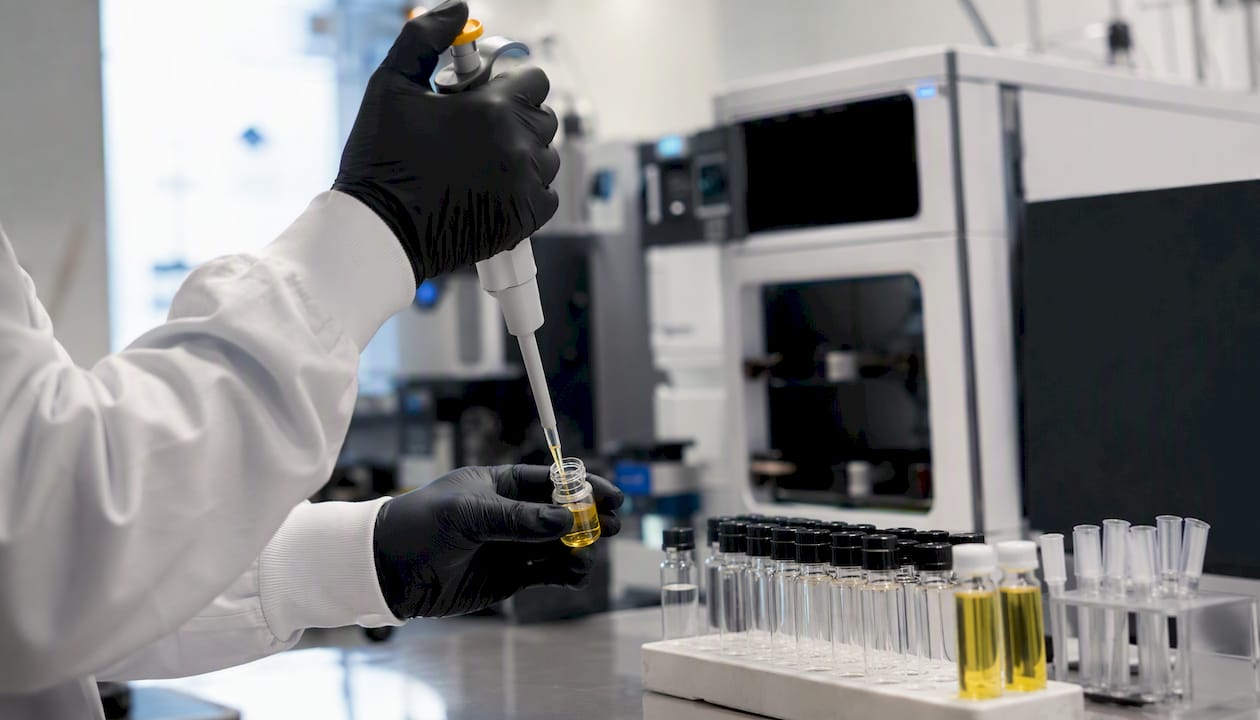
This matters for K2 because synthetic cannabinoids produce dozens of distinct metabolites depending on which compound was consumed. A rapid immunoassay might flag a positive based on a cross-reactive antibody. LC-MS/MS tells you exactly what triggered that flag.
LabCorp’s synthetic cannabinoid screen with reflexed confirmation is a standard example of how this workflow operates in practice: an initial immunoassay screen runs first, and any positive automatically triggers the LC-MS/MS confirmation step.
Mayo Clinic Laboratories’ expanded synthetic cannabinoid metabolite screen illustrates the breadth of what reference labs can report. The analyte list includes compounds like FUBINACA, 5F-PINACA, and MDMB-4en-PINACA, names that reflect how specific the chemistry has become. ARUP Laboratories maintains a comparable synthetic cannabinoid metabolite screen with its own component list and test codes, useful for cross-referencing before you send a specimen.
| Specimen type | Example analytes reported | Lab notes |
|---|---|---|
| Urine (LC-MS/MS) | JWH-018, JWH-073, AB-PINACA derivatives | Most common; reflex confirmation available |
| Urine (expanded screen) | FUBINACA, 5F-PINACA, MDMB-4en-PINACA | Reference labs; broader coverage |
| Blood | Parent compounds (short window) | Rarely used; rapid clearance limits utility |
| Hair | Various metabolites | Long detection window; less standardized |
Typical lab turnaround for LC-MS/MS confirmation runs one to five business days depending on the facility. For legal or forensic cases, confirm that the lab is CLIA-certified and can provide a chain-of-custody report.
An editorial perspective on K2 testing that most guides skip
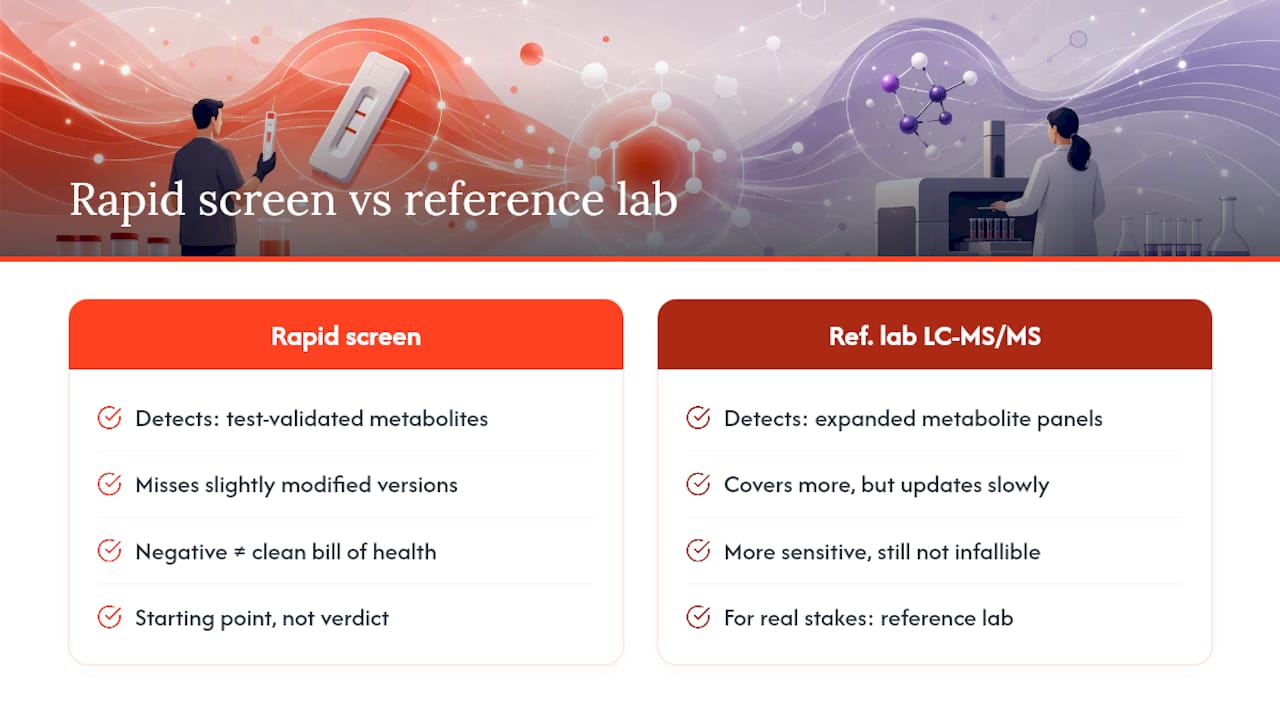
The honest problem with K2 testing isn’t the technology. LC-MS/MS is genuinely impressive, and expanded metabolite panels from reference labs cover a lot of ground. The problem is the gap between what a test was validated against and what’s actually circulating on the street at any given moment.
Synthetic cannabinoid manufacturers operate on a faster cycle than lab developers. By the time a new analyte gets added to an expanded panel, a slightly modified version of that compound may already be in distribution. This isn’t a hypothetical. NYC Health’s own public health guidance states explicitly that toxicology testing is not a reliable harm-reduction or surveillance tool for K2 precisely because of this dynamic.
What that means practically: a negative result on a rapid K2 screen is not a clean bill of health. It means the specific metabolites that test was designed to detect weren’t present above the cutoff. Those are two very different statements, and conflating them leads to bad decisions, whether you’re a parent, an employer, or someone monitoring their own use.
The right mental model is to treat rapid screens as a starting point, not a verdict. Use them for initial awareness. When the stakes are real, send the specimen to a reference lab and ask for an expanded panel. That’s not overcaution. It’s just how the chemistry works.
Passmydrugtest carries K2 screening products with U.S. shipping
If you’ve read this far, you know the two things that matter most: getting a test that actually covers K2 metabolites, and knowing when to escalate to a lab. Passmydrugtest stocks at-home synthetic cannabinoid urine screens and substance-ID kits, ships fast across the United States, and has phone support available during business hours if you need help choosing between formats.
The at-home K2 urine dip cards available through Passmydrugtest list specific analytes and cutoff values in their product specs, so you’re not buying blind. For readers who also want to understand the full picture of urine-based drug testing methods before deciding, that resource walks through how different panel types compare. When you’re ready to order, the detox products and test kit category is the fastest route to what you need, with U.S. delivery and a clear return policy.
Sources
- K2 – NYC Health
- Synthetic Cannabinoids (K2, Spice), Screen with Reflexed Confirmation – LabCorp
- K2 / Spice urine test (synthetic cannabinoids) – NarcoCheck
- Case report (PMC) – K2 clinical complications and detection issues