
Synthetic Urine Laws: Is Fake Pee Legal in Your State?
Synthetic urine is legal to buy and own in most of the U.S., but using it to cheat a drug test is a crime in a growing number of states. The trigger is almost always intent: the moment you use synthetic urine to defraud a screening, you can face misdemeanor or felony charges depending on where you live. State laws change often, so treat anything you read here as a starting point checked against current statutes, not a final answer. Your fastest next step is confirming your own state’s code directly, which we cover further down.
Key Takeaways
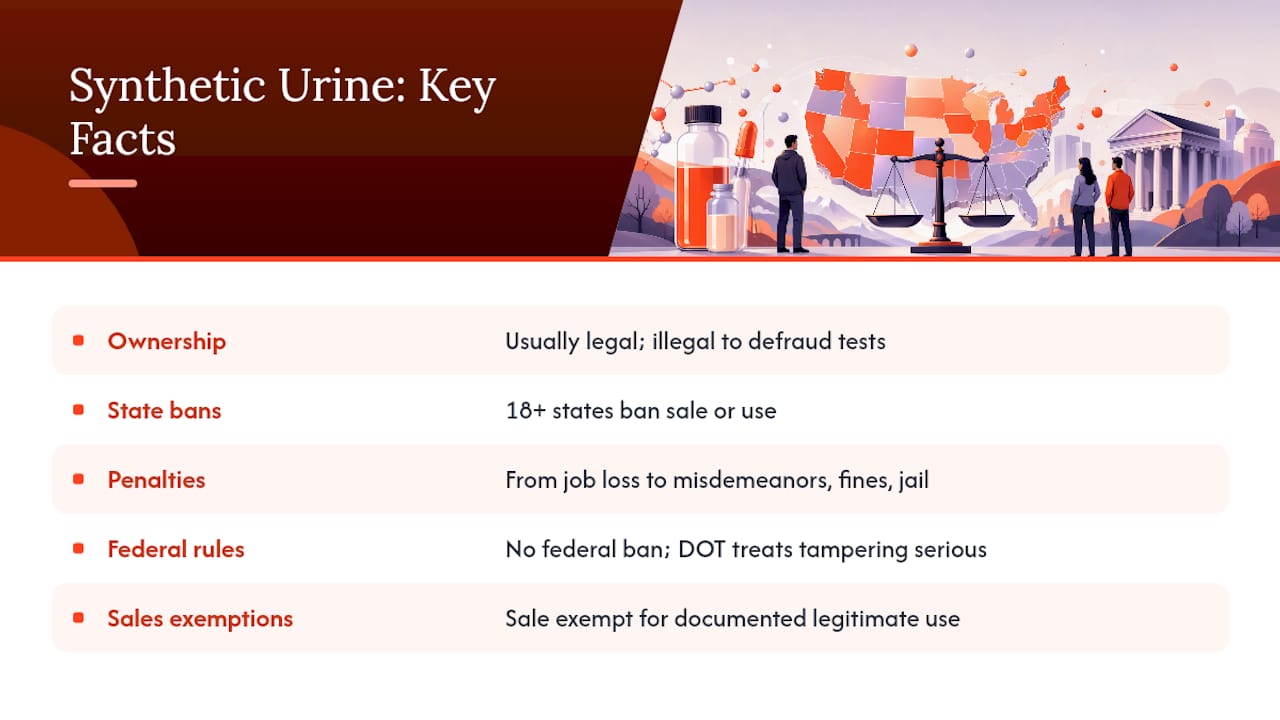
Synthetic urine is broadly legal to possess in the U.S., but using or selling it to defeat a drug test is a crime in at least 18 states and can trigger federal consequences for safety-sensitive workers.
| Point | Details |
|---|---|
| Intent is the trigger | Possession is often legal; using synthetic urine to defraud a test is what states criminalize. |
| Penalties cluster around misdemeanors | Fines up to roughly $1,000 and up to a year in jail are common first-offense maximums. |
| Sale draws harsher charges | States like Louisiana and Michigan penalize distribution and supply more heavily than personal use. |
| No ban doesn’t mean no risk | General fraud, tampering laws, and DOT rules can still apply where no synthetic-urine statute exists. |
| Laws change often | Confirm your state’s current code and effective dates before relying on any online summary. |
If you’re navigating a workplace or legal screening and want to understand your testing method and options without legal risk, Passmydrugtest’s drug testing method guide breaks down how validity checks work and what labs actually screen for. For employees facing a scheduled workplace test, the employee drug testing resource covers your rights and what to expect from the process.
Table of Contents
- What Do Synthetic Urine Laws Actually Say?
- Which States Ban Synthetic Urine Outright?
- What If Your State Has No Explicit Ban?
- What Are the Penalties for Using or Selling Synthetic Urine?
- How Do Authorities Actually Enforce These Laws?
- How Can You Check the Law in Your State?
- Why Do States Keep Passing These Laws?
- Frequently Asked Questions
- Sources
What Do Synthetic Urine Laws Actually Say?
Most synthetic urine statutes draw a line between the product and the purpose. Owning a bottle of synthetic urine, by itself, isn’t illegal in the majority of states. Using it, marketing it, or selling it specifically to help someone beat a drug or alcohol test is what turns a legal product into a criminal violation.
Statutes typically define a “drug-masking product” or “synthetic urine” in fairly specific terms, then list prohibited conduct. Michigan’s law, for example, defines the product and bans distributing, delivering, selling, or possessing it with intent to distribute, under MCL 750.410c. Tennessee’s statute goes further, criminalizing intentional use to falsify a test while carving out an exception for bona fide educational, medical, or scientific sales.
Lawmakers writing these bills tend to include the same building blocks:
- A definition section spelling out what counts as synthetic urine or a urine additive.
- Language prohibiting manufacture, marketing, sale, distribution, use, or possession “to defraud” a screening test.
- Exemptions for calibration equipment, laboratory research, or documented medical and educational purchases.
Pro Tip: Prosecutors usually prove intent through circumstantial evidence, like text messages, packaging marketed as “detox” or “pass a test,” or statements made to a test collector. Courts rarely need a confession to establish fraudulent purpose.
Which States Ban Synthetic Urine Outright?
Coverage varies a lot by state, and legislatures keep adding bills. Reporting on this trend counts at least 18 states with explicit bans as of recent tracking, and that number keeps climbing. Here’s how the landscape breaks down, current as of early 2026. Always cross-check against the state’s own code before relying on this for a legal decision.
States with explicit use-and-sale bans:
- Tennessee — §39-17-437 criminalizes intentional use or possession to falsify a test and bans sales outside documented exceptions. Violations are misdemeanors.
- Alabama — §13A-12-340 bans knowingly manufacturing, marketing, selling, distributing, using, or possessing synthetic urine to defraud a screening.
- Iowa — Iowa Code 715A.11 prohibits manufacturing, marketing, selling, distributing, using, or possessing synthetic urine to defraud a test. A first offense is a simple misdemeanor, with harsher penalties on repeat violations.
- Michigan — MCL 750.410c targets distribution and sale with intent, punishable by up to a year in jail or a $1,000 fine.
States criminalizing distribution or supply specifically:
- Louisiana — RS 14:102.25 criminalizes supplying products meant to falsify a screening test, with fines and possible imprisonment.
States with recent bills or emerging activity:
Legislatures in several Southern and Midwestern states have introduced bills modeled on Tennessee’s and Alabama’s language in the past few years, often pushed by employer and insurance groups, as reporting on a Mississippi bill describes. Some pass; others stall in committee and get reintroduced the following session.
States without an explicit synthetic urine statute:
A number of states have no law naming synthetic urine specifically. That doesn’t mean using it carries no risk, which the next section covers.
Statutes get amended, repealed, and reintroduced constantly. This checklist reflects law as reviewed in early 2026 and should be verified against the state’s official code before you make any decision based on it.
What If Your State Has No Explicit Ban?
Silence in the statute books isn’t a green light. Prosecutors in states without a synthetic-urine-specific law can still reach for general fraud, deceptive practices, or tampering statutes to charge someone who tries to fake a screening.
- General fraud or “obstruction of justice” statutes can apply to falsifying a court-ordered or legally mandated drug test.
- Employers almost never need a criminal statute to act: attempting to defeat a workplace test is typically a straightforward violation of your employment contract, leading to termination or a referral to law enforcement.
- Safety-sensitive workers face a separate layer of federal exposure. DOT/ODAPC rules under 49 CFR Part 40 treat sample tampering or adulteration as a program violation, which can pull a commercial driver or safety-sensitive employee off duty regardless of what state law says.
A generic tampering statute might read something like “knowingly falsifying a physical evidence sample submitted for official testing,” language broad enough to sweep in a swapped urine cup even without the words “synthetic urine” anywhere in the code.
What Are the Penalties for Using or Selling Synthetic Urine?
Penalties cluster around a few tiers, and sale or distribution almost always draws a harsher charge than simple possession or use.
- Simple misdemeanor: Iowa’s first-offense penalty under 715A.11, which can also come with a court-ordered substance-use evaluation instead of, or alongside, a fine.
- Misdemeanor with jail exposure: Michigan’s MCL 750.410c allows up to 1 year in jail or a $1,000 fine for distribution offenses.
- Enhanced penalties for repeat offenses: Iowa’s statute steps up punishment for a second or subsequent violation.
- Fines plus possible imprisonment for supply: Louisiana’s RS 14:102.25 targets anyone supplying a product meant to falsify a test.
Across these representative statutes, maximum penalties commonly top out around a year in jail and roughly $1,000 in fines for a first offense, with felony-level exposure reserved mostly for large-scale distribution or repeat violations. Sentencing details vary by state, so treat these figures as a general range, not a guarantee.
How Do Authorities Actually Enforce These Laws?
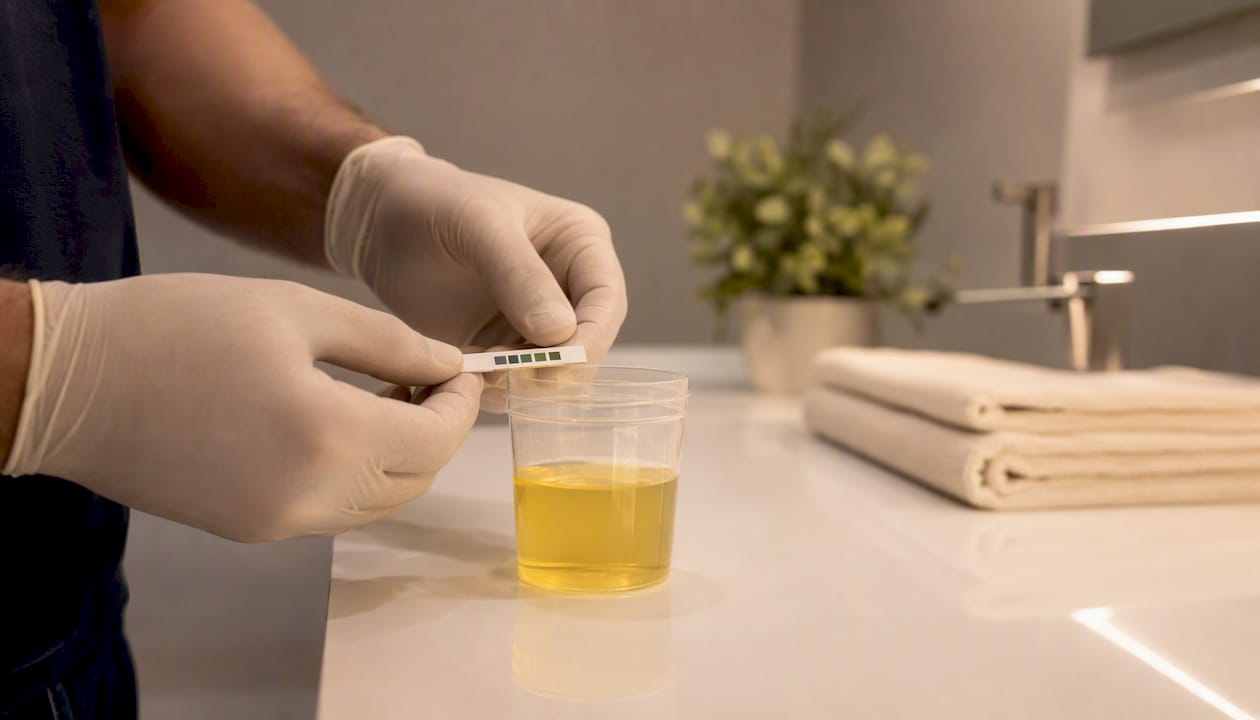
Enforcement usually starts at the collection site, not in a courtroom. A collector who notices an unusual temperature, color, or container can flag a sample for validity testing. Labs then check creatinine, pH, and specific gravity, markers that routinely catch synthetic and diluted samples. A failed validity check can get reported to an employer, and in some cases, to law enforcement.
Most statutes carve out exceptions for legitimate commerce. Sellers documenting a sale to a school lab, a hospital, or a calibration company for equipment testing typically fall outside the ban, provided they keep records showing the buyer’s purpose was educational, medical, or scientific rather than fraudulent.
How Can You Check the Law in Your State?
- Search your state’s official code for “synthetic urine” or “drug-masking product” to find the exact statute number.
- Check your state legislature’s bill-tracking page for pending amendments, since penalties and definitions change almost every session.
- Review the National Conference of State Legislatures for cross-state tracking of drug-testing and fraud legislation.
- Confirm the statute’s effective date. A law passed this year may not apply to conduct that happened before it took effect.
- Contact a local public defender’s office or municipal court clerk if the statutory language is ambiguous for your situation.
Why Do States Keep Passing These Laws?
Lawmakers target synthetic urine mainly because of workplace safety, not moral panic. Industries with safety-sensitive roles, transportation especially, push for bans because a masked positive test can put a truck driver or machine operator back on the job undetected. My honest read: the smartest move is never attempting deception at all. Verify your state’s actual statute before you decide anything.
Frequently Asked Questions
Is synthetic urine illegal to own?
In most states, simply owning synthetic urine isn’t a crime. The legal problem starts when you use it, or intend to use it, to defraud a drug or alcohol test.
Is synthetic urine legal in all 50 states?
No. At least 18 states have statutes explicitly banning synthetic urine use or sale, and more states keep introducing bills each legislative session.
What happens if you’re caught using synthetic urine?
Consequences range from a failed workplace test and termination to misdemeanor charges under state law, with possible fines, jail time, or a court-ordered substance evaluation depending on the state and prior offenses.
Do federal laws regulate synthetic urine?
There’s no single federal ban, but DOT/ODAPC rules treat sample tampering as a serious violation for safety-sensitive transportation employees, independent of any state statute.
Can synthetic urine be sold legally for other purposes?
Yes. Many statutes, including Tennessee’s, exempt sales for documented educational, medical, or scientific use, provided sellers keep records showing the buyer’s legitimate purpose.
This article is general information, not a substitute for advice from a qualified lawyer. Consult a qualified legal professional about your own circumstances before acting on anything here.
Sources
- MCL – Section 750.410c – Michigan Legislature
- Iowa Code 715A.11 (2026) – Synthetic urine and urine additives
- Tennessee Code §39-17-437 – Falsification of the results of a drug test – Synthetic urine prohibited
- Alabama Code §13A-12-340 – Manufacture, sale, use, etc., of synthetic urine or urine additive
- DOT/ODAPC – 49 CFR Part 40 (adulteration/tampering guidance)