

Remote Job Drug Testing: What to Expect Before You Start
Yes, remote jobs can and often do drug test. Working from home does not exempt you. Employers who screen office staff commonly apply the same policy to remote hires. They just collect the sample differently, usually an oral-fluid swab you take at home on video, or a visit to a local collection site. What matters is the employer’s written policy, your state’s law, and whether the job is covered by federal Department of Transportation (DOT) rules.
This guide explains when remote employers test, how at-home collection works, how THC is handled, and how to prepare calmly and honestly.
TL;DR
- Remote employees and applicants can be tested for the same reasons as on-site staff: pre-employment, random, reasonable suspicion and post-accident.
- The most common remote method is an oral-fluid sample collected at home on video, with results typically back in 24 to 48 hours.
- THC can show up on tests long after use, and a positive result does not prove impairment at work.
- State law varies a great deal, and DOT-covered jobs follow federal rules that override state law.
- Read the written policy, ask HR which test and window apply, and plan ahead so nothing surprises you.
Table of Contents
- Do remote jobs drug test?
- When an employer can require a test
- How remote and hybrid drug tests actually work
- Test types and what each one looks at
- THC, medical marijuana and your state
- What a drug-free workplace policy should tell you
- Preparing for a remote screening the smart way
- Our perspective
- Where our range fits
- FAQ
- Sources
Do remote jobs drug test?
Many do, though not all. Testing depends on the employer, the industry and the role, not on where your desk is. One 2023 benchmarking survey found that 61.5% of respondents do not run pre-employment marijuana tests for non-safety-sensitive positions, while 35.9% do. So a large share of employers skip THC screening for ordinary desk roles, but a meaningful minority still include it.
A remote job is more likely to include a screen when:
- The company runs a standard pre-employment package for every offer, regardless of location.
- The role touches regulated work, such as transportation, healthcare, finance or government contracting.
- The client or contract the employer serves requires a drug-free workforce.
- The employer’s handbook lists random or reasonable-suspicion testing for all staff.
Job boards advertise “no drug test required” remote listings, but those filters reflect the posting, not a guarantee. Policies can change between the listing and the offer letter, so confirm in writing.
When an employer can require a test
Written drug-testing policies typically list pre-employment, post-accident, random and reasonable-suspicion testing. Employers may use all of them or only some, but they must document the policy and apply it consistently to employees in the same situation.
Pre-employment
This is the one remote applicants meet most often. It usually comes after a conditional offer. You receive instructions by email, then complete a collection within a set window, often a day or two. Our page on pre-employment drug testing covers the typical panels and timelines.
Random
Random testing means employees are picked without warning. The same employer guidance cautions against randomly testing everyone in low-risk jobs because it could infringe privacy rights. For cannabis in particular, one workforce source notes that random testing is generally not allowed unless required by law. That is a general statement, so check your own state and employer policy.
Reasonable suspicion
Reasonable suspicion needs more than a hunch. Legal commentary describes it as an articulable belief backed by particular facts and reasonable inferences, and for remote staff it stresses contemporaneous documentation of observable behavior, such as slurred speech on a video call, while staying within ADA limits on medical inquiries. Connecticut guidance, for example, lets employers act on specific articulable symptoms of impairment that reduce job performance while working or on call.
Post-accident and return-to-duty
These apply mostly to roles with physical risk, such as driving or field work. A pure home-office employee rarely meets them, but a hybrid role with site visits might.
How remote and hybrid drug tests actually work
Remote testing, sometimes called a telehealth collection, usually has the applicant or employee give an oral-fluid sample at home while a video app guides the process, with results typically available within 24 to 48 hours. The same SHRM report explains that the rise of oral-fluid testing lets employers mail kits to applicants and either watch them live or record the collection through an app.
A typical sequence looks like this:
- You receive an email or text with a link and a deadline.
- A kit arrives, or you are directed to a local collection site instead.
- You verify your identity on camera.
- You follow on-screen steps to collect the swab while the collection is observed or recorded.
- You seal and ship the sample, or the app submits it.
- A laboratory reports the result to the employer, usually within a day or two.
Because the collection is observed, the process is designed to be fair and consistent. Your best preparation is practical: have a quiet space, a charged device, photo ID and the instructions within reach, and avoid eating, drinking or smoking in the window the instructions specify.
Not every remote worker tests at home
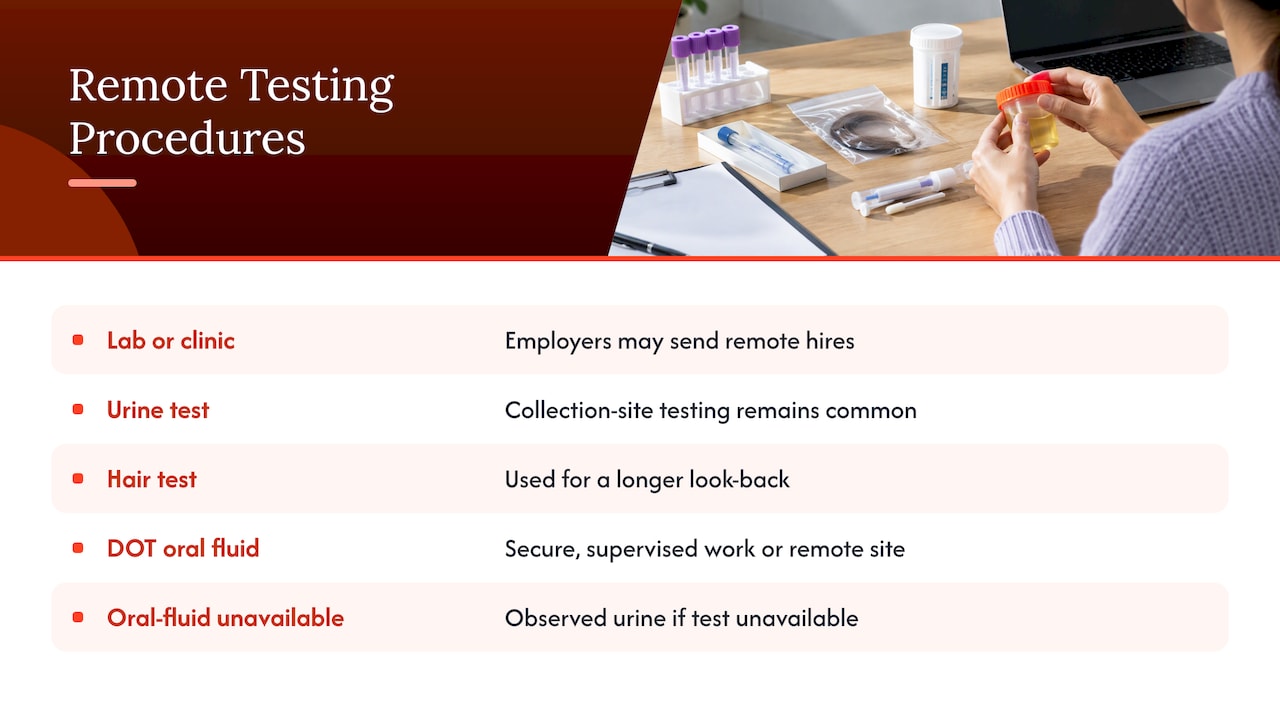
Some employers send remote hires to a lab or clinic. Urine testing at a collection site is still common, and hair testing is used by some employers for a longer look-back. Federal DOT collections follow stricter rules. Under 49 CFR § 40.47, an oral-fluid collection for a DOT test must happen at a collection site meeting specific security and supervision requirements, which may be permanent or temporary and located at the work site or a remote site. A May 2026 Federal Register notice also revises DOT procedures to require a directly observed urine collection when an oral-fluid test is required but cannot be performed because oral-fluid testing is not yet available. If you hold a safety-sensitive transportation role, rely on your employer and the DOT, not a general guide, for your exact procedure.
Test types and what each one looks at
| Test | Typical remote use | General look-back | Notes |
|---|---|---|---|
| Oral fluid (saliva) | Most common for at-home, video-observed collection | Short, recent use | Easy to observe, fast results |
| Urine | Local collection site or lab | Days to weeks, depending on use pattern | Widely used pre-employment |
| Hair | Lab or clinic collection | Longest window | Used by some employers for extended history |
Exact detection windows depend on the lab, the cutoff level, how often you use and your body. You can read more on our pages about marijuana urinalysis detection times, how marijuana is detected in drug testing and saliva testing.
THC, medical marijuana and your state
This is where most readers have questions. Three points matter.
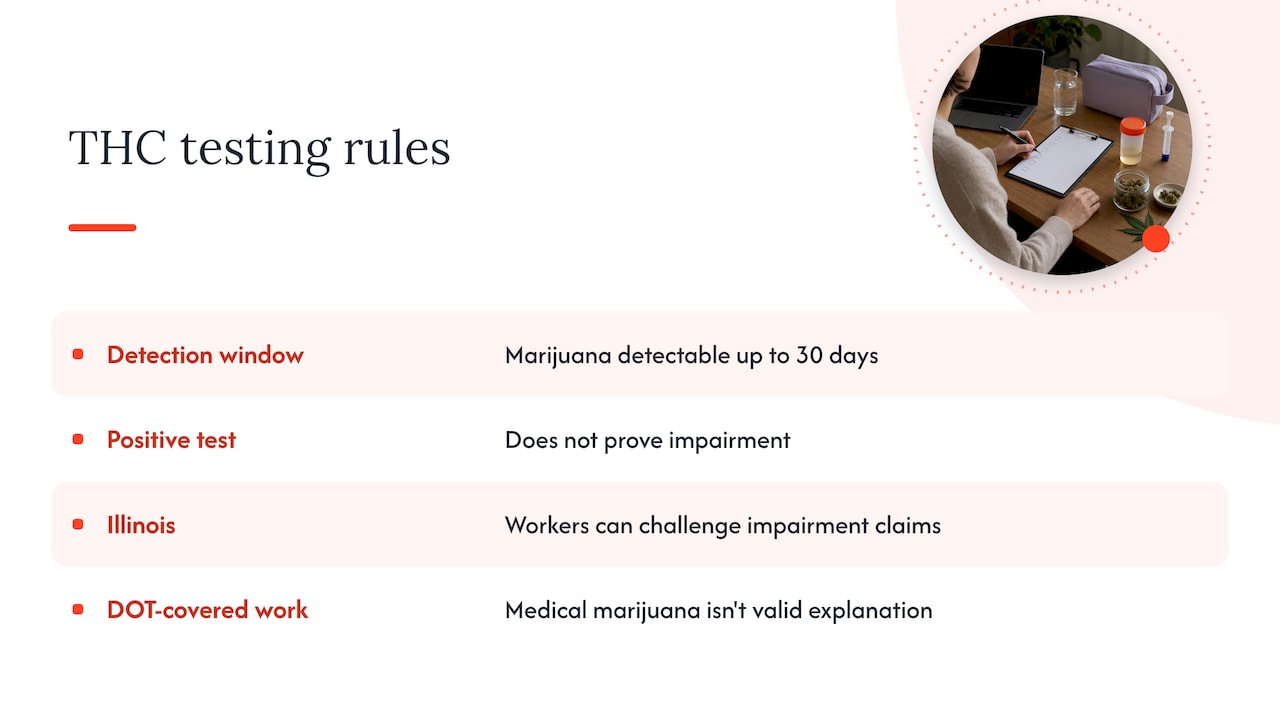
A positive test is not proof of impairment. One workplace cannabis source says that drug tests can detect marijuana for up to 30 days after use, so a positive does not mean you were under the influence at the time. Employers can still prohibit use during work hours and possession on their property.
State law differs. Some states protect off-duty cannabis use or limit testing, and others let employers screen freely. Two examples we have covered are Illinois’ marijuana testing law, which lets workers challenge claims of impairment, and Washington cannabis testing for job applicants. Your state’s rules apply to you based on where you work, so confirm them before assuming a protection exists.
Federal rules override. For DOT-covered work, medical marijuana is not a valid explanation for a positive result under 49 CFR § 40.151(e), and DOT rules preempt conflicting state or local law for covered employees. An employment-law review adds that remote workers in safety-sensitive roles remain subject to testing even where marijuana is legal under state law.
If you hold a medical card, tell the right person early. Ask HR or the medical review officer how a prescription or certification is handled for your role, and raise any disability-related questions with an employment attorney in your state.
What a drug-free workplace policy should tell you
You are entitled to know the rules before you are tested. A sound policy is written and covers when testing happens, consent and collection procedures, reporting timeframes, and consequences for positive results, adulteration or refusal. Some states require employers to give formal notice of the policy before screening applicants or employees. That same source notes policies should say whether an employee can be removed from work pending results.
Before you accept an offer, ask:
- Which test type will I take, and at home or at a site?
- What substances are on the panel, and is THC included?
- What is the deadline to complete the collection?
- What happens if the sample is invalid or I need a retest?
- Is the job covered by DOT or another federal program?
These are normal questions, and asking them signals that you are taking the process seriously.
Preparing for a remote screening the smart way
Preparation is mostly about information and timing.
- Find out the test type. The right plan for a saliva swab is different from the plan for a hair test.
- Count back honestly. Think about how recently and how often you have used. Frequent use generally means longer detection, and no product or guide can promise a particular result.
- Follow the collection instructions exactly. Wait periods before an oral-fluid test, ID requirements and deadlines are there for a reason.
- Do not tamper. Employer policies treat adulteration or substitution as seriously as a positive, and an observed remote collection is built to catch it. Adulteration can cost you the offer.
- Ask about timing. If you need more time, ask the employer for a reasonable start date or schedule rather than rushing.
- Keep records. Save the instruction emails, your confirmation and any result notice.
Our marijuana drug testing facts page is a good next read if you want the basics of how THC metabolites are measured.
Our perspective
We hear from people every day who accepted a remote job and then saw an email about a drug screen. The surprise is usually the worst part, not the test itself.
Our view is simple: the best preparation is information. Know which sample type you will give, know how your state treats cannabis, and know what your employer’s policy says. Once you know those three things, you can make a plan that fits your own situation.
That is why we pair detailed educational guides with a curated range of drug-test products and live phone support during our published business hours. We want you to pick what suits your specific scenario, whether it is a workplace, legal or pre-employment screening, rather than guess.
We design our guides to be clear and practical, and we ship within the United States quickly so you are not left waiting if your test date is close.
MIchael
Where our range fits
If you want to understand your own situation before a screening, we offer at-home drug test kits and preparation products for different sample types, along with guides explaining each one. You can browse urine testing, saliva testing and hair testing products, or start from our main shop and call us if you want help matching a product to your test.
For hair screens specifically, our hair detox shampoo range is a place to start. Products are intended to be used as directed, and results vary by person and test.
FAQ
Do remote jobs drug test?
Many employers do, especially for pre-employment and in regulated industries. Remote status does not change a company’s policy; it only changes how the sample is collected. Ask HR for the written policy and the test type before your collection date.
How is a drug test done for a work-from-home job?
The most common method is an oral-fluid swab taken at home while a video app guides and observes you. Results typically return within 24 to 48 hours. Some employers instead send you to a local lab for a urine or hair collection.
Can a remote employer test me at random?
If the written policy allows it and it is applied consistently, yes in many cases. Some states and employers limit random testing, particularly for low-risk roles and for cannabis. Check your state law and handbook, and talk to an employment attorney if you are unsure.
Does a medical marijuana card protect me on a remote job drug test?
It depends on your state and your role. For DOT-covered work, medical marijuana is not accepted as an explanation for a positive result. For other jobs, ask your employer or a state-licensed employment attorney how your certification is treated.
How long does THC stay detectable?
It varies with the test type, how often you use and your body. One workplace source says marijuana can be detectable up to about 30 days after use. Our detection times guide explains the ranges by test.
Sources
- Creative Approaches to Drug-Testing Remote Workers Will Persist (SHRM)
- Employer’s Guide to Drug Testing in the Workplace
- Reasonable suspicion? Addressing growing employee substance abuse trends
- Cannabis Drug Testing in the Workplace
- Ogletree Benchmarking Survey 2023
- DOT 49 CFR Part 40 Section 40.47
- Federal Register, Volume 91, Issue 90, May 11, 2026
- SMACNA Substance Abuse Testing Guidelines
- Clearing the Haze: What Employers Should Expect (Employment Law Worldview)
- Handbook Hot Topics: State Laws Shape Drug-Testing Policies (Kutak Rock)