
Hair Dye and Drug Tests: What Actually Changes in Your Result
Yes, hair dye can affect a hair drug test, but not in the simple way most people assume. The test still reads a roughly 90-day window, and dye does not erase that window. Chemical treatments can lower the measured amount of THC and other drugs in the strand, and labs know it. This guide covers what dyeing, bleaching and perming do, what hair color has to do with it, and what to do before a hair screening.
TL;DR
- A hair test looks back about 90 days, and cosmetic dye alone does not shorten that window.
- Studies show permanent color, bleach and perms can lower measured THC. Reported drops range from about 14% to 60% or more, depending on the treatment.
- Labs are trained to record hair treatments and may interpret results with that in mind, so a lower reading is never a promise of a negative.
- Dye color itself does not matter. The chemistry (peroxide, alkaline bleach) does.
- If you have a hair test coming, plan around the timeline and the sample, not around a single product or trick.
Table of Contents
- Does hair dye affect a drug test?
- How a hair drug test works
- What the research says about dye, bleach and perms
- Does your natural hair color matter?
- Why dyeing is not a plan on its own
- Other things that change a hair test result
- Our perspective
- Preparing for a hair test: where to start
- Hair detox shampoo and test kits at Pass My Drug Test
- FAQ
- Sources
Does hair dye affect a drug test?
There are two honest answers, and both are true.
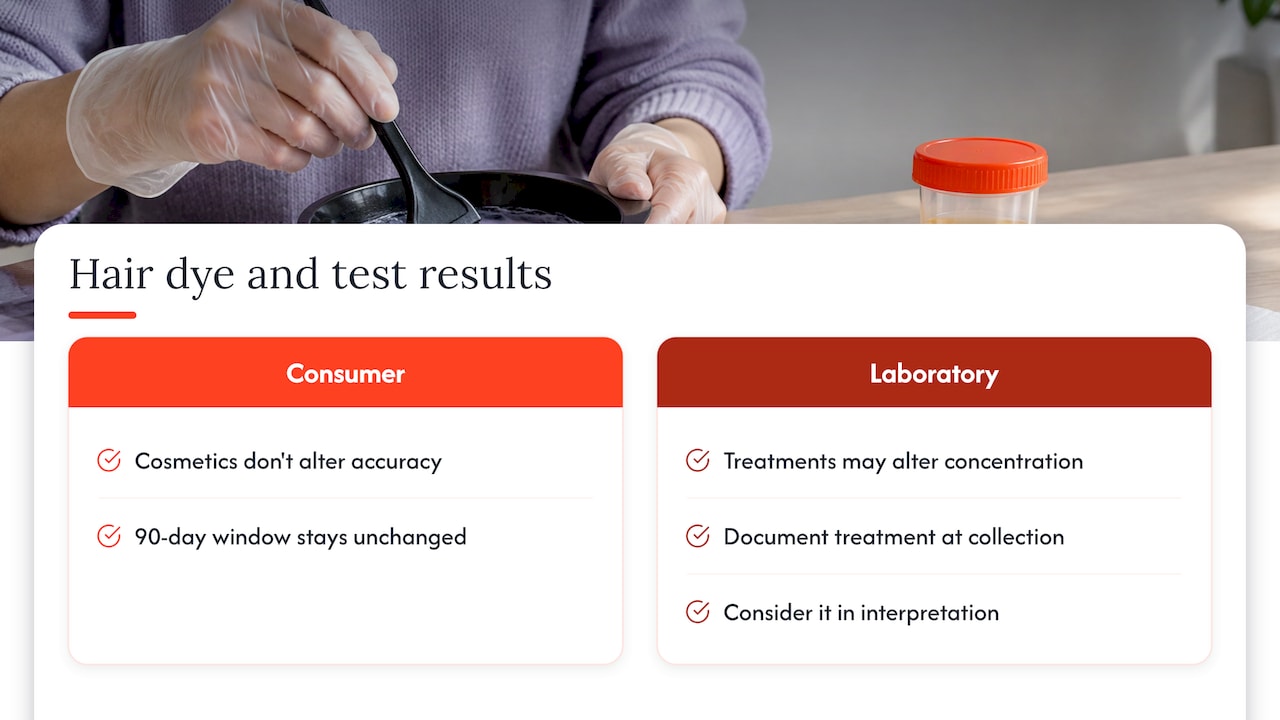
The first is the consumer-health answer. Healthline says that washing, dyeing or styling your hair will not affect the accuracy of a hair strand test. A company blog on the topic makes a similar point: metabolites sit inside the hair shaft, so the 90-day detection window does not change because of a cosmetic treatment.
The second is the laboratory answer. The 2021 consensus of the Society of Hair Testing states that bleaching, dyeing, perming, straightening and UV exposure can change the drug concentration in hair. It also says the type of treatment should be documented when the sample is collected and considered when the result is interpreted.
Put together: dye does not make the past 90 days disappear, but strong chemical treatment can reduce how much drug a lab measures. Whether that matters depends on the drug, the treatment, your hair and the cutoff the lab applies.
How a hair drug test works
Knowing the mechanics makes the dye question much easier to understand.
The detection window
A standard hair test reaches back about 90 days. Healthline notes that drugs generally cannot be detected in hair until five to seven days after use. A 2025 review in the Journal of Applied Laboratory Medicine explains why. Drugs enter the hair bulb within as little as 30 minutes, but they do not show up in hair above the scalp for at least a couple of days. That process can take up to 10 days.
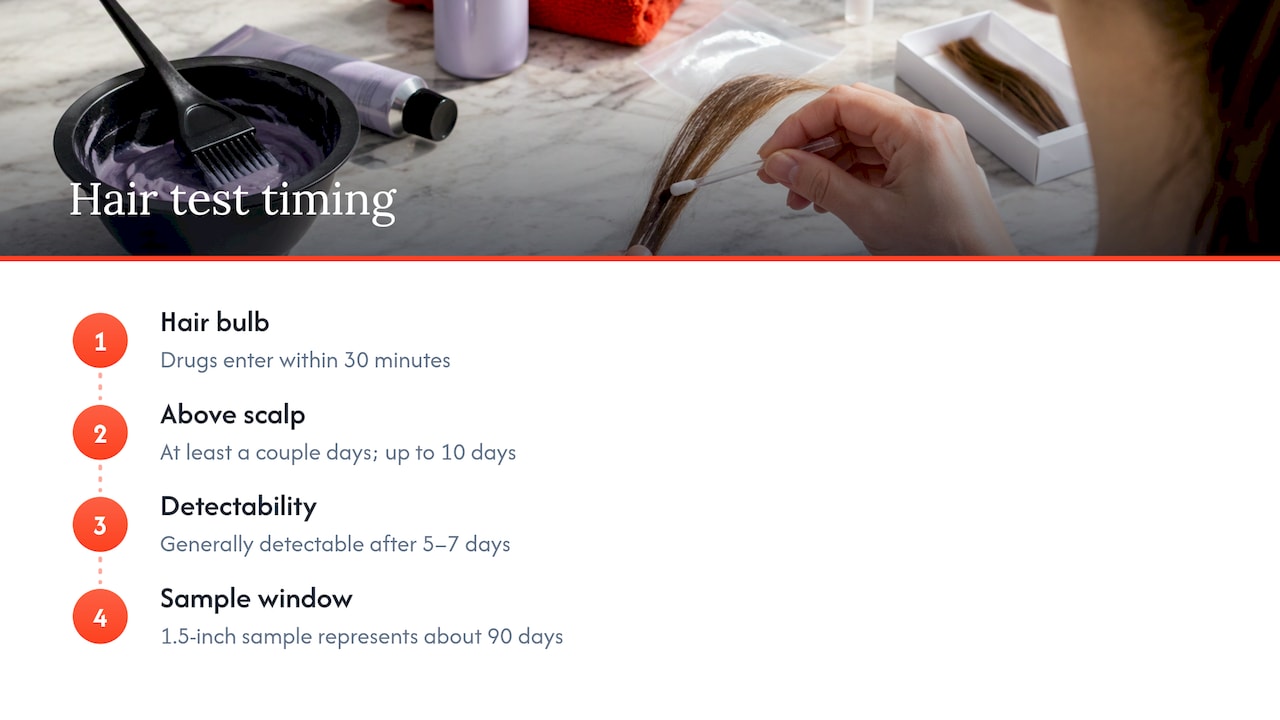
The 90 days come from simple arithmetic. Hair grows about half an inch a month, so a 1.5-inch sample from the scalp represents about three months. If you want more detail on timing, see our guide to the hair drug test window and our hair drug test detection times.
Collection and analysis
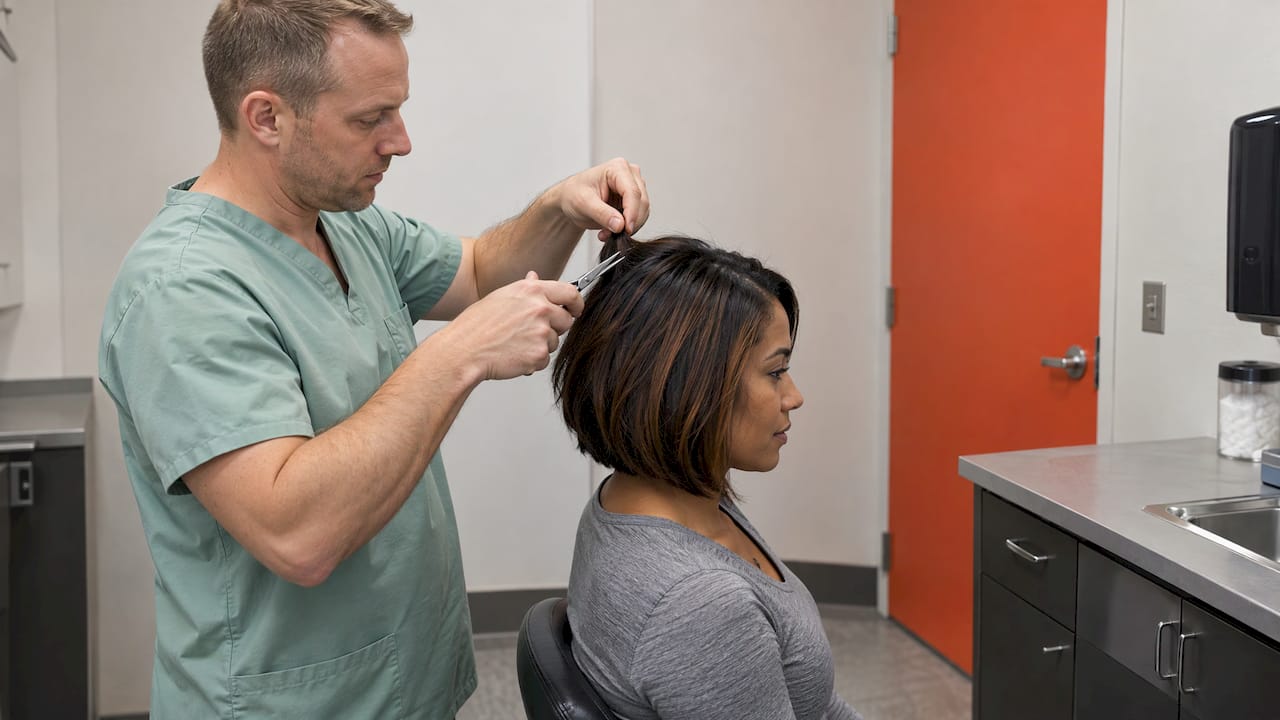
Per Healthline, a collector cuts 100 to 120 hairs from the crown. The sample is washed, checked for environmental contamination and screened with an immunoassay method called ELISA. International UNODC guidelines prefer the back of the crown as the collection site. They say a lock about as thick as a pencil is enough, and they say the collector should record the hair’s color, length, collection site and any cosmetic treatments.
That last point is the one to remember. The person taking your sample is expected to ask about, and write down, what you have done to your hair.
Cutoffs
Labs compare what they measure against cutoff levels. Under the proposed federal workplace guidelines, as summarized by LegalClarity, the initial screening cutoffs for hair are 1 pg/mg for marijuana metabolites, 500 pg/mg for cocaine, 200 pg/mg for opioids, 500 pg/mg for amphetamines and 300 pg/mg for PCP. Many private employers use their own panels, so check which one applies to you.
What the research says about dye, bleach and perms
The studies are consistent on direction and less consistent on size. Here is what they report.
| Treatment or study | What was found | Source |
|---|---|---|
| Coloring (Bertges et al., 2022) | THC concentration reduced by about 30% | PMC |
| Bleaching (Bertges et al., 2022) | THC concentration reduced by about 14% | PMC |
| Bleaching, another study | Mean decrease of 34% in THC (range 16.1% to 65.7%, 15 samples) | PMC |
| Perming, another study | Mean decrease of 48.2% in THC (range 24.2% to 74.8%, 10 samples) | PMC |
| Bleach and dye cycles (Mestria et al., 2023) | About 60% THC loss, more than other treatments | Wiley |
| Cosmetic treatment in general (Jurado et al., 1997) | Drug content lower in treated hair in every case; THC difference about 30% | PubMed |
The numbers differ because the studies used different products, different hair and different methods. The pattern is the same everywhere: treated hair tends to show less drug.
Why it happens
Permanent dyes and bleach rely on peroxide and alkaline conditions. Mestria and colleagues concluded that hydrogen peroxide under alkaline conditions, as in permanent bleaching, was the most effective at lowering drug concentrations. They also note that damage to melanin in the hair shaft is one of the main reasons drugs leach out. THC appeared especially vulnerable, which the authors link to its lipophilic nature.
The twist: metabolites can go up
A 2026 study in Drug Testing and Analysis treated hair with nine permanent dyes and one bleach. THC and cocaine mostly decreased. But THC-COOH and benzoylecgonine, the metabolites, increased in most samples. The authors suggest peroxide oxidation may form them inside the hair from the parent compounds.
This matters because the marijuana confirmation targets THC-COOH. So the result of a treatment is not a clean, predictable drop. It can push different numbers in different directions.
Dye color does not matter
The same 2026 paper says the findings indicate dye color itself is irrelevant, while chemical treatments can significantly change toxicological results. Choosing a darker or lighter shade does nothing for a test. The process is what counts.
Does your natural hair color matter?
It can. Drugs bind to melanin, the pigment that darkens hair. A SAMHSA presentation on hair pigmentation states that melanin content is higher in darker hair, and that the same dose can produce higher concentrations in dark hair than in light hair. The 2025 Journal of Applied Laboratory Medicine review adds that white hair incorporates almost no drug in the bulb.
There is a counterpoint in the same SAMHSA material. A statistical study of eight data sets found no significant association between hair color and the amount of drug recovered. The conclusion was that color plays a role in how drugs accumulate, but only a small part of a very complex process.
So the practical read is this: hair color is one variable among several, and no one can look at your hair and tell you how it will test.
Why dyeing is not a plan on its own
After reading the numbers, it is tempting to treat dye or bleach as a fix. Three facts argue for a wider view.
Results are variable. The same treatment gave a drop of 16% in one sample and 66% in another within a single study. A reduction that is large on average can still leave a particular sample above a cutoff.
Labs look for treatment. Researchers have developed markers for it. A 2023 review in Analytical and Bioanalytical Chemistry describes PTCA, a breakdown product of the pigment eumelanin, as a way to detect oxidative hair treatment. A cutoff of 20 ng/mg was proposed to tell treated from natural hair. Natural hair also contains some PTCA, and white or light blond samples may not show a big enough rise, so the method has limits. Still, the direction of the field is clear.
Interpretation takes treatment into account. The SoHT consensus asks that treatments be documented and considered. The UNODC guidelines tell toxicologists to stay alert to alternative explanations when reading a positive result. A treated sample is read with that context.
The researchers behind the 2022 Bertges paper make one more point worth knowing. The treatments they studied were not visible by eye, which is part of why sample manipulation is hard to detect, and part of why labs keep working on ways to detect it.
If you want to see how we cover the bleach side in detail, read what actually happens with hair bleaching and drug tests and how bleach changes drug levels.
Other things that change a hair test result
Dye is only one item on a longer list.
- Heat styling. The 2025 review reports that thermal degradation from a hair straightener lowers GHB, cocaine and cocaethylene, raises cannabinol, and can push THC up or down depending on hair color.
- Perming and straightening treatments. Both are named in the SoHT consensus alongside bleach and dye.
- UV exposure. Also named in the consensus.
- Damaged hair. The review notes that damage can affect how drugs are incorporated, fixed or released.
- External contamination. The UNODC guidelines say the washing procedure must be validated by each lab, and that with massive external contamination no wash can fully remove the contaminating compounds.
- Medications and supplements. Healthline cautions that false positives are possible, so tell the collector about prescriptions and supplements.
Our perspective
We hear from many people who have a hair test coming and have heard that dye is the answer, or that it makes no difference at all. Neither version is complete, and we would rather you decide with the full picture.
What we see in the research is that hair is a record with a long memory. Treatments change the record at the edges, and the effect varies from head to head. That is why we build our guides around the specific situation: which drug, which test, how much time you have, what kind of hair you have, and who is asking for the sample.
This is also why we pair education with a curated range of products. Our hair detox shampoo is there for people who want a product made for the hair test scenario, and our guides explain how the test works, so you can pick what suits your circumstances. Our team is available by phone during our published business hours if you want to talk it through, and we ship fast within the United States.
Our advice is simple. Start with the timeline, understand your test, and choose your preparation deliberately instead of relying on a rumor.
MIchael
Preparing for a hair test: where to start
A short, practical sequence works better than guessing.
- Confirm the test type. Ask the employer or the court which test it is: hair, urine or saliva. Many people prepare for the wrong one.
- Work out your timeline. Hair holds about 90 days of history in a 1.5-inch sample. Because of the five-to-ten-day lag before use shows up in hair, very recent use often is not what a hair test reads. Our detection times guide lays this out by drug.
- List your prescriptions and supplements. Have them ready for the collector, as Healthline advises.
- Be honest about treatments. The collector is supposed to record dye, bleach and perms. Expect the question.
- Read the full how-to. Our walkthroughs on passing a hair strand drug test and what you can do before a hair follicle test cover the options step by step.
- Know the other test types. If your screening might be urine or saliva instead, see our pages on passing a saliva test and urine drug testing.
Hair detox shampoo and test kits at Pass My Drug Test
If your screening is a hair test, we carry Zydot Ultra Clean Shampoo in our hair detox shampoo range, chosen for people preparing for this exact situation. You can also browse our hair drug testing kits if you want to know where you stand before the real thing.
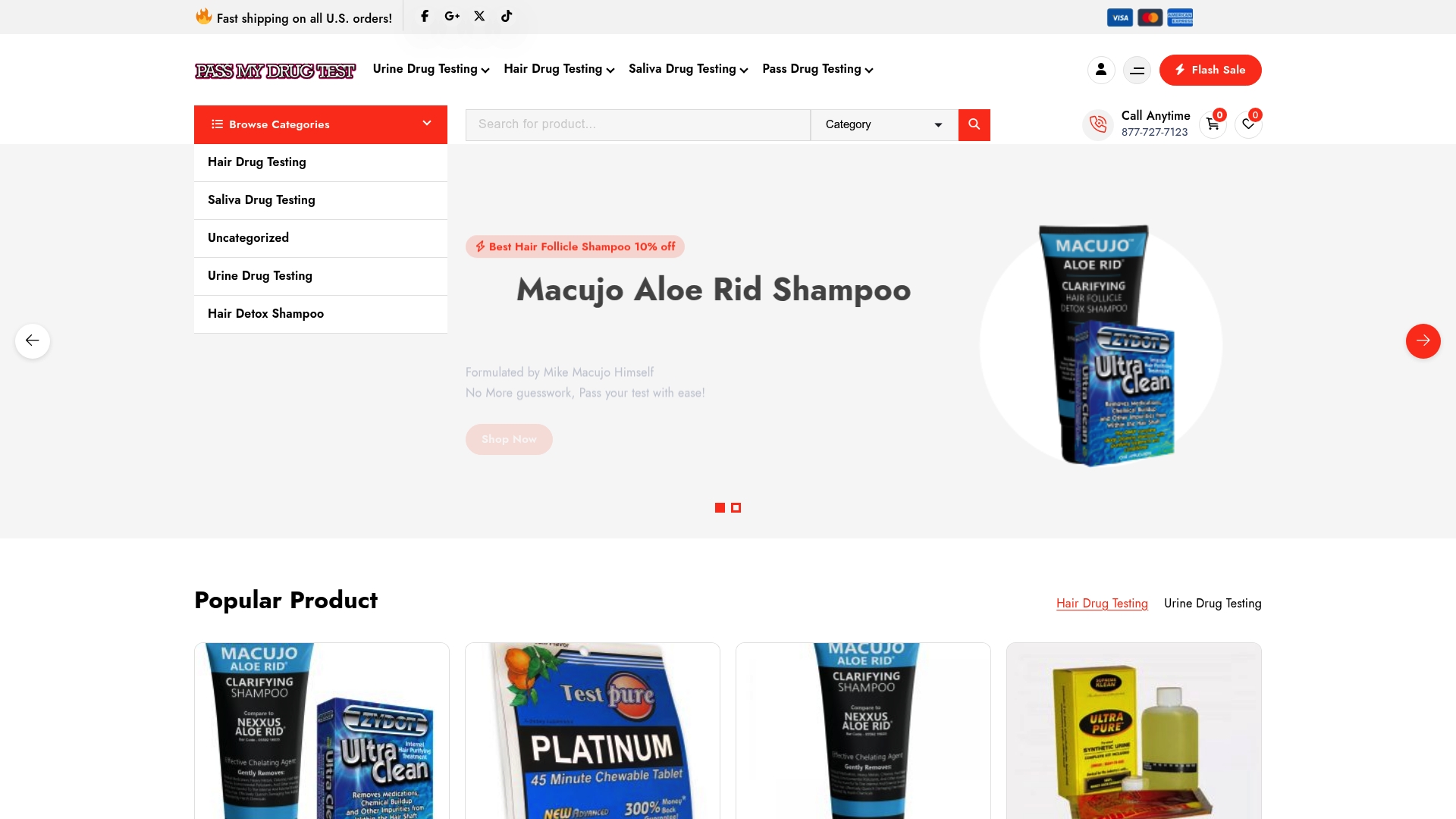
Orders ship fast within the United States, and our team answers the phone during published business hours if you want help choosing. Start at Pass My Drug Test and pick the product that matches your test.
FAQ
Will hair dye make me pass a hair drug test?
Not on its own. Studies show permanent color and bleach can lower the measured level of THC, with reported drops from roughly 14% to 60% depending on the treatment. But results vary from sample to sample, and labs record treatments when they read the result. Dye color makes no difference.
Does dyeing my hair shorten the 90-day detection window?
No. The window comes from how much hair is cut and how fast it grows, about half an inch a month. A treatment can change how much drug is measured in that hair, but it does not change which months the strand represents.
Does hair color affect a drug test?
It can influence how much drug builds up. Drugs bind to melanin, and the same dose can produce higher concentrations in dark hair than in light hair. A statistical review of several data sets found color to be only a small part of a complex process, so it is not a reliable predictor.
Can a hair test detect that I dyed or bleached my hair?
Often the collector simply records it. Labs also have chemical markers, such as PTCA, that can point to oxidative treatment, though these have limits with very light hair. Treat it as something that can come up, not something that stays hidden.
How soon after use does a drug show up in hair?
Typically not for five to seven days, and the process can take up to 10 days. Use in the last week or so before collection is generally not what a hair test reads.
Sources
- Healthline: Hair Strand Drug Test
- AMH Nationwide: Will Dying Hair Affect Drug Test?
- 2021 SoHT Consensus on Drugs of Abuse Testing in Hair
- Journal of Applied Laboratory Medicine: Review on Toxicology Testing in Hair
- UNODC Guidelines for testing drugs in hair, sweat and oral fluid
- LegalClarity: How Long Does a Hair Follicle Test Go Back
- Bertges et al. 2022: Manipulation of THC Hair Concentrations
- Mestria et al. 2023: Assessment of homemade hair treatment
- Jurado et al. 1997: Influence of cosmetic treatment of hair on drug testing
- Duda et al. 2026: Effect of Permanent Dye Colour on Illicit Drug Concentrations
- SAMHSA DTAB: Hair pigmentation literature review
- Wissenbach et al. 2023: Advances in testing for sample manipulation