
Mushrooms Drug Test: Detection Windows and Next Steps
Standard 5-panel, 10-panel, and 12-panel workplace drug screens do not test for psilocybin or psilocin. If you’re facing a routine pre-employment or DOT-mandated urine screen, magic mushrooms almost certainly won’t appear on the results. That said, the situation isn’t entirely simple.
- Standard panels target THC, cocaine, amphetamines, opiates, and PCP — not psilocybin or its active metabolite, psilocin.
- Specialized lab tests can detect psilocin in urine, blood, or hair, but they are expensive and uncommon outside forensic or court-ordered contexts.
- DOT regulations prohibit Schedule I drug use regardless of whether the standard panel catches it — employers in safety-sensitive industries can act on observation alone.
- If you’re facing a court-ordered test, a reasonable-suspicion screening, or work in a field with expanded panel policies, assume psilocin-specific testing is possible.
Key Takeaways
Standard workplace panels don’t test for psilocybin or psilocin, but specialized lab methods, employer policies, and hair testing can all create real detection risk depending on your specific situation.
| Point | Details |
|---|---|
| Standard panels miss psilocin | Routine 5-, 10-, and 12-panel screens don’t include psilocybin or psilocin as analytes. |
| Detection windows are short | Urine and blood tests typically detect psilocin only for a short time after ingestion. |
| Hair tests reach back months | Hair and fingernail specimens can detect psilocin metabolites over extended periods after use. |
| Adulteration causes unexpected positives | Mushrooms laced with PCP or other substances can trigger a positive on a standard panel. |
| Passmydrugtest | Offers at-home test kits, detox products, and educational guides to help you understand and prepare for your specific test type. |
Table of Contents
- What is psilocybin, and why does psilocin matter for drug tests?
- Which test types can detect psilocybin/psilocin?
- What factors change how long psilocybin/psilocin is detectable?
- Why might you fail a test after using only mushrooms?
- How do specialized psilocybin/psilocin tests work?
- What should you do if a psilocybin test comes back positive?
- Do detox products actually work for mushrooms?
- An honest perspective on mushrooms and drug testing
- What people get wrong about the “safe” detection window
- How Passmydrugtest can help you prepare
- Sources
What is psilocybin, and why does psilocin matter for drug tests?
Psilocybin is a prodrug. Your body doesn’t use it directly — the moment it enters your system, enzymes in the gut and liver strip away a phosphate group through a process called dephosphorylation, converting it into psilocin. Psilocin is the compound that actually crosses the blood-brain barrier and produces the psychedelic effects associated with magic mushrooms.
This distinction matters enormously for testing. Labs aren’t looking for psilocybin — they’re looking for psilocin, because that’s what circulates in blood and gets excreted in urine. Psilocin also clears the body fast. Pharmacokinetic research documents a short plasma half-life, meaning concentrations drop to low or undetectable levels within hours of ingestion for most people.
The DEA classifies psilocybin as a Schedule I controlled substance, placing it alongside heroin and LSD in terms of federal legal status — no accepted medical use, high abuse potential. That classification is why employers and courts can act on psilocybin use even when a standard panel never flags it.
Which test types can detect psilocybin/psilocin?
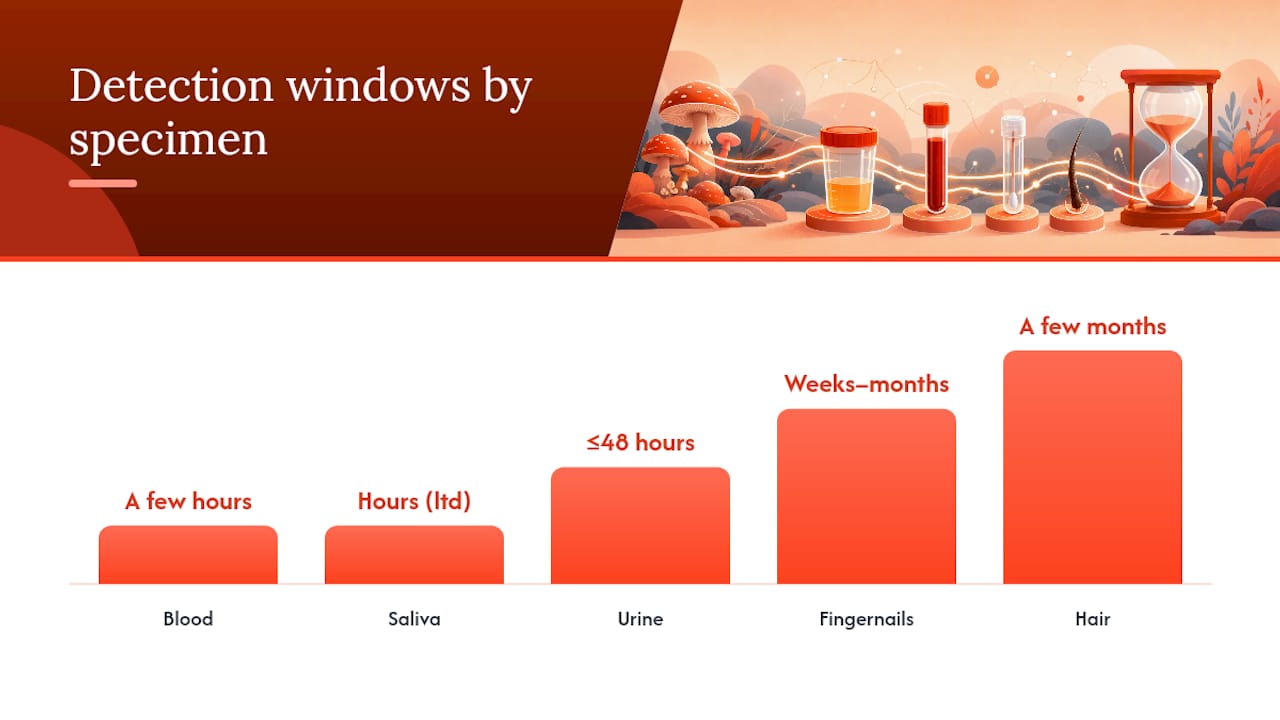
Detection depends almost entirely on which specimen type is collected and how soon after use. Healthline’s overview and peer-reviewed pharmacokinetic data point to the following general windows:
| Specimen | What is detected | Typical detection window |
|---|---|---|
| Urine | Psilocin and metabolites | Up to 48 hours post-ingestion |
| Blood | Psilocin | A few hours post-ingestion |
| Saliva | Psilocin | Hours; very limited data |
| Hair | Psilocin incorporated into keratin | A few months |
| Fingernails | Psilocin incorporated into keratin | Weeks to months |
A few things worth knowing about each:
- Urine is the most practical specimen for psilocin detection, but the window is narrow. A test collected 48 hours or more after a single moderate dose will often return negative even with a sensitive method.
- Blood offers an even shorter window. It’s primarily useful in emergency or forensic settings where recent ingestion is suspected.
- Saliva testing for psilocin has very limited published data. Treat any quoted window as approximate.
- Hair testing has a lag of roughly 7–10 days before new growth incorporates drug metabolites, so very recent use may not appear. DNA Legal notes that hair segment analysis can map use history over months, which is why it appears in legal and custody proceedings.
- Fingernails grow slowly and retain metabolites similarly to hair, giving a longer retrospective window than urine or blood.
Pro Tip: If you know the type of test you’re facing, timing is your most useful variable. A urine screen ordered days after use is far less likely to detect psilocin than one ordered the same day.
What factors change how long psilocybin/psilocin is detectable?
Detection windows are ranges, not fixed points. Several variables push them in either direction:
- Dose and frequency. A single low dose clears faster than repeated heavy use. Chronic use can lead to accumulation in fatty tissue, though psilocin’s rapid metabolism limits this effect compared to THC.
- Individual metabolism. Liver function, hydration status, body mass, and age all affect how quickly psilocin is processed and excreted. Someone with slower liver metabolism may retain detectable levels longer.
- Lab method and cutoff sensitivity. This is where the gap between a routine immunoassay screen and a specialized LC-MS/MS confirmation becomes critical. A standard immunoassay may not even have a validated psilocin antibody. An LC-MS/MS method with a 1.0 ng/mL cutoff will catch concentrations that a less sensitive method misses entirely.
- Timing of collection. Pharmacokinetic data confirms that collection timing relative to ingestion is the single most important determinant of a positive result in urine or blood. Hours matter.
Why might you fail a test after using only mushrooms?
The most common reason for an unexpected positive on a standard panel after using mushrooms isn’t psilocin — it’s what else was in the mushrooms. Adulteration is a documented problem. Healthline reports that illicit mushrooms are sometimes laced with PCP or other substances, which do appear on routine 5-panel and 10-panel screens.
If a standard panel comes back positive and you believe you only used psilocybin, adulteration is a real possibility worth investigating. Other considerations:
- Immunoassay cross-reactivity. Screening tests use antibodies that can occasionally react to structurally similar compounds, producing a false positive. This is why a positive screen is never a confirmed result on its own.
- Sample handling errors. Mislabeling, temperature excursions, or chain-of-custody breaks can corrupt results.
- Prescription medications. Certain medications have produced false positive results on immunoassay panels — always disclose current prescriptions to the Medical Review Officer (MRO).
Request confirmatory testing immediately if you dispute a positive. GC-MS or LC-MS/MS confirmation is specific enough to distinguish psilocin from other compounds and eliminates most immunoassay cross-reactivity errors.
How do specialized psilocybin/psilocin tests work?
Most workplace drug testing follows SAMHSA guidelines, which define standard panels and laboratory practices for occupational programs. Psilocin is not on those panels. Getting a psilocin-specific test requires either a specialized lab order or an employer with an expanded panel policy.
Here’s how the process works in practice:
- Screening phase (immunoassay). A preliminary screen uses antibody-based reagents. For psilocin, validated immunoassay kits are not widely available, so many labs skip directly to confirmation methods.
- Confirmation phase (LC-MS/MS or GC-MS). LabCorp’s psilocin screen and confirmation uses LC-MS/MS with a testing threshold of 1.0 ng/mL. This method identifies psilocin by its specific molecular transitions, not just a general antibody reaction, making it highly accurate.
- Chain of custody. Every certified lab test generates a chain-of-custody document tracking sample handling from collection to result. This document is what makes a result legally defensible.
If an employer or clinician wants to add psilocin testing, they need to specifically request an expanded or custom panel from a certified laboratory. Standard requisition forms won’t include it. For employee urine drug testing contexts, the ordering party — not the employee — controls what the panel includes.
Pro Tip: Ask the testing facility directly: “Is psilocin included in this panel?” If they can’t confirm it, it almost certainly isn’t.
What should you do if a psilocybin test comes back positive?
Act quickly and methodically. A positive result on a drug test is not automatically a final verdict.
- Request the full lab report. Ask for the specific analyte detected, the concentration reported, the method used, and the cutoff threshold. A positive at 1.1 ng/mL on a 1.0 ng/mL cutoff is very different from a result at 50 ng/mL.
- Verify chain of custody. Ask for the chain-of-custody form. Any gap in documentation is grounds to challenge the result.
- Request confirmatory testing. If the initial result was a screening test, demand LC-MS/MS or GC-MS confirmation before any employment action is taken.
- Ask for a split-sample retest. Many certified labs retain a portion of the original sample. Request independent analysis at a separate certified lab.
- Disclose all medications to the MRO. The Medical Review Officer reviews positive results and can reclassify a result as negative if a legitimate medical explanation exists.
- Document everything. Keep records of every communication with your employer, the lab, and the MRO — dates, names, and what was said.
- Seek legal advice if the stakes are high. Court-ordered tests, safety-sensitive positions, and professional licenses all carry consequences that warrant a conversation with an attorney before you respond formally.
Red flags suggesting lab error include: no chain-of-custody documentation, a result reported without a confirmation method, or a lab that cannot name the specific analyte and cutoff.
Do detox products actually work for mushrooms?
The short answer: probably not for psilocin, and here’s why. Psilocin clears the body so quickly on its own that the detection window is already narrow. Healthline notes that commercial detox products lack strong evidence for reliably masking or accelerating psilocin elimination enough to guarantee passing a specialized test.
- Myth: Drinking large amounts of water flushes psilocin faster. Fact: Extreme dilution may lower urine concentration below a cutoff, but labs check creatinine levels and specific gravity to flag diluted samples. A diluted result often triggers a retest.
- Myth: Detox drinks reliably beat specialized psilocin tests. Fact: Because psilocin clears so fast naturally, the more realistic risk is a test ordered on the day of use — and no drink changes that timeline enough to matter.
- Myth: Home remedies like vinegar or bleach alter results. Fact: These are adulterants. Modern labs test for them, and a sample flagged as adulterated is treated as a positive or refusal in most employer policies. See home remedies and their limitations for a fuller breakdown.
What actually works: abstinence before a known test date, and using a reputable at-home test kit to verify your own status before the official collection. That’s the only approach with a reliable track record.
An honest perspective on mushrooms and drug testing
What people get wrong about the “safe” detection window
The conventional wisdom — “shrooms clear in a day or two, so you’re fine” — is mostly accurate for standard workplace panels. However, it creates a false sense of security in two specific situations that matter a lot.
First, it ignores the employer policy problem. LegalClarity makes this point clearly: a DOT employer doesn’t need a positive psilocin test to remove you from a safety-sensitive role. Observed impairment, a reasonable-suspicion referral, or a non-DOT expanded panel can all trigger consequences that a clean standard urine screen won’t prevent. The test not catching it is not the same as being protected.
Second, it ignores the hair test problem. If you’re in a legal proceeding, a custody dispute, or a high-stakes employment investigation, hair testing can reach back months. The “it clears fast” logic only applies to urine and blood. Anyone facing a forensic or legal context should treat hair testing as a real possibility, not a theoretical one.
The practical takeaway: know your specific test type before assuming you’re in the clear. A routine pre-employment urine screen is very different from a court-ordered expanded panel.
How Passmydrugtest can help you prepare
Knowing whether psilocin will show up is only half the equation. The other half is knowing your test type, understanding what the panel actually screens for, and having a way to check your own status before the official collection date.
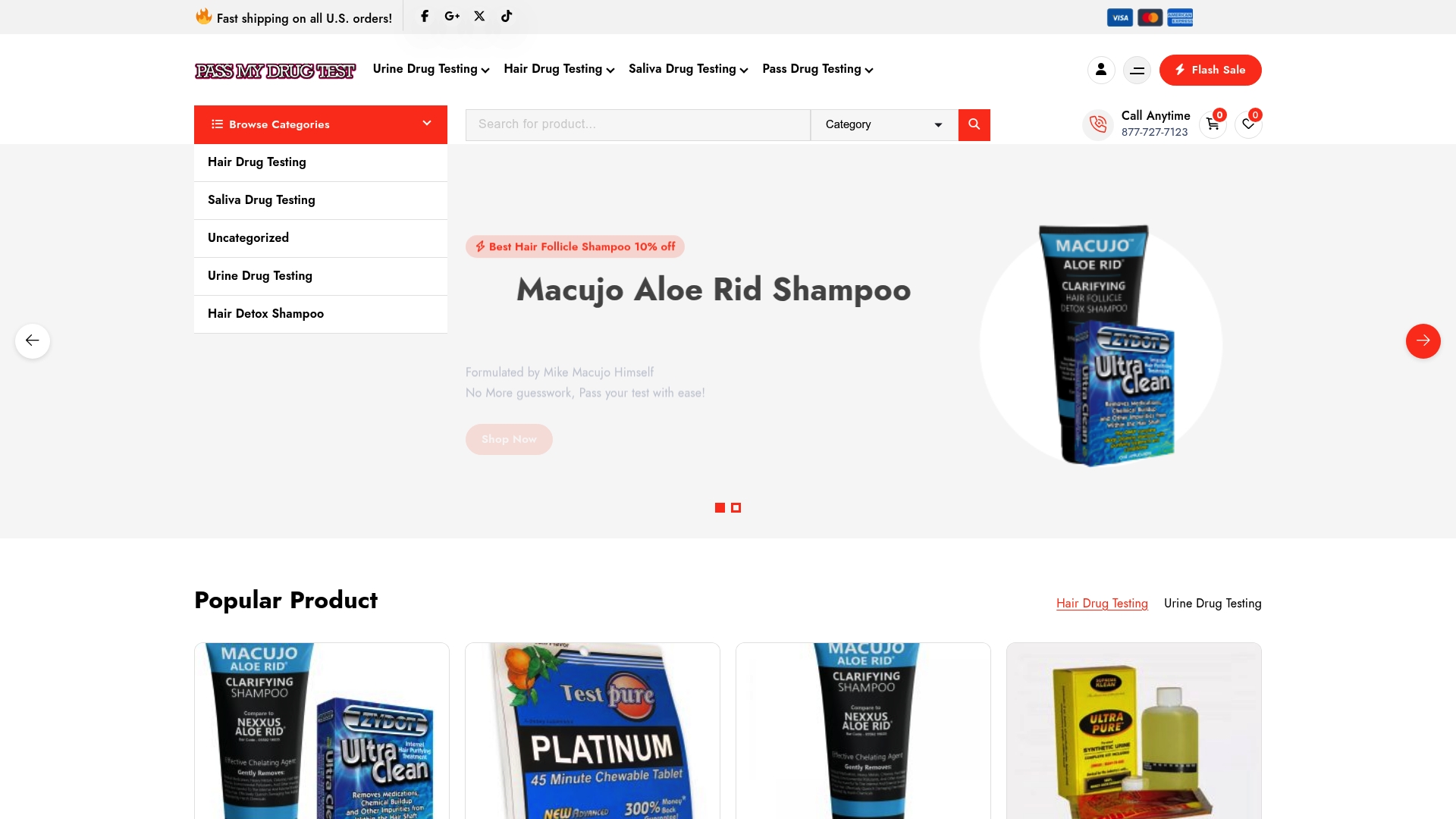
Passmydrugtest combines product access with practical educational content built for exactly this situation. Whether you need to understand drug testing methods before a pre-employment screen, find detox products suited to your timeline, or get hair testing information before a legal proceeding, the site covers the full range. At-home test kits let you verify your status privately before the official test date. Fast shipping is available on U.S. orders, and phone support is available during published business hours. Check your test type first, then use the resources that match your situation.
Sources
- Psilocybin | DEA
- 791012: Psilocin, Screen and Confirmation, Urine | Labcorp
- Do Shrooms Show Up on a Drug Test? What to Expect
- Do Magic Mushrooms (shrooms) show up on a drug test?
- Pharmacokinetics and pharmacodynamics of psilocybin — PMC4080811
- Analytical methods for hallucinogens and designer drugs — PMC12030428
- Do Shrooms Show Up on a DOT Drug Test? Rules & Risks – LegalClarity
- A Guide to Magic Mushrooms (Psilocybin) Drug Testing | DNA Legal
This article is general information, not a substitute for advice from a qualified lawyer. Consult a qualified legal professional about your own circumstances before acting on anything here.