
Military Drug Test: What Service Members and Applicants Need to Know
A military drug test is a DoD-administered urinalysis program designed to deter and detect drug misuse across all branches of the U.S. Armed Forces. Urine is the primary specimen. Any presumptive positive goes through mandatory confirmatory testing at a DoD-certified forensic laboratory using gas chromatography-mass spectrometry (GC‑MS) or liquid chromatography-tandem mass spectrometry (LC‑MS/MS). Before a result is finalized, labs cross-check it against the electronic prescription reporting system (ePRS) to account for legitimate medications. A confirmed positive or a refusal to test carries serious administrative and disciplinary consequences under the Uniform Code of Military Justice (UCMJ).
Here is what you need to know at a glance:
- Primary specimen: Urine, collected under direct observation in most cases
- Testing triggers: New-entrant screening, random selection, commander-directed, probable-cause, and Testing Designated Position (TDP) requirements
- Panel scope: Cannabinoids, cocaine, amphetamines, multiple opioid classes, benzodiazepines, LSD, synthetic cannabinoids, and emerging threats
- Confirmatory method: GC‑MS or LC‑MS/MS at a DoD-certified lab, not a rapid field device
- MRO review: A Medical Review Officer verifies prescriptions via ePRS before any positive is reported to command
- Consequences: Range from treatment referral and administrative separation to UCMJ charges and loss of security clearance
State-legal marijuana is not a defense. Federal law and the UCMJ govern service members regardless of where they live or what state law permits. A positive THC result is treated the same in California as it is in Texas.
Key Takeaways
The military drug testing program is a forensic-grade federal system governed by DoDI 1010.01 and 10 U.S.C. §978, where confirmed positives carry UCMJ consequences that state law cannot override.
| Point | Details |
|---|---|
| Urine is the primary specimen | Direct observation during collection makes substitution strategies ineffective in military settings. |
| GC‑MS/LC‑MS/MS confirms positives | Immunoassay screens are just the first step; confirmatory lab methods eliminate most false positives. |
| MRO and ePRS protect legitimate users | Prescriptions verified through ePRS can clear a presumptive positive before command is notified. |
| Refusal equals a positive | Refusing to provide a specimen triggers the same administrative and disciplinary consequences as a confirmed positive. |
| State marijuana laws do not apply | The UCMJ governs service members federally; a positive THC result carries consequences regardless of state law. |
If you want to check your own status privately before an official test, Passmydrugtest offers at-home drug testing kits and detox preparation resources that can help you understand where you stand.
Table of Contents
- How does a military drug test work from collection to lab confirmation?
- What does the DoD test for on the military panel?
- What are the detection windows for military urine testing?
- Can supplements or OTC medications cause a false positive?
- What are the consequences of a positive military drug test?
- What should you do if you get a presumptive positive result?
- Common myths about military drug testing that the lab facts correct
- What most people get wrong about military drug testing
- Sources
How does a military drug test work from collection to lab confirmation?
The Military Personnel Drug Abuse Testing Program (MPDATP), governed by DoDI 1010.01, sets the framework every branch follows. The process moves through four distinct phases: selection, collection, laboratory analysis, and Medical Review Officer adjudication.
Selection mechanisms
Random selection is computerized, which removes human discretion and makes avoidance nearly impossible. Army guidance describes “Smart Testing Techniques” that include back-to-back testing, weekend and holiday testing, and testing during field exercises. Beyond random selection, commanders can order testing at any time based on probable cause or reasonable suspicion, and certain positions (TDPs) require testing regardless of random selection cycles.
Collection protocol
Collection follows DoD-authorized chain-of-custody forms. A same-sex observer directly watches the specimen leave the body in most military collections. That single safeguard eliminates the substitution strategies that sometimes work in unobserved civilian workplace tests. Members have a defined time window to provide a specimen, and failure to produce one within that window can be treated as a refusal.
Laboratory workflow
- Initial immunoassay screening occurs at a DoD-certified lab
- Any presumptive positive triggers mandatory confirmatory testing by GC‑MS or LC‑MS/MS
- Four named DoD forensic labs handle confirmatory work: the Air Force Drug Testing Laboratory (AFDTL) at Lackland AFB, the Navy Drug Screening Laboratory (NDSL), the Forensic Toxicology Drug Testing Laboratory (FTDTL), and the Special Forensic Toxicology Drug Testing Laboratory (SFTDTL)
- Point-of-collection rapid tests are not authorized for official DoD determinations
MRO and ePRS review
A Medical Review Officer reviews every confirmed positive before it reaches command. The MRO queries the ePRS to check whether a valid prescription explains the result. If a legitimate prescription exists and the dose is consistent, the MRO can report the result as negative. This step is the primary safeguard against wrongful positives from legally prescribed medications.
Pro Tip: If you are notified of a presumptive positive, immediately gather every prescription bottle, pharmacy receipt, and prescriber contact you have. The MRO will contact you directly, and having documentation ready shortens the review window considerably.
What does the DoD test for on the military panel?
The DoD panel is broad. Program materials list the following major categories, with representative substances in each:
- Cannabinoids: Delta‑9 THC (marijuana) and Delta‑8 THC; synthetic cannabinoids (K2/Spice variants) are tested separately
- Cocaine: Cocaine and its primary metabolite benzoylecgonine
- Amphetamines: Amphetamine, methamphetamine, MDMA (ecstasy), and designer stimulant variants
- Opioids: Heroin (via 6-MAM metabolite), morphine, codeine, oxycodone, hydrocodone, and fentanyl; fentanyl was added to the panel as an emerging threat
- Benzodiazepines: Multiple agents in this sedative class
- LSD: Re-added to the panel after a period of absence as use trends shifted
- Synthetic cannabinoids: Tested as a separate category from natural THC
- Emerging threats: The panel is updated as new substances appear in military populations
The phrase “military 26-panel” circulates widely online. The DoD panel is not a fixed 26-substance list that never changes. It is a living document updated by the Drug Demand Reduction Program in response to emerging drug trends. Applicants and service members should treat the panel as broad and check their branch’s current policy for the most recent additions. Assuming a substance is not tested because it is newer or less common is a mistake the program is specifically designed to punish.
What are the detection windows for military urine testing?
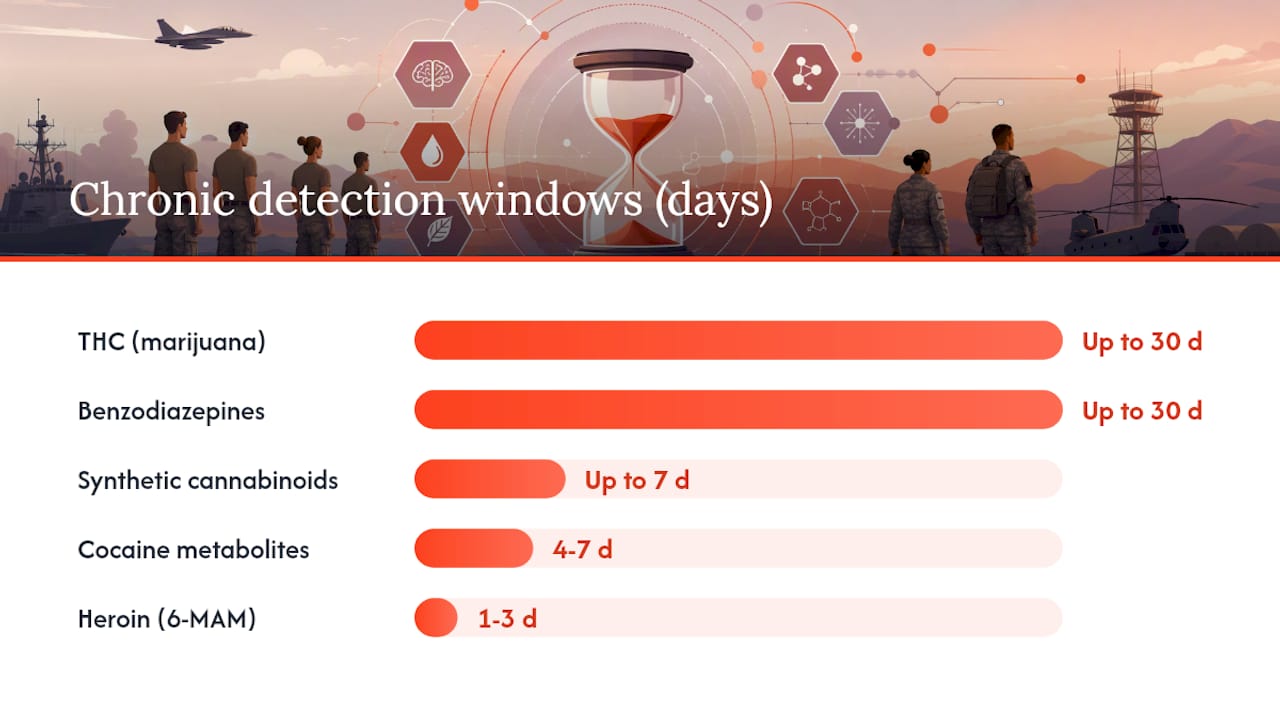
Detection windows are population-level ranges, not guarantees for any individual. The military labs use validated cutoff concentrations, and whether a specific specimen tests positive depends on dose, frequency, metabolism, body composition, and hydration at the time of collection.
| Drug Class | Single-Use Detection | Chronic/Heavy Use Detection |
|---|---|---|
| THC (marijuana) | 1–3 days | Up to 30 days or longer |
| Cocaine metabolites | 2–4 days | 4–7 days |
| Amphetamines | 1–3 days | 3–5 days |
| Heroin (6-MAM) | 6–24 hours | 1–3 days |
| Oxycodone/Hydrocodone | 1–3 days | 3–5 days |
| Fentanyl | 1–3 days | 3–5 days |
| Benzodiazepines | 1–7 days | Up to 30 days |
| LSD | 1–3 days | 1–3 days |
| Synthetic cannabinoids | 1–3 days | Up to 7 days |
THC stands out because it is fat-soluble. A toxicology review confirms that detection duration varies significantly by route of administration and frequency of use. A daily user with higher body fat can test positive for THC weeks after last use, while an infrequent user may clear within two or three days. Hair testing, by contrast, captures drug history for approximately 90 days, though the military’s primary specimen remains urine.
Key biological and testing variables that shift these windows:
- Frequency and dose: Higher and more frequent use extends detection
- Body fat percentage: THC and some other lipophilic drugs accumulate in fat tissue and release slowly
- Hydration: Dilute urine lowers drug concentration, but military labs check creatinine and specific gravity to flag dilution
- Metabolism: Individual metabolic rate affects how quickly drugs are processed and excreted
- Testing cutoffs: DoD labs use specific concentration thresholds; a specimen just below the cutoff tests negative even if the drug is present
Pro Tip: Drinking large amounts of water before a test to dilute your specimen does not reliably work in military collections. Labs measure creatinine and specific gravity. A specimen flagged as too dilute can trigger a retest or be treated as a refusal, which carries its own consequences.
The DoD Drug Demand Reduction Program processed 3,400,612 total specimens from 1,667,447 unique members in a reporting period, with an overall positive rate of approximately 1.3%. That rate is low, but the volume means the labs are highly practiced at catching what they look for.
Can supplements or OTC medications cause a false positive?
Yes, and it happens more often than most service members expect. The initial immunoassay screen is designed for speed and sensitivity, not perfect specificity. That means some legal substances can produce a presumptive positive before confirmatory testing sorts out what actually happened.
Common culprits include:
- Hemp-derived CBD products: Even legal hemp products can contain trace THC. Enough of it, consumed regularly, can push a specimen above the THC cutoff
- Certain cold and allergy medications: Pseudoephedrine and related compounds can cross-react with amphetamine assays in some screening platforms
- Poppy seed foods: Morphine and codeine metabolites from poppy seeds have triggered opioid presumptive positives, though military cutoffs are set to reduce this risk
- Unverified supplements: OPSS research confirms that dietary supplements can contain undisclosed or mislabeled ingredients that produce screening cross-reactions or outright contamination with prohibited substances
The good news is that GC‑MS and LC‑MS/MS confirmatory testing eliminates the vast majority of immunoassay false positives. These methods identify the exact molecular structure of a compound, so a cold medicine metabolite does not survive confirmation as methamphetamine. The MRO’s ePRS check adds another layer: if a prescribed medication explains the result, the MRO can clear it before command ever sees it.
Where service members get into trouble is when they assume the confirmatory process will automatically protect them without any action on their part. The MRO will contact you, but you need to respond promptly and provide documentation. Silence is not a strategy.
For more on how false positives in drug testing arise and what documentation helps resolve them, Passmydrugtest covers the topic in detail.
Pro Tip: Before any expected testing period, photograph your supplement labels, keep pharmacy receipts, and note the prescribing doctor’s contact information. If a presumptive positive comes back, you want that paper trail ready before the MRO calls, not after.
What are the consequences of a positive military drug test?
The consequences depend on whether you are an applicant or a service member, whether it is a first offense, and how the command decides to proceed. The range runs from mandatory counseling to federal criminal charges.
For applicants
10 U.S.C. §978 requires testing of new entrants, typically within 72 hours of entry on active duty. Refusal to consent to testing can bar enlistment outright. A finding of drug dependency can disqualify an applicant entirely. There is no gray area here: a positive at accession ends the enlistment process for most applicants.
For active-duty service members
- Administrative outcomes: Counseling, referral to a Substance Abuse Rehabilitation Program (SARP or equivalent), administrative separation, or a bar to reenlistment
- Disciplinary outcomes: UCMJ charges under Article 112a (wrongful use, possession, or introduction of controlled substances), which can result in reduction in rank, forfeiture of pay, confinement, or a punitive discharge
- Security clearance: A confirmed positive is a significant adverse factor in any security clearance review and can result in revocation
- NCIC reporting: Positive results may be reported to the National Crime Information Center depending on the circumstances and command decision
Refusal to test
Refusing to provide a specimen is treated as an admission in most circumstances. Military OneSource confirms that refusal is a disciplinary matter and can lead to separation or court-martial. There is no benefit to refusal.
The state-law question
Federal law governs service members, not state law. A service member stationed in a state where recreational marijuana is legal who tests positive for THC faces the same UCMJ consequences as one stationed in a state where marijuana is fully illegal. State legalization is legally irrelevant to military drug policy.
Voluntary self-identification before a positive test result can sometimes open a path to treatment rather than punishment. Commands have discretion here, and seeking help proactively through official channels is generally treated more favorably than a positive test result that forces the issue.
What should you do if you get a presumptive positive result?
A presumptive positive is not a final determination. The confirmatory process exists precisely because the initial screen is not definitive. Here is how to handle the notification correctly.
- Stay cooperative. Do not argue with the collection officer or command. Cooperation preserves your options; resistance does not.
- Request MRO contact information. The MRO will reach out to you, but knowing who they are and how to contact them speeds the process.
- Gather all prescription documentation immediately. Prescription bottles, pharmacy printouts, prescriber names and phone numbers, and any recent medical records that explain the substance.
- Request chain-of-custody paperwork. You have the right to review the chain-of-custody documentation for your specimen. Errors in that chain can be grounds for challenging a result.
- Request lab reports in writing. Ask for the full laboratory report, including the confirmatory test results and the specific concentrations detected.
- Contact a JAG representative. A Judge Advocate General attorney can advise you on your rights before you make any statements to command. This is especially important if disciplinary action is being considered.
- Know voluntary self-identification rules. If you have not yet been notified of a positive and you have a substance use issue, voluntary self-identification through official channels may open treatment options that a positive test result would not.
- Use Military OneSource. Military OneSource provides confidential counseling referrals and substance use resources that do not automatically trigger command notification in all cases.
Pro Tip: Keep physical copies of every document related to your case in a personal file separate from your unit records. If your case goes to an administrative board or UCMJ proceeding, you want your own complete record, not one filtered through command channels.
Common myths about military drug testing that the lab facts correct
A lot of the advice circulating online about beating a military drug test is based on civilian workplace testing, which operates under completely different conditions. Here is where the popular assumptions break down.
- Myth: Home rapid test kits predict DoD results. Retail immunoassay strips use different cutoffs than DoD labs and are not calibrated to military standards. A negative on a home kit does not mean a negative at AFDTL or NDSL. Passmydrugtest’s drug testing method guide explains the difference between screening and confirmatory methods in plain terms.
- Myth: Synthetic urine works in military collections. Direct observation by a same-sex observer is standard in military collections. The observer watches the specimen leave the body. Substitution is not a realistic option in that environment.
- Myth: Drinking water clears your system fast. Labs measure creatinine and specific gravity. A specimen that falls below the creatinine threshold is flagged as dilute and may trigger a retest or be treated as a refusal. Dilution is not a strategy; it is a red flag.
- Myth: Detox drinks fool GC‑MS confirmation. Immunoassay screens can sometimes be affected by adulterants, but GC‑MS and LC‑MS/MS identify specific molecular structures. Labs also test for common adulterants and can flag a specimen as substituted or adulterated, which carries the same consequences as a positive.
- Myth: Testing is predictable enough to time abstinence. Army Smart Testing Techniques are specifically designed to prevent pattern avoidance. Back-to-back testing, holiday testing, and field exercise testing are all authorized. There is no safe window to predict.
- Myth: The MRO process is just a formality. The MRO review is a genuine safeguard. It has cleared service members with legitimate prescriptions and caught documentation errors. Engaging with it honestly and promptly is the right move when you have a legitimate explanation.
What most people get wrong about military drug testing
The single biggest misconception I see is the assumption that military drug testing works like a civilian workplace test with stricter consequences. It does not. The collection protocol, the lab infrastructure, and the legal framework are categorically different.
Civilian workplace tests are often unobserved, use point-of-collection devices, and are governed by employer policy. Military tests are directly observed, processed by forensic labs that handle millions of specimens per year, and backed by federal statute and the UCMJ. The gap between those two systems is not a matter of degree. It is a structural difference that makes most civilian avoidance strategies irrelevant in the military context.
The second misconception is about state marijuana laws. I understand why service members in legal states think this is a gray area. It is not. The UCMJ is federal law. It does not have a carve-out for recreational use in legal states. A service member who uses marijuana legally under state law on a weekend pass and then tests positive on Monday faces the same Article 112a exposure as someone who used it in a state where it was never legal. The only relevant question is whether the substance was in the body. Where or why it got there is not a defense.
The third thing people underestimate is the MRO process. Service members with legitimate prescriptions sometimes panic when they hear “presumptive positive” and assume the worst. The MRO exists to prevent exactly that outcome. Engage with it honestly, provide your documentation, and let the process work. The system has real safeguards. Use them.
Sources
These are the primary sources used throughout this article. Each one is publicly available and worth bookmarking if you need to verify policy or follow up with official guidance.
- Navy Drug Testing Program — Our Process
- The DoD Drug Demand Reduction Program (SAMHSA meeting materials)
- Commander Urinalysis Testing FAQs — Army document
For service-specific procedures, always check your branch’s current policy documents, as panel updates and collection protocols can vary by service and are revised as new substances emerge.
This article is general information, not a substitute for advice from a qualified lawyer. Consult a qualified legal professional about your own circumstances before acting on anything here.