
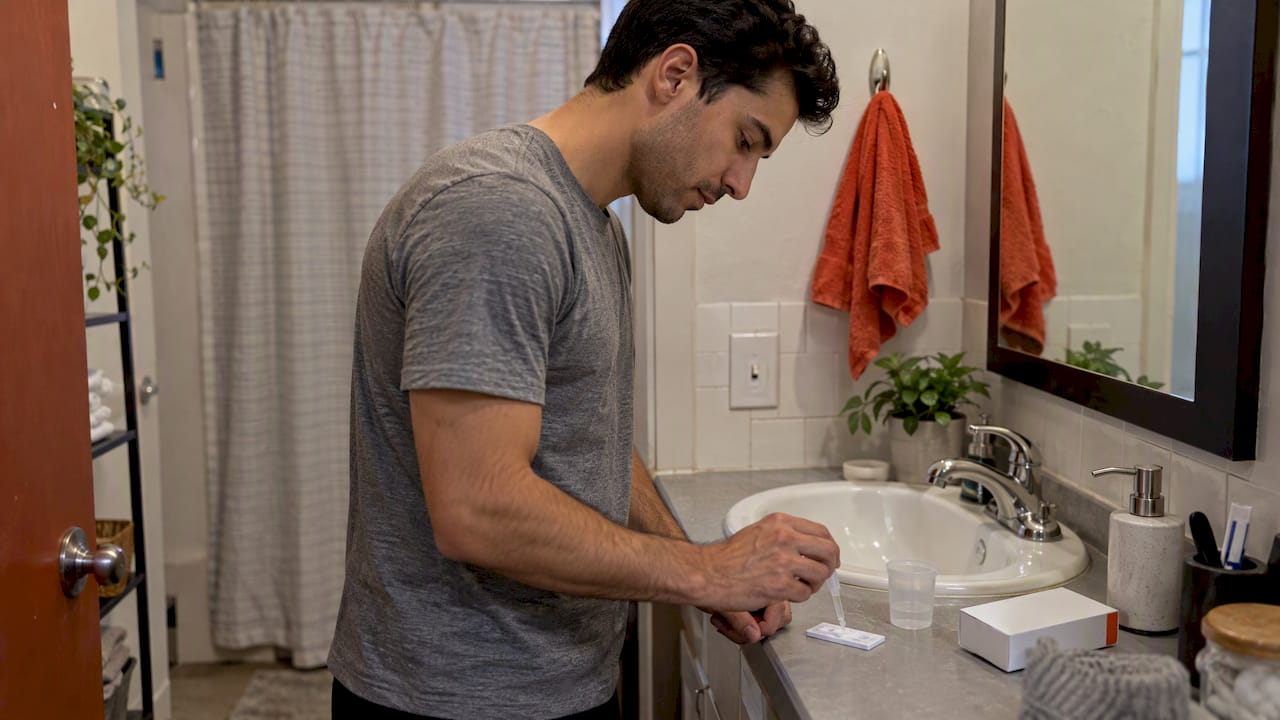
Home Drug Pretest Before a Lab Test: How to Use It
A home pretest is a quick urine screening you take yourself, before the official lab test, to see where you stand. It is a screen, not a verdict. It tells you whether THC metabolites are likely present at a set cutoff, and it gives you time to plan. A positive result still needs laboratory confirmation, and a negative one is not a guarantee about the lab’s result.
This guide covers how a home pretest works, how to take it and read it (including faint and invalid lines), why results can be wrong, how long THC can stay detectable, and what to do with each outcome.
TL;DR
- An at-home urine test is a qualitative screen: it shows whether a drug may be present, and a positive should go to a lab for confirmation.
- Follow the instructions exactly: timing, storage and expiration date all affect the result.
- On a typical cassette, any line in the T region, however faint, means negative. No C line means invalid, so repeat with a new test.
- THC metabolites can stay detectable for days in occasional users and longer in frequent users, so the right time to pretest is early enough to leave you options.
- Treat the pretest as information for planning, not as a reason for panic or rash decisions.
Table of Contents
- What a home pretest actually is
- When to take a pretest
- How to take a home pretest, step by step
- How to read the result
- Why home results can be wrong
- What to do with each result
- What about detox products?
- A simple timeline you can adapt
- Our perspective
- Get your pretest ready
- FAQ
- Sources
What a home pretest actually is
Most at-home THC tests are lateral flow immunoassays. They detect 11-nor-9-carboxy-THC (THC-COOH), a metabolite of THC, usually at a cutoff of 50 ng/mL. Below that concentration the test reads negative. At or above it, the test reads positive.
The FDA describes these kits as qualitative. They say yes or no for a drug class. They do not tell you how much you used, when you used it, or whether you are impaired.
That last point matters. A CDC advisory notes that a urine cannabinoid result cannot show impairment or the exact time of last use. It indicates only the likelihood of prior exposure.
How it differs from the lab test
A formal test commonly runs in two steps. First comes an immunoassay screen, much like your home kit. Then any presumptive positive goes to confirmatory testing with GC-MS, LC-MS or LC-MS/MS. Those methods identify the specific compound, which a screening strip cannot do.
The CDC advisory also explains why: screening tests react with virtually all THC metabolites, while confirmation methods can be specific to one metabolite.
Labs running federal workplace programs also check whether the specimen itself is valid. SAMHSA’s guidance describes specimen validity testing that looks for dilution, substitution and adulteration, using measures such as creatinine and specific gravity. Your home pretest does none of that. It only reads the drug line.
| Home pretest | Laboratory test | |
|---|---|---|
| Purpose | Preliminary screen for planning | Official result |
| Method | Lateral flow immunoassay | Immunoassay screen, then GC-MS or LC-MS/MS confirmation |
| Result | Qualitative: positive or negative at a cutoff | Confirmed, compound-specific |
| Specimen validity checks | No | Often, depending on the program |
| Time to result | Minutes | Usually longer |
When to take a pretest
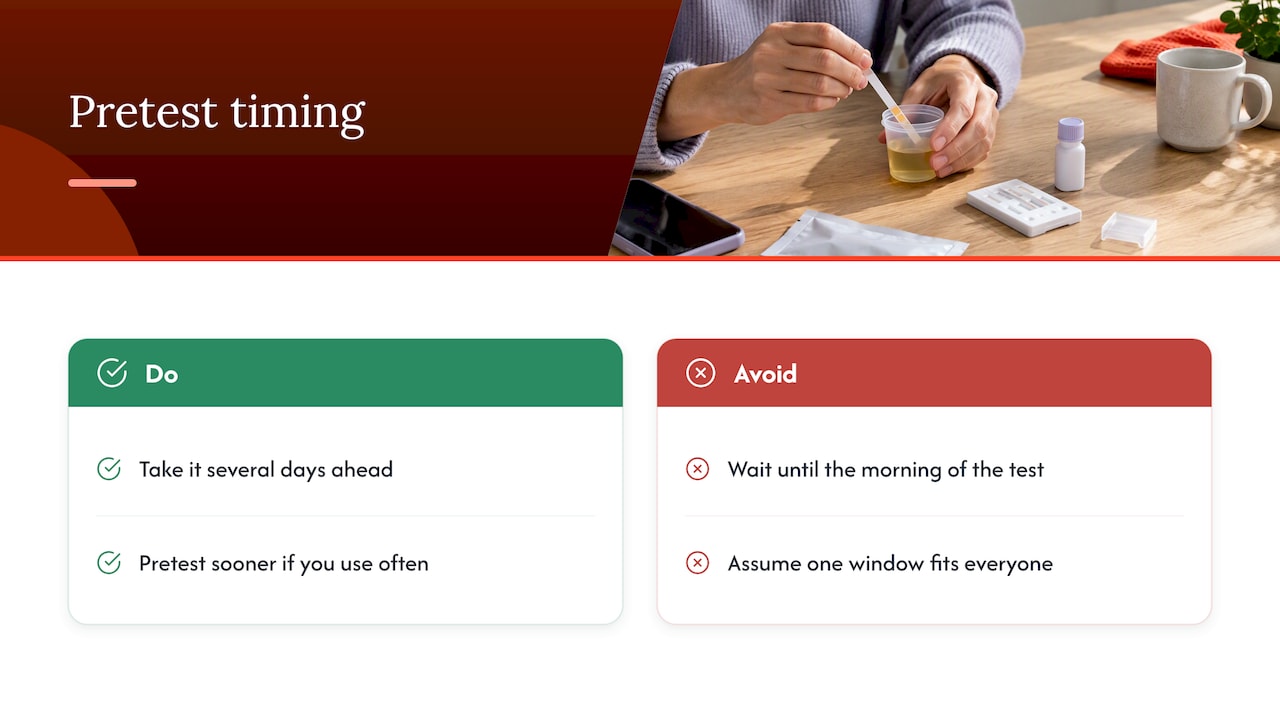
Take it early. A pretest the morning of the test tells you something, but leaves you almost no room to act. A pretest several days ahead gives you time to repeat it, to talk to the people who set the test, and to decide on your plan.
The CDC advisory says a single marijuana cigarette can leave metabolites detectable for several days. It says urine testing may detect prior use for up to two weeks in casual users, and possibly longer in chronic users. Metabolism, metabolite accumulation and changes in urine volume from diet, exercise and age all play a part.
So no single number fits everyone. If you use often, assume your window is long and pretest sooner. If you use rarely, a shorter lead time may do, but your own body still decides.
Match the pretest to the real test
A urine pretest tells you about urine. If your upcoming screening uses hair or saliva, a urine strip does not predict it. Different specimens have different detection windows and different collection rules. Before you buy anything, find out which specimen type your employer, court or program will use. The same question applies to the cutoff: your home kit’s cutoff may not match the one the lab applies.
How to take a home pretest, step by step
The FDA’s advice on home-use tests comes down to following the directions and checking expiration dates and storage conditions. Here is a practical sequence.
- Check the package. Confirm the expiration date and that the pouch is sealed and undamaged. Store the kit as the label directs.
- Read the instructions fully before you open anything. Brands differ in dip depth, dip time and read window.
- Let the kit and the sample reach the temperature the instructions call for. Do not rush a cold test.
- Collect a fresh urine sample in a clean cup. Many people choose a first-morning sample because it is more concentrated, but follow what your kit says.
- Dip or dispense exactly as directed. Start a timer the moment you do.
- Lay the test flat and wait. Read it inside the window on the instructions. A line that appears long after the window can mislead you.
- Record the result. Take a photo, note the date and time, and keep the lot number.
User technique is a known weak point. A 2024 academic study identified misreading by users as a source of errors, especially among people used to other rapid-test formats. Many of those tests treat two lines as positive. Drug tests often work the opposite way.
How to read the result
On the common cassette and dip-card format, the logic runs backward from what most people expect:
| What you see | What it means |
|---|---|
| Lines at both C and T | Negative |
| A line at C only | Positive (preliminary) |
| A faint line at T, plus a C line | Negative: any line in T counts, however faint |
| No line at C | Invalid: discard and repeat with a new test |
The faint-line rule is where most confusion starts. On a standard THC card, a faint T line is still a line, so the result is negative. If your brand’s instructions say something different, follow your brand.
An invalid result means the test failed, whether from a procedure error, a sample problem or a bad kit. Do not guess. Repeat with a fresh device.
Why a faint line is not a number
A faint line does not mean you are “almost positive” in any measurable way. The strip is built to answer one question at one cutoff. Two people with different actual concentrations can show similar faint lines, and the same sample can look slightly different across brands. Use it as a yes or no.
Why home results can be wrong
The FDA says at-home tests are fairly sensitive but not 100% accurate. Results can be affected by:
- test technique or storage
- food or drink
- medicines
- testing too soon or too late
That is why the agency recommends that a positive be confirmed by a laboratory. It also says people should not take serious action based only on an at-home result, and should talk to a doctor about concerns over drug use or possible false results.
The practical lesson is consistency. Use the same brand, the same time of day and the same timing each time you pretest, so changes in your results reflect changes in your body rather than changes in your method.
What to do with each result
If the pretest is negative
You have good news, but only for that sample, that strip and that cutoff. If a negative still worries you, the FDA suggests testing again later or talking with a doctor. Keep your habits steady until the real test, and take the real test with confidence that you did your homework.
If the pretest is positive
Do not treat it as final. The FDA says to send a positive sample to a laboratory for confirmation and to take no serious action until you have that result. A positive also tells you something useful: you have time to plan, rather than finding out at the collection site.
If you have a medical reason for a medication that could affect a result, or a medical cannabis situation, speak with your doctor and, where relevant, the test administrator or your employer’s medical review contact. Rules on that vary by employer, program and state, so ask the party running the test.
If the result is invalid or unclear
Repeat with a new test from a different lot if you can. Re-read the instructions for timing. If two kits in a row give you strange results, check storage and expiration before you blame your sample.
What about detox products?
People ask whether preparation products can change a result. Here is a sober way to think about it.
The most reliable factor is time away from use, since metabolites clear at a pace set by your body. Products sold for test preparation, such as detox drinks, chewable tablets and cleanses, are used by many people alongside that time. Our products are designed to be used as part of a plan, with the instructions followed closely. No product can promise a particular outcome for every person, and none replaces the lead time your body needs.
A few safe-use points apply whatever you choose:
- Follow the label on timing, quantity and fluids. Do not double up on doses.
- Pretest after, not just before. If you use a product, a home test is the way to see how your own sample reads under your own routine. Use the same brand and procedure each time.
- Know the specimen. A urine product does nothing for a hair or saliva test, and hair tests call for products made for hair.
- Know what labs look for. Programs that follow federal workplace rules run specimen validity checks for dilution, substitution and adulteration. A sample that looks abnormal can be flagged on its own, apart from the drug result.
- Check with your doctor before taking any supplement if you take prescription medicine or have a health condition, because medicines and supplements can themselves affect test results, according to the FDA.
- Mind the law. Rules on workplace testing, cannabis use and sample handling differ by state, employer and program. Read your employer’s policy or court order carefully.
A simple timeline you can adapt
| Timing | Action |
|---|---|
| As soon as you know a test is coming | Find out the specimen type (urine, hair or saliva) and any lead time |
| 1 to 2 weeks out | Take a first pretest, record the result, and plan around it |
| During preparation | Follow product labels and keep fluids and routine steady |
| 2 to 3 days out | Repeat the pretest the same way |
| Day of the test | Bring ID and follow collection instructions |
This is a planning outline, not a medical protocol. Your own detection window may be shorter or longer than you expect, as the CDC’s description of wide variation makes clear.
Our perspective
We built Passmydrugtest around one idea: you should not walk into a screening blind. Most of the people we hear from are not trying to cause trouble. They have a job, a court date or a program, and they want a straight answer about where they stand.
That is why we pair product selection with plain explanations. A home pretest is the cheapest information you can buy before a lab test, and it makes every other choice better. Pretest first, pick the right product for your specific specimen type, and then pretest again so you know how your own sample reads.
We also think the right product depends on the scenario: urine, hair or saliva, workplace or legal, days of notice or weeks. Our catalog covers urine, saliva and hair testing and hair detox shampoo, with fast shipping in the United States and phone support during published business hours, so you can talk through your situation before you order.
MIchael
Wait
Get your pretest ready
If you are preparing for a screening, start with the specimen type. We carry urine, saliva and hair drug testing options and hair detox shampoo, and our guides walk through which fits which situation. You can browse everything on Passmydrugtest, and our team is available by phone during published business hours if you want help choosing.
FAQ
Can a home test replace a lab test?
No. A home test is a preliminary screen. The FDA says a positive result should be confirmed by a laboratory, and that people should avoid serious action based only on an at-home result. Use it for planning, not as a final answer.
What does a faint line mean on a THC test?
On a standard THC card, any line in the T region, however faint, means negative, as long as the C line is present. If there is no C line, the test is invalid and you should repeat it with a new one. Always check the instructions that came with your brand.
Can a home test give a false result?
Yes. The FDA notes that technique, storage, food or drink, medicines, and testing too soon or too late can affect results. Using the same brand and procedure every time helps you compare results fairly.
How long should I allow before a drug test?
As much as you can. The CDC notes that metabolites can be detectable for several days after a single use, up to about two weeks in casual users, and possibly longer in chronic users. Your own window depends on your metabolism and other factors.
Does a positive urine test mean I am impaired?
No. A urine cannabinoid result indicates likely prior exposure, not current impairment or the time of last use, according to the CDC advisory.
Sources
- Drugs of Abuse Home Use Test, FDA
- How You Can Get the Best Results With Home Use Tests, FDA
- Urine Testing for Detection of Marijuana: An Advisory, CDC MMWR
- Can the Results Be Trusted? Assessing the Reliability of At-Home Drug Tests, Seattle University
- How to Detect Tampered Drug Tests, Today’s Clinical Lab
- Clinical Drug Testing in Primary Care, TAP 32, SAMHSA