
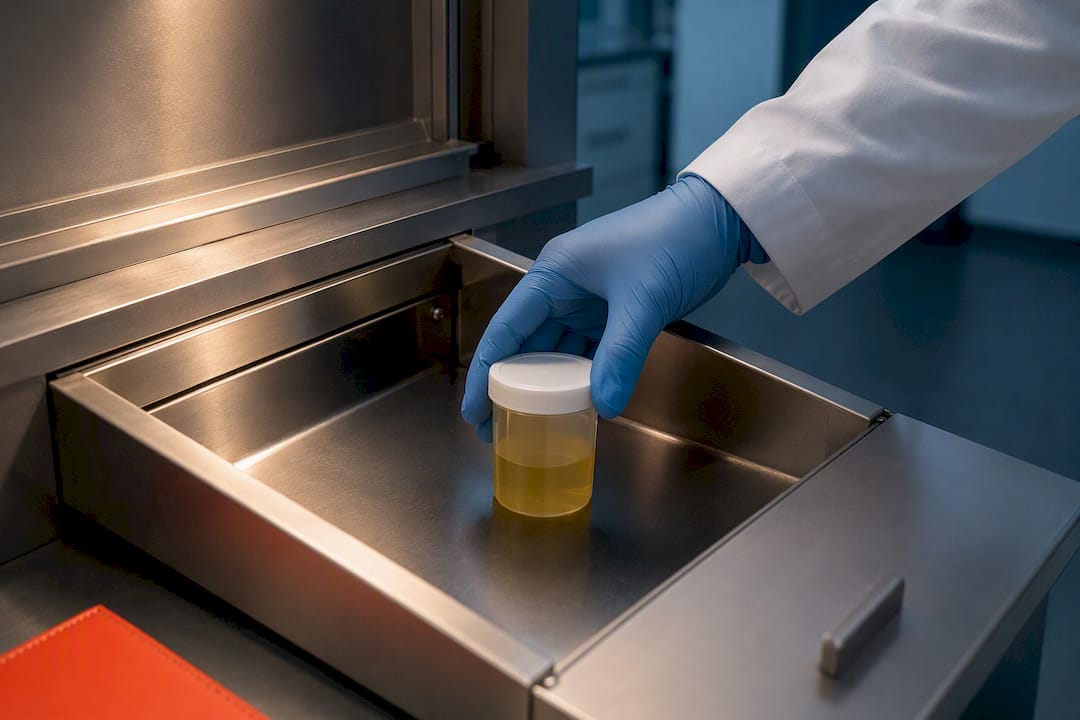
HHC Drug Test Risk for U.S. Workers: Single Dose Can Flag Urine 5 Days
Yes, HHC can trigger a positive result on a standard cannabinoid drug screen. Immunoassay tests are built to catch THC metabolites, and HHC’s molecular structure is close enough to slip past that filter and flag as a presumptive positive. That result is not the final word, though. A true confirmation requires lab-based GC-MS or LC-MS/MS testing, which is the only way to know what actually triggered the screen.
TL;DR:
- HHC can produce a positive result on standard cannabinoid immunoassay tests due to molecular similarity, with detection possible in urine up to five days after use.
- Confirmatory testing with GC-MS or LC-MS/MS is essential to distinguish HHC from THC, especially since many tests are not specifically designed to identify HHC metabolites.
- The potency and detection timeline of HHC vary depending on the route of administration, dose, and individual metabolism, with heavier and frequent use extending detection windows.
- State laws surrounding HHC are inconsistent, and a positive HHC test can have the same employment or legal consequences as a THC positive, regardless of its legal status.
- At-home testing kits can help individuals gauge their own risk before official testing but are only presumptive, making confirmatory lab analysis necessary for definitive results.
Table of Contents
- Can an HHC Drug Test Cause a Positive Result?
- How Does the Body Metabolize HHC?
- HHC Detection Windows in Urine, Blood, Saliva, and Hair
- What Affects How Long HHC Stays Detectable?
- What to Do About a Presumptive Positive HHC Result
- How Labs Confirm HHC Versus THC
- Preparing for an HHC Drug Test the Right Way
- Legal and Employment Risks From an HHC Positive
- How Sensitive Are HHC Drug Tests Compared to THC Tests?
- What the Research Actually Tells Us
- Get Ahead of Your Next Drug Test With the Right Tools
- Sources
- FAQ
Can an HHC Drug Test Cause a Positive Result?
Immunoassay screens don’t hunt for a single molecule. They use antibodies designed to bind to THC-COOH and structurally similar compounds, which is exactly the problem. HHC and its main breakdown product, HHC-COOH, resemble THC-COOH closely enough that the antibodies grab onto them too. Chemists call this cross-reactivity, and it’s the reason a THC-focused test kit can’t reliably tell HHC and THC apart.
The evidence for this isn’t theoretical. Spike experiments and routine screening data have both confirmed that HHC and related cannabinoid analogs produce positive immunoassay results. One clinical toxicology analysis found that as HHC use increased in a testing population, the rate of presumptive positive screens climbed sharply. Cross-reactivity confirmed in spike testing means labs saw a jump in flagged cannabinoid screens tied to HHC and analog compounds, not just traditional THC use.
A few things matter here for anyone trying to make sense of a screening result:
- Immunoassays are cheap, fast, and designed for volume, not precision.
- A positive on this kind of test is presumptive, meaning it flags a possible match, not a confirmed one.
- Only mass spectrometry methods can identify the exact compound responsible.
- Employers and testing labs almost always treat a presumptive positive as grounds for confirmatory testing before any final decision.
In practical terms, that means an HHC user who never touched THC can still land in the same “positive” bucket as a THC user on the initial screen. The distinction only shows up once a lab runs the confirmatory step.
How Does the Body Metabolize HHC?
HHC doesn’t enter the body as a single, uniform compound. Commercial HHC products contain a mix of two mirror-image forms, called (9R)-HHC and (9S)-HHC, and they are not equally potent. Research on controlled dosing suggests (9R)-HHC tends to be more potent and more abundant in the products people actually buy, which matters because the two epimers metabolize at different rates and show up in different ratios depending on the product.
Once ingested, the liver converts HHC into several tracked metabolites:
- 11-OH-HHC — an active intermediate metabolite, structurally close to THC’s own active metabolite.
- 8-OH-HHC — a secondary metabolite that shows up in some analytical panels.
- HHC-COOH — the primary target compound for confirmatory urine testing, roughly analogous to THC-COOH.
- Glucuronide conjugates of HHC-COOH — the form HHC-COOH often takes in urine, which affects how labs need to process a sample before measuring it accurately.
Route of administration changes the timeline. Inhaled HHC hits peak blood concentration fast, often within minutes, while orally ingested HHC takes longer to metabolize and produces a slower, more drawn-out curve. Controlled dosing studies using HPLC-MS/MS confirmed detectable HHC and its metabolites in serum, urine, and saliva after both inhalation and oral consumption, with the kinetics shifting meaningfully based on how the product was taken.
Here’s the wrinkle that trips up a lot of interpretation: HHC-COOH isn’t exclusive to HHC. Delta-9 THC metabolism can also produce compounds that overlap with what a lab is measuring, which means detecting HHC-COOH alone doesn’t automatically prove someone used HHC rather than THC.
Pro Tip: If you’ve used both THC and HHC products in the same window, don’t assume a lab can automatically sort out which one caused a positive. Ask specifically whether the lab’s method distinguishes HHC-specific stereoisomers, because not all confirmatory panels do.
HHC Detection Windows in Urine, Blood, Saliva, and Hair
Detection windows for HHC follow a similar logic to THC, but the specifics vary by specimen type and by how the compound moves through the body.
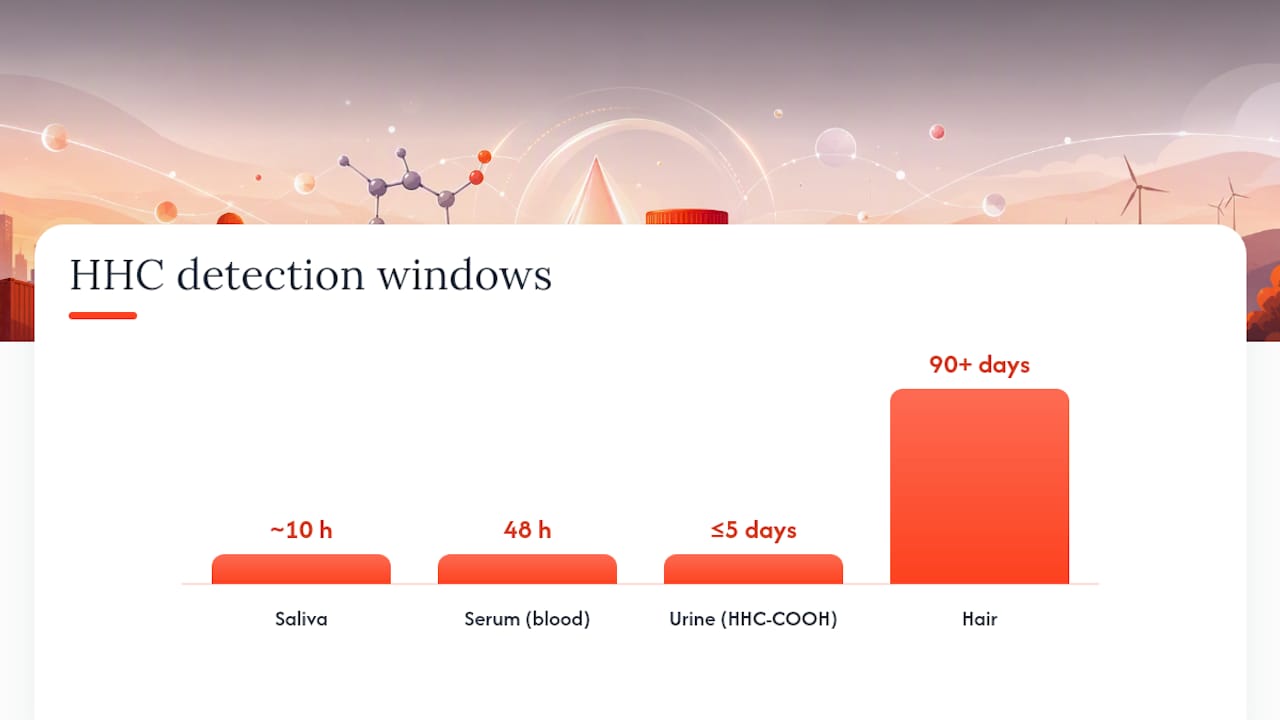
Urine. This is the most common workplace and legal testing matrix, and it targets HHC-COOH specifically. A small controlled study found urine remained positive for up to five days after a single controlled dose, with serum staying detectable for up to 48 hours in the same research. Occasional users may clear the compound within days, but regular or heavy users can show detectable metabolite levels for several weeks, mirroring what’s seen with chronic THC use.
Blood and serum. Parent HHC clears from blood relatively fast because the body converts it quickly into metabolites. A GC-MS method built specifically for HHC epimers detected the compound in 17 of 321 forensic serum samples from suspected impaired drivers, with a validated detection limit as low as 0.15 nanograms per milliliter. That kind of sensitivity is far beyond what a standard workplace immunoassay can achieve.
Saliva. This window is short, typically reflecting recent use rather than a pattern of use. Controlled inhalation and oral dosing studies found that on-site oral fluid tests produced inconsistent results depending on the device and testing window, with one commercial urine screening product staying positive up to 10 hours after use in that same research. Saliva testing after inhalation carries oral-residue effects too, meaning a positive can reflect what’s in the mouth rather than what’s circulating systemically.
Hair. Hair testing captures the longest window by far, often stretching back 90 days or more for repeated use, since drugs and metabolites become trapped in the hair shaft as it grows. It won’t catch a single, isolated use the way urine or blood might, and interpretation gets complicated by external contamination, hair treatment, and growth rate. Readers curious about how that window actually works in practice can look at hair test detection timelines for a fuller breakdown.
Every one of these ranges is an estimate, not a guarantee. Individual biology, dose, product potency, and the specific cutoff level a lab or employer uses all shift the real-world outcome.
What Affects How Long HHC Stays Detectable?
Several variables determine whether HHC shows up on a test and for how long, and they interact in ways that make prediction genuinely difficult.
- Frequency and dose. A single low dose clears faster than daily or heavy use, which builds up metabolite reserves in fat tissue and extends the detection window substantially.
- Route of administration. Inhalation produces a fast peak and faster initial decline; oral products metabolize more slowly and can extend detectable levels over a longer stretch.
- Product potency and epimer ratio. Since (9R)-HHC and (9S)-HHC behave differently in the body, two products marketed as the same concentration can produce very different testing outcomes.
- Individual metabolism. Body fat percentage, liver function, and hydration status all affect how quickly metabolites clear. Diluted urine, whether intentional or not, can also affect whether a screen catches a low-level positive.
- Test-specific cutoffs. Immunoassay manufacturers set different sensitivity thresholds, and confirmatory labs report their own limits of quantification, meaning the same sample could test differently depending on where it’s sent.
- Product inconsistency. Because most HHC products aren’t federally regulated the way pharmaceutical cannabinoids are, actual potency and epimer ratio can vary from batch to batch even within the same brand. That inconsistency, flagged in pharmacology research on semi-synthetic cannabinoids, makes it genuinely difficult for any user to predict their own detection window with confidence.
What to Do About a Presumptive Positive HHC Result
The first move is simple: ask for confirmatory testing. A presumptive positive from an immunoassay is a screening result, not a diagnosis, and any lab or employer should be willing to send the sample for GC-MS or LC-MS/MS analysis if you request it.
A few steps make that process go smoothly:
- Ask which specific method the confirmatory lab uses and what its reporting cutoff is, since labs vary in sensitivity and in which HHC metabolites they even test for.
- Request documentation of chain of custody, especially in a workplace or legal context where the result could affect employment or legal standing.
- Avoid touching or resubmitting the sample in any way that could be interpreted as tampering.
- If you’re taking a prescribed medication or a legal hemp-derived product, disclose it during medical review, since some compounds can complicate interpretation.
Pro Tip: Don’t rely on short-term home remedies or last-minute tricks if a confirmed result carries real stakes for your job or a legal matter. Those approaches are unreliable, and the smarter move is asking your employer’s testing policy directly and getting qualified legal or occupational advice if the outcome matters.
How Labs Confirm HHC Versus THC
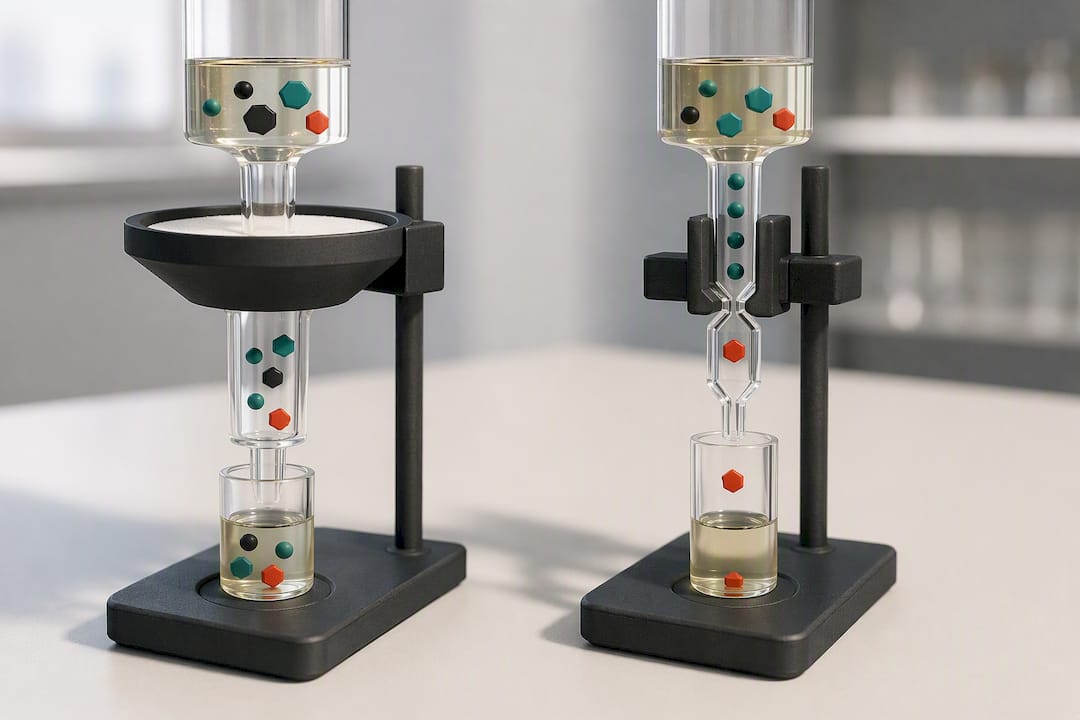
Immunoassays screen. Mass spectrometry confirms. That distinction is the backbone of every legitimate drug testing program, and it matters even more with a compound like HHC that overlaps so closely with THC on a molecular level.
Confirmatory labs target the parent HHC compound directly, along with its two stereoisomers, and HHC-COOH after a hydrolysis step that frees the compound from its glucuronide conjugate in urine. A method-development study on urine confirmation found that the choice of hydrolysis method changes the measured unconjugated concentration significantly, which is why asking a lab which hydrolysis protocol they use is a legitimate, useful question rather than an obscure technicality.
Newer stereoselective LC-MS/MS methods can now separate 9R- from 9S-HHC and their respective metabolites across blood, oral fluid, and urine, giving labs validated tools to distinguish the two epimers with real precision. That capability isn’t universal, though.
- Not every clinical or workplace lab includes HHC on its standard cannabinoid confirmation panel.
- Confirmation for HHC specifically often requires an explicit request, separate from a routine THC-COOH confirmation.
- Reported detection limits vary by lab, with validated methods reaching sensitivities as low as 0.15 ng/mL in some forensic applications.
If HHC use is relevant to your situation, ask directly whether the lab’s confirmatory panel covers it. Assuming a standard THC confirmation test automatically checks for HHC is a mistake that can lead to a misleading “clean” result.
Preparing for an HHC Drug Test the Right Way
Preparation starts with honesty about timing, not shortcuts. If you’ve used HHC products and know a test is coming, the most reliable variable you control is time since last use, not any product marketed as a quick fix.
Hydration matters, but overcorrecting backfires. Drinking excessive water right before a urine test can dilute the sample enough that a lab flags it as invalid, which often triggers a retest or raises suspicion rather than helping. Moderate, normal hydration is the safer path.
If you’re unsure whether a product you used was HHC, Delta-8, or Delta-9 THC, that uncertainty itself is worth addressing before testing. Many HHC products are marketed loosely, and given the product inconsistency common in the unregulated cannabinoid market, what’s on the label isn’t always a reliable guide to what’s actually in the product or how it will metabolize.
For anyone who wants a clearer sense of where they stand before an official test, at-home screening kits can offer a useful gut check, though they carry the same presumptive limitations as lab immunoassays. They’re a planning tool, not a guarantee. If a home test comes back positive and you’re facing a real deadline, that’s the moment to focus on accurate information rather than guesswork, and to understand that no product can reliably guarantee erasing a recent, heavy use pattern overnight.
Legal and Employment Risks From an HHC Positive
A positive HHC-related drug test can carry the same practical consequences as a THC positive in most U.S. workplaces, because most employer drug policies are written around cannabinoid metabolites broadly, not HHC by name. That means an employee who believed they were using a “legal” hemp-derived product can still fail a company screening and face the same disciplinary consequences as someone who used marijuana directly.
HHC’s legal status itself is unsettled and varies by state, sitting in a gray zone tied to hemp-derived cannabinoid regulations that are still evolving. Some states have moved to restrict or ban HHC and similar semi-synthetic cannabinoids explicitly, while others haven’t addressed it directly at all. That patchwork means a product legal to buy in one state might still violate a testing policy, and it might be treated differently by regulators in a neighboring state entirely.
For safety-sensitive jobs, particularly those involving federal transportation regulations, the standard is typically strict and doesn’t carve out exceptions for novel cannabinoids just because they aren’t Delta-9 THC by name. Reviewing your employer’s specific testing policy before using any hemp-derived product is a far better strategy than assuming a legal purchase equals a safe test result.
Court cases and workplace disputes involving novel cannabinoids like HHC are still relatively new, and legal precedent hasn’t caught up with the pace of product availability. That gap is exactly why documentation, confirmatory testing, and early legal consultation matter more here than with a more established compound.
How Sensitive Are HHC Drug Tests Compared to THC Tests?
Standard cannabinoid immunoassays weren’t built with HHC in mind, but their antibody-based design means they often catch it anyway, just with less precision than they show for THC itself. Sensitivity to HHC varies significantly by manufacturer and by which antibody the specific test kit uses, which is part of why cross-reactivity findings differ across studies.
Specificity is really where the gap shows. A THC-specific confirmatory test knows exactly what it’s measuring and can report exact concentrations of THC-COOH down to fractions of a nanogram. An HHC confirmation, by contrast, requires a lab to specifically look for HHC’s distinct metabolites and stereoisomers, something a routine THC panel simply isn’t built to do. A forensic GC-MS method built for this purpose reported detection limits down to 0.15 ng/mL for HHC specifically, a level of resolution that generic cannabinoid immunoassays can’t match.
The practical comparison breaks down like this: immunoassays are broadly sensitive but poorly specific across the cannabinoid family, catching HHC, THC, and other analogs in the same net. Confirmatory mass spectrometry is highly specific but only useful if the lab is actually looking for the right compound. That’s the central irony of HHC testing right now. The technology to identify it precisely exists and has been validated in peer-reviewed research, but it only gets used when someone specifically asks for it.
What the Research Actually Tells Us
The controlled studies on HHC are still small in scale, but they’re remarkably consistent with each other. Pharmacokinetically, HHC behaves enough like THC that immunoassay cross-reactivity isn’t a fluke, it’s a predictable outcome of similar molecular structure. That consistency across independent research groups is what makes the core guidance here trustworthy rather than speculative.
The rule worth remembering is simple: treat any positive cannabinoid screen as a starting point, not an endpoint, and insist on mass-spectrometry confirmation before drawing conclusions or making decisions with real consequences. Passmydrugtest exists to help people understand these products and prepare with accurate information, but the confirmatory lab, not any product or article, is the actual authority on what’s in your system.
— MIchael
Get Ahead of Your Next Drug Test With the Right Tools
Understanding the science behind cross-reactivity is one thing. Actually knowing where you stand before an official test is another, and that’s where having the right resources on hand makes a real difference. A curated shop of testing and preparation products alongside educational guides written specifically for people facing a real deadline, not generic health content, can provide a direct path to that clarity.
Whether you’re trying to understand your own risk before a workplace screening or you simply want a reliable way to self-check before an official appointment, the full range of drug testing products covers urine, saliva, and hair testing options in one place. If a longer detection window is your concern, the hair drug testing category and related detox shampoo options are worth a look well before test day, not the night before. For anything with legal or employment stakes riding on the outcome, a confirmatory lab result should always be your final word, but fast U.S. shipping and phone support can help ensure you are not stuck figuring out your options alone. Visit Passmydrugtest to browse products suited to your specific situation and get a straight answer about which test fits your timeline.
This article is general information, not a substitute for advice from a qualified doctor. Consult a qualified healthcare professional about your own circumstances before acting on anything here.
FAQ
Does HHC Show Up on a Standard Drug Test?
Yes, HHC frequently causes a presumptive positive on standard cannabinoid immunoassay screens because their metabolites cross-react with the antibodies designed to detect THC-COOH. Confirmatory GC-MS or LC-MS/MS testing is required to determine whether HHC, THC, or both are actually present.
Is HHC as Strong as Delta-9 THC?
Potency depends heavily on the stereoisomer and dose, but research suggests (9R)-HHC, the more common form in commercial products, approaches THC’s potency in some effects while the (9S) form is considerably weaker. Product labeling rarely specifies the epimer ratio, which makes potency hard to predict from packaging alone.
Why Is HHC Banned in Some States?
Several states have restricted or banned HHC because it’s a semi-synthetic cannabinoid derived from hemp that produces intoxicating effects similar to THC, placing it in a legal gray area under evolving hemp regulations. Regulators in those states have moved to close what they view as a loophole around federal hemp law, though the legal landscape still varies significantly from state to state.
Can a Confirmatory Lab Tell HHC and THC Apart?
Yes, validated stereoselective LC-MS/MS and GC-MS methods can distinguish HHC’s specific stereoisomers and metabolites from THC, but only if the lab specifically tests for HHC. Many routine confirmation panels default to THC-COOH alone, so confirming HHC use often requires an explicit request.
How Long Does HHC Stay in Your Urine?
Detection time depends on frequency of use, but a controlled study found HHC metabolites remained detectable in urine for up to five days after a single dose. Regular or heavy users can test positive for considerably longer, similar to patterns seen with chronic THC use.
Where Can I Buy an At-Home HHC or THC Test Kit?
Passmydrugtest carries urine, saliva, and hair testing products that let you check your status before an official screening, with current pricing listed on the site. These kits are a planning tool for presumptive results, and any result with real stakes attached should still be confirmed by a certified lab.